A topsoil calculator turns the size of your lawn or garden bed and the depth you want into the amount of topsoil to order. Enter the length and width (or a circle or triangle), pick a depth, and the calculator gives cubic yards, cubic feet, bags, an estimated weight, truck loads and cost.
Quick answer: Cubic yards of topsoil = area in square feet × depth in inches ÷ 12 ÷ 27. A 40 ft × 25 ft lawn (1,000 sq ft) at 4 inches is 1,000 × 4 ÷ 12 ÷ 27 = 12.35 cubic yards, or 13.58 with 10% extra for settling.
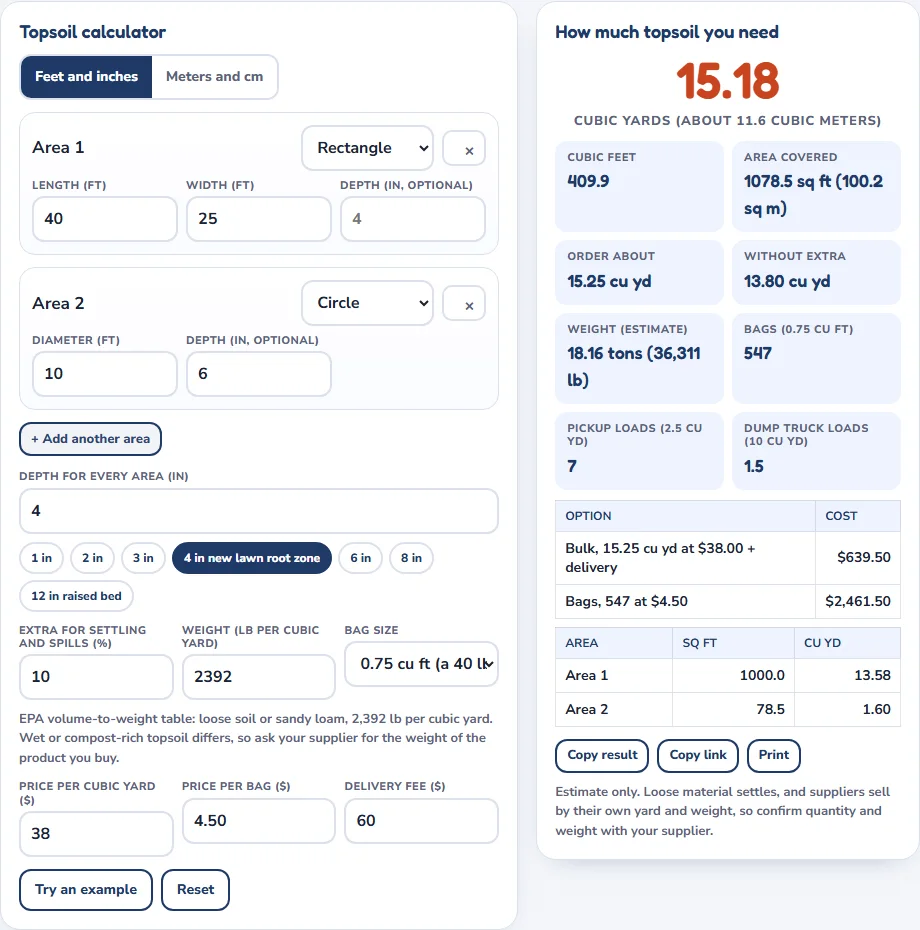
This free topsoil calculator handles the jobs people usually search for: a lawn, a vegetable bed, a raised bed, a patch of low ground or a whole yard split into several areas. You can mix shapes in one estimate, give each area its own depth and switch between feet and meters, so a single topsoil calculator replaces separate sheets for each part of the yard.
How to use the topsoil calculator
- Pick feet and inches or meters and centimeters.
- Add each area: a rectangle (length and width), a circle (diameter), a triangle (base and height) or a known area in square feet or square meters.
- Set the depth for every area, or give one area its own depth if it differs, such as a deeper raised bed.
- Leave 10 percent extra for settling and spills, or change it. Add a weight, a bag size and prices if you want weight, bags and cost.
- Read cubic yards, the amount to order rounded to a quarter yard, bags, truck loads and the bulk-versus-bags cost.
The calculator runs in your browser and keeps your numbers on your device. Use Copy result to paste the quantity into a message to your supplier, or Print for the job sheet.
How much topsoil do I need? The formula
Topsoil is bought by volume, so the calculation is area times depth. Convert the depth from inches to feet by dividing by 12, which gives cubic feet, and divide by 27 to get cubic yards because a cubic yard is 3 × 3 × 3 feet. Michigan State University Extension gives the same shortcut: multiply the square feet by the depth in inches by 0.0031 to get cubic yards.
| Shape | Area formula | Example | Area |
|---|---|---|---|
| Rectangle | length × width | 40 ft × 25 ft | 1,000 sq ft |
| Circle | π × (diameter ÷ 2)² | 10 ft diameter | 78.5 sq ft |
| Triangle | base × height ÷ 2 | 12 ft × 8 ft | 48 sq ft |
| Irregular | split into the shapes above and add | a rectangle and a circle | sum of the parts |
Topsoil calculator cubic yards: area and depth table
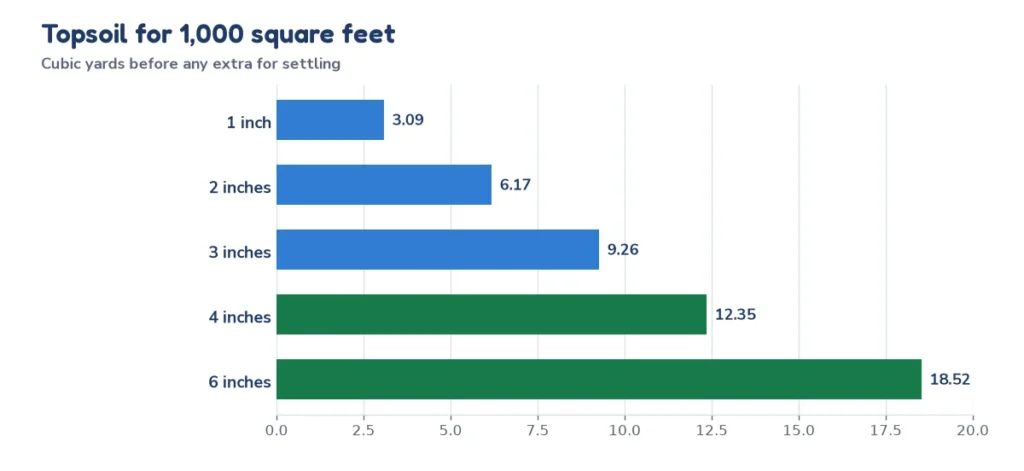
This topsoil calculator cubic yards table gives the amount before any extra for settling. Each extra inch of depth adds the same amount, which is about 3.09 cubic yards for every 1,000 square feet.
| Area | 1 in | 2 in | 3 in | 4 in | 6 in |
|---|---|---|---|---|---|
| 100 sq ft | 0.31 | 0.62 | 0.93 | 1.23 | 1.85 |
| 250 sq ft | 0.77 | 1.54 | 2.31 | 3.09 | 4.63 |
| 500 sq ft | 1.54 | 3.09 | 4.63 | 6.17 | 9.26 |
| 1,000 sq ft | 3.09 | 6.17 | 9.26 | 12.35 | 18.52 |
| 2,000 sq ft | 6.17 | 12.35 | 18.52 | 24.69 | 37.04 |
| 5,000 sq ft | 15.43 | 30.86 | 46.30 | 61.73 | 92.59 |
Topsoil calculator for lawn: what depth do you need?
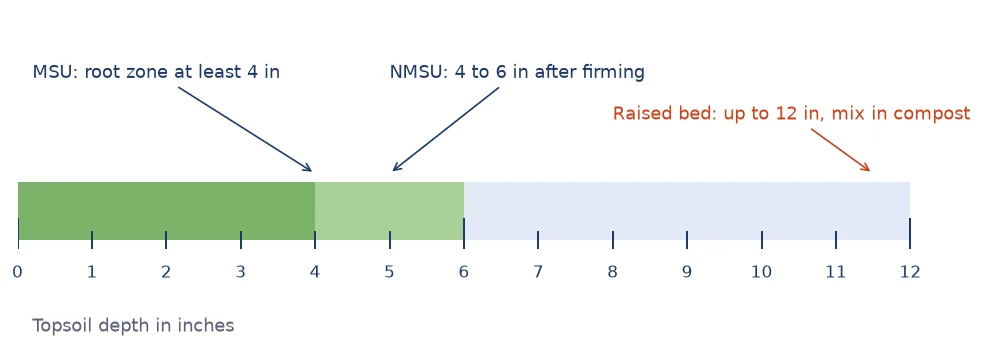
For a lawn, the topsoil calculator needs one number from you: the depth. The right depth depends on the job, and university extension publications are consistent for lawns. The Michigan State University Extension lawn guide says purchased topsoil is needed when what is on site cannot give an adequate root zone, which it puts at at least 4 inches, and that the soil should be screened to remove weedy perennial grasses and stones.
New Mexico State University says to add topsoil and organic matter to reach a total topsoil depth of 4 to 6 inches after firming, and that a shallower soil can hurt turf appearance and raise water use.
| Job | Depth to enter | Source and note |
|---|---|---|
| New lawn on poor or no topsoil | 4 to 6 inches after firming | NMSU H509 and MSU E2910 |
| Lawn where some topsoil exists | The shortfall up to 4 inches | MSU E2910: root zone at least 4 inches |
| Filling low spots | Measure the dip and add the settling allowance | Your own measurement |
| Raised bed | The bed height, up to about 12 inches | MSU Extension: a full foot may mat down unless mixed with compost |
| Seed or sod bed | Firm to a bed where a heel sinks about half an inch | MSU E2910 seedbed test |
Worked example: a lawn and a round bed
Say you are re-seeding a 40 ft × 25 ft lawn at 4 inches and adding a round bed 10 ft across at 6 inches. The lawn is 1,000 sq ft, which at 4 inches is 12.35 cubic yards. The bed is 78.5 sq ft at 6 inches, which is 1.45 cubic yards. Together that is 13.80 cubic yards, and with 10 percent for settling the topsoil calculator shows 15.18 cubic yards, which you would order as 15.25.
Doing the same sum by hand takes a few lines, which is why a topsoil calculator that keeps several areas on one screen saves time. If the quote comes back in tons instead of yards, divide by the weight per cubic yard and compare it with the tool’s weight line before you accept it.
Settling, extra and the amount to order
Loose topsoil compacts once it is spread and watered, so most people order a little more than the exact volume. The calculator adds 10 percent by default and rounds the order up to the next quarter yard, which suits suppliers that sell by the yard.
| Extra for settling (1,000 sq ft at 4 in) | Cubic yards | Order (next quarter yard) |
|---|---|---|
| 0% | 12.35 | 12.50 |
| 5% | 12.96 | 13.00 |
| 10% | 13.58 | 13.75 |
| 15% | 14.20 | 14.25 |
| 20% | 14.81 | 15.00 |
Topsoil bags calculator: how many bags do you need?
This topsoil bags calculator step is the same math as the yard calculation. Bagged topsoil is sold by weight or by cubic feet. MSU Extension notes that a 40 pound bag of topsoil is about 0.75 cubic feet and that the volume varies with moisture. Divide the cubic feet you need by the bag size and round up.
| Bed | Cubic feet | Cubic yards | 0.75 cu ft bags | 1.5 cu ft bags |
|---|---|---|---|---|
| 4 ft × 4 ft raised bed, 8 in | 10.7 | 0.40 | 15 | 8 |
| 4 ft × 8 ft raised bed, 12 in | 32.0 | 1.19 | 43 | 22 |
| 3 ft × 6 ft bed, 6 in | 9.0 | 0.33 | 12 | 6 |
| 10 ft × 10 ft bed, 4 in | 33.3 | 1.23 | 45 | 23 |
| 20 ft × 10 ft bed, 3 in | 50.0 | 1.85 | 67 | 34 |
Topsoil cost calculator: bulk or bagged?
As a topsoil cost calculator, the tool compares both routes using your prices. Bulk delivery is almost always cheaper per cubic yard than bags once you need more than a few bags, but you pay a delivery fee and need somewhere to put the pile. The comparison below uses illustrative prices, $38 per cubic yard plus a $60 delivery fee against $4.50 per 0.75 cubic foot bag, so enter your local prices in the calculator for a real answer.
| Amount | Bulk with delivery | Bags needed | Bags cost |
|---|---|---|---|
| 1 cubic yard | $98.00 | 36 bags | $162.00 |
| 3 cubic yards | $174.00 | 108 bags | $486.00 |
| 13.58 cubic yards (the 1,000 sq ft lawn) | $582.50 | 489 bags | $2,200.50 |
How many truck loads is that?
MSU Extension’s garden hotline notes that a full-size pickup truck holds about 2.5 cubic yards and a dump truck holds between 10 and 14 cubic yards. The calculator shows pickup loads and dump truck loads using 2.5 and 10 cubic yards.
| Order | Pickup loads (2.5 cu yd) | Dump truck loads (10 cu yd) |
|---|---|---|
| 1.00 cu yd | 1 | 0.10 |
| 3.00 cu yd | 2 | 0.30 |
| 5.00 cu yd | 2 | 0.50 |
| 10.00 cu yd | 4 | 1.00 |
| 13.58 cu yd | 6 | 1.36 |
| 20.00 cu yd | 8 | 2.00 |
Weight of topsoil and why your supplier’s number wins
The calculator multiplies cubic yards by a weight per cubic yard that you can edit. It starts at 2,392 pounds per cubic yard, the figure the U.S. EPA volume-to-weight conversion table gives for loose soil or sandy loam. Wet, clay-rich or compost-blended topsoil can weigh more or less, so ask the supplier for the weight per cubic yard of the product you are buying and enter it. At 2,392 pounds, 13.58 cubic yards weighs about 32,500 pounds, or 16.2 tons.
Raised bed soil calculator: topsoil for gardens
As a raised bed soil calculator, the tool works with the inside length and width. For raised beds, use the inside length and width and the depth you will fill to. A full foot of plain topsoil can mat down, so MSU Extension suggests mixing in compost, which means you may order a topsoil and compost blend instead. Add 1 to 2 inches of extra depth if you want the bed to stay full after settling.
Measuring a yard for the topsoil calculator
Walk the area with a tape measure and write down each section as a rectangle, circle or triangle. Measure the depth at a few places with a stick or a spade, because lawns are rarely level and a low corner can swallow more soil than the rest of the yard. Use the average depth you want to add, not the depth of the hole you dig. For a slope, measure along the ground and use the average of the high and low ends.
Leave out anything you will not cover, such as a patio, a shed pad or a tree base, by adding only the parts that receive soil. Entering parts as separate areas also makes it easy to see which job drives the total, and which part to trim if the budget is tight. The topsoil calculator keeps every area visible, so you can remove one and read the new total at once.
Common mistakes when ordering topsoil
| Mistake | What goes wrong | Fix |
|---|---|---|
| Entering depth in feet instead of inches | The result is 12 times too big or too small | Check the unit label next to the depth box |
| Forgetting settling | The area ends up a little low after watering | Keep 10 percent extra |
| Using the supplier’s tons as yards | Quantities differ by 1.1 to 1.4 times | Convert with the supplier’s weight per cubic yard |
| One depth for every area | Deep beds and a thin lawn layer get the same amount | Give each area its own depth |
| Ordering unscreened soil for a lawn | Weeds, stones and clods come with it | Ask for screened topsoil as MSU Extension advises |
Frequently asked questions
10 quick answers
How much topsoil do I need for 1,000 square feet?
At 4 inches deep you need about 12.35 cubic yards, and 13.58 with 10 percent extra. Every extra inch adds about 3.09 cubic yards.
How do I calculate cubic yards of topsoil?
Multiply length by width by depth, all in feet, and divide by 27. For depth in inches, divide by 12 first. Or multiply square feet by depth in inches by 0.0031.
How deep should topsoil be for a new lawn?
Extension publications call for a root zone of at least 4 inches and a total topsoil depth of 4 to 6 inches after firming. Aim for 6 inches over compacted or very poor subsoil.
How many bags of topsoil do I need?
Divide the cubic feet by the bag size. A 40 pound bag is about 0.75 cubic feet, so a cubic yard is about 36 bags.
How much does a cubic yard of topsoil weigh?
It depends on moisture and composition, so ask your supplier. The calculator starts at the EPA table figure of 2,392 pounds per cubic yard for loose soil, and you can edit it.
How many cubic yards fit in a pickup truck?
MSU Extension says a full-size pickup holds about 2.5 cubic yards, and a dump truck holds 10 to 14.
Should I buy bags or have topsoil delivered?
For more than a few cubic feet, bulk delivery is usually cheaper per cubic yard. Enter your local prices to see both totals.
How much extra topsoil should I order?
About 10 percent is common to cover settling and spills. The calculator lets you set the percent.
Can I calculate topsoil for a round bed?
Yes. Choose Circle and enter the diameter. The area is pi times the radius squared, and the calculator does the rest.
Is this the same as a mulch calculator?
The math is the same volume formula, but mulch is applied in a thinner layer. Use the mulch calculator for mulch depth and bag sizes.
Related calculators
- Mulch calculator for mulch, gravel and cubic yards
- Concrete calculator for slabs, footings and post holes
- Volume calculator for boxes, cylinders and cones
- Area calculator to measure irregular shapes
- Square footage calculator for room and yard areas
- Unit converter for feet, meters and cubic yards
- All free calculators
Sources and further reading
- Michigan State University Extension E2910: Establishing a lawn: topsoil root zone and seedbed preparation
- New Mexico State University H509: Establishing turfgrass: topsoil depth of 4 to 6 inches after firming
- U.S. EPA: Standard Volume-to-Weight Conversion Factors: loose soil or sandy loam at 2,392 pounds per cubic yard
- eXtension Ask an Expert, MSU Extension: amount of topsoil to purchase: the 0.0031 shortcut, bag volume and truck loads
Last reviewed: October 2026.