Identifying fractions means naming the part of a whole that is shaded, colored or counted, such as 3/4 of a pizza or 2 of 5 stars. The printable PDFs on this page have four sets of shapes and one set of pictures, all with answer keys, and the notes below explain how to teach each step. They follow standard 3.NF.A.1, which the Common Core standards for grade 3 fractions describe, and they are the first page in the fractions worksheets series. Good identifying fractions practice starts with real objects, then pictures, then symbols, and children who are secure at identifying fractions can go on to compare, add and simplify them.
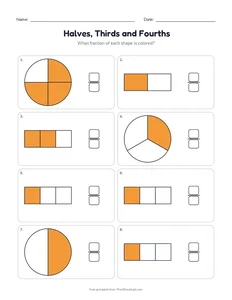
Halves, thirds, fourths. Name the fraction.
Quick answer: Identifying fractions means naming the part of a whole that is shaded, such as 3 of 4 equal parts shaded is 3/4. This page has 5 free printable identifying fractions worksheets with answer keys for grades 1 to 3. Updated October 2026.
Naming the fraction of a shape
To name a fraction, count two things: how many equal parts there are in total (the denominator) and how many are colored (the numerator). A pizza cut into 6 equal slices with 5 colored shows 5/6.
What is on this page
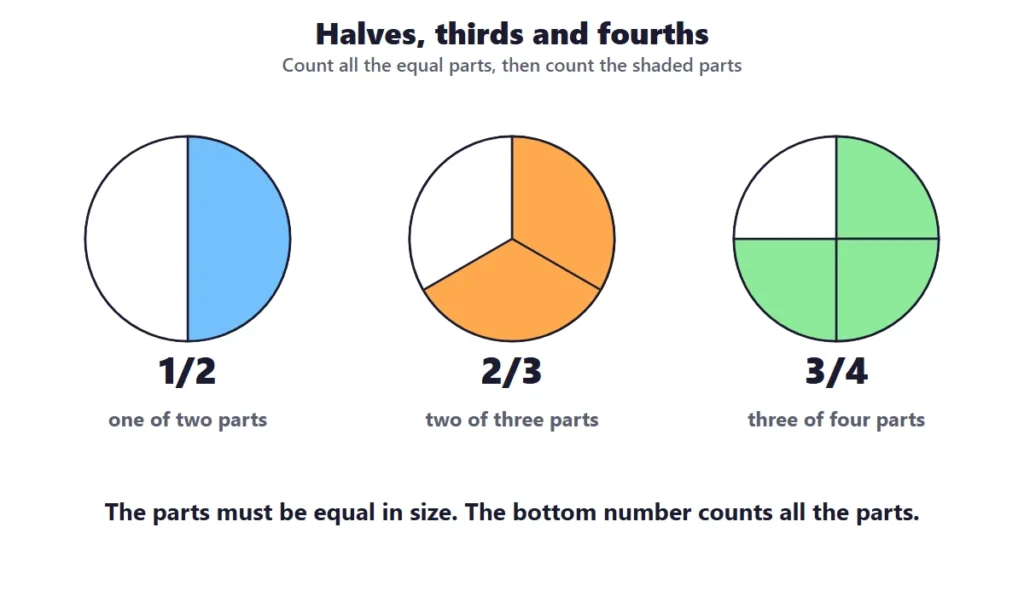
Halves, thirds and fourths: the first shapes children meet, as pizzas, bars and grids.
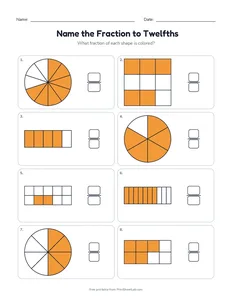
Fractions of shapes to twelfths.
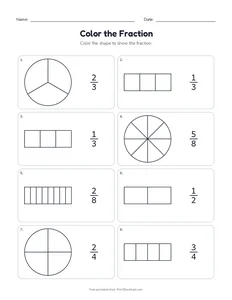
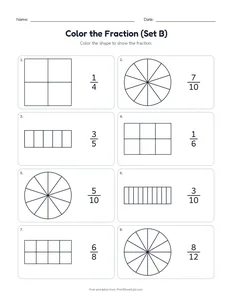
Color the fraction: the fraction is given and children color that many parts. Doing it both ways shows children really understand the parts.
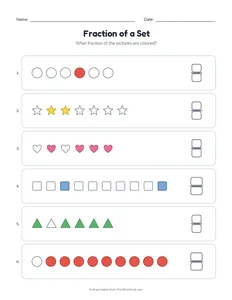
Fraction of a set: some of a row of pictures are colored; what fraction is that?
A mistake to look for
Children sometimes write colored parts over uncolored parts (3 colored, 1 not, written 3/1) instead of colored over total (3/4). Ask “How many parts are there altogether?” before they write the bottom number.
Identifying fractions worksheets: what is in the set
There are 5 identifying fractions worksheets on this page, and every one has an answer key except for any cut-out games. The first three sets name fractions of shapes, the next two ask children to color the fraction, and the last set moves from shapes to groups of pictures.
Worksheet
What children do
Standard
Halves, Thirds and Fourths
Name the fraction of pizzas, bars and grids cut into 2, 3 or 4 parts.
3.NF.A.1
Name the Fraction to Twelfths
Shapes cut into up to 12 equal parts.
3.NF.A.1
Color the Fraction
Color each shape to show the fraction.
3.NF.A.1
Color the Fraction (Set B)
Eight more fractions to color, up to twelfths.
3.NF.A.1
Fraction of a Set
What fraction of the pictures are colored?.
3.NF.A.1
Identifying fractions: the words children need
Identifying fractions starts with a few words, and children who know them can read any fraction in the worksheets. The table lists the six words used on every page of the pack, with an example of each. Wikipedia’s article on fractions gives the history and the other kinds of fractions that children meet later.
Word
What it means
Example
numerator
the top number: how many parts are counted or shaded
3 in 3/8
denominator
the bottom number: how many equal parts make the whole
8 in 3/8
unit fraction
a fraction with 1 on top: one equal part of the whole
1/8
equal parts
parts that are exactly the same size
the slices of one pizza
whole
the object or group that is cut into parts
one pizza, or a row of 6 stars
fraction bar
the line between the two numbers, read as “out of”
3 out of 8
A good habit when identifying fractions is to read every fraction out loud with the words “out of”: 3/8 is “3 out of 8 equal parts”. This keeps the top number as a count and the bottom number as the size of the parts, which is the idea behind standard 3.NF.A.1.
Halves thirds fourths worksheets: the names of the equal parts
The first set on this page is a halves thirds fourths worksheets set, because children meet these parts first, in grade 1 and grade 2 geometry. Identifying fractions with these three denominators is the foundation for everything else. A shape with 2 equal parts has halves, 3 equal parts has thirds, and 4 equal parts has fourths, or quarters. The Common Core grade 3 standards use the denominators 2, 3, 4, 6 and 8, and the other sets go up to twelfths for children who are ready. This table shows every name from 2 to 12, with the share of the whole and the angle at the center of a circle:
Equal parts
Name of each part
Unit fraction
Share of the whole
Angle in a circle
Everyday example
2
half
1/2
50%
180°
half a sandwich
3
third
1/3
33.3%
120°
a third of a pie
4
fourth (quarter)
1/4
25%
90°
a quarter of an hour: 15 minutes
5
fifth
1/5
20%
72°
a fifth of a dollar: 20 cents
6
sixth
1/6
16.7%
60°
one face of a die
7
seventh
1/7
14.3%
51.4°
one day of the week
8
eighth
1/8
12.5%
45°
one slice of an 8-slice pizza
9
ninth
1/9
11.1%
40°
one player of a baseball team
10
tenth
1/10
10%
36°
a dime is a tenth of a dollar
11
eleventh
1/11
9.1%
32.7°
one player of a soccer team
12
twelfth
1/12
8.3%
30°
one month of the year
The share column shows why a bigger denominator means a smaller piece: a half is 50% of the whole, and a twelfth is only 8.3%. Children can see this when they cut circles of paper into 2, 3 and 4 parts and lay the pieces next to each other.
Fractions of shapes worksheets: equal parts first
The fractions of shapes worksheets use pizzas, bars and grids, and each one is cut into equal parts. Before children write a fraction they should check that the parts are equal, because a shape cut into unequal parts does not show a fraction. The same shape can be cut in different ways: a square can be cut into 2 equal parts by a vertical line, a horizontal line or a diagonal, and every one gives halves. This is a good question for a class: “Are these two halves the same size, even though they look different?” It is the first rule of identifying fractions of shapes: look at the sizes of the parts, not at their shapes.
Shading fractions worksheets: how many ways can a fraction be shaded?
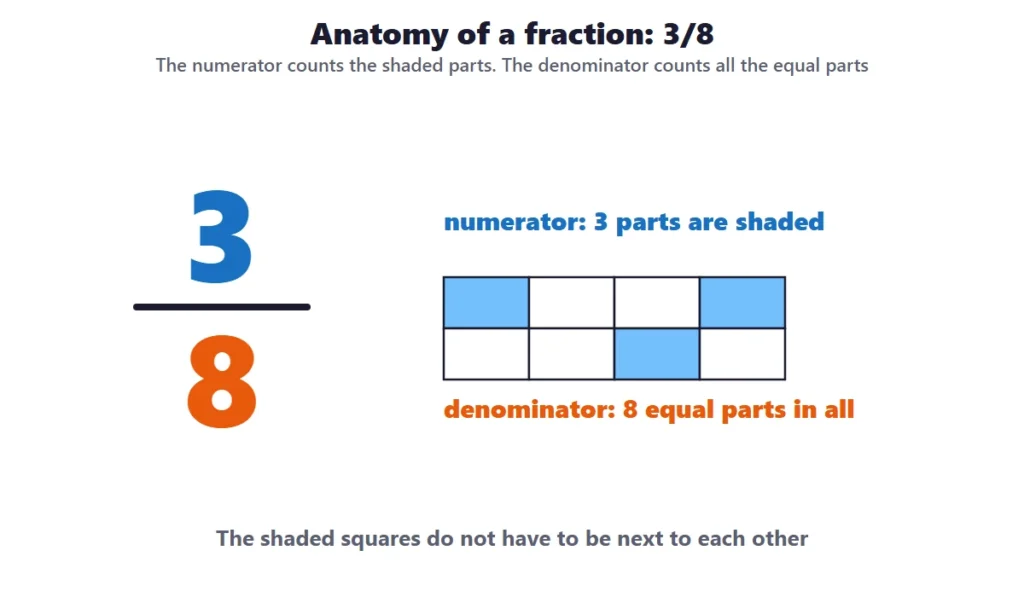
The shading fractions worksheets show that the shaded parts do not have to be next to each other. Any 3 of the 8 squares in a grid show 3/8, so there are many correct pictures, and identifying fractions never depends on where the shaded parts are. The number of ways to shade k parts of a shape with n equal parts is a number from combinations, and the table shows how fast it grows:
Numerator and denominator. The fraction 3/8.
Shape cut into
Fraction to shade
Parts to shade
Different ways to shade it
4 equal parts
1/4
1
4
4 equal parts
2/4
2
6
6 equal parts
2/6
2
15
6 equal parts
3/6
3
20
8 equal parts
3/8
3
56
8 equal parts
4/8
4
70
12 equal parts
5/12
5
792
12 equal parts
6/12
6
924
A grid of 12 squares can show 6/12, or one half, in 924 different ways. This is why the “Color the Fraction” worksheets have no single correct picture, and why the answer key says to check the count of colored parts and the count of all parts.
Fraction of a set worksheets: when the whole is a group
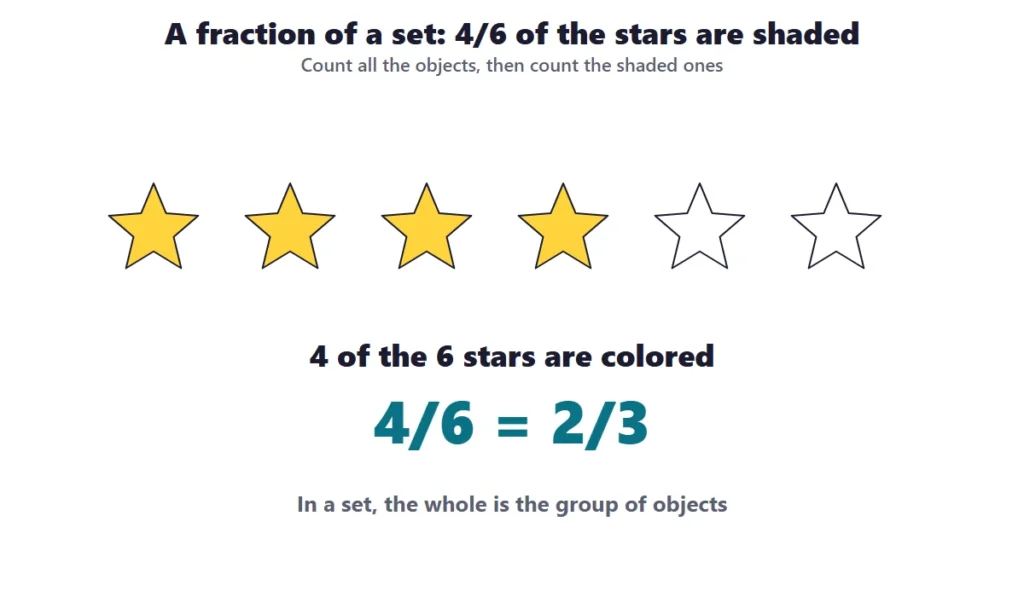
On the fraction of a set worksheets, the whole is a group of separate objects, such as 6 stars or 12 crayons, and each object is one part. If 4 of the 6 stars are colored, the fraction is 4/6, and the denominator counts every star, colored or not. This table shows eight sets, with the fraction in simplest form and the share of the set:
Colored out of the whole set
Fraction
In simplest form
Share of the set
4 of 6 pictures
4/6
2/3
66.7%
3 of 5 pictures
3/5
3/5
60%
2 of 8 pictures
2/8
1/4
25%
6 of 9 pictures
6/9
2/3
66.7%
5 of 10 pictures
5/10
1/2
50%
3 of 12 pictures
3/12
1/4
25%
8 of 12 pictures
8/12
2/3
66.7%
1 of 4 pictures
1/4
1/4
25%
Children often find identifying fractions of a set harder than of a shape, because the parts are separate. Counters or cubes help: lay out the whole group, turn some over, and count. The fractions of a number and mixed numbers page takes this idea further, by finding a fraction of a number such as 3/4 of 12.
Identifying fractions up to twelfths: how many different fractions are there?
When children are identifying fractions up to twelfths, they meet 66 fractions that are less than 1, but only 45 different amounts. Some fractions are repeats: 2/4 and 1/2 are the same amount, and so are 3/6, 4/8, 5/10 and 6/12. This table counts the new amounts that each denominator brings:
Denominator
Fractions below 1 with this denominator
New amounts
Repeats of an earlier amount
Different amounts so far
2
1
1
0
1
3
2
2
0
3
4
3
2
1
5
5
4
4
0
9
6
5
2
3
11
7
6
6
0
17
8
7
4
3
21
9
8
6
2
27
10
9
4
5
31
11
10
10
0
41
12
11
4
7
45
Prime denominators such as 5, 7 and 11 bring no repeats at all, since every fraction with a prime denominator is already in simplest form. The repeats are the subject of the equivalent fractions page, and the fraction strips tool lets children see them with strips of equal length.
Common mistakes when identifying fractions
Most mistakes in identifying fractions are about what the two numbers count. This table shows five mistakes that teachers see often, with what went wrong and the fix:
What the child writes or says
What went wrong
The fix
A pizza cut into 4 unequal pieces is called fourths
the pieces are not the same size
only equal parts make fractions: look at the size of every part
3 colored and 1 not colored is written 3/1
counts the parts that are not colored
write colored over all the parts: 3/4
2 colored out of 8 is written 2/6
counts the white parts as the whole
count all the parts, colored and white: 8
A shape cut into 6 parts has 6 as the numerator
swaps the top and bottom numbers
the bottom number counts all the parts
1/8 is bigger than 1/4 because 8 is bigger than 4
looks at the number, not at the size of the pieces
more parts means smaller parts: draw both bars
Identifying fractions word problems
Story problems show where identifying fractions is used in everyday life. Ask children to say what the whole is, and to say the fraction as “out of” before they write it:
Word problem
Working
Answer
A pizza is cut into 8 equal slices and 3 are eaten. What fraction of the pizza is eaten?
3 out of 8
3/8
A box has 12 crayons and 5 are red. What fraction of the crayons are red?
5 out of 12
5/12
A flag has 3 equal stripes and 1 stripe is blue. What fraction is blue?
1 out of 3
1/3
A garden has 10 equal beds and 4 of them have tomatoes. What fraction has tomatoes?
4 out of 10
4/10 or 2/5
A chocolate bar has 12 squares. Lin eats 5 of them. What fraction of the bar is left?
12 − 5 = 7 squares
7/12
A row of 6 apples has 4 green apples. What fraction of the apples are green?
4 out of 6
4/6 or 2/3
Games and activities for identifying fractions
Children learn identifying fractions best when they play with it. These games use things that are found at home or in a classroom:
Fold and name: fold a paper strip into 2, 3 or 4 equal parts, and name one part
Pizza fractions: draw a pizza, cut it, and ask a friend to name the shaded part
Fraction of the crayons: pick 8 crayons from a box, and say what fraction are one color
Fraction bingo: a bingo card with fractions and calling cards with pictures
Egg carton fractions: fill some of the 12 cups with counters, and name the fraction of the carton that is full
Fraction hunt: find halves and thirds at home: a window, a sandwich, a clock
Extra support and extra challenge with identifying fractions
For children who need more support: start with halves and fourths, using folded paper and real food, because identifying fractions is easiest with things the child can touch. Name the parts out loud, and ask “how many equal parts are there?” before every answer. Do the first two worksheets only, with the answer key at hand, and move on when the fraction names are secure.
For children who need more challenge: ask for two different pictures of 3/8, for a set where 2/3 of the objects are red, and for a fraction that is the same amount as 3/6. The “Color the Fraction (Set B)” worksheet and the fraction of a set pictures are good challenges.
How to tell that a child is ready to move on from identifying fractions
The child checks that the parts are equal before naming a fraction.
The child writes the numerator and the denominator in the right places.
The child colors a fraction in two different ways.
The child names the fraction of a set of pictures.
A short lesson is the best way to introduce identifying fractions. This 20-minute plan can be used in a classroom, at a tutoring session or at home, and it uses the worksheets at the end:
Minutes
Activity
What to say or ask
0 to 3
Show a pizza cut into 8 equal slices and ask for the fraction of 3 slices
How many parts are there? How many are eaten?
3 to 8
Cut a paper strip into 4 equal parts and color 3
What are the two numbers counting?
8 to 13
Compare a shape cut into unequal parts with one cut into equal parts
Is this a fraction? Why or why not?
13 to 18
Lay out 6 counters, turn 4 over, and write the fraction of the set
What is the whole now?
18 to 20
Start a worksheet, and check one answer with the key
Read it aloud with “out of”.
Where identifying fractions fits across the grades
No skill stands alone. This table shows what children learn before and after identifying fractions, with the standard that goes with each step:
Grade
What children do
Standard or page
Grade 1
Halves and fourths of shapes
1.G.A.3
Grade 2
Halves, thirds and fourths of shapes
2.G.A.3
Grade 3
Identifying fractions as numbers: parts of a whole
Parents do not need to be experts to help with identifying fractions. These suggestions work well, and each takes only a few minutes:
Practice identifying fractions by cutting a sandwich or a pizza, and ask for the fraction of each piece.
Ask how much is left of a bar of chocolate after a few squares are eaten.
Look for fractions on a measuring cup, a clock and a ruler.
Use a set of toy cars: “what fraction of the cars are red?”
Check each answer by reading the fraction aloud with “out of”.
How to check progress in identifying fractions
A teacher or parent can check progress with the answer key and a few questions. This table shows three common situations, what they mean and what to do next:
What you see
What it means
What to do next
The child is good at identifying fractions of shapes but not of sets
The idea of equal parts is secure, but a set is a new kind of whole
Use counters, and ask “how many objects are there altogether?”
The child gets 9 of 10 right in every set
The skill is secure
Move on to fractions on a number line
The child writes 3/1 for 3 colored and 1 white
The child counts the white parts only
Ask “how many parts are there altogether?” before the bottom number
A five-day plan for identifying fractions
Most children need about a week of short sessions for identifying fractions. This plan follows the order of the worksheets on this page:
Day
What to do
Practice
Day 1
Halves, thirds and fourths: fold paper and name the parts
Halves, Thirds and Fourths
Day 2
Name the fraction of shapes up to twelfths
Name the Fraction to Twelfths
Day 3
Color the fraction when the fraction is given
Color the Fraction
Day 4
Color the fraction, the second set, and a talk about equal parts
A grid with 8 equal squares is cut into eighths, even though the colored squares are scattered. The pieces do not have to be next to each other.
What is the difference between a fraction of a shape and of a set?
In a shape the parts are pieces of one object. In a set, each whole object is one part, like 3 of 5 balloons.
At what age do children learn fractions?
Identifying fractions begins with halves and fourths in grade 1 and thirds in grade 2. In grade 3 children learn that a fraction is a number with a numerator and a denominator, and the standard 3.NF.A.1 covers it.
Why must the parts of a fraction be equal?
A fraction names an amount of the whole, and the amount is only the same for every part when the parts are equal, so equal parts are the first thing to check when identifying fractions. If the parts are different sizes, the shaded part could be bigger or smaller than the name suggests.
Is 3/8 the same if the shaded squares are not next to each other?
Yes. The fraction only depends on how many parts are shaded and how many parts there are altogether. A grid with 3 shaded squares out of 8 shows 3/8, wherever the shaded squares are.
What is the best way to practice identifying fractions?
Use real objects first, such as a pizza, a chocolate bar or a box of crayons, then move to pictures and then to the worksheets. Say every fraction aloud with the words “out of”, and mix shapes with sets, so that identifying fractions does not depend on one kind of picture.
Where can I download free identifying fractions worksheets?
Open any worksheet in the gallery above, choose US Letter or A4, then print or save the PDF. They are free and each has an answer key.
What do the top and bottom numbers of a fraction mean?
The bottom number (denominator) is how many equal parts the whole is split into. The top number (numerator) is how many of those parts you have.