Comparing fractions means deciding which of two fractions is greater, and writing the symbol >, < or =. The four PDFs on this page use bar models, fractions with the same denominator, fractions with the same numerator, and any two fractions, all with answer keys. They follow standards 3.NF.A.3d and 4.NF.A.2 of the Common Core standards for grade 4 fractions, and the notes below show the methods in the order children learn them.
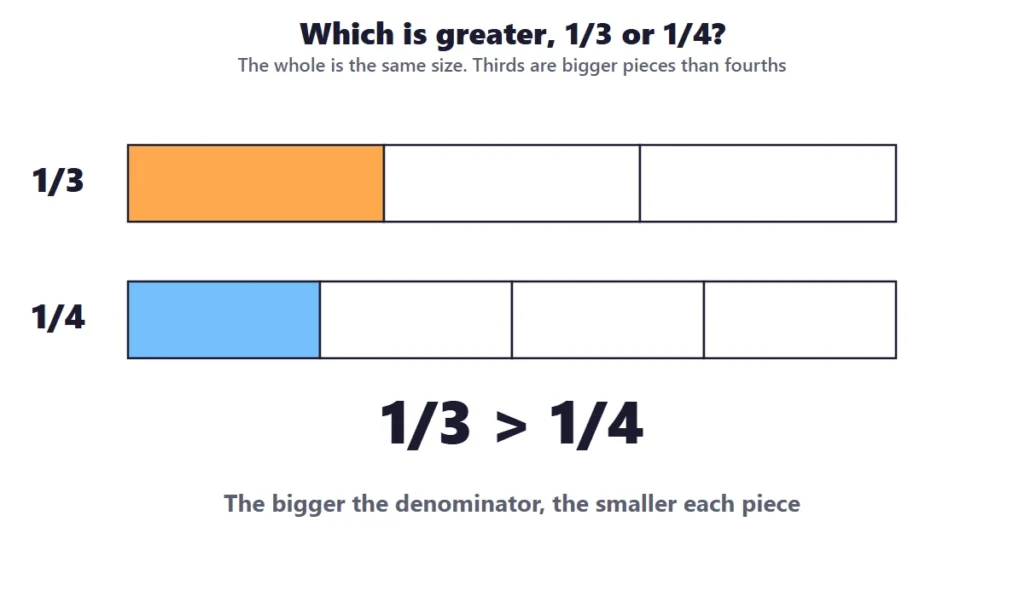
Bars. 1/3 and 1/4.
Three ways to compare fractions
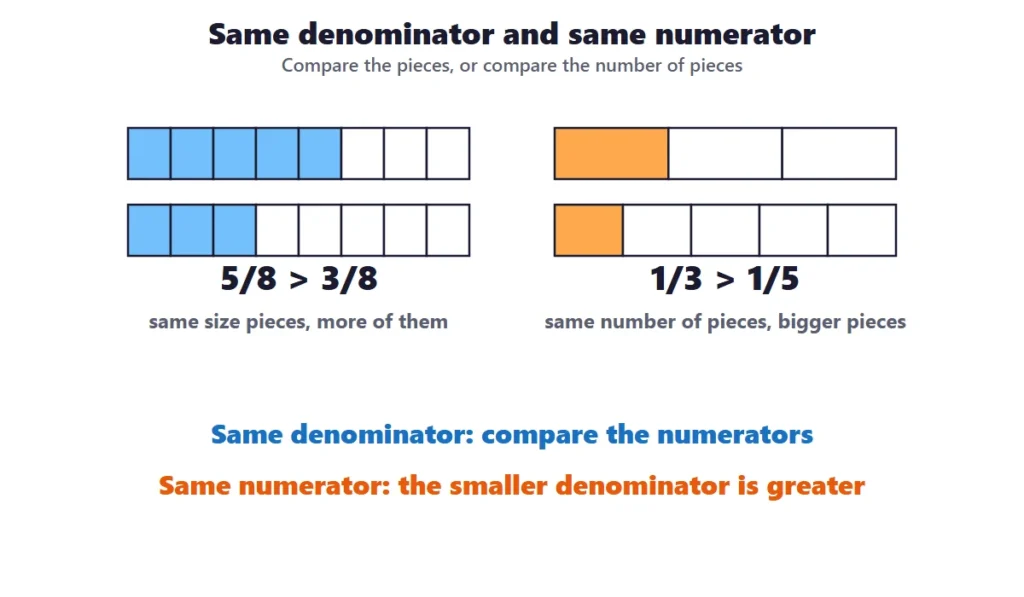
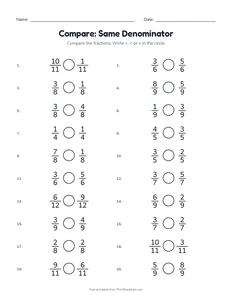
Same denominator: the pieces are the same size, so more pieces is more. 5/8 > 3/8.
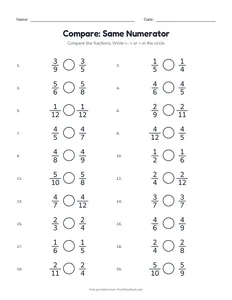
Same numerator: the same number of pieces, so bigger pieces win. 1/3 > 1/5, because thirds are bigger than fifths. This one surprises children who think a bigger number always means more.
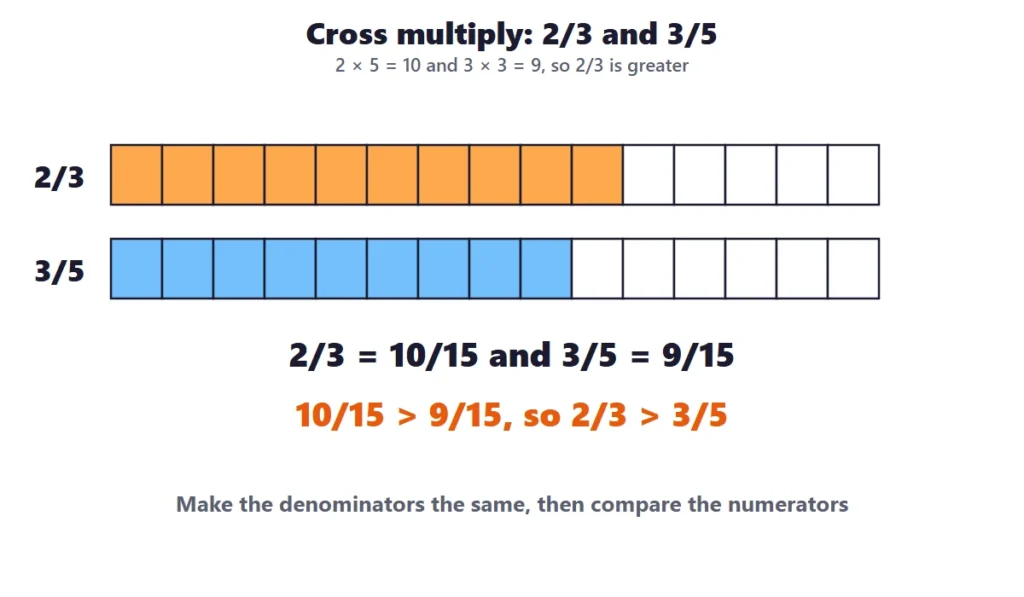
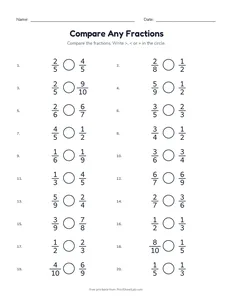
Different numerators and denominators: make the denominators the same, or cross-multiply. For 2/3 and 3/5: 2 × 5 = 10 and 3 × 3 = 9, so 2/3 > 3/5.
What is on this page
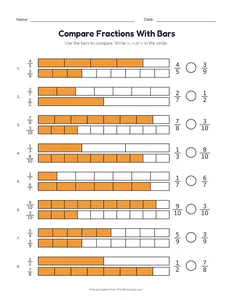
Comparing with bar models, where the bars are drawn to the same length so the fractions can be seen.
Same denominator, same numerator and mixed sets with numbers only.
Comparing fractions worksheets: what is in the set
There are 4 comparing fractions worksheets on this page, and every one has an answer key except for any cut-out games. The first set uses bar models, the next two sets compare fractions with the same denominator and the same numerator, and the last set mixes different denominators.
Worksheet
What children do
Standard
Compare Fractions With Bars
Use bar models to compare two fractions.
3.NF.A.3
Compare: Same Denominator
20 pairs with the same denominator.
3.NF.A.3
Compare: Same Numerator
20 pairs with the same numerator.
3.NF.A.3
Compare Any Fractions
20 pairs with different denominators.
3.NF.A.3
Comparing fractions: six methods and when to use each
There is no single method for comparing fractions, because the best method depends on the numbers. When the denominators are the same, the pieces are the same size, so the fraction with more pieces is greater. When the numerators are the same, the fraction with the smaller denominator has bigger pieces. For other pairs, a common denominator or cross multiplication always works. Wikipedia’s article on fractions describes the same methods. This table lists six of them:
Method
What to do
Example
Same denominator
compare the numerators: the greater numerator is the greater fraction
3/8 < 5/8
Same numerator
compare the denominators: the smaller denominator is the greater fraction
1/3 > 1/5
Common denominator
rewrite both with the same denominator, then compare the numerators
2/3 = 10/15 and 3/5 = 9/15
Cross multiply
compare a × d with b × c
2 × 5 = 10 and 3 × 3 = 9
Benchmark
compare each fraction with 1/2 or with 1
3/8 < 1/2 < 5/9
Bar or number line
draw both fractions and see which is longer
a bar for 1/3 is longer than a bar for 1/4
The worksheets on this page follow the order of the table. Each set uses only the methods that the children already know, so a child is never asked to compare two fractions without a method.
Comparing fractions grade 3: same denominator or same numerator
The comparing fractions grade 3 standard, 3.NF.A.3d, allows children to compare two fractions with the same numerator or the same denominator, by reasoning about their size. The pairs are common: for each denominator d, there are d − 1 fractions below 1, and every pair of them can be compared by looking at the numerators only. This table counts the pairs for seven denominators:
Denominator
Fractions below 1
Pairs to compare
Smallest
Greatest
3
2
1
1/3
2/3
4
3
3
1/4
3/4
5
4
6
1/5
4/5
6
5
10
1/6
5/6
8
7
21
1/8
7/8
10
9
36
1/10
9/10
12
11
55
1/12
11/12
With a denominator of 12 there are 55 pairs to compare, and a child who understands the idea can answer every one of them without drawing anything. The first three sets on this page use the same idea, with 20 pairs on each of the two worksheets that compare the same denominator and the same numerator.
Fraction bars compare the size of the pieces
Fraction bars compare fractions at a glance, as long as the bars are the same length. A bar cut into 3 equal parts has a bigger piece than a bar of the same length cut into 4, so 1/3 is greater than 1/4. This table gives the unit fractions up to twelfths in decimal form, and shows how much each is greater than the next one:
Unit fraction
Decimal
Share of the whole
How much greater than the next unit fraction
1/2
0.500
50%
1/6
1/3
0.333
33.3%
1/12
1/4
0.250
25%
1/20
1/5
0.200
20%
1/30
1/6
0.167
16.7%
1/42
1/7
0.143
14.3%
1/56
1/8
0.125
12.5%
1/72
1/9
0.111
11.1%
1/90
1/10
0.100
10%
1/110
1/11
0.091
9.1%
1/132
1/12
0.083
8.3%
1/156
The gaps get smaller as the denominator grows: 1/2 is 1/6 greater than 1/3, but 1/11 is only 1/132 greater than 1/12. This is the reason why large denominators are harder to compare by eye, and why a bar of 12 parts is hard to tell from a bar of 11. The fraction strips tool shows the bars side by side.
Compare fractions with unlike denominators: a common denominator
To compare fractions with unlike denominators, rewrite both fractions so that they have the same denominator. The easiest common denominator is the least common multiple of the two denominators, though the product also works. After that, the fraction with the greater numerator is greater. This table shows six pairs, with the common denominator and the result:
Pair
Common denominator
Rewritten
Result
2/3 and 3/5
15
10/15 and 9/15
2/3 > 3/5
3/4 and 5/8
8
6/8 and 5/8
3/4 > 5/8
5/6 and 7/9
18
15/18 and 14/18
5/6 > 7/9
3/7 and 2/5
35
15/35 and 14/35
3/7 > 2/5
4/9 and 1/2
18
8/18 and 9/18
4/9 < 1/2
7/12 and 3/5
60
35/60 and 36/60
7/12 < 3/5
Notice how close some pairs are: 7/12 and 3/5 differ by only 1/60, and a child who tries to compare them by eye will often be wrong. The GCF and LCM calculator finds the least common multiple of any two numbers, and the equivalent fractions page shows how to rewrite fractions with the same denominator.
Greater than less than fractions: benchmark fractions
Greater than less than fractions can often be answered by comparing with 1/2, a benchmark. A fraction n/d is less than 1/2 if 2n is less than d, equal to 1/2 if 2n = d, and greater than 1/2 if 2n is greater than d. This table tests ten fractions:
Two easy cases. Same denominator, same numerator.
Fraction
Double the numerator
Denominator
Compare
Fraction compared with 1/2
3/8
6
8
6 < 8
less than 1/2
5/9
10
9
10 > 9
greater than 1/2
4/8
8
8
8 = 8
equal to 1/2
7/12
14
12
14 > 12
greater than 1/2
2/5
4
5
4 < 5
less than 1/2
5/6
10
6
10 > 6
greater than 1/2
3/7
6
7
6 < 7
less than 1/2
6/11
12
11
12 > 11
greater than 1/2
1/3
2
3
2 < 3
less than 1/2
5/10
10
10
10 = 10
equal to 1/2
If one fraction is less than 1/2 and the other is greater than 1/2, the comparison is done. For two fractions that are both close to 1, such as 7/8 and 5/6, look at what is missing. Each is one piece short of 1, and the piece that is missing is smaller for the greater fraction:
Pair
Piece missing from the first
Piece missing from the second
Smaller missing piece
Greater fraction
7/8 and 5/6
1/8
1/6
1/8
7/8
3/4 and 4/5
1/4
1/5
1/5
4/5
9/10 and 8/9
1/10
1/9
1/10
9/10
5/6 and 6/7
1/6
1/7
1/7
6/7
Ordering fractions from least to greatest
When children can compare two fractions, they can order a whole list. This table puts eight fractions in order, with each one written over 120 so that the numerators can be compared directly, and also as a decimal and a share of the whole:
Place
Fraction
Over 120
Decimal
Share of the whole
1
1/2
60/120
0.500
50%
2
3/5
72/120
0.600
60%
3
5/8
75/120
0.625
62.5%
4
2/3
80/120
0.667
66.7%
5
7/10
84/120
0.700
70%
6
3/4
90/120
0.750
75%
7
4/5
96/120
0.800
80%
8
5/6
100/120
0.833
83.3%
The number 120 works because it is a multiple of 2, 3, 4, 5, 6, 8 and 10, which are the denominators on the list. A common denominator for a list of fractions is the least common multiple of all the denominators, and this is a good example of why that number is useful.
Common mistakes when comparing fractions
Most mistakes come from treating the numerator and the denominator as separate whole numbers. This table shows five mistakes, what went wrong and the fix:
What the child writes or says
What went wrong
The fix
1/8 > 1/4, because 8 is greater than 4
compares the bottom numbers the wrong way round for unit fractions
a bigger denominator means smaller pieces: draw the two bars
2/3 < 3/5, because 2 < 3 and 3 < 5
compares the tops and the bottoms separately
use a common denominator: 10/15 > 9/15
3/8 = 3/5, because both have 3 on top
ignores the denominators
the pieces are different sizes: 3/5 is more
1/2 of a small pizza > 1/4 of a large pizza
compares fractions of different wholes
fractions can only be compared when the whole is the same
5/6 < 7/8, because 5 < 7
compares the numerators of different denominators
see how much is missing: 1/6 is greater than 1/8, so 5/6 is less
Comparing fractions word problems
Comparing fractions answers everyday questions such as who ate more, or which is longer. Ask children to find the method first and to say the answer in a full sentence:
Word problem
Working
Answer
Ana ate 3/8 of a pizza and Ben ate 5/8 of the same pizza. Who ate more?
3/8 < 5/8
Ben
Lin walked 1/3 of a mile and Max walked 1/4 of a mile. Who walked farther?
1/3 > 1/4
Lin
A jug holds 2/3 of a liter and a bottle holds 3/5 of a liter. Which holds more?
10/15 > 9/15
the jug
Sam read 5/6 of a book and Tia read 7/8 of a book of the same length. Who read more?
20/24 < 21/24
Tia
A rope is 3/4 meter long and a ribbon is 5/8 meter long. Which is longer?
6/8 > 5/8
the rope
A recipe needs 1/2 cup of milk or 4/9 cup of water. Which is more?
9/18 > 8/18
the milk
Games and activities for comparing fractions
Children learn comparing fractions best when they play with it. These games use things that are found at home or in a classroom:
Fraction war: each player turns over a fraction card, and the player with the greater fraction takes both cards
Strip race: cut two paper strips into different numbers of parts and see which shaded part is longer
Greater or less: one child says a fraction, and the other says whether it is greater or less than 1/2
Closest to one: pick two fraction cards and add them: the sum closest to 1 wins
Fraction line-up: give five fraction cards to five children and ask them to stand in order
Compare bingo: a bingo card with the symbols >, < and =, and calling cards with pairs of fractions
Online practice: the free comparing fractions game on this site gives quick practice with the symbols
Extra support and extra challenge with comparing fractions
For children who need more support: use paper strips or the fraction wall, and compare unit fractions first. Ask “which pieces are bigger?” before any rule is used. Keep to the same denominator for a few days, and then to the same numerator, and use a bar for every comparison until the child can answer without one.
For children who need more challenge: ask for a fraction between 1/3 and 1/2, for three fractions that are all greater than 2/3 and less than 3/4, and for the greatest of 4/7, 5/9 and 7/12. The “Compare Any Fractions” worksheet with cross multiplication is a good challenge.
How to tell that a child is ready to move on from comparing fractions
The child compares fractions with the same denominator without a picture.
The child compares fractions with the same numerator and explains why.
The child uses 1/2 as a benchmark.
The child finds a common denominator to compare any two fractions.
A short lesson is the best way to introduce comparing fractions. This 20-minute plan can be used in a classroom, at a tutoring session or at home, and it uses the worksheets at the end:
Minutes
Activity
What to say or ask
0 to 3
Show two bars of the same length, one cut into 3 parts and one into 4
Which piece is bigger, and why?
3 to 8
Compare 3/8 and 5/8 using the number of pieces
What is the same? What is different?
8 to 13
Compare 1/3 and 1/5 using the size of the pieces
Which has bigger pieces?
13 to 18
Compare 2/3 and 3/5 using a common denominator
What denominator works for both?
18 to 20
Start a worksheet and check one answer
Draw a bar to check.
Where comparing fractions fits across the grades
No skill stands alone. This table shows what children learn before and after comparing fractions, with the standard that goes with each step:
Grade
What children do
Standard or page
Grade 2
Equal shares: halves, thirds and fourths
2.G.A.3
Grade 3
Compare fractions with the same numerator or denominator
3.NF.A.3d, this page
Grade 4
Compare fractions with different numerators and denominators
Comparing fractions is used in every later fraction topic. The whole sequence is on the fractions worksheets page.
Helping at home with comparing fractions
Parents do not need to be experts to help with comparing fractions. These suggestions work well, and each takes only a few minutes:
Ask “which is more, 1/2 of a pizza or 1/3 of the same pizza?” at dinner.
Look at measuring cups: 3/4 cup is more than 2/3 cup, but how much more?
Use a deck of cards with fractions to play fraction war.
Ask the child to draw a bar when they are not sure.
Praise “the pieces are smaller, so I need more of them”.
How to check progress in comparing fractions
A teacher or parent can check progress with the answer key and a few questions. This table shows three common situations, what they mean and what to do next:
What you see
What it means
What to do next
The child compares unit fractions backwards
The idea that more parts means smaller parts is not yet secure
Cut paper strips into 2, 3 and 4 parts and compare the pieces
The child gets 9 of 10 right in every set
The skill is secure
Move on to adding and subtracting fractions
The child compares the tops and the bottoms separately
The child treats a fraction as two whole numbers
Use a common denominator, and compare one thing at a time
A five-day plan for comparing fractions
Most children need about a week of short sessions for comparing fractions. This plan follows the order of the worksheets on this page:
Cutting a whole into 3 pieces makes bigger pieces than cutting it into 4, so one third is more than one fourth.
Do fractions need the same whole to compare?
Yes. Half of a small pizza is less than half of a big one, so the bars on these worksheets always show the same size whole.
How do you compare fractions with different denominators?
Rewrite both fractions with a common denominator, for example the least common multiple of the two denominators. Then compare the numerators. You can also cross multiply: for a/b and c/d, compare a × d with b × c.
Which is bigger, 1/3 or 1/4?
One third is bigger. When a whole is cut into 3 equal parts, each part is bigger than when it is cut into 4 equal parts. So for fractions with the same numerator, the smaller denominator gives the greater fraction.
Can you compare fractions of different wholes?
Not directly. A half of a big pizza can be more than three quarters of a small pizza. The comparison only works when both fractions are parts of the same whole, so always check what the whole is.