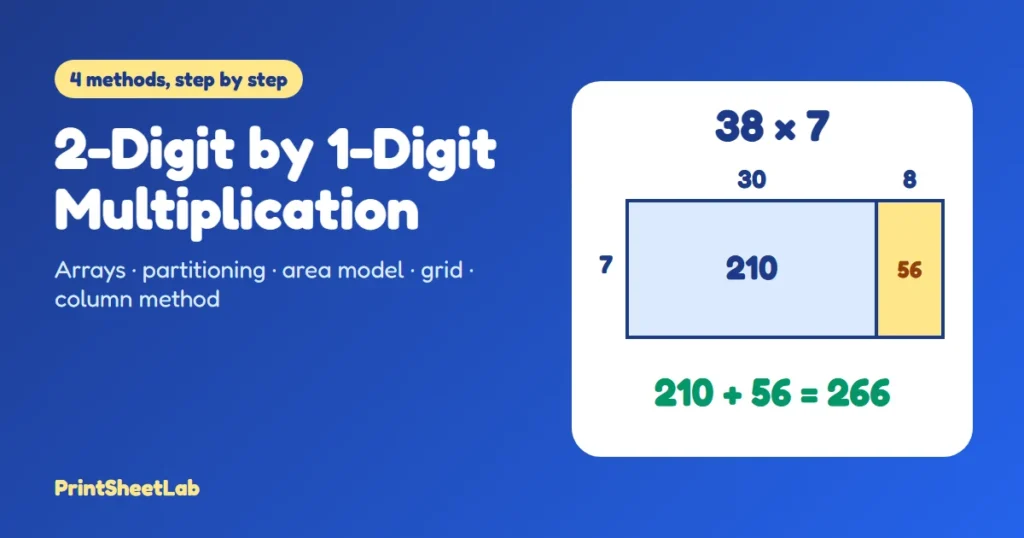
2 digit by 1 digit multiplication means multiplying a number from 10 to 99 by a number from 1 to 9, such as 38 × 7. The easiest way to understand it is to split the two-digit number into tens and ones, multiply each part, and add the two answers: 38 × 7 = 210 + 56 = 266.
This guide shows four methods for two digit by one digit multiplication, in the order most children learn them: partitioning (expanded form), the area model, the grid method and the standard column method with regrouping. Each one has a worked example, and arrays come first for beginners. There is a 12-question practice set with answers, a list of common mistakes, and printable multiplication worksheets for every level when your child is ready to practise.
All four methods rest on the same idea, called the distributive property: multiplying a whole number is the same as multiplying its parts and adding the results. Once a child sees that, the column method stops being a trick and becomes a short way of writing something they already understand.
What children need before 2 digit by 1 digit multiplication
Three skills make this topic easy. Check them first, because most errors in 2-digit by 1-digit problems come from a gap here rather than from the method.
- Times tables up to 9 × 9. Every method needs single-digit facts like 7 × 8. If facts are slow, spend a week with our times tables tricks and a printable multiplication chart on the desk.
- Place value. Children must know that the 3 in 38 means 3 tens, or 30. The place value anchor chart guide shows how to teach tens and ones clearly.
- Multiplying tens. If 3 × 7 = 21, then 30 × 7 = 210, because 3 tens times 7 is 21 tens. Counting in tens on a number line, as in our skip counting guide, builds this quickly.
Start with arrays: 2 by 1 digit multiplication for beginners
An array is a rectangle of objects in equal rows. For 12 × 3, lay out 3 rows of 12 counters, buttons or dots. Count them and you get 36. Now draw a line through every row after the tenth counter. The array splits into a 3 × 10 block (30) and a 3 × 2 block (6), and 30 + 6 = 36.
That split is the whole secret of 2 by 1 digit multiplication, and arrays make it something children can see. Children see with their own eyes that breaking 12 into 10 and 2 does not change the total. Try a few more on squared paper: 13 × 5 splits into 50 and 15, which makes 65.
For extra hands-on work, model the tens with rods and the ones with cubes using our printable base ten blocks, then move to the multiplication arrays and equal groups worksheets. Stay with arrays until a child can explain why the split works.
Method 1: partitioning (expanded form)
Partitioning writes the two-digit number in expanded form, multiplies each part, then adds. It is the most natural written method for 2 digit by 1 digit multiplication and works well as mental maths later.
Worked example: 23 × 4
- Write 23 in expanded form: 23 = 20 + 3.
- Multiply the tens: 20 × 4 = 80.
- Multiply the ones: 3 × 4 = 12.
- Add the two parts: 80 + 12 = 92.
Written as one line: 23 × 4 = (20 × 4) + (3 × 4) = 80 + 12 = 92. Try 47 × 6 the same way: 40 × 6 = 240 and 7 × 6 = 42, so the answer is 282. If expanded form is new, the tens and ones worksheets are a good warm-up.
Method 2: the area model for 2-digit by 1-digit questions
The area model draws the problem as a rectangle. The long side is split into tens and ones; the short side is the single digit. Each smaller rectangle holds one partial product.
Worked example: 38 × 7
- Draw a long rectangle. Split the top edge into a wide part labelled 30 and a narrow part labelled 8.
- Write 7 down the left side.
- Fill each box: 30 × 7 = 210 and 8 × 7 = 56.
- Add the boxes: 210 + 56 = 266.
Drawing the tens box bigger than the ones box matters in every 2-digit by 1-digit calculation. It shows that 210 is most of the answer, which helps children notice when a final answer is far too small. The US Common Core standard 4.NBT.B.5 names rectangular arrays and area models as ways to explain this kind of calculation.
Method 3: the grid method
The grid method is a tidy table version of the area model for a 2-digit by 1-digit problem. The single digit goes in the first column, the tens and ones across the top, and the products in the cells.
Worked example: 64 × 5
| × | 60 | 4 |
|---|---|---|
| 5 | 300 | 20 |
Add the cells: 300 + 20 = 320. The grid makes a good bridge to bigger problems because the same layout grows to 3-digit numbers and to 2-digit by 2-digit products. NRICH, the University of Cambridge maths project, explains how the grid method grows out of partitioned arrays.
Method 4: the standard column method with regrouping
The column method, also called short multiplication or the standard algorithm, is the fastest written way to do 2 digit by 1 digit multiplication. In the 2-digit by 1-digit case it does exactly what partitioning does, but it multiplies the ones first and stores any extra tens as a small carried digit.
Worked example without regrouping: 32 × 3
Write 3 under the ones digit of 32. Multiply the ones: 2 × 3 = 6, write 6. Multiply the tens: 3 × 3 = 9, write 9. The answer is 96.
Worked example with regrouping: 56 × 4
- Multiply the ones: 6 × 4 = 24.
- Write the 4 in the ones column and carry the 2 (two tens) under the tens column.
- Multiply the tens: 5 × 4 = 20 tens.
- Add the carried tens: 20 + 2 = 22. Write 22 to the left. The answer is 224.

A harder 2-digit by 1-digit example: 79 × 8. Ones: 9 × 8 = 72, write 2 and carry 7. Tens: 7 × 8 = 56, plus the carried 7 makes 63. The answer is 632. Check with partitioning: 560 + 72 = 632.
The rule to remember is multiply first, then add the carry. The mistakes table below shows what happens otherwise.
Same problem, four ways: comparing the methods
Seeing one 2-digit by 1-digit calculation solved four ways is the clearest way for a child to understand that the methods agree. Here is 38 × 7 in each method.
| Method | What you write for 38 × 7 | Best for |
|---|---|---|
| Partitioning (expanded form) | (30 × 7) + (8 × 7) = 210 + 56 = 266 | First written method; mental maths |
| Area model | Rectangle split into 30 and 8, height 7: boxes of 210 and 56 | Visual learners; explaining why it works |
| Grid method | Grid with 30 | 8 across and 7 down: 210 | 56, total 266 | Neat layout that scales to bigger numbers |
| Column (standard) method | 8 × 7 = 56, write 6 carry 5; 3 × 7 = 21, + 5 = 26; answer 266 | Speed and accuracy once place value is secure |

In which grade do children meet 2-digit by 1-digit problems?
Most children meet two digit by one digit multiplication in Grade 3 (UK Year 3) and become fluent with the written method in Grade 4 (UK Year 4). The official documents set out the steps like this.
| Stage | What the official standard says | What it looks like |
|---|---|---|
| US Grade 3 (Common Core 3.NBT.A.3) | Multiply one-digit numbers by multiples of 10 from 10 to 90 | 9 × 80, 5 × 60 |
| England Year 3 | Two-digit numbers times one-digit numbers, mental methods progressing to formal written methods | Partitioning, arrays, grid method |
| US Grade 4 (Common Core 4.NBT.B.5) | Multiply up to four digits by one digit using place value strategies, arrays and area models | Area model, partial products |
| England Year 4 | Multiply two-digit and three-digit numbers by one digit using the formal written layout | Short (column) multiplication |
| US Grade 5 (Common Core 5.NBT.B.5) | Fluently multiply multi-digit whole numbers using the standard algorithm | Column method for any size |
The England wording comes from the Year 3 and Year 4 sections of the national curriculum mathematics programmes of study, which also uses 39 × 7 = 30 × 7 + 9 × 7 as its example of the distributive law. The US wording comes from the Common Core State Standards for Mathematics (PDF).
Common mistakes in 2 digit by 1 digit multiplication
These errors show up again and again. Each wrong answer below is what a child really gets if they make that slip, so you can spot the cause of a wrong two by one digit multiplication from the answer alone.
| Mistake | Wrong answer | Fix |
|---|---|---|
| Forgetting the carried digit (56 × 4) | 204 | Write the carry small and cross it out once used |
| Adding the carry before multiplying (56 × 4) | 284 | Say aloud: “multiply, then add the carry” |
| Writing the two products side by side (23 × 4) | 812 | Go back to partitioning: 80 + 12, not 8 next to 12 |
| Treating the tens digit as ones (38 × 7) | 21 + 56 = 77 | Read 3 as “3 tens” or 30 every time |
| A slow or wrong times table fact | Any | Practise the single facts separately until they are instant |
A quick estimate catches most of these. Round the two-digit number to the nearest ten first: 56 × 4 is close to 60 × 4 = 240, so 204 is a little low and 284 is too high. 224 is sensible.
Practice set: two digit by one digit multiplication with answers
Solve each 2 digit by 1 digit multiplication with any method. Cover the answers, then check. The first row needs no regrouping; the rest do. Every answer has been checked.
| Question | Answer | Question | Answer | Question | Answer | Question | Answer |
|---|---|---|---|---|---|---|---|
| 21 × 4 | 84 | 33 × 3 | 99 | 16 × 5 | 80 | 27 × 3 | 81 |
| 42 × 6 | 252 | 58 × 2 | 116 | 35 × 7 | 245 | 64 × 9 | 576 |
| 87 × 4 | 348 | 76 × 5 | 380 | 93 × 8 | 744 | 99 × 9 | 891 |
Word problems
- A box holds 24 crayons. How many crayons are in 6 boxes? 144
- A school bus has 52 seats. How many seats are there on 4 buses? 208
- A hall has 7 rows of 18 chairs. How many chairs are there? 126
- A notebook costs 75 rupees. How much do 3 notebooks cost? 225 rupees
For more word problems, use our multiplication word problem worksheets.
Worksheets and games for 2-digit by 1-digit practice
Short, regular practice is easier to keep up than one long session: ten problems a day is plenty. Here is a sequence that moves from facts to fluency.
- Fact fluency first: 5 minutes on the mixed times tables game or a single table game such as the 7 times table game.
- Printable practice: our 2 digit by 1 digit multiplication worksheets cover multiplication 2 digit by 1 digit with and without regrouping, with answer keys.
- Your own problems: make an unlimited 2-digit by 1-digit worksheet with the math worksheet generator.
- Next steps: move to 3 and 4 digit by 1 digit multiplication, then 2 digit by 2 digit multiplication.
A child has mastered 2 digit by 1 digit multiplication and is ready for the next level when they get 9 out of 10 right without help, can explain one problem using the area model, and catch their own mistakes by estimating.
Related guides and printables
- Times tables tricks for kids
- Skip counting for kids: patterns and number lines
- How to make a place value anchor chart
- Free online math games for kids by grade
- Multiplication facts worksheets to 100
Sources
Grade expectations are taken from the Common Core State Standards for Mathematics (3.NBT.A.3, 4.NBT.B.5, 5.NBT.B.5) and the England national curriculum for mathematics (Years 3 and 4). The link from arrays to the grid method follows NRICH, University of Cambridge.
Frequently asked questions
6 quick answers
How do you do 2 digit by 1 digit multiplication step by step?
Split the two-digit number into tens and ones, multiply each part by the single digit, then add. For 47 × 6: 40 × 6 = 240, 7 × 6 = 42, and 240 + 42 = 282. The column method does the same steps, starting with the ones.
What is the easiest method for 2 digit by 1 digit multiplication?
For most children, partitioning is easiest to understand because it uses only times table facts and addition. The column method is fastest once place value is secure.
What does regrouping mean in two digit by one digit multiplication?
Regrouping (carrying) happens when the ones product is 10 or more. In 56 × 4, 6 × 4 = 24, so you write 4 and carry 2 tens to add to the tens product: 20 + 2 = 22, giving 224.
What grade learns 2 by 1 digit multiplication?
Children usually start in Grade 3 (UK Year 3) with arrays and partitioning, and use the formal column method in Grade 4 (UK Year 4).
Is 2 digit by 1 digit multiplication the same as short multiplication?
Yes, when it is done in columns. In the UK the written column method for multiplication 2 digit by 1 digit is called short multiplication. Long multiplication is the layout used when both numbers have two or more digits, such as 46 × 23.
How can I check a 2 digit by 1 digit multiplication answer?
Estimate by rounding the two-digit number to the nearest ten (56 × 4 is about 60 × 4 = 240), then re-solve with a different method, such as partitioning after using the column method.