Equivalent fractions are fractions with different names that show the same amount, such as 1/2, 2/4 and 4/8. The four PDFs on this page have a printed fraction wall, a color-by-fraction picture, missing numerators and denominators, and simplest form, all with answer keys. They follow standards 3.NF.A.3 and 4.NF.A.1, which the Common Core standards for grade 4 fractions describe, and the notes below explain each step.
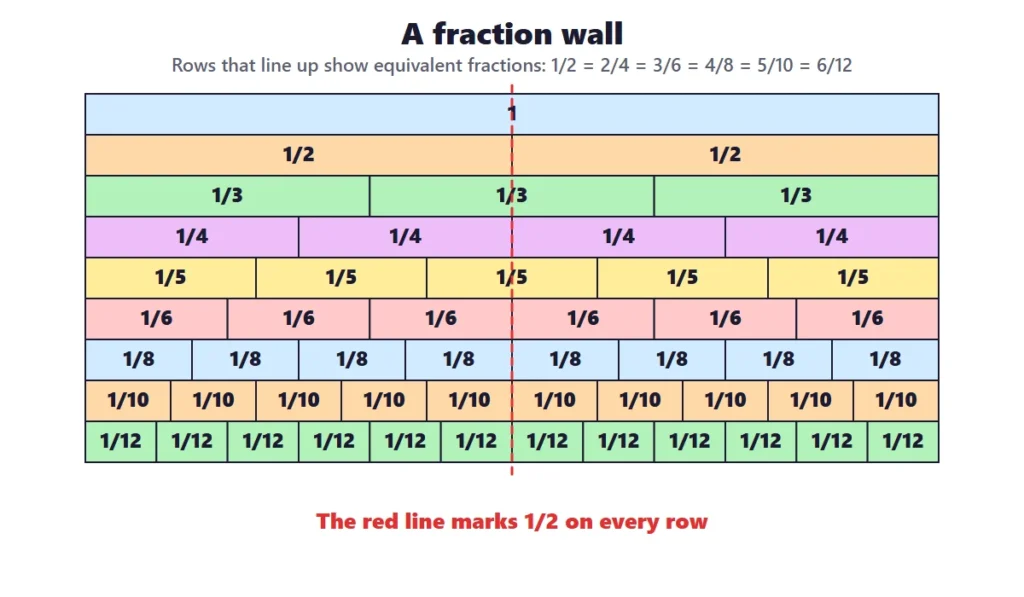
Fraction wall. Rows that line up.
Quick answer: Equivalent fractions are fractions with different numbers that name the same amount, such as 1/2, 2/4 and 3/6. Multiply or divide the top and bottom by the same number to find one. This page has 4 free printable worksheets with answer keys for grades 3 and 4. Updated October 2026.
What makes fractions equivalent?
Equivalent fractions name the same amount. Half a pizza is the same as two quarters or three sixths: the pieces are smaller, but there are more of them. On a fraction wall you can see it directly, because the rows line up.
The rule
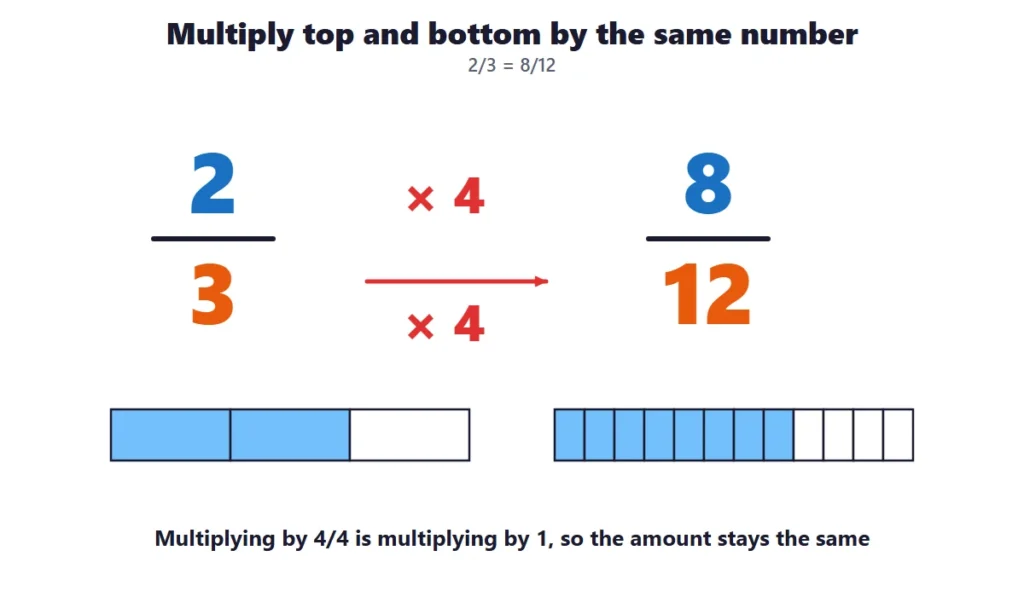
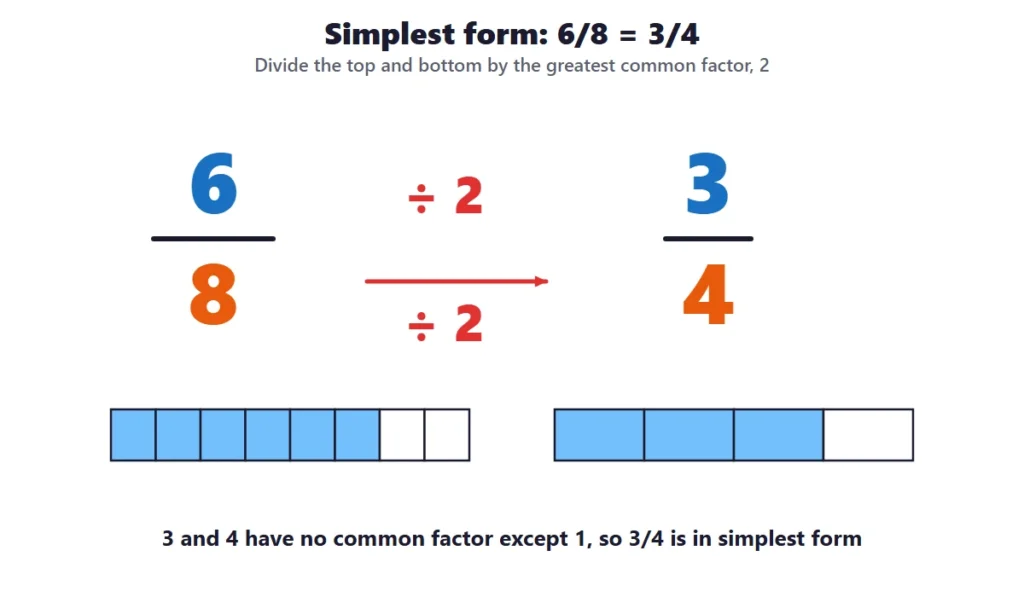
Multiply (or divide) the top and bottom by the same number. 2/3 × 4/4 = 8/12. Multiplying by 4/4 is multiplying by 1, so the amount does not change. Dividing both numbers by their biggest common factor gives the simplest form: 6/8 ÷ 2/2 = 3/4.
What is on this page
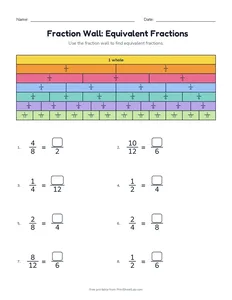
Fraction wall: a printed wall from 1 whole to twelfths, with questions to solve using it.
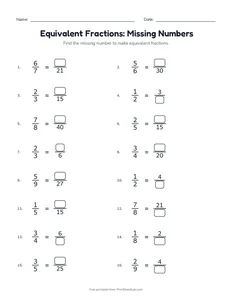
Missing numbers: 2/3 = ☐/12 and 3/5 = 9/☐.
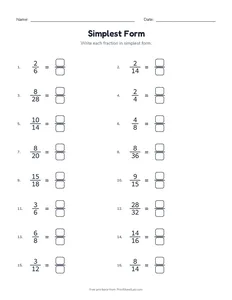
Simplest form: reduce fractions like 8/12.
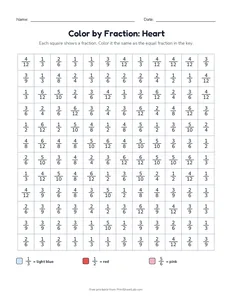
Color by fraction: squares showing 2/4, 3/6 and 5/10 all get the same color as 1/2, which reveals a picture.
Equivalent fractions worksheets: what is in the set
There are 4 equivalent fractions worksheets on this page, and every one has an answer key except for any cut-out games. The first two sets use pictures, the third has missing numbers, and the fourth moves on to simplest form.
Worksheet
What children do
Standard
Fraction Wall: Equivalent Fractions
Use the printed fraction wall to find equal fractions.
3.NF.A.3
Color by Fraction: Heart
Squares with equal fractions share a color.
3.NF.A.3
Equivalent Fractions: Missing Numbers
Find the missing numerator or denominator.
3.NF.A.3
Simplest Form
Write each fraction in simplest form.
3.NF.A.3
Equivalent fractions: what they are and where they come from
When a whole is cut into more equal parts, each part is smaller, but more of them are needed to show the same amount. Half a pizza is 1 piece of 2, 2 pieces of 4 or 4 pieces of 8, and all of them are the same amount. These fractions are equivalent, and every fraction has a family of them. The table shows the first six members of seven families. Wikipedia’s article on fractions explains why every fraction has infinitely many equivalent fractions:
Fraction
× 1
× 2
× 3
× 4
× 5
× 6
1/2
1/2
2/4
3/6
4/8
5/10
6/12
1/3
1/3
2/6
3/9
4/12
5/15
6/18
2/3
2/3
4/6
6/9
8/12
10/15
12/18
1/4
1/4
2/8
3/12
4/16
5/20
6/24
3/4
3/4
6/8
9/12
12/16
15/20
18/24
2/5
2/5
4/10
6/15
8/20
10/25
12/30
5/6
5/6
10/12
15/18
20/24
25/30
30/36
Each fraction in a row comes from multiplying the numerator and the denominator by the same number, k. This is the same as multiplying by k/k, which is 1, and multiplying by 1 does not change the amount. Children who see this stop thinking that the numbers change the value.
Fraction wall worksheet: which rows line up
On the fraction wall worksheet, the rows are cut into 1, 2, 3, 4, 5, 6, 8, 10 and 12 parts, and the edges that line up show equivalent fractions. The edge at 1/2 is on every row that has an even number of parts, and the edge at 1/3 is on the rows for 6 and 12. This table lists, for nine fractions, the other rows of the wall that have an edge in the same place:
Fraction
Other rows with the same edge
Equivalent fractions on those rows
1/2
4, 6, 8, 10, 12
2/4, 3/6, 4/8, 5/10, 6/12
1/3
6, 12
2/6, 4/12
2/3
6, 12
4/6, 8/12
1/4
8, 12
2/8, 3/12
3/4
8, 12
6/8, 9/12
1/5
10
2/10
2/5
10
4/10
1/6
12
2/12
5/6
12
10/12
The fractions 1/5 and 2/5 each line up with only the row of tenths. This is a good question to ask: “why does 1/5 have only one equivalent fraction on the wall?” The answer is that the wall has no row with 15 or 20 parts. The fraction strips tool lets children make a wall with any rows they like.
Equivalent fractions grade 4: multiply by a fraction that equals 1
For equivalent fractions grade 4, the rule from standard 4.NF.A.1 is that a/b = (n × a)/(n × b). The table shows eight examples, with the decimal of the old and the new fraction as a check that the amount did not change:
Start
Multiply top and bottom by
Equivalent fraction
Check: decimal of both
3/4
2
6/8
0.750 and 0.750
3/4
3
9/12
0.750 and 0.750
2/5
4
8/20
0.400 and 0.400
5/6
2
10/12
0.833 and 0.833
7/8
5
35/40
0.875 and 0.875
4/9
3
12/27
0.444 and 0.444
3/10
4
12/40
0.300 and 0.300
1/12
6
6/72
0.083 and 0.083
The decimals in the last column always match, because multiplying the top and bottom by the same number does not change the quotient. A child who checks one example this way learns to trust the rule.
Missing numerator worksheets: finding the missing number
The third set is a missing numerator worksheets set, and it also has missing denominators. The method is to compare the two denominators, or the two numerators, that are known. If 2/3 = ☐/12, then 3 times 4 is 12, so the numerator is 2 times 4. If 3/5 = 9/☐, then 3 times 3 is 9, so the denominator is 5 times 3. This table shows six problems with the working:
Multiply. 2/3 = 8/12.
Missing number
What the known pair shows
Multiply by
Missing number
2/3 = ☐/12
3 × 4 = 12
4
2 × 4 = 8
5/6 = ☐/18
6 × 3 = 18
3
5 × 3 = 15
7/8 = ☐/40
8 × 5 = 40
5
7 × 5 = 35
3/5 = 9/☐
3 × 3 = 9
3
5 × 3 = 15
4/7 = 12/☐
4 × 3 = 12
3
7 × 3 = 21
3/4 = 18/☐
3 × 6 = 18
6
4 × 6 = 24
In every problem the same factor is used on the top and on the bottom. Children who find the factor first make fewer mistakes than children who guess the missing number.
Simplifying fractions worksheets: the greatest common factor
The simplifying fractions worksheets ask for the simplest form of a fraction, which is the equivalent fraction with the smallest numbers. A fraction is in simplest form when the numerator and the denominator have no common factor except 1. To simplify a fraction, divide the top and bottom by the greatest common divisor, which is the greatest number that goes into both. This table shows eight fractions, with the factors that children list in the first method:
Fraction
Factors of the numerator
Factors of the denominator
Greatest common factor
Simplest form
6/8
1, 2, 3, 6
1, 2, 4, 8
2
3/4
12/18
1, 2, 3, 4, 6, 12
1, 2, 3, 6, 9, 18
6
2/3
10/25
1, 2, 5, 10
1, 5, 25
5
2/5
18/24
1, 2, 3, 6, 9, 18
1, 2, 3, 4, 6, 8, 12, 24
6
3/4
15/45
1, 3, 5, 15
1, 3, 5, 9, 15, 45
15
1/3
28/42
1, 2, 4, 7, 14, 28
1, 2, 3, 6, 7, 14, 21, 42
14
2/3
36/48
1, 2, 3, 4, 6, 9, 12, 18, 36
1, 2, 3, 4, 6, 8, 12, 16, 24, 48
12
3/4
40/100
1, 2, 4, 5, 8, 10, 20, 40
1, 2, 4, 5, 10, 20, 25, 50, 100
20
2/5
Children can also divide by any common factor in steps: 12/18 divided by 2 is 6/9, and 6/9 divided by 3 is 2/3. Both ways give the same simplest form, and the simplify fractions calculator checks the answers. The GCF and LCM calculator finds the greatest common factor of any two numbers.
Cross products: a quick check for equivalent fractions
There is a check that works for any pair of fractions. Two fractions are equivalent when the cross products are equal: a/b = c/d when a × d = b × c. This table tests six pairs:
Pair
First numerator × second denominator
First denominator × second numerator
Equivalent?
2/3 and 8/12
2 × 12 = 24
3 × 8 = 24
yes: both are 24
3/4 and 6/8
3 × 8 = 24
4 × 6 = 24
yes: both are 24
2/5 and 3/7
2 × 7 = 14
5 × 3 = 15
no: 14 is not 15
5/6 and 10/12
5 × 12 = 60
6 × 10 = 60
yes: both are 60
4/9 and 5/11
4 × 11 = 44
9 × 5 = 45
no: 44 is not 45
3/8 and 9/24
3 × 24 = 72
8 × 9 = 72
yes: both are 72
The same test is used in the comparing fractions page to find which of two fractions is greater, and it is the reason why 2/3 and 8/12 are equivalent. Children do not have to learn it until grade 4 or 5, but it is a good way to check the answers on the worksheets.
Common mistakes with equivalent fractions
The biggest mistake is adding the same number to the numerator and the denominator, and this table shows why it does not work:
Fraction
Add the same number to both
New fraction
Original decimal
New decimal
Same amount?
1/2
+ 1
2/3
0.500
0.667
no
2/3
+ 2
4/5
0.667
0.800
no
3/4
+ 1
4/5
0.750
0.800
no
1/4
+ 3
4/7
0.250
0.571
no
5/6
+ 1
6/7
0.833
0.857
no
Adding changes the amount, while multiplying does not. Here are five mistakes that teachers see most often, with what went wrong and the fix:
What the child writes or says
What went wrong
The fix
2/3 = 4/5, because 2 was added to both numbers
adds instead of multiplying
multiply the top and bottom by the same number: 2/3 = 4/6
1/2 = 2/3
multiplies the top by 2 and the bottom by 3
use the same number on both: 1/2 = 2/4
6/8 simplified is 6/4
divides only the denominator
divide the top and the bottom by 2: 3/4
12/18 simplified is 6/9, and it is finished
stops before the greatest common factor
check for another common factor: 6/9 = 2/3
3/5 = 6/9, because 3 × 2 = 6 and 5 × 2 = 10 but wrote 9
a mistake in one multiplication
multiply both numbers by the same factor, and check with the wall
Equivalent fractions word problems
Equivalent fractions show up when two people share the same thing in different ways. Ask children to find an equivalent fraction first and then to answer the question:
Word problem
Working
Answer
Ana ate 2/4 of a pizza and Ben ate 1/2 of the same pizza. Who ate more?
2/4 = 1/2
the same amount
A recipe uses 3/6 of a cup of sugar. What is this in simplest form?
divide 3 and 6 by 3
1/2 of a cup
Lin read 4/8 of a book and Max read 2/4 of the same book. Are they at the same place?
4/8 = 2/4 = 1/2
yes
A fence has 8 equal sections and 6 are painted. What fraction is painted in simplest form?
6/8 = 3/4
3/4
A class of 12 has 8 children with brown hair. What fraction is that in simplest form?
8/12 = 2/3
2/3
A ribbon is cut into 10 equal pieces and 5 are used. What fraction is left in simplest form?
5/10 = 1/2
1/2
Games and activities for equivalent fractions
Children learn equivalent fractions best when they play with it. These games use things that are found at home or in a classroom:
Fold and match: fold three paper strips into halves, fourths and eighths, and show that they match
Fraction wall bingo: a bingo card with fractions, and calling cards with equivalent fractions
Pizza trade: a slice of 1/2 can be traded for 2 slices of 1/4: draw three trades
Equivalent fraction dominoes: a chain of cards that match the equal fractions
Color the heart: the worksheet “Color by Fraction: Heart” uses a color for each family
Simplify race: give each player a list of fractions, and the first to simplify them all wins
Extra support and extra challenge with equivalent fractions
For children who need more support: use the fraction wall and paper strips, and start with halves and fourths. Ask “which row has an edge in the same place?” and write down the pair. Practice multiplying by 2 and 3 before other numbers, and leave simplest form until the child can find a missing numerator.
For children who need more challenge: ask for the simplest form of 84/126, for a fraction with a denominator of 60 that equals 3/5, and for all the fractions equal to 1/3 with a denominator below 30. The “Simplest Form” worksheet with the greatest common factor method is a good challenge.
How to tell that a child is ready to move on from equivalent fractions
The child finds equivalent fractions on the wall.
The child multiplies the top and bottom by the same number.
The child finds a missing numerator or denominator.
A short lesson is the best way to introduce equivalent fractions. This 20-minute plan can be used in a classroom, at a tutoring session or at home, and it uses the worksheets at the end:
Minutes
Activity
What to say or ask
0 to 3
Show a fraction wall and ask which rows line up at 1/2
What do you notice about the numbers?
3 to 8
Write 1/2, 2/4 and 4/8 and find the pattern
What do we multiply by?
8 to 13
Multiply 3/4 by 2/2 and 3/3 and check with the wall
Why does the amount stay the same?
13 to 18
Simplify 6/8 by dividing by 2
Is there a bigger number that goes into both?
18 to 20
Start a worksheet and check one answer with the key
Check with the wall.
Where equivalent fractions fits across the grades
No skill stands alone. This table shows what children learn before and after equivalent fractions, with the standard that goes with each step:
Equivalent fractions are the key to the rest of fractions. The whole sequence is on the fractions worksheets page.
Helping at home with equivalent fractions
Parents do not need to be experts to help with equivalent fractions. These suggestions work well, and each takes only a few minutes:
Cut a pizza into 4, then into 8, and show that 2/4 = 4/8.
Use a measuring cup: 1/2 cup is the same as 2/4 cup.
Ask “how can we say that in simpler numbers?” about a score such as 6/8.
Look at a ruler: 4/8 of an inch is 1/2 an inch.
Check answers with a calculator that simplifies fractions.
How to check progress in equivalent fractions
A teacher or parent can check progress with the answer key and a few questions. This table shows three common situations, what they mean and what to do next:
What you see
What it means
What to do next
The child finds equal fractions on the wall but not without it
The picture is secure, but the rule is not
Link the picture to “multiply the top and bottom by the same number”
The child gets 9 of 10 right in every set
The skill is secure
Move on to comparing fractions
The child adds the same number to the top and bottom
The child thinks equal means a constant difference
Show that 2/3 and 4/5 are different on the wall
A five-day plan for equivalent fractions
Most children need about a week of short sessions for equivalent fractions. This plan follows the order of the worksheets on this page:
Day
What to do
Practice
Day 1
Fold paper strips, and find 1/2 = 2/4 = 4/8
Fraction Wall: Equivalent Fractions
Day 2
Use the wall to find equivalent fractions for 1/3, 2/3 and 3/4
Fraction Wall: Equivalent Fractions
Day 3
Color by fraction: squares that are equal share a color
Color by Fraction: Heart
Day 4
Multiply the top and bottom by the same number
Equivalent Fractions: Missing Numbers
Day 5
Divide the top and bottom by the greatest common factor
Equivalent fractions worksheet: the multiplication chart
An equivalent fractions worksheet asks children to find fractions with different names for the same amount. The quickest way is to multiply the numerator and the denominator by the same number. This table shows three fractions multiplied by 2 up to 6:
Fraction
× 2
× 3
× 4
× 5
× 6
1/2
2/4
3/6
4/8
5/10
6/12
2/3
4/6
6/9
8/12
10/15
12/18
3/4
6/8
9/12
12/16
15/20
18/24
Simplifying fractions worksheets and practice
Simplifying fractions is the reverse: divide the top and bottom by their greatest common factor. These simplifying fractions worksheets and this simplifying fractions worksheet pdf style practice use that rule. Six examples with the factor:
Fraction
Greatest common factor
Simplified
12/18
6
2/3
8/20
4
2/5
15/45
15
1/3
24/36
12
2/3
18/27
9
2/3
35/49
7
5/7
This page is also searched as equivalent fractions worksheet, equivalent fraction worksheets, equivalent fractions worksheets, equivalent fractions worksheet pdf, equivalent fractions pdf, free equivalent fractions worksheet, creating equivalent fractions worksheet, modeling equivalent fractions worksheet, practice with equivalent fractions and simplifying fractions practice. They are all the free PDFs above, with an answer key.
Frequently asked questions
7 quick answers
How do you know two fractions are equivalent?
Multiply across: for 2/3 and 8/12, 2 × 12 = 24 and 3 × 8 = 24. If the two results match, the fractions are equal.
What is simplest form?
A fraction is in simplest form when the top and bottom have no common factor except 1, like 3/4.
What are equivalent fractions?
Equivalent fractions are fractions that have different numerators and denominators but show the same amount, such as 1/2, 2/4 and 4/8. You can make them by multiplying or dividing the top and bottom by the same number.
How do you know if two fractions are equivalent?
Check that the cross products are equal: for a/b and c/d, a × d must equal b × c. You can also simplify both fractions, or compare them on a fraction wall.
When is a fraction in simplest form?
A fraction is in simplest form when the numerator and the denominator have no common factor except 1. For example, 3/4 is in simplest form, but 6/8 is not, because both numbers can be divided by 2.
Where can I download free equivalent fractions worksheets?
Open any worksheet in the gallery above, choose US Letter or A4, then print or save the PDF. They are free and each has an answer key.
How do you simplify a fraction?
Divide the numerator and the denominator by their greatest common factor. For 12/18 the factor is 6, so 12/18 simplifies to 2/3.