Quick answer: Adding and subtracting decimals works like whole numbers, with one rule: line up the decimal points so tenths sit under tenths and hundredths under hundredths, and add zeros as placeholders. This page has 5 free printable worksheets with answer keys for grades 4 and 5. Updated October 2026.
Line up the decimal points
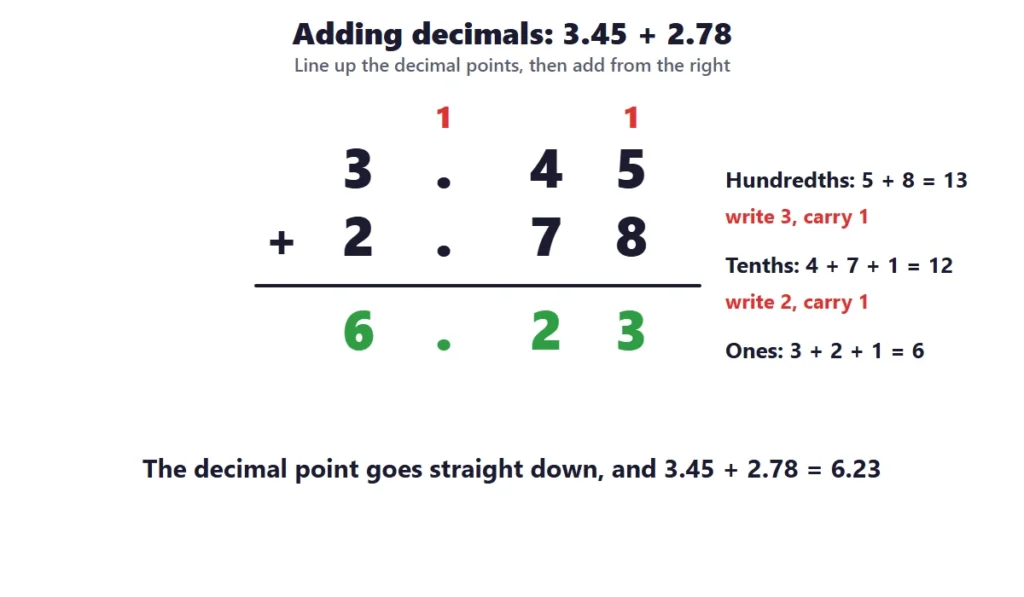
When adding or subtracting decimals, line up the decimal points so each place is in its own column. If one number has fewer decimal places, you can add zeros so both have the same: 7.2 − 1.35 becomes 7.20 − 1.35. Then work right to left as usual and bring the point straight down.
Adding and subtracting decimals worksheets: what is in the set
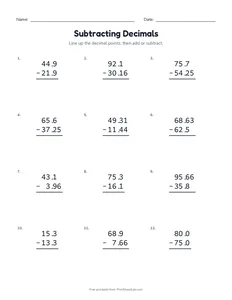
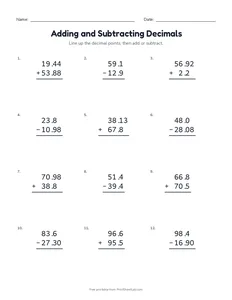
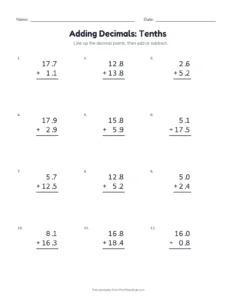
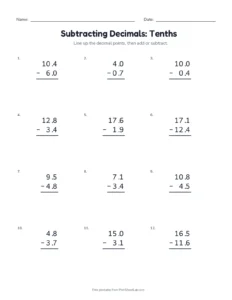
There are 5 adding and subtracting decimals worksheets on this page, and every one has an answer key except for any cut-out games. The first two sets practice adding and subtracting tenths and hundredths, and the last three use tenths only or a mix of both.
Worksheet
What children do
Standard
Adding Decimals
12 additions with tenths and hundredths.
5.NBT.B.7
Subtracting Decimals
12 subtractions with tenths and hundredths.
5.NBT.B.7
Adding and Subtracting Decimals
A mixed set of 12 problems.
5.NBT.B.7
Adding Decimals: Tenths
Add tenths lined up by the decimal point.
5.NBT.B.7
Subtracting Decimals: Tenths
Subtract tenths lined up by the decimal point.
5.NBT.B.7
Adding decimals worksheets: line up the points
The one rule for adding decimals worksheets is to line up the decimal points, so that each place is in its own column. Then add from the right, carry as with whole numbers, and bring the point straight down into the answer. If the numbers have different numbers of places, write zeros at the end so that they match. The standard is 5.NBT.B.7, which asks grade 5 children to add, subtract, multiply and divide decimals to hundredths. The Common Core standards for grade 5 number and operations in base ten describe it. This table shows six problems with equal places and the answers:
Problem
Write it with equal places
Sum
Difference (first minus second, if first is greater)
7.2 and 1.35
7.20 and 1.35
8.55
5.85
5 and 2.37
5.00 and 2.37
7.37
2.63
12.4 and 3.875
12.400 and 3.875
16.275
8.525
0.6 and 0.045
0.600 and 0.045
0.645
0.555
9 and 0.07
9.00 and 0.07
9.07
8.93
4.5 and 2.25
4.50 and 2.25
6.75
2.25
Decimal addition grade 5: how often do you carry?
Decimal addition grade 5 problems carry more often than most children expect. When two numbers with a ones digit, a tenths digit and a hundredths digit are added, the number of carries is:
Carries when adding 2-place decimals (0.00 to 9.99)
Pairs
Share
None
166,375
16.6%
One carry
358,875
35.9%
Two carries
338,625
33.9%
Three carries
136,125
13.6%
All pairs
1,000,000
100%
Only 17% of the pairs have no carries, so a worksheet of random decimals needs carrying almost every time. In 50% of them the sum is 10 or more, which means that the answer has an extra digit on the left. The worksheets on this page include problems with and without carrying.
Subtracting decimals worksheets: borrowing and zeros
Subtracting decimals worksheets add one more step, which is borrowing. Among the 500,500 pairs of numbers with a ones digit, a tenths digit and a hundredths digit, where the first is at least as big as the second, the numbers that need borrowing are:
Subtracting 2-place decimals (larger on top)
Pairs
Share
No borrowing
166,375
33.2%
Some borrowing
334,125
66.8%
All pairs
500,500
100%
Two thirds of subtraction problems need borrowing, so it is the normal case. A special case is a whole number minus a decimal, such as 5 − 2.37. Write 5 as 5.00, and borrow across the zeros: the answer is 2.63. The standard method is the same as for the whole-number subtraction on the subtraction worksheets page.
Adding and subtracting decimals: three ways to estimate
An estimate catches the most common mistakes, such as dropping the decimal point or lining up the wrong digits. Round each number to the nearest whole number and add or subtract. The estimate should be close to the exact answer, with a difference of at most 1 for two numbers:
Problem
Round to whole numbers
Estimate
Exact answer
How far off
3.45 + 2.78
3 + 3
6
6.23
0.23
7.2 + 1.35
7 + 1
8
8.55
0.55
12.4 + 3.875
12 + 4
16
16.275
0.27
9.9 + 3.6
10 + 4
14
13.5
0.50
8.04 − 2.97
8 − 3
5
5.07
0.07
15.5 − 6.25
16 − 6
10
9.25
0.75
Mental math with decimals: round, then adjust
When one decimal is close to a whole number, children can round it, add or subtract, and adjust. This turns many problems into easy ones. Here are five examples:
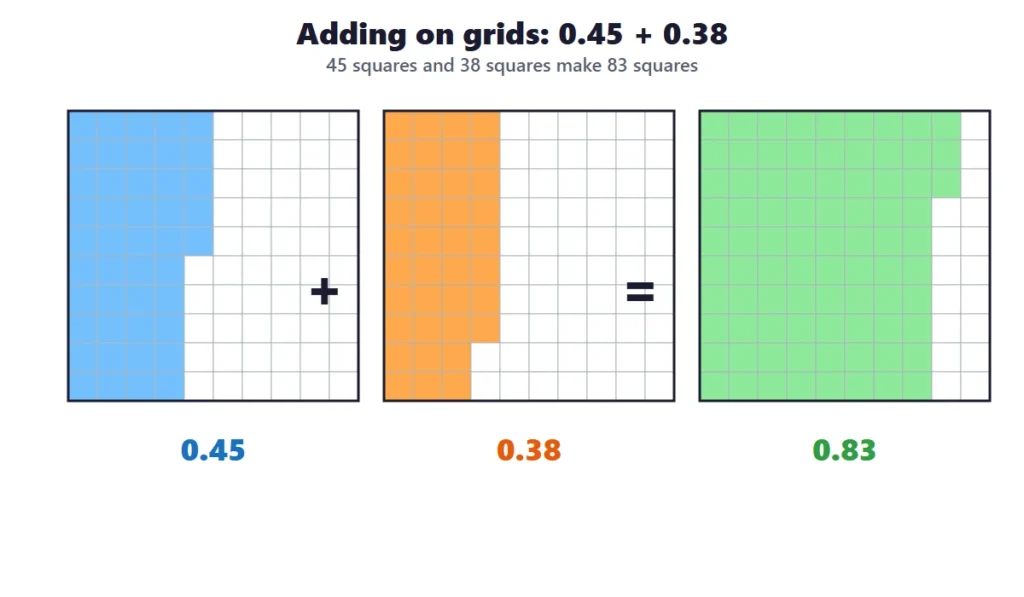
Grids. 0.45 + 0.38 = 0.83.
Problem
Mental step
Working
Answer
9.9 + 3.6
round 9.9 up to 10, add, take back 0.1
10 + 3.6 − 0.1
13.5
4.98 + 2.3
round 4.98 up to 5, add, take back 0.02
5 + 2.3 − 0.02
7.28
8.5 − 3.9
subtract 4, add 0.1 back
8.5 − 4 + 0.1
4.6
6.25 + 1.75
the hundredths make 1
6 + 1 + 0.25 + 0.75
8
10 − 2.4
count up from 2.4 to 10
2.4 + 7.6 = 10
7.6
Mental math with decimals gets faster with practice, and the worksheets give children plenty of problems for it. A good habit is to say the estimate before the exact answer, so that the child always knows roughly what to expect. This habit catches most mistakes with the decimal point, and it makes the written method feel more meaningful.
Decimal column addition and money
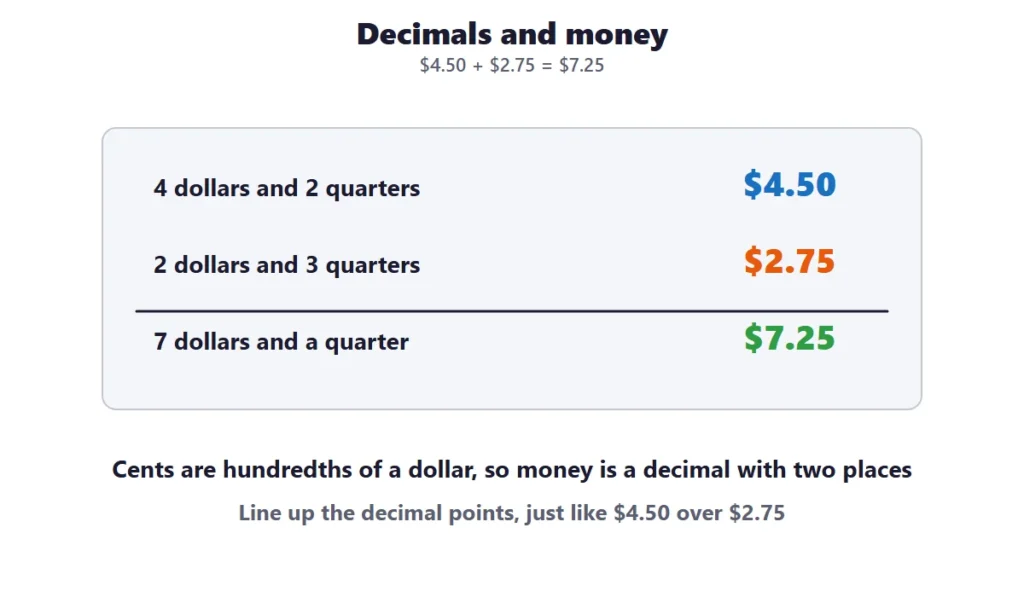
Decimal column addition is the same as adding money. Dollars are the whole part, and cents are the hundredths. A child who can add $4.50 and $2.75 can add 4.50 and 2.75. The page on money worksheets has more practice, and the diagram above shows the same problem with coins. The answer is $7.25, which is 7 dollars and a quarter.
Adding three decimals: the same method with one more row
The method for adding and subtracting decimals extends to three numbers. Line up all three decimal points, add the hundredths first, and carry as many as 2 into the next column. Shopping lists and measurements often have three or more numbers. Here are four examples with the working:
Problem
Hundredths
Tenths (with carry)
Ones (with carry)
Answer
1.25 + 0.8 + 2.35
5 + 0 + 5 = 10, write 0, carry 1
2 + 8 + 3 + 1 = 14, write 4, carry 1
1 + 0 + 2 + 1 = 4
4.40
3.5 + 2.75 + 1.9
0 + 5 + 0 = 5
5 + 7 + 9 = 21, write 1, carry 2
3 + 2 + 1 + 2 = 8
8.15
0.45 + 0.38 + 0.27
5 + 8 + 7 = 20, write 0, carry 2
4 + 3 + 2 + 2 = 11, write 1, carry 1
0 + 0 + 0 + 1 = 1
1.10
6.04 + 3.6 + 0.96
4 + 0 + 6 = 10, write 0, carry 1
0 + 6 + 9 + 1 = 16, write 6, carry 1
6 + 3 + 0 + 1 = 10
10.60
Notice that the carry can be 2 when three numbers are added, just as in the adding three numbers page. The sums are 4.40, 8.15, 1.10 and 10.60, and a final zero is kept when the numbers are money.
How to teach adding and subtracting decimals: from money to columns
A good way to teach adding and subtracting decimals is to start with money. Children already know that $4.50 + $2.75 is $7.25, because they can add the dollars and the cents. Then show the same problem in columns, with the decimal points lined up and the dollar sign taken away. Finally, change the units: the numbers are now lengths or weights, and the method is the same. This order, from money to columns to other units, makes the rule feel like something the child already knew, and it reduces the mistake of lining up the wrong digits.
Base ten blocks and hundred grids can also be used. A flat is one whole, a rod is one tenth and a cube is one hundredth, so adding 0.45 and 0.38 means putting together 4 rods and 5 cubes with 3 rods and 8 cubes. The cubes make 13, which is one rod and three cubes, so the answer has 8 rods and 3 cubes, or 0.83. This is exactly the carrying that the written method uses.
Children who add and subtract decimals well usually have three habits in common. They line up the decimal points before they start, they write zeros so that the numbers have the same number of places, and they check the answer with an estimate. These habits take only a few seconds, and they prevent nearly all of the mistakes in the table below. It is worth praising the habits as well as the answers, so that children keep them when the numbers get longer and the problems get harder in grade 6.
Common mistakes when adding and subtracting decimals
These are the mistakes that teachers see most often, with the wrong answer and the right one:
Problem
Wrong answer
What went wrong
Right answer
7.2 + 1.35
207 as a whole number sum (72 + 135)
dropped the decimal point
8.55
7.2 + 1.35
8.37
treated 0.2 as 0.02 by lining up the last digits
8.55
5 − 2.37
3.37
wrote 5 as 5.00 but did not borrow across
2.63
3.45 + 2.78
5.13
did not carry the 1 from the hundredths
6.23
4.5 − 2.25
2.35
subtracted the smaller digit from the larger
2.25
Adding and subtracting decimals word problems
Word problems use money, length, weight and volume, which are all decimals. Ask children to estimate first, then to line up the points and solve:
Word problem
Working
Answer
Maya buys a book for $4.50 and a pen for $2.75. How much does she spend?
4.50 + 2.75
$7.25
A ribbon is 7.2 meters long. Leo cuts off 1.35 meters. How much is left?
7.20 − 1.35
5.85 meters
Ana runs 3.45 km on Monday and 2.78 km on Tuesday. How far does she run?
3.45 + 2.78
6.23 km
A bag of flour weighs 5 kg. A recipe uses 2.37 kg. How much flour is left?
5.00 − 2.37
2.63 kg
A tank holds 12.4 liters. Sam adds 3.875 liters. How much is in the tank?
12.400 + 3.875
16.275 liters
A plant is 0.6 m tall and grows 0.045 m. How tall is it now?
0.600 + 0.045
0.645 m
Games and activities for adding and subtracting decimals
Children learn adding and subtracting decimals best when they play with it. These games use things that are found at home or in a classroom:
Shopping spree: give each child $20 and a price list, and let them find the total and the change
Decimal dominoes: match each problem with its answer on a set of cards
Race to 10: players add decimals to reach exactly 10 without going over
Meter stick math: measure two objects and add or subtract the lengths in meters
Receipt check: add the items on a real receipt and compare with the total
Make 1: find two decimals with hundredths that add up to 1, such as 0.35 and 0.65
A 20-minute lesson on adding and subtracting decimals
A short lesson is the best way to introduce adding and subtracting decimals. This 20-minute plan can be used in a classroom, at a tutoring session or at home, and it uses the worksheets at the end:
Money. $4.50 + $2.75.
Minutes
Activity
What to say or ask
0 to 3
Show $4.50 + $2.75 with play money
How many dollars? How many cents? Do the cents make another dollar?
3 to 8
Write 3.45 + 2.78 in columns with the points lined up
Which place do we add first? Where does the point go?
8 to 13
Subtract 7.20 − 1.35 together, and borrow
Why do we write 7.2 as 7.20?
13 to 18
Estimate and then solve four problems
Is the answer close to our estimate?
18 to 20
Start a worksheet and check one answer
Did you bring the point straight down?
Where adding and subtracting decimals fits across the grades
No skill stands alone. This table shows what children learn before and after adding and subtracting decimals, with the standard that goes with each step:
Grade
What children do
Standard or page
Grade 4
Add decimal fractions with denominators 10 and 100
Fluently add, subtract, multiply and divide multi-digit decimals
6.NS.B.3
This page is the main step in grade 5. Children who need review can go back to the page on decimal place value.
Helping at home with adding and subtracting decimals
Parents do not need to be experts to help with adding and subtracting decimals. These suggestions work well, and each takes only a few minutes:
Let the child add the prices on a receipt, and check against the total.
Measure ingredients for a recipe in decimals of a liter or kilogram, and add them.
Ask for the change from $10 when something costs $6.35.
Ask the child to estimate first, and say how close the answer is.
Use the answer keys, and look for the mistakes in the table above.
How to check progress in adding and subtracting decimals
A teacher or parent can check progress with the answer key and a few questions. This table shows three common situations, what they mean and what to do next:
What you see
What it means
What to do next
The child adds correctly when the numbers have the same length
The child understands the method but not the alignment
Write both numbers with zeros, so they have the same number of places
The child gets 9 of 10 right on all five sets
The skill is secure
Move on to multiplying and dividing decimals
The child drops the decimal point
The child treats the numbers as whole numbers
Use an estimate to check, and use money as the model
A five-day plan for adding and subtracting decimals
Most children need about a week of short sessions for adding and subtracting decimals. This plan follows the order of the worksheets on this page:
Day
What to do
Practice
Day 1
Adding tenths, lined up by the decimal point
2 worksheets
Day 2
Subtracting tenths, lined up by the decimal point
1 worksheet
Day 3
Adding decimals with tenths and hundredths
12 problems
Day 4
Subtracting decimals, and adding zeros
12 problems
Day 5
Mixed adding and subtracting, and word problems
12 problems and 6 stories
When the plan is complete, the child is ready for multiplying decimals. The whole sequence is on the decimals worksheets page.
Adding and subtracting decimals worksheets: six worked examples
Here are six problems with the answer, and the version with zeros added as placeholders so that every number has the same number of decimal places. The zeros do not change the value, but they make the columns line up:
Problem
Write it with equal decimal places
Answer
3.4 + 2.75
3.40 + 2.75
6.15
0.6 + 0.45
0.60 + 0.45
1.05
12.5 + 7.08
12.50 + 7.08
19.58
9.3 – 4.62
9.30 – 4.62
4.68
5 – 1.35
5.00 – 1.35
3.65
10.2 – 0.57
10.20 – 0.57
9.63
Adding and subtracting decimals worksheet, practice and PDFs
This page is also searched as adding and subtracting decimals worksheets, an adding and subtracting decimals worksheet, adding subtracting decimals worksheet, adding and subtracting with decimals worksheet, decimal addition and subtraction worksheets, addition and subtraction of decimals worksheets, addition and subtraction decimals worksheets and adding with decimals worksheets. All are the free PDFs above, each with an answer key. The pdf versions need no sign-up: open a worksheet, choose US Letter or A4, then print or save. Adding and subtracting decimals worksheets are best used after children can read decimals on a place value chart; for a fun worksheet, try the money word problems, where decimals are everyday amounts.
Frequently asked questions
7 quick answers
Why can I add a zero to 7.2?
7.2 and 7.20 are the same number: 2 tenths equals 20 hundredths.
Do I line up the last digits?
No. Line up the decimal points, not the last digits, so tenths add to tenths.
How do you add decimals with different numbers of places?
Line up the decimal points, and write zeros at the end of the shorter number so that all the places are filled. For 7.2 + 1.35, write 7.20 + 1.35 = 8.55.
Why must the decimal points be lined up?
So that tenths are added to tenths and hundredths to hundredths. If the last digits are lined up instead, the places do not match, and the answer is wrong.
How do you subtract a decimal from a whole number?
Write the whole number with a decimal point and zeros, such as 5.00, and then borrow across the zeros. For 5 − 2.37 the answer is 2.63.
Where can I download free adding and subtracting decimals worksheets?
Open any worksheet in the gallery above, choose US Letter or A4, then print or save the PDF. They are free and each has an answer key.
Why do you add zeros when adding decimals?
Zeros give every number the same number of decimal places, so the digits line up in columns. 5 – 1.35 becomes 5.00 – 1.35 = 3.65.