A bingo fundraiser is an evening of bingo games where the entry fees, snack sales and sponsor gifts go to a school, club or charity, and it works best when you fix the budget, the rules and the schedule before you print a single card. This guide is the plan: nine steps, a computed break-even table, three ways to price tickets, a prize ladder, a list of volunteer jobs and a two-hour run of show. The tools it points to are free and run in your browser.
In short: with fixed costs of $395 and a $1.00 cost per player, a bingo fundraiser at a $10 entry breaks even at 44 players, or 35 once snack sales count. Twelve games with 100 players and 200 cards take about 77 minutes of play, so doors at 6:00 p.m. means you finish near 8:17. Rules on bingo, raffles and prizes differ by country and state, so check them first. This page is not legal advice.
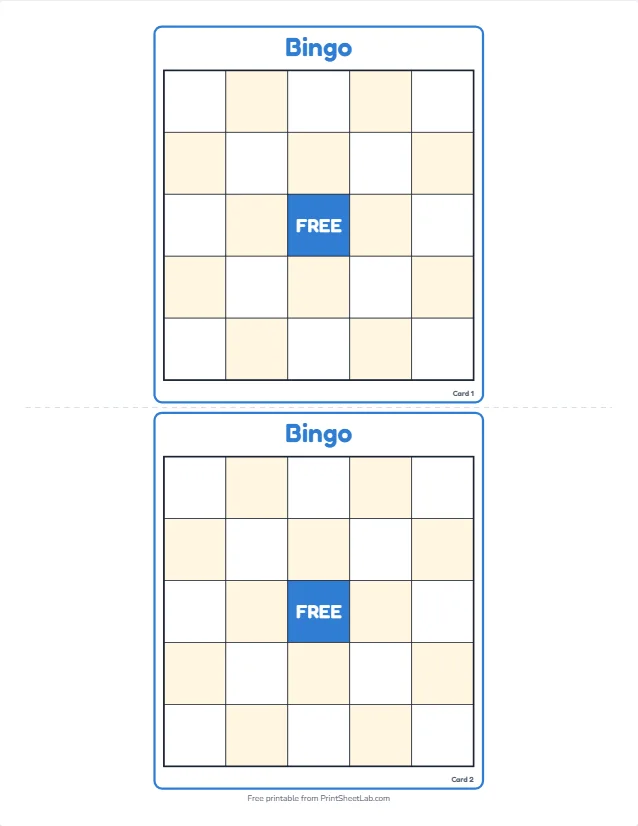
Why a bingo fundraiser works for schools and charities
Bingo is one of the few games that a seven-year-old and a grandparent can play at the same table without a lesson. The rules take one minute to explain, the winner is decided by chance rather than skill, and the caller sets the pace. That makes it easy to staff, easy to repeat every year and friendly to families, which is why parent groups, sports clubs, faith groups and small charities keep coming back to it.
Bingo also has a cost structure that suits a volunteer team. The big expenses are prizes and a little printing, the venue is often free (a gym, a hall or a cafeteria), and the only skilled job is the caller, who needs a clear voice and a steady rhythm. A free browser tool can do the calling, so you need no machine, no ball cage and no flashboard.
A bingo fundraiser is not the right choice for every group. If your community expects a catered dinner, a silent auction or a walkathon, bingo will feel small on its own. It shines as the main event for a school family night, or as the entertainment around a dinner, a book fair or a seasonal fair. Be honest about the crowd you can bring: the break-even tables later in this guide show how many people you need.
Check the rules before you plan anything
Rules about bingo, raffles, prizes and charity gaming vary by country, state, province and sometimes by city or school district. In some places a school or registered charity may run bingo with a simple permit. In others, a license, a registered organizer, a limit on prize values or a ban on cash prizes applies, and some places treat any game with an entry fee and a prize as regulated gambling. This guide cannot tell you which of these applies to you, and nothing in it is legal advice.
Do these four things before you set a date. Ask your school office, district or umbrella charity whether bingo is allowed and who must approve it. Ask the local authority that handles charitable gaming or lotteries (the name differs by place) what a permit costs, how long it takes and what records you must keep. Ask the venue whether its insurance covers the event. Write down what you were told, with the name and date, and keep it with your event file.
The rules often depend on how money and prizes move, so a few details are worth settling early: whether players pay to enter or to buy cards, whether prizes are cash or goods, whether prizes are donated or bought, whether minors may play, and whether you may sell raffle tickets at the same event. The free-to-play sponsor model later in this guide changes some of these answers, but it does not make the question go away. When in doubt, ask in writing and wait for the answer.
The whole plan in nine steps
The table gives the whole job on one page. The sections below follow the money: rules first, then the budget and pricing, then prizes, cards, roles, the schedule and promotion. Work from top to bottom, because the later steps depend on the earlier ones: you cannot price a ticket before you know the cost of the bingo fundraiser, and you cannot promote it before the date is fixed.
| Step | What to decide | Output you should have |
|---|---|---|
| 1 | Check the rules for bingo, raffles and prizes | A written yes or no, a permit if needed |
| 2 | Set the goal and the budget | Fixed costs, cost per player, break-even number |
| 3 | Choose the date, room and capacity | A booked room with space for your target crowd |
| 4 | Recruit the volunteers | A name next to every job in the roles table |
| 5 | Price the tickets or choose the sponsor model | One entry price, one extra-card price, one bundle |
| 6 | Collect the prizes | A prize ladder with a prize for every game |
| 7 | Make the cards and test the caller | Printed numbered cards and a rehearsed caller screen |
| 8 | Promote the night | Flyers, a link, a reminder and a sponsor thank-you |
| 9 | Run the evening and close the books | Counted cash, a thank-you note and a short report |
Set the goal and break-even for a bingo night fundraiser
Start with the number you want the bingo fundraiser to raise, then work backward. A bingo night fundraiser has two kinds of cost. Fixed costs do not change with the size of the crowd: prizes, signs, a permit.
Costs per player rise with every person who walks in: printed cards, a pencil or dauber, and any free drink. The break-even point is the number of players at which the money in equals the money out. The idea is the same as in any small business, and the break-even point explained on Wikipedia gives the general formula.
A sample budget
The sample below is for a school bingo night with 100 players and 12 games. All amounts are US dollars and are assumptions to replace with your own quotes. The cost per player is $1.00: 20 cards at two per page is ten pages, which is about $0.50 at five cents a page, plus about $0.50 for a pencil or a dauber.
| Cost line | Amount |
|---|---|
| Prizes for 12 games (7 at $15, 4 at $30, 1 final prize at $75) | $300 |
| Signs, banners, entry tickets and name tags | $45 |
| Permit or license fee, if your area requires one (placeholder) | $50 |
| Fixed costs | $395 |
| Cost per player (printing and pencil) | $1.00 |
Donated prizes bring the fixed costs down quickly. If local businesses give half of the prizes, the fixed costs fall by about $150. Treat that as a bonus when the goods arrive, not a reason to leave it out of the budget: plan with bought prizes and be pleasantly surprised.
Break-even by entry price
The break-even number is the fixed costs divided by what each player contributes after their own costs. At a $10 entry with $395 fixed costs, each player contributes $9.00, so you need 44 players. The first table shows entry fees only. The second adds an average snack margin of $2.50 per attendee (an assumption: snacks and drinks sold for about $5 a head with half of that going back into the cost of the food).
| Entry price | Fixed costs $200 | Fixed costs $395 | Fixed costs $600 | Fixed costs $1,000 |
|---|---|---|---|---|
| $5 | 50 players | 99 players | 150 players | 250 players |
| $8 | 29 players | 57 players | 86 players | 143 players |
| $10 | 23 players | 44 players | 67 players | 112 players |
| $12 | 19 players | 36 players | 55 players | 91 players |
| $15 | 15 players | 29 players | 43 players | 72 players |
| $20 | 11 players | 21 players | 32 players | 53 players |
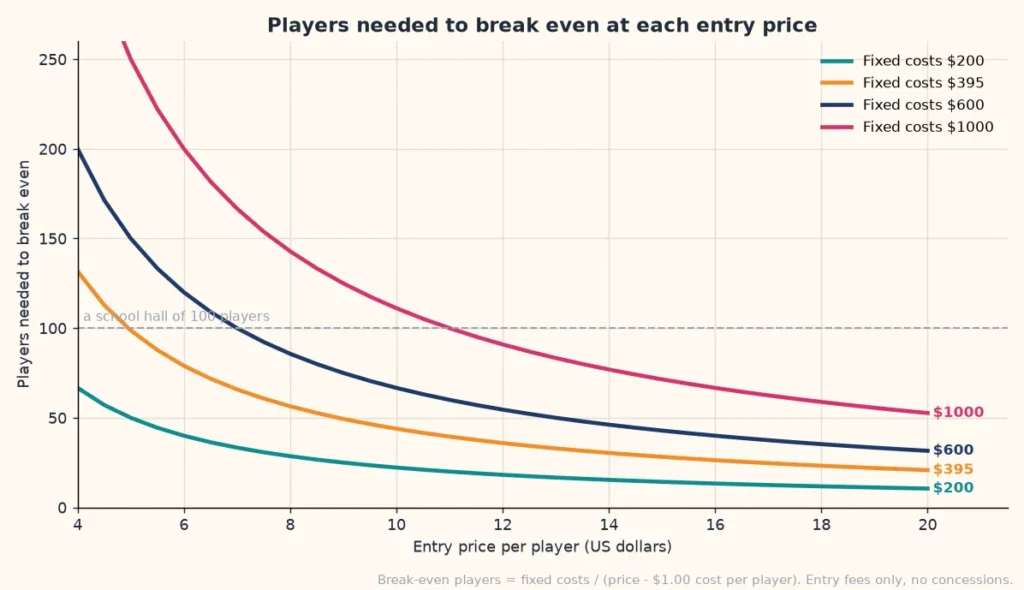
Read across a row to see what a prize budget does to your risk, and down a column to see what the price does. The curve flattens quickly past $10: moving from $5 to $10 cuts the players you need by more than half, while moving from $15 to $20 saves only a handful. That is the argument for a mid-range price with good value rather than a very low price with a hope of a huge crowd.
| Entry price | Break-even, entry fees only | Break-even with snack margin |
|---|---|---|
| $5 | 99 players | 61 players |
| $8 | 57 players | 42 players |
| $10 | 44 players | 35 players |
| $12 | 36 players | 30 players |
| $15 | 29 players | 24 players |
| $20 | 21 players | 19 players |
Money raised by attendance
Break-even is only the floor. The next table shows what a bingo fundraiser raises at three entry prices once attendance is known, with fixed costs of $395, the $1.00 cost per player and the $2.50 snack margin. A negative number means the night loses money.
| Players | $5 entry | $10 entry | $15 entry |
|---|---|---|---|
| 40 | -$135 | $65 | $265 |
| 60 | -$5 | $295 | $595 |
| 80 | $125 | $525 | $925 |
| 100 | $255 | $755 | $1,255 |
| 150 | $580 | $1,330 | $2,080 |
| 200 | $905 | $1,905 | $2,905 |
| 300 | $1,555 | $3,055 | $4,555 |
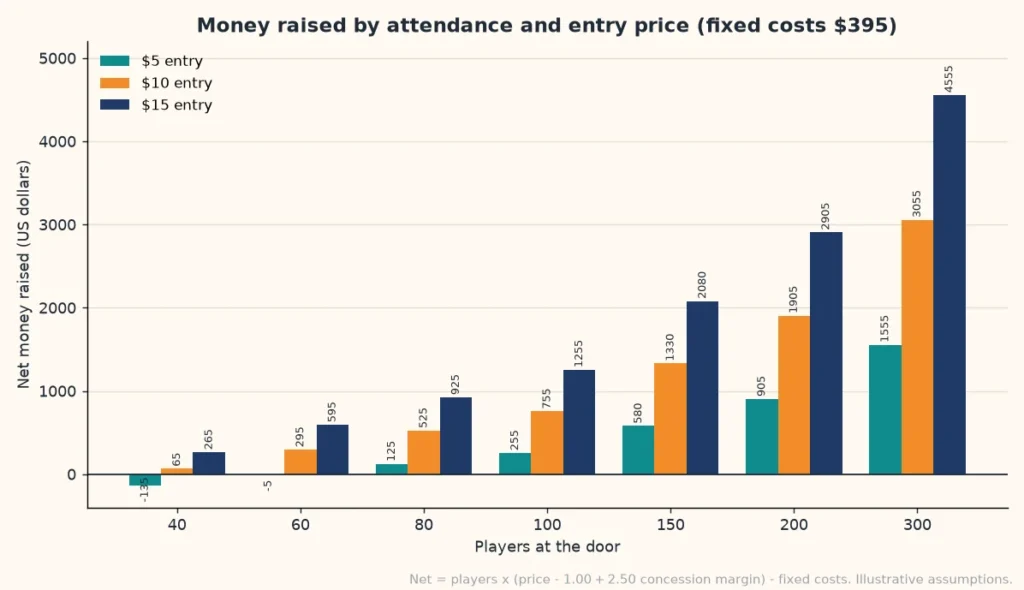
With 100 players at $10 the night raises $755: $505 from entry fees after costs, plus $250 from snacks. With 40 players at $5 it loses $135. The practical lesson for any bingo fundraiser is to sell tickets in advance. A pre-sale count tells you a month early whether you are above or below the break-even line, while there is still time to promote harder or move the date.
Ticket pricing for a school bingo night
A school bingo night is usually priced per player, not per card, because it keeps the door simple: one price, one pack, one wristband or stamp. The pack should say exactly what it contains. In the sample plan, the entry pack is two cards for each of the 12 games and a pencil. Players can see the value at a glance, and nobody has to do arithmetic at the table.
Entry price, extra cards and family bundles
Three price points cover most events. The entry pack is the main price. Extra cards are a small upsell for people who want more chances. A family bundle gives parents a reason to bring the whole household, which also lifts the snack margin. Keep the options to three, since a longer menu slows the door and invites questions.
| Option | Sample price | What it includes | Why it helps |
|---|---|---|---|
| Entry pack | $10 | 2 cards for each game and a pencil | The main price; sets the break-even |
| Extra card sheet | $2 | One more card for each game | Small upsell; adds a few percent of chance |
| Family bundle | $25 | 4 entry packs for one household | Lifts attendance and snack sales |
| Early-bird entry | $8 | The entry pack, bought before the date | Builds a pre-sale count |
The early-bird price is the one that earns its keep. A $2 discount costs you $2 per early buyer, but each pre-sale is a seat that is already committed, and it gives you a real count for the printing and the snack order.
Are extra cards fair?
Selling more cards raises a fair question: does a player with eight cards beat a player with two? Yes, but by less than most people expect. In bingo with N cards in play, a player who holds c of them wins a given game with a chance of about c divided by N, because every card has the same chance. The table shows the chance for a single game and the first-line median from the simulation.
| Cards in play | Median calls to any line | Chance with 1 card | With 2 cards | With 4 cards | With 8 cards |
|---|---|---|---|---|---|
| 100 | 16 | 1.0% | 2.0% | 4.0% | 8.0% |
| 200 | 14 | 0.5% | 1.0% | 2.0% | 4.0% |
| 400 | 13 | 0.2% | 0.5% | 1.0% | 2.0% |
With 200 cards in play, a two-card player has about a 1.0% chance of winning any one game. Over all 12 games that rises to roughly 11%, because 1 minus 0.99 to the power of 12 is about 0.11. A player who buys eight cards has about 4.0% a game and 39% over the 12 games. More cards help, but nobody is guaranteed a prize, and the extra-card sheet costs only a couple of dollars. Say that plainly on the sign: it keeps the night fair and avoids disappointment.
A free-to-play charity bingo night with sponsor prizes
A charity bingo night does not have to charge an entry fee at all. In the free-to-play model of a bingo fundraiser, local businesses sponsor games: each sponsor pays a fee or covers the prize for one named game, its name goes on the screen and on the card footer, and players pay nothing to play.
The money comes from the sponsors, from voluntary donations at the door and from snack sales. Some groups choose this model because it keeps the game open to families who cannot afford a ticket, and because in some places it may change how the rules apply. Ask your local authority before relying on that.
The numbers work like this. Each sponsor pays $100 for one game, and you spend about $30 on the prize for it, leaving $70 per sponsor. Fixed costs drop to $95 (signs and the placeholder permit fee), because prizes are bought per sponsored game. Each attendee costs $0.50 for printing and adds the $2.50 snack margin.
| Sponsored games | 100 attendees | 150 attendees | 250 attendees |
|---|---|---|---|
| 6 of 12 | $525 | $625 | $825 |
| 10 of 12 | $805 | $905 | $1,105 |
| 14 of 12 | $1,085 | $1,185 | $1,385 |
Ten sponsors and 150 attendees raise about $905 with no entry fee, compared with $1,330 for the paid model at $10. The free model raises less in a good year but carries almost no risk: if only 60 people come, the sponsors have already paid. Its weak point as a bingo fundraiser is the work of selling sponsorships, so start asking six weeks out and offer something concrete: a named game, the logo on the screen and a line in the thank-you post.
What to offer a sponsor
- A named game. The sponsor presents one game, and the host says the name before the first call.
- A line on the card. The footer of each card can carry up to a short line of sponsor names (the card maker has a footer text field).
- A prize handover. The sponsor, or a staff member, hands the prize to the winner for a photo, with the winner’s permission.
- A thank-you. A short message to the sponsor after the night with the number of guests and the total raised.
Bingo night prizes: what to buy, what to ask for and what to avoid
Good bingo night prizes for a bingo fundraiser are easy to hand over, wanted by the people who win them and cheap enough to keep the net high. A prize ladder helps: small prizes for the short games, a middle tier for the harder patterns, and one memorable prize for the final blackout. Put the ladder on a poster so players can see what each pattern is worth.
| Game | Pattern | Median calls | Prize value |
|---|---|---|---|
| 1 | Any line | 14 | $15 |
| 2 | Four corners | 22 | $15 |
| 3 | Postage stamp | 22 | $15 |
| 4 | Letter T | 40 | $30 |
| 5 | X | 40 | $30 |
| 6 | Letter L | 44 | $30 |
| 7 | Any line | 14 | $15 |
| 8 | Picture frame | 56 | $30 |
| 9 | Four corners | 22 | $15 |
| 10 | Letter T | 40 | $15 |
| 11 | Postage stamp | 22 | $15 |
| 12 | Blackout | 62 | $75 |
The total is $300, matching the budget. A longer pattern earns a bigger prize, because players wait longer for it. Where you can, replace a bought prize with a donated one. Restaurants give vouchers, bookshops give books, a gym may give a month’s pass, and a bakery gives a cake. Each donated item is a small sponsorship, so it deserves a mention on the screen.
Prize ideas by audience
- Families with children: books, board games, craft kits, an extra recess for a class, a front-row seat at the next assembly.
- Adults: a restaurant voucher, a coffee basket, a plant, a car wash voucher, a donated service.
- Everyone: a “mystery bag” for the blackout, wrapped, so the winner opens it on stage.
- Not recommended: alcohol, anything age-restricted, and prizes you cannot hand over on the night.
Cash prizes are the item most likely to be restricted by local rules, so many school groups use goods and vouchers only. Check what your area allows for prizes before you buy anything, and keep receipts and donor details for your records.
Ties and shared wins
Two or more cards can finish on the same call, and it happens more often than most organizers expect. In 1,500 simulated games each, a tie for the first winner of any line happened in 16% of games with 100 cards in play, 20% with 200 and 26% with 400. Decide the rule before the night: split the prize, give a second prize, or settle it with a tie-breaker, such as the next number called.
The simplest rule for a fundraiser is to buy one spare prize for each of the first few games, so a tie never costs the winners anything. If you expect about one tie in five games, the spare costs you about 20 percent of the small prizes, which is a small price for no arguments.
Make the cards and run the caller
A bingo fundraiser needs three things on the night: a card for every player, a way to call the numbers, and a way to check a claim. The free bingo card generator makes the cards.
It prints 1 to 100 different cards in one set, with one, two, four or six cards per page, on Letter or A4 paper, portrait or landscape. Cards are numbered (“Card 1” and so on) and you can add a logo, a title, a footer line and a color theme, so the school crest and the sponsor names fit on every card.
For 200 cards, print two sets. A second set would otherwise reuse the same card numbers, so give each set its own footer text, such as “Set A” and “Set B”, and a winner can say “Set B, card 17” so the checker finds the card at once. A sample card and the full steps are in the guide to how to make bingo cards, and the printable bingo cards hub has ready-made templates, including a blank bingo card page if you want to start from nothing.
For the calling, use the free bingo number caller. It calls the 75 numbers in a fresh random order, shows a big ball and a call board, lists the calls so far and speaks each call aloud if you want. There is an auto-call setting from every 3 seconds to every 30 seconds, an undo button, a repeat button and a big-screen mode for a projector or TV, which you leave with the Esc key. Pick the pattern from the picker so the mini diagram is on the screen for everyone.
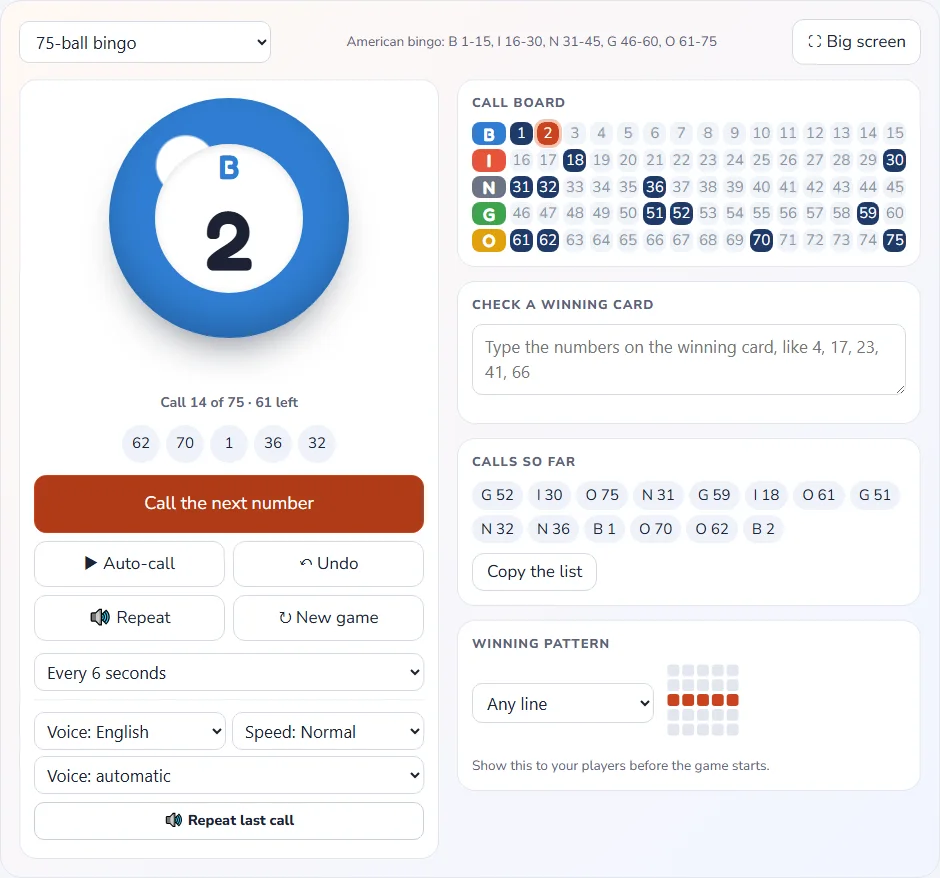
Two features matter most on a busy night. The first is “Check a winning card”: when someone shouts, type the numbers from their card and the tool tells you whether they were all called, which settles a claim in seconds without a long reading of the list. The second is the game saved in the browser, which resumes after a reload, so a tripped cable or a closed tab does not lose the game. The caller does not track who won which prize, so keep a prize sheet on the table.
How long does each game take?
This is the number most schedules get wrong. The simulation below dealt random 75-ball cards with a free center, 1,500 games for each size of crowd, and recorded the call on which the first card finished each pattern. With 200 cards in play, the median is 14 calls for any line, 22 for four corners and a postage stamp, 40 for letter T and X, and 62 for blackout. At one call every 8 seconds that is about 1.9 minutes for a line and 8.3 for a blackout, before claim checks and prizes.
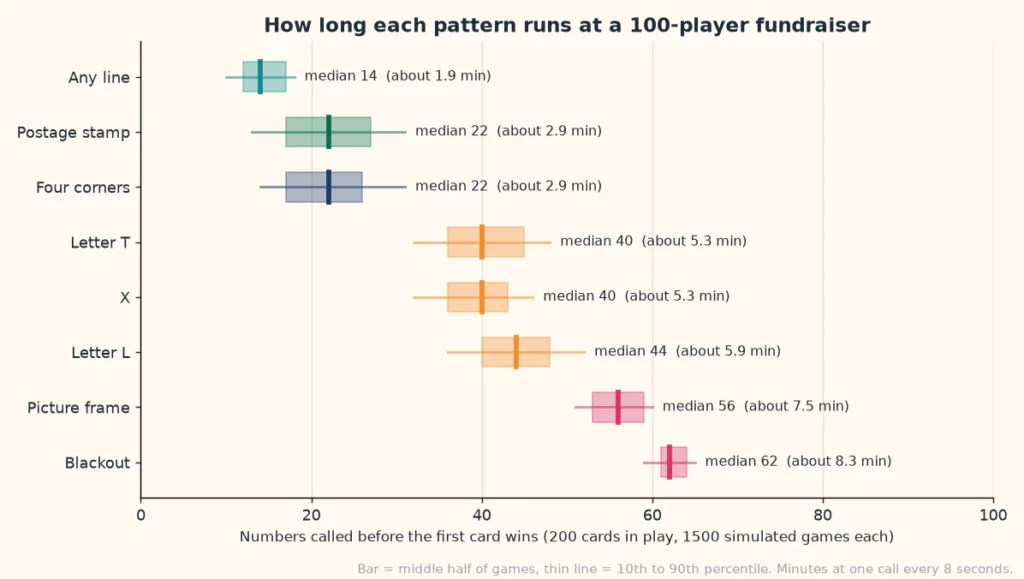
| Cards in play | Any line | Four corners | X | Blackout | Tie on any line |
|---|---|---|---|---|---|
| 50 | 18 | 29 | 46 | 65 | 13% |
| 100 | 16 | 25 | 43 | 64 | 16% |
| 200 | 14 | 22 | 40 | 62 | 20% |
| 400 | 13 | 19 | 37 | 61 | 26% |
| 800 | 11 | 17 | 35 | 60 | 31% |
The table shows why a bigger crowd does not make a night much longer: doubling the cards from 200 to 400 shortens a line by only one call, and blackout hardly moves, because every card has to wait for most of the 75 numbers. It also shows that short patterns make for busy, noisy games with frequent ties, while long patterns give a calm stretch. Alternate the two in your schedule, and read the bingo patterns guide for pictures of each one.
A family bingo night: working for kids, grown-ups and everyone in between
A family bingo night is the most common form of school fundraising bingo, and it has its own needs. Young children get bored during a long blackout, parents want to talk, and some players need large print or a slower pace. Plan for a mixed room rather than for the adults at the front table.
- Keep the first hour for the youngest. Start with the short patterns and finish the first block before bedtime. If you have lots of small children, a picture version such as picture bingo for kids lets non-readers join.
- Slow the pace. Use a call every 10 or 15 seconds for the first games, and speed up later. The caller offers both.
- Offer large-print cards. Print one card per page for anyone who wants bigger numbers, and a seat near the screen.
- Give each game a name. “The Dragon” is easier to follow than “letter T”, and the screen shows the pattern anyway.
- Plan for helpers. A few older students can walk the room and check claims. Never put a child in charge of money.
Keep the language inclusive: say “everyone” and “families”, and do not single anyone out for winning or losing. Offer a quiet corner and a way to play without paying for those who need it, such as a sponsored seat. For a classroom version of the same game, see bingo activities for the classroom.
Roles: who does what on the night
A bingo fundraiser fails on people, not on bingo. A short list of named jobs, with one backup for each, makes the evening run smoothly. For 100 players, a team of 14 to 16 volunteers is comfortable. The table lists the jobs, how many people to assign and what each person must know.
| Role | People | What they do | Skill needed |
|---|---|---|---|
| Event lead | 1 | Owns the schedule, makes decisions, handles problems | Calm and organized |
| Caller | 1 + 1 backup | Runs the caller screen and announces each pattern | Clear voice, steady pace |
| Claim checker | 2 | Walks to a shouting player and checks the card against the call list | Careful, polite |
| Door and tickets | 3 | Sells and checks tickets, hands out cards and pencils | Friendly, accurate |
| Money handler | 2 | Counts the cash twice, with two people at all times | Honest, accurate |
| Snack stand | 3 | Sells snacks and drinks, tracks the float | Fast, food-safe |
| Prize table | 1 | Holds the prizes, logs who won each game | Organized |
| Floor helpers | 2 | Help new players, collect cards and tidy up | Patient |
| Photographer | 1 | Takes sponsor and winner photos with consent | Discreet |
Rehearse the evening once. Fifteen minutes with the caller screen on the projector, a stack of cards and two people playing claimants will expose every awkward moment: the pencil that is missing, the card number that is too small to read, the volume that does not reach the back. It is the cheapest hour of the whole plan.
Run of show: a two-hour school bingo night, minute by minute
Here is the evening for 100 players and 200 cards, using the median game lengths above at one call every 8 seconds and 2 minutes per game for claims, prizes and resetting. The twelve games take about 77 minutes, and with doors, rules, a break and a close the whole night is 2 hours 17 minutes. Times are rounded. Add a few minutes of slack, because a tie or a false claim costs more than the median.
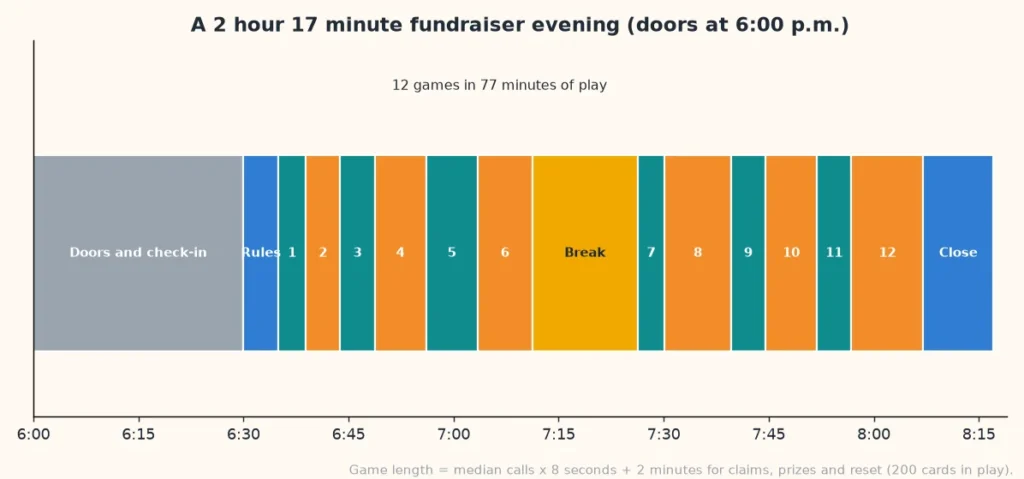
| Start | Segment | Minutes | Notes |
|---|---|---|---|
| 6:00 | Doors, check-in, cards handed out | 30 | Cards, pencils and name tags; the caller screen is tested |
| 6:30 | Welcome, rules and prize list | 5 | Read the house rules once, show the first pattern |
| 6:35 | Game 1: Any line | 4 | Median 14 calls |
| 6:39 | Game 2: Four corners | 5 | Median 22 calls |
| 6:44 | Game 3: Postage stamp | 5 | Median 22 calls |
| 6:49 | Game 4: Letter T | 7 | Median 40 calls |
| 6:56 | Game 5: X | 7 | Median 40 calls |
| 7:03 | Game 6: Letter L | 8 | Median 44 calls |
| 7:11 | Break and concession rush | 15 | Sell snacks, thank sponsors, keep the caller screen up |
| 7:26 | Game 7: Any line | 4 | Median 14 calls |
| 7:30 | Game 8: Picture frame | 9 | Median 56 calls |
| 7:40 | Game 9: Four corners | 5 | Median 22 calls |
| 7:45 | Game 10: Letter T | 7 | Median 40 calls |
| 7:52 | Game 11: Postage stamp | 5 | Median 22 calls |
| 7:57 | Game 12: Blackout | 10 | Median 62 calls |
| 8:07 | Prize photos, thanks, close | 10 | Announce the total raised later, not on the night |
The break is the most valuable part of the bingo fundraiser schedule. It is when the snack stand takes most of its money, when sponsors get their thank-you, and when the caller rests. Do not skip it, and do not let it grow past 15 minutes. Put the long patterns, the picture frame and the blackout, in the second half, where the crowd is already settled and the prizes feel bigger.
Rules to read out before game one
- Name each game and show the pattern on the screen before the first call.
- The center square is free on a 75-ball card, so every card starts with it counted.
- To claim, call out “Bingo!” clearly, and keep the card in your hand; a checker will come to you.
- A claim is checked against the list of called numbers, and the checker’s decision is final.
- If two players win on the same call, the prize is shared or a second prize is given, as announced.
- One prize per game, and every card is ready to be reused for the next game.
- Be kind: everyone is here to support the same cause.
Promotion: filling the room
Break-even depends on attendance, so promotion is half the work of a bingo fundraiser. The plan below starts a month out. Most groups pre-sell the first 40 percent of tickets in the first two weeks, and fill the rest in the last week through reminders.
| When | Action | Goal |
|---|---|---|
| 5 weeks out | Fix the date and book the room; ask sponsors | Sponsors confirmed |
| 4 weeks out | Flyer in backpacks, newsletter item, social post | Early-bird sales open |
| 3 weeks out | Announce the prize ladder and sponsor names | Excitement and credibility |
| 2 weeks out | Reminder with the price and the pre-sale deadline | Count of pre-sold tickets |
| 1 week out | Final reminder; confirm the volunteer list | Seat count for the room |
| Day before | Print cards for the pre-sale count plus 20 percent | Printed and numbered |
Put the price, the date, the time, the venue and the cause on every flyer, and say what the money will buy: a new playground, a class trip, a scholarship. Specific goals sell tickets to a bingo fundraiser. Mention that the evening is for all ages, say whether snacks are for sale, and give one clear way to buy a ticket in advance. If your area limits advertising of games of chance, check the wording with your local authority first.
Fundraising bingo online and hybrid
Fundraising bingo also works online, for families who cannot come in person or for a group spread across towns. The free online bingo game lets a host run a live game: guests join by a link, and their cards mark themselves as numbers are called. For a classroom or a team, the custom bingo online game does the same with your own words. See how to play bingo online with friends for the steps.
Neither tool takes payments or donations, and neither one knows who has paid. Collect gifts through your school or charity’s normal donation page and share the game link with donors, or run the online game free of charge and invite donations at the end. Everything in the rules section applies to online games as well, and remote play can raise additional questions about where players live, so check before you charge for a remote game.
A hybrid night is possible: screen-share the big-screen caller to a video call while the room plays on paper. Keep the two groups in separate games, with separate prizes, because the checking works differently and a remote claim needs a screenshot or a read-aloud of the card.
Extras that raise more without a longer night
Once the basics are in place, a few extras can lift the total without making the evening longer. Pick two or three, not all of them. Every idea below needs a quick check against your local rules, because some of them (anything with an extra prize draw) may be regulated separately.
- Pick a theme. A holiday or school-spirit theme gives the flyer a hook, and the card maker has ready templates, for example Halloween bingo and Christmas bingo.
- Sell a class table. Each class or team buys a table, and a friendly rivalry builds attendance.
- Add a snack bundle. A drink and a snack for a set price at the door speeds up the line and raises the margin per head.
- Offer a sponsor game. One game, one local business, one logo on the screen: the easiest way to cut prize costs.
- Run a round for the staff. A teachers-against-parents game is cheap, funny and good for photos.
- Print a keepsake card. A card with the school crest and the date is a souvenir people keep after the night.
- Plan a repeat. Announce the date of the next bingo fundraiser before the first one ends, and collect names for a reminder list.
For a corporate or club version of the same evening, with a larger crowd and a longer prize list, the guide to corporate tambola shows how a company event handles tickets and prizes, and the same ideas carry over to a charity bingo night.
The final week: a checklist
The last week is for confirming, not for deciding. Walk through this list on Monday and again on the day before the event, and tick every line.
- Permit or written approval is in the event folder, with the name of the person who gave it.
- The pre-sale count is known, and the printed cards cover it plus 20 percent.
- Every volunteer has a role, a backup and the start time.
- The caller screen is tested on the real projector, with sound, and the big-screen mode works.
- Prizes are wrapped, labeled with the game number and stored with the prize table helper.
- The cash float, the cash boxes and the count sheets are ready.
- Snack stock is ordered, and allergy labels are printed.
- Signs show the price, the prize ladder and the pattern list.
- The reminder has gone out, and the sponsors have the date, the time and the thank-you plan.
- A rain plan, an accessibility check and a quiet corner are agreed for the night.
Money handling and the thank-you
Treat the cash from the bingo fundraiser like the cause deserves. Use two people at every cash point, a numbered cash box, a float of small bills and a written count at the end. Count the money twice, with two people, and have both sign the sheet. Bank the money the next working day, and keep the sheet, the ticket stubs and the prize receipts together for your records.
Afterward, compare the result with the plan. Note the number of players, the revenue from entry, snacks and sponsors, the real cost of prizes, and the games that ran long. A one-page report makes next year easier and gives your sponsors something concrete. Send thank-you notes within a week, including a photo of the cause the money supported, and announce the final total once the books are closed.
Fundraising has its own good practices and rules about records and acknowledgments, and a general overview of fundraising is a useful place to start reading. Your school office or charity regulator is the authority on what you must keep and report.
Mistakes that sink a bingo fundraiser
- Skipping the rules check. A canceled bingo fundraiser costs far more than a permit. Ask early and in writing.
- Pricing on hope. Use the break-even table with a pessimistic attendance, not an optimistic one.
- No pre-sale. Without a count, you print too many or too few cards and order the wrong amount of food.
- Too many long games. A blackout takes 62 calls. Two of them in a row lose the room.
- No tie rule. About one game in five has a tie, so announce the rule before it happens.
- One person holding all the money. Always count with two people and sign the sheet.
- Forgetting the break. It is where the snack sales and sponsor thank-yous happen.
- Calling too fast. A pace that suits the caller can lose a table of beginners. Test it on the rehearsal night.
If your group also runs a prize draw or raffle at the same event, treat it as a separate activity with its own rules, since many places regulate raffles on their own. For other party and group games to fill a fair, the kitty party games guide has ideas that work with a small prize budget, and the bingo number chart is a handy printout for the check table.
Frequently asked questions
12 quick answers
How do you run a bingo fundraiser?
Check the local rules, set a budget and a break-even number, book a room, recruit volunteers, collect prizes, print numbered cards, promote the event and run a timed schedule. A night for 100 players needs about 14 to 16 volunteers, around 12 games and roughly two hours.
How much should I charge for a bingo fundraiser?
A price of $8 to $12 for an entry pack suits most school events. With $395 of fixed costs and a $1.00 cost per player, a $10 entry breaks even at 44 players, or 35 with snack sales. Always run your own numbers with the table above.
How many people do I need for a bingo fundraiser to make money?
It depends on the price and the costs. With $395 fixed costs, 44 players break even at $10 and 99 at $5, entry fees only. Pre-sell tickets so you know the count a month ahead.
Is a bingo fundraiser legal?
It depends on where you are. Rules on bingo, raffles and prizes vary by country, state and province, and some places require a permit or limit prizes. This guide is not legal advice, so ask your school office or local gaming authority before you sell tickets.
How many games should a bingo night have?
Ten to twelve games fit in two hours with a break. At one call every 8 seconds, the 12 games in this guide take about 77 minutes of play with 200 cards, and the whole night takes 2 hours 17 minutes.
What are good bingo night prizes?
Gift vouchers, books, board games, craft kits, baskets and donated services. Give a bigger prize for a longer pattern and a memorable prize for the final blackout. Check local rules before you offer cash.
Can a fundraising bingo night be free to play?
Yes. In the sponsor model, local businesses pay for named games, and the money comes from sponsors, donations and snacks. Ten sponsors at $100 and 150 attendees raise about $905 in the sample plan. Rules may still apply, so check them.
How many bingo cards do I need?
Plan for two cards per player for each game, plus 20 percent spare. For 100 players that is 200 cards, and the card maker prints up to 100 different cards per set, so print two sets and mark them Set A and Set B.
How long does a bingo game take?
With 200 cards in play, the median is 14 calls for any line and 62 for a blackout. At one call every 8 seconds that is about 2 and 8 minutes, before claims and prizes.
What happens if two players get bingo at the same time?
Announce the rule before the first game: share the prize, give a second prize or use a tie-breaker. In the simulation, a tie for the first winner of a line happened in about 20% of games with 200 cards.
Can we use the free bingo tools for a bingo fundraiser at school?
Yes. The card maker prints numbered cards with your logo and footer, the number caller runs the games on a projector, and nothing needs an account or is uploaded. Both are free to use.
How do we play fundraising bingo online?
Share a live game link with players and run the caller on a shared screen. Collect donations through your normal donation page, since the game tool does not take payments. Check your local rules for remote games too.