To calculate your final grade, find the average of each graded category, multiply it by the category weight, and add the results; if your class uses one running points total, divide points earned by points possible. This guide walks through the three methods teachers use, with worked numbers and the traps that make students miscalculate. The final grade formula is short, but each method needs different inputs, so it helps to know which one your class uses.

How to calculate your final grade with weighted categories
Knowing how to calculate your final grade starts with the syllabus. Most list categories with a percent weight, such as homework, quizzes, tests and a final exam. Each category is averaged on its own, then scaled by its weight. The math is a weighted average, which Wikipedia describes as an average where some data points contribute more than others.
| Category | Weight | Your average | Weighted points |
|---|---|---|---|
| Labs | 25% | 91% | 22.8 |
| Quizzes | 15% | 84% | 12.6 |
| Midterm | 20% | 78% | 15.6 |
| Final exam | 25% | 88% | 22.0 |
| Participation | 15% | 100% | 15.0 |
| Final grade | 100% | 88% |
Each weighted point is the weight times your average, so labs add 25 × 0.91 = 22.8. Add the five rows and you get 88%. The weights must add to 100 percent, so check that before you trust the answer.
Weighted average grade: the final grade formula in one line
Final grade = (weight 1 × average 1) + (weight 2 × average 2) + and so on, with each weight written as a decimal. If a category is not graded yet, drop it and divide by the weights that are left so you do not count a missing score as zero.
How to calculate a final grade with total points
Some classes simply add up every point, and how to calculate your final grade there is a single division. The final grade is total points earned divided by total points possible, and larger assignments count for more because they carry more points. Here the same student has five graded items.
| Item | Points possible | Points earned | Percent |
|---|---|---|---|
| Homework set | 40 | 36 | 90% |
| Quiz 1 | 20 | 14 | 70% |
| Quiz 2 | 20 | 19 | 95% |
| Unit test | 100 | 82 | 82% |
| Project | 120 | 111 | 92.5% |
| Total | 300 | 262 | 87.3% |
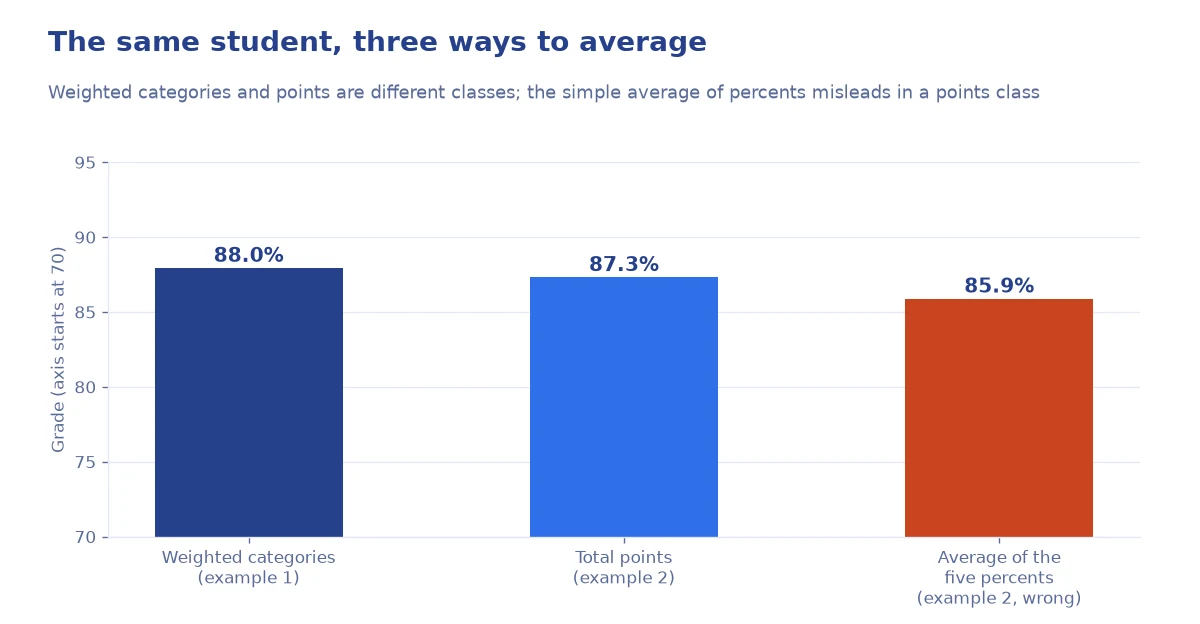
Points earned over points possible is 262 ÷ 300 = 87.3%. Averaging the five percents instead would give 85.9%, which is wrong for a points class because the quizzes would count as much as the 120 point project. Use the method your syllabus names.
Drop the lowest grade: how it changes the math
Many instructors drop the lowest quiz or homework, which changes how to calculate your final grade for that category. The Sakai gradebook documentation explains the rule: dropped grades are omitted from the calculation, and the points possible in that category go down by the dropped items’ points. The score and its points leave together, so you cannot drop just the score.
| Case | Quiz points | Quiz average | Course grade (quizzes 40%, exam 60% at 80%) |
|---|---|---|---|
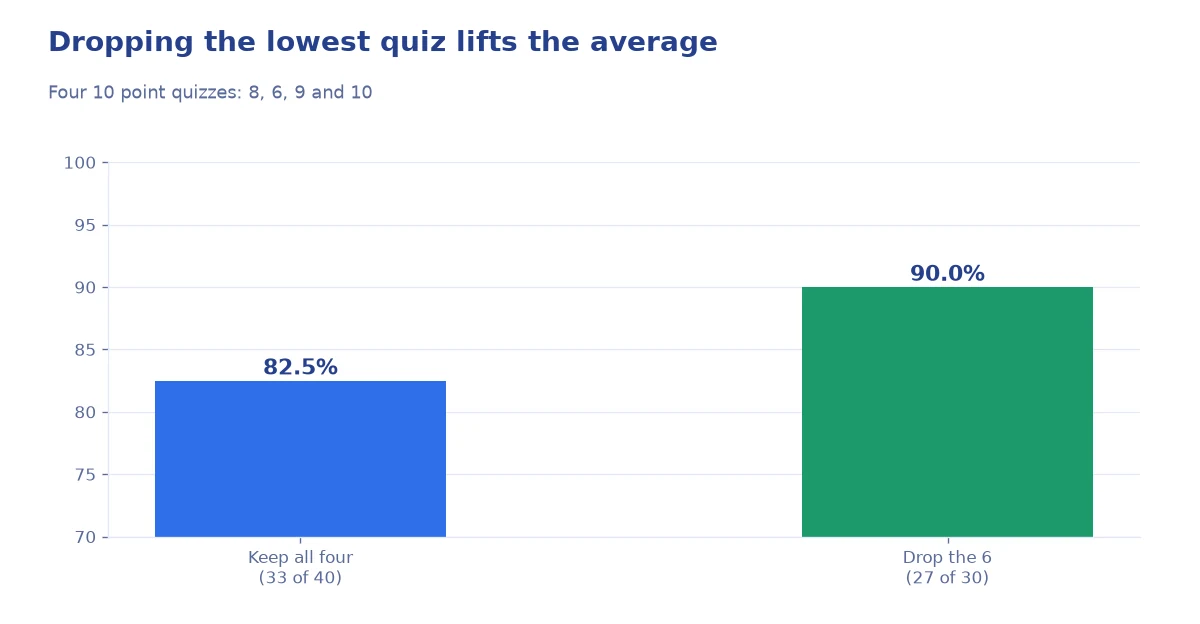
| Keep all four quizzes | 33 of 40 | 82.5% | 81% |
| Drop the lowest quiz (the 6) | 27 of 30 | 90% | 84% |
Dropping one quiz lifts the quiz average from 82.5% to 90% and the course grade by 3.00 points. The same Sakai page notes that the drop options need every item in the category to have the same point value, or an equal-weight setting, so check how your instructor handles uneven quizzes.
Blank, missing and zero: why they are not the same
A zero is a real score that lowers your average. A blank that has not been graded yet is usually left out of the calculation until it is entered. The two can differ a lot, so look at what your gradebook shows before you worry.
| Situation | Points | Category average |
|---|---|---|
| Fourth 20 point assignment still ungraded | 54 of 60 | 90% |
| Fourth assignment entered as a zero | 54 of 80 | 67.5% |
That is a 22.50 point swing from one missing item. If a score is missing because you forgot to turn it in, ask whether late work is accepted. If it is missing because it has not been graded, the average is likely higher than it looks.
Extra credit and rounding
The final grade formula treats extra credit the same way for every method: it is normally added to the points earned and not to the points possible. With 410 of 500 points, a 10 point extra credit item raises the total to 420 ÷ 500 = 84% instead of 82%. Rounding rules vary: some teachers round a 89.5 up to 90, others do not. Ask once, and use that rule in every calculation.
Common mistakes when you calculate a grade
| Mistake | What goes wrong | Fix |
|---|---|---|
| Averaging category percents without weights | A 10 percent category counts as much as a 40 percent one | Multiply each average by its weight first |
| Weights that add to more or less than 100 | The result is scaled wrong | Divide by the sum of the weights you used |
| Averaging percents in a points class | Small quizzes count like big tests | Add points earned and divide by points possible |
| Counting an ungraded item as zero | The grade looks lower than it is | Leave it out until it is graded |
| Dropping the score but not its points | The category average is off | Remove both the score and the points possible |
How to calculate final grade when a class has only a midterm and a final
Smaller classes sometimes use just two tests and a few homework grades. The method is the same, with fewer rows. Suppose homework is 20 percent, the midterm is 35 percent and the final is 45 percent, and you scored 90, 72 and 81.
| Part | Weight | Your score | Weighted points |
|---|---|---|---|
| Homework | 20% | 90% | 18.0 |
| Midterm | 35% | 72% | 25.2 |
| Final exam | 45% | 81% | 36.5 |
| Final grade | 100% | 79.7% |
The final grade is 79.7%. Notice that the final exam contributes 36.5 points and the midterm 25.2 even though your midterm score was lower, because the final carries more weight. This is why a strong exam late in the course can move a grade so much.
A checklist for how to calculate your final grade
- Find the grading section of the syllabus and write down every category and weight.
- Check that the weights add to 100 percent, and note any drop or extra credit rules.
- Get each category average from your gradebook, using points earned over points possible.
- Multiply each average by its weight and add the results, or divide total points for a points class.
- Compare the result with your portal grade; if they differ, look for an ungraded item or a drop rule.
From a percent to a letter grade
Once you have the percent, match it to your syllabus scale. The common US scale puts an A at 90 and above, a B at 80 to 89, a C at 70 to 79 and a D at 60 to 69, with plus and minus bands in between, but each instructor may differ. Our GPA conversion chart lists the usual cutoffs, and the final grade calculator lets you edit them.
Let a calculator do the arithmetic
Once you know how to calculate your final grade by hand, you can check every number above in the final grade calculator: pick weighted categories or total points, enter your grades, and it shows the score you still need on the final. For a course grade from weighted parts alone, use the weighted grade calculator.
Free tools for grade math
- Final grade calculator: the score you need on the final exam
- Weighted grade calculator: a course grade from weighted categories
- Grade calculator: test and assignment scores to percent and letter grades
- Percentage calculator: percent of a score
- College GPA calculator: what your final grades do to your GPA
- Homework planner printable: keep track of assignments before they are graded
Related guides: How to raise your grade before finals (plan by weight and score needed); Cumulative GPA explained (what final grades do to your GPA).
Sources
Sakai Community Documentation: dropped grades for how drop and keep rules change points possible; Wikipedia: Weighted arithmetic mean for the weighted average; Wikipedia: Academic grading in the United States for common letter grade ranges. Your syllabus is the rule for your class.
Frequently asked questions
7 quick answers
How do you calculate your final grade?
To calculate your final grade for weighted categories, multiply each category average by its weight and add the results. For a points class, divide total points earned by total points possible. Always check which method the syllabus names.
How do I calculate a final grade with weights?
Write each weight as a decimal, multiply it by your average in that category, and add the products. If the weights do not total 100 percent, divide the sum by the total weight you used.
What is the formula for the final grade?
Final grade = sum of (category average × category weight). For points, final grade = points earned ÷ points possible × 100.
How do I calculate my grade if the lowest score is dropped?
Remove the lowest score and its points possible from the category, then divide the remaining points earned by the remaining points possible. Then apply the category weight as usual.
Does an ungraded assignment count as zero?
Usually not. Many gradebooks leave ungraded items out until they are entered. A missing zero is different from an ungraded blank, so check what your gradebook shows.
How is extra credit added to a grade?
Extra credit is usually added to the points earned but not to the points possible, so it can raise the grade. Your instructor decides how it is applied and whether it has a cap.
What score do I need on the final?
Solve for it: (goal − current grade × (1 − final weight)) ÷ final weight. The final grade calculator does this for any grade, weight and goal.