The fastest way to raise your grade before finals is to start with the numbers: find how much of the course is still open, how far one exam can move you, and which assignments carry the most weight. This plan gives you tables to size up the gap, questions to ask your instructor, and a three-week schedule.

Step 1: find out how far you can still raise your grade
To raise your grade before finals you first need to know the limit: your grade can only change by the weight that is still ungraded. If 40 percent of the course remains, your final grade can land anywhere between your current work scaled to 60 percent and that plus 40 points. The table shows the floor and the ceiling for a few starting points.
| Your grade now | Weight still open | Lowest finish | Highest finish |
|---|---|---|---|
| 65% | 20% | 52% | 72% |
| 65% | 40% | 39% | 79% |
| 72% | 20% | 57.6% | 77.6% |
| 72% | 40% | 43.2% | 83.2% |
| 78% | 20% | 62.4% | 82.4% |
| 78% | 40% | 46.8% | 86.8% |
| 85% | 20% | 68% | 88% |
| 85% | 40% | 51% | 91% |
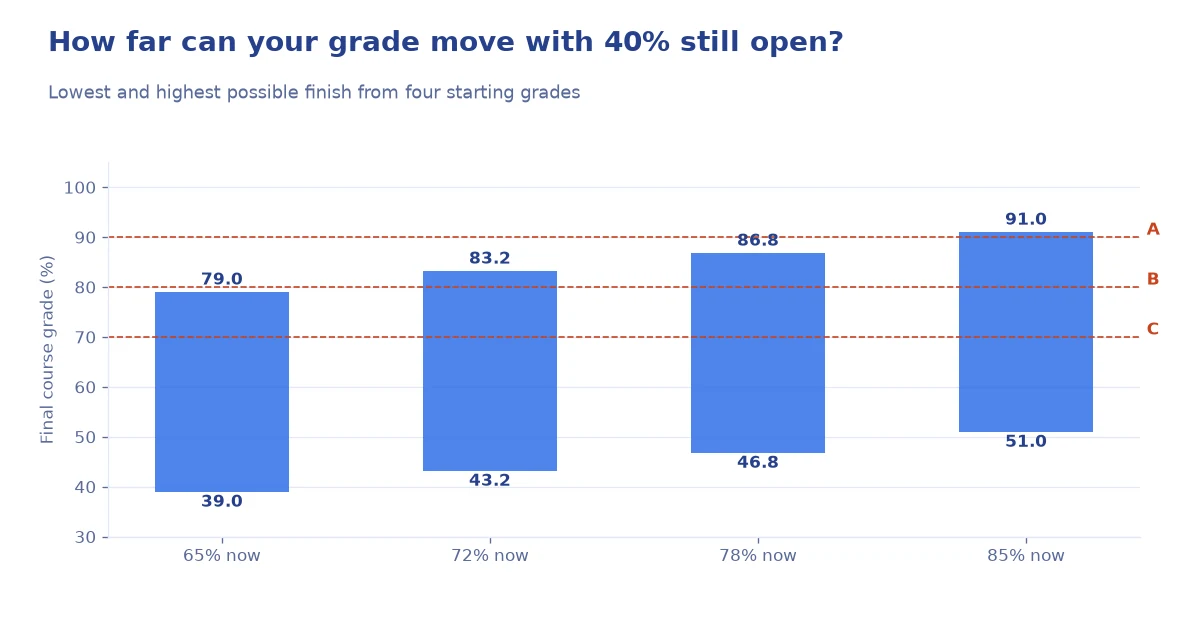
With a 72% and 40 percent still open, the best you can finish at is 83.2%, so a B (80%) is in reach and an A is not. Use the final grade calculator for your own grade and weights. It shows the score you need for every letter, so you can pick a goal you can actually reach.
Step 2: how to raise your grade by seeing what one exam point is worth
Every point you score on an assessment moves your course grade by its weight. A point on a 30 percent final is worth 0.3 of a course-grade point, while a point on a 5 percent quiz is worth 0.05.
| Assessment weight | A 10 point improvement moves your grade by | A 20 point improvement moves your grade by |
|---|---|---|
| 5% | 0.50 | 1.00 |
| 10% | 1.00 | 2.00 |
| 20% | 2.00 | 4.00 |
| 30% | 3.00 | 6.00 |
| 40% | 4.00 | 8.00 |
Step 3: how to bring up your grade where the gain is biggest
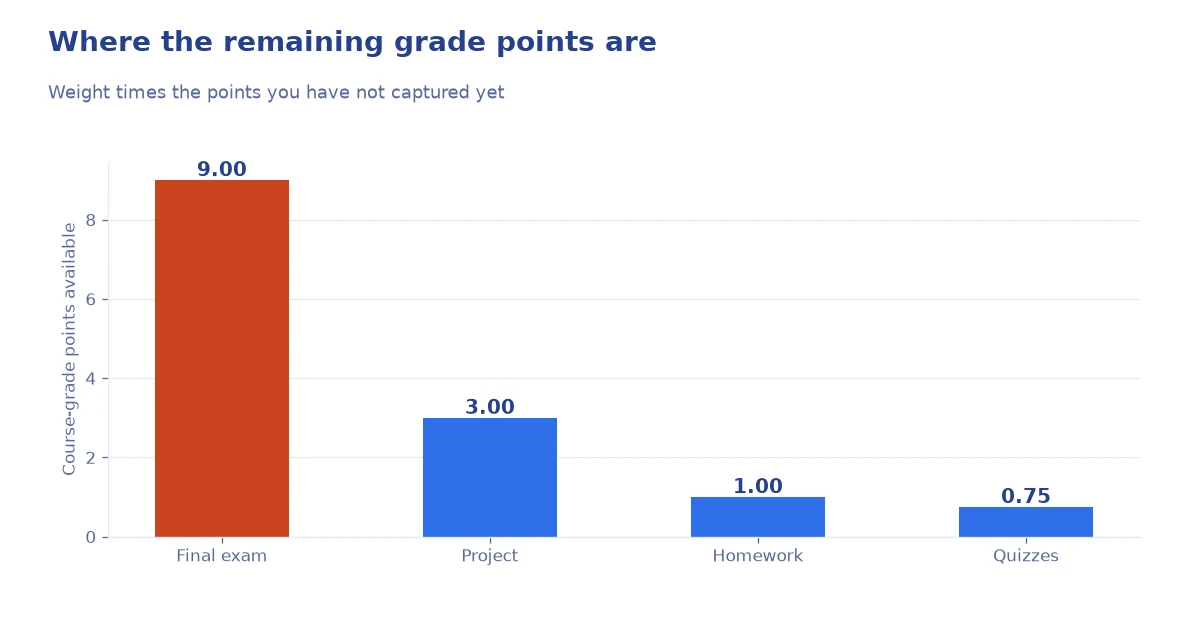
The gain you can still earn from an item is its weight times the points you have not yet captured. A big assessment where you expect a lower score is worth more of your time than a small one you already do well on.
| Item still open | Weight | Score you expect now | Course-grade points you can still gain |
|---|---|---|---|
| Final exam | 30% | 70% | 9.00 |
| Project | 15% | 80% | 3.00 |
| Homework | 10% | 90% | 1.00 |
| Quizzes | 5% | 85% | 0.75 |
In this example the final exam holds the most room, 9.00 points, and the project is second. Homework and quizzes together hold less than half as much, so they matter, but they should not take the week.
Step 4: talk to your instructor with numbers
Several university student success pages give the same advice. The Randolph-Macon College midterm guide says office hours are a good time to understand what it would take to improve your overall grade, and University of Kentucky advice suggests one-on-one conversations to clarify what went wrong and what to change. Bring your numbers to make the meeting short and useful, because a specific plan is easier for an instructor to react to than a general worry.
- Which assignments and exams are still ahead, and what is each worth?
- Is there extra credit, a retake, or a policy that replaces a low score?
- Can you look at the exam you missed points on, so you can see what to fix?
- What would you recommend I do first in the weeks before the final?
Step 5: use support and keep the midterm in perspective
Many schools offer tutoring and academic coaching, and some contact students with a low midterm grade. Midterm grades are also a checkpoint, not a verdict: Illinois Wesleyan notes that its midterm grades are not reported on the permanent record and do not indicate your final course grade. Policies differ, so check your own school. Knowing that a low midterm grade is not permanent can make it easier to commit to the plan.
Step 6: know the deadlines and your options before you bring up your grade
Check the registrar calendar for the last day to withdraw, and ask your advisor how withdrawing would affect financial aid or progress. If you repeat a course, find out whether the new grade replaces the old one. At the University of Cincinnati, for example, an approved grade replacement counts only the newest grade in the cumulative GPA, up to 18 semester credit hours.
A three-week plan to raise your grade before finals
| Week | Focus | What to do |
|---|---|---|
| Three weeks out | Find the gap | Calculate the score you need, list what is still open, and book one meeting with your instructor |
| Two weeks out | Fix the weak spots | Redo missed questions, attend tutoring, and finish any late or extra-credit work |
| Final week | Practice under exam conditions | Take timed practice exams, review mistakes, and sleep the night before |
Midterm grade low? What to do when the goal is out of reach
Sometimes the math says no, and you cannot raise your grade before finals to the letter you hoped for. If the score you need is above 100 percent, pick the highest letter that is still reachable, and treat it as the goal. A realistic goal can be easier to plan for when you want to raise your grade before finals, and it often protects the grades you already have. Run the numbers again after your next practice exam, because a changed current grade or weight changes the answer.
What a realistic improvement looks like
If you want to bring up your grade, expect improvement of a few points, not twenty. Take a student at 78 percent with 40 percent of the course left. Each row shows the course grade after scoring a given average on everything still open.
| Average on the remaining 40% | Course grade | Letter (common scale) |
|---|---|---|
| 60% | 70.8% | C |
| 70% | 74.8% | C |
| 80% | 78.8% | C |
| 90% | 82.8% | B |
| 100% | 86.8% | B |
Raising the average on open work from 70 to 90 percent adds 8.00 points to the course grade, enough to move a C into a B. A plan that lifts the open work by twenty points can matter more than an hour spent re-checking old assignments.
Mistakes that waste study time before the final
- Studying everything equally instead of the topics tied to the heaviest assessment.
- Re-reading notes without testing yourself on questions you can miss.
- Skipping office hours because the grade feels too far gone to fix.
- Ignoring small deadlines that still carry weight, such as a project or a missing homework set.
- Waiting until the week of the final to calculate the score you need.
Free tools to raise your grade before finals
- Final grade calculator: the score needed for every letter grade
- Weighted grade calculator: see what each category is worth
- Grade calculator: check an assignment percent
- College GPA calculator: see the effect on your GPA
- Homework planner printable: plan study blocks week by week
- How to calculate your final grade: the three methods in detail
Related guides: GPA conversion chart (letter, percent and 4.0 scale lookups); Good GPA in college (what counts as good for each goal).
Sources
Randolph-Macon College: Advice for a Midterm Reset; University of Kentucky: Bounce back after midterms; Illinois Wesleyan University: Midterm grades for students; University of Cincinnati: Grade Replacement Policy. Rules differ by school and by instructor.
Frequently asked questions
7 quick answers
How can I raise my grade before finals?
To raise your grade before finals, work out how much of the course is still open and what score you need, focus on the assessments with the largest weight and most room, talk to your instructor, and use tutoring. A written plan beats studying everything.
Can I still raise my grade before finals with a few weeks left?
Often yes, and you can raise your grade before finals if enough weight is still open. If 30 to 40 percent of the course remains, a strong final can move a grade a letter. Use the calculator to find your best and worst case.
How much does the final exam count?
It depends on the class, and the syllabus is the only reliable answer. Many courses weight the final somewhere between 10 and 40 percent, so look it up and enter the exact number.
What if I need more than 100 percent on the final?
The grade is out of reach on the exam alone. Check for extra credit or a replacement policy, and set the next letter grade down as your goal.
Should I withdraw from a class I am struggling in?
It can be right in some cases, but it may affect aid, standing and progress. Talk to your advisor and check the registrar deadline before you decide.
Do midterm grades go on my transcript?
At some schools they do not. Illinois Wesleyan states that midterm grades are not reported on the permanent record, but policies differ, so check yours.
What should I ask my teacher about my grade?
Ask what is still open and what each part is worth, whether extra credit or a retake exists, and what you should fix first. Bring your current grade and a list of the missed questions.