Change the numbers, layout and number of problems, then download a new PDF with its answer key.
Multiplication facts to 100 are the products of two numbers from 0 to 10, from 0 × 0 to 10 × 10. The eleven PDFs on this page have fact drills, missing factors, fact families, a caterpillar, a color-by-product picture, a riddle, match-up cards, bingo and story problems, and every sheet has an answer key. They follow standard 3.OA.C.7 of the Common Core standards for grade 3 operations and algebraic thinking, and the notes below show how many facts there are, which are hardest, and how to learn them.
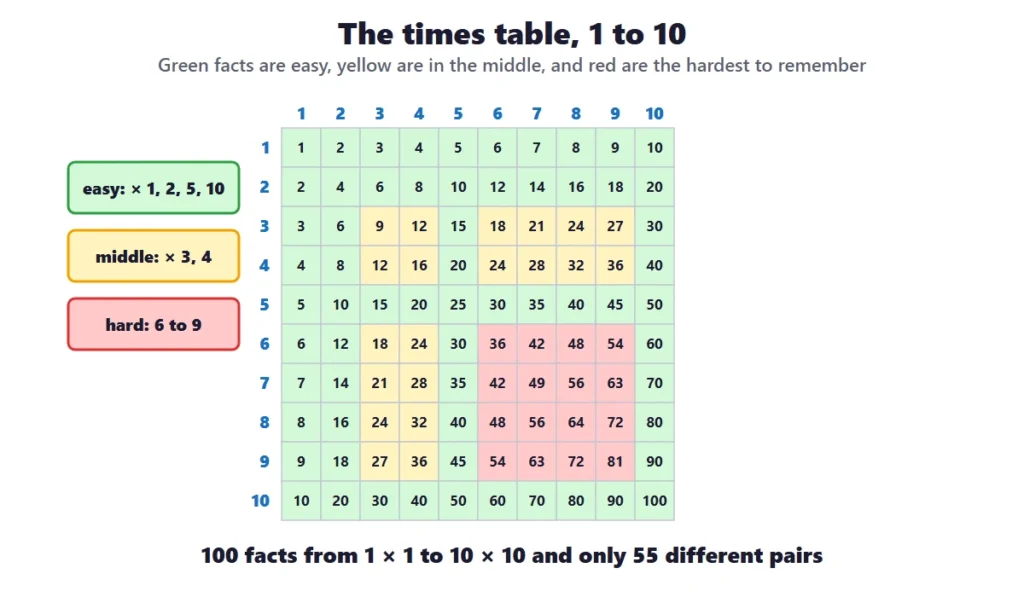
The times table. Easy, middle and hard facts.
Quick answer: Multiplication facts to 100 are the products of two numbers from 0 to 9, up to 9 × 9 = 81. There are 100 facts, but only 55 different ones. This page has 11 free printable worksheets with answer keys for grade 3. Updated October 2026.
About these multiplication facts worksheets
By the end of grade 3, children are expected to know from memory all products of two one-digit numbers (Common Core 3.OA.C.7). These worksheets cover every fact from 0 × 0 to 10 × 10, mixed up rather than table by table, so children practice recalling any fact. For one table at a time, see the times tables worksheets.
What is on this page
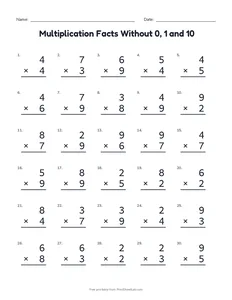
Fact practice: 30 vertical facts, plus a set that leaves out the easy 0, 1 and 10 facts.
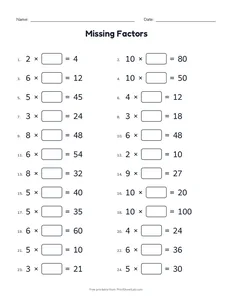
Horizontal facts and missing factors: 6 × ☐ = 42 makes children think about the facts in both directions, which also prepares them for division.
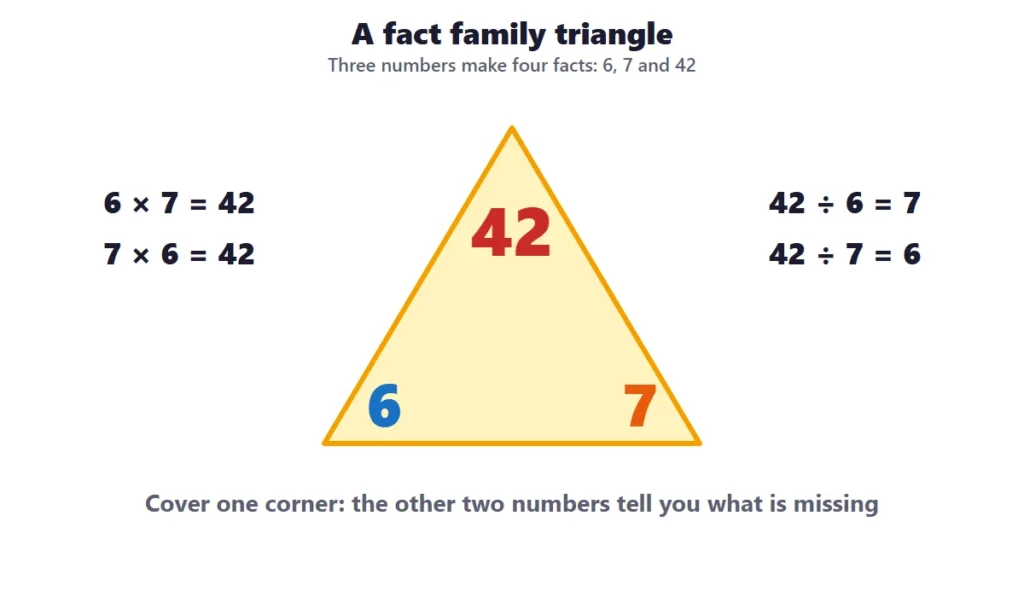
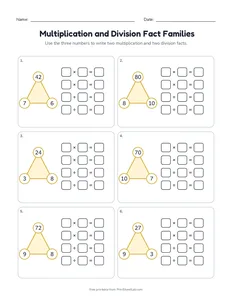
Fact families: 6, 7 and 42 make two multiplication and two division facts.
Games: a caterpillar path, a color-by-product picture, a riddle, match-up cards and bingo.
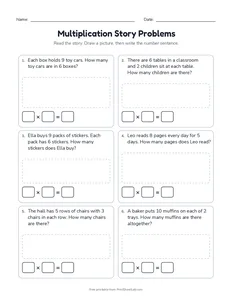
Story problems about bags, rows and packs.
Tips for learning the facts
Learn the easy facts first: × 0, × 1, × 2, × 5 and × 10.
Use the order rule: if you know 3 × 8, you know 8 × 3. That halves the facts to learn.
Use known facts: 6 × 7 is 5 × 7 plus one more 7, so 35 + 7 = 42.
Practice a little every day and time only one short sheet at a time.
Multiplication facts to 100 worksheets: what is in the set
There are 11 multiplication facts to 100 worksheets on this page, and every one has an answer key except for any cut-out games. The sheets are fact drills, missing factors and fact families, plus a caterpillar, a color-by-product picture, a riddle, match-up cards, bingo and story problems.
Worksheet
What children do
Standard
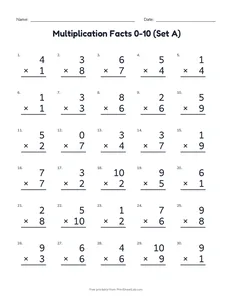
Multiplication Facts 0-10 (Set A)
30 vertical facts from 0 × 0 to 10 × 10.
3.OA.C.7
Multiplication Facts Without 0, 1 and 10
30 facts using only 2 to 9, the ones that take the most practice.
3.OA.C.7
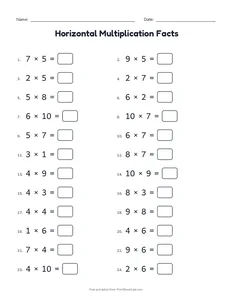
Horizontal Multiplication Facts
24 facts written across the page.
3.OA.C.7
Missing Factors
Find the missing number: 6 × ☐ = 42.
3.OA.C.7
Multiplication and Division Fact Families
Write two multiplication and two division facts for each triangle.
3.OA.C.7
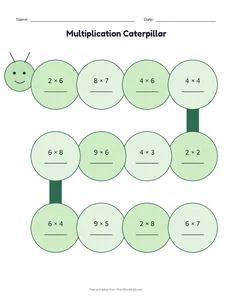
Multiplication Caterpillar
Solve 12 facts along the caterpillar.
3.OA.C.7
Color by Product: Fish
Solve each fact and color by the key to reveal a fish.
3.OA.C.7
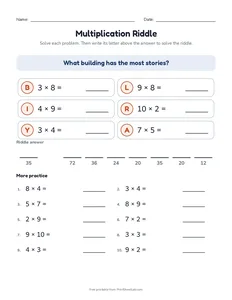
Multiplication Riddle
Solve the facts to decode a riddle.
3.OA.C.7
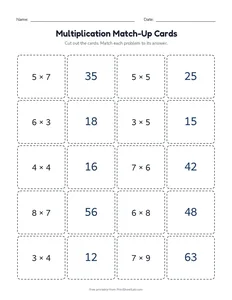
Multiplication Match-Up Cards
Match 10 facts to their products.
3.OA.C.7
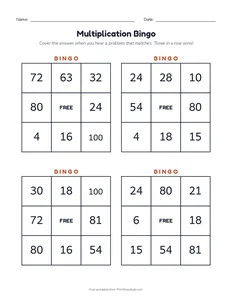
Multiplication Bingo
Bingo boards and calling cards with facts to 10 × 10.
3.OA.C.7
Multiplication Story Problems
Six story problems using facts up to 10 × 10.
3.OA.C.7
Multiplication facts to 100: how many facts are there?
Multiplication facts to 100 look like a lot to learn, but the order rule and the easy facts cut the number down. The times table from 0 × 0 to 10 × 10 has 121 facts when each order is counted, but only 66 different facts, since 3 × 8 and 8 × 3 are the same. This table shows how the numbers change as the easy facts are taken away:
Part of the times table
Facts (each order counted)
Different facts (order rule)
Squares among them
0 to 10
121
66
11
1 to 10
100
55
10
2 to 9 (the hard core)
64
36
8
Facts with a 0
21
11
1
Facts with a 1 but no 0
19
10
1
The facts that need real practice are the 36 different facts in the 2 to 9 table, and only 10 of those are among the hardest, with both factors from 6 to 9. Wikipedia’s article on multiplication describes the history of the times table. The multiplication arrays and equal groups page shows the arrays that give the facts their meaning.
Multiplication facts worksheets: the easy, middle and hard facts
The multiplication facts worksheets include a sheet that leaves out 0, 1 and 10, since these facts are the easy ones. Among the other 64 facts, some are easier than others. This table splits them into three groups:
Group of facts in the 2 to 9 table
Facts
Different facts
Examples
Easy: a factor of 2 or 5
28
15
2 × 7 = 14, 5 × 8 = 40
Middle: factors 3 and 4 with 3 to 9
20
11
3 × 7 = 21, 4 × 9 = 36
Hard: both factors from 6 to 9
16
10
6 × 7 = 42, 7 × 8 = 56, 8 × 9 = 72
Only 10 different facts have both factors from 6 to 9, and they are 6 × 6, 6 × 7, 6 × 8, 6 × 9, 7 × 7, 7 × 8, 7 × 9, 8 × 8, 8 × 9 and 9 × 9. If a child knows all the facts except these, practicing them one at a time is a much smaller job than learning the whole table. This table gives a helper fact for each of the six that have two different factors:
Hard fact
Product
Helper fact
How it helps
6 × 7
42
5 × 7 = 35
add one more 7: 35 + 7 = 42
6 × 8
48
5 × 8 = 40
add one more 8: 40 + 8 = 48
6 × 9
54
5 × 9 = 45
add one more 9: 45 + 9 = 54
7 × 8
56
6 × 8 = 48
add one more 8: 48 + 8 = 56
7 × 9
63
6 × 9 = 54
add one more 9: 54 + 9 = 63
8 × 9
72
7 × 9 = 63
add one more 9: 63 + 9 = 72
Multiplication facts 0-10: a strategy for each table
For multiplication facts 0-10, there is a strategy for each table. Some facts are best known by heart, but a strategy gives a child something to fall back on when memory fails. This table shows one strategy for each table from 0 to 10, with an example:
Table
Strategy
Example
× 0
anything times 0 is 0
8 × 0 = 0
× 1
the number stays the same
8 × 1 = 8
× 2
double the number
2 × 7 = 14
× 3
double, then add one more
3 × 7 = 14 + 7 = 21
× 4
double, then double again
4 × 7 = 14 → 28
× 5
half of the × 10 fact
5 × 8 = 80 ÷ 2 = 40
× 6
5 times plus one more
6 × 7 = 35 + 7 = 42
× 7
5 times plus 2 times
7 × 8 = 40 + 16 = 56
× 8
double the × 4 fact
8 × 7 = 28 × 2 = 56
× 9
10 times minus one more
9 × 7 = 70 − 7 = 63
× 10
put a 0 after the number
10 × 7 = 70
Each strategy builds on a fact that the child already knows. For 6 × 7 the helper is 5 × 7 = 35, and one more 7 makes 42. The times tables worksheets page has the tables one at a time.
Basic multiplication worksheets: patterns in the table
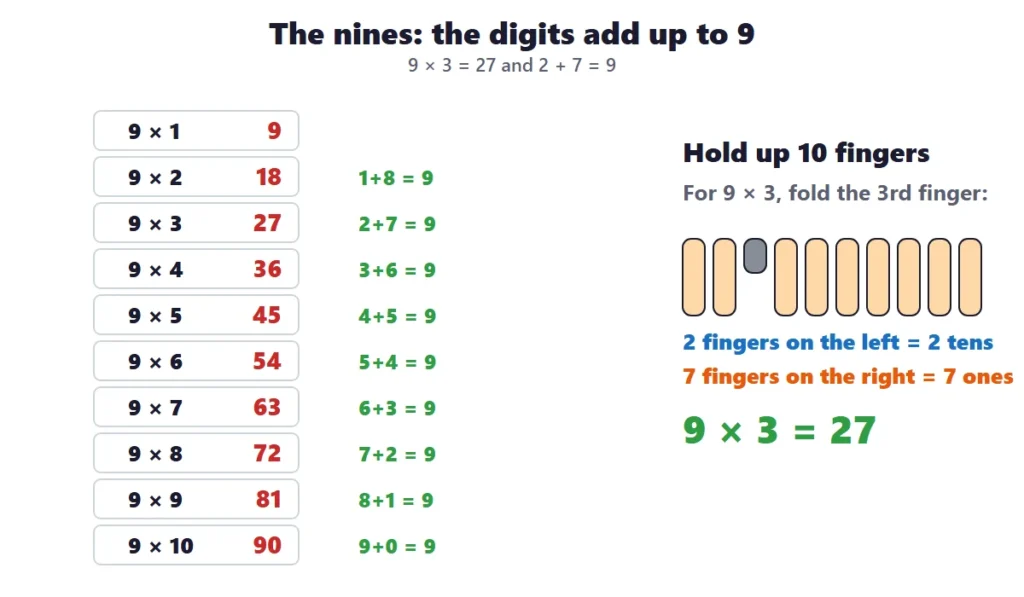
The basic multiplication worksheets are easier when children look for patterns. The 9s have the best of them: the digits of every product add up to 9, and the tens digit is one less than the number that 9 is multiplied by. This table shows the ten facts:
The nines. The digits add up to 9.
Fact
Product
Digits added
Pattern
9 × 1
9
9
tens digit is 0, one less than 1
9 × 2
18
1 + 8 = 9
tens digit is 1, one less than 2
9 × 3
27
2 + 7 = 9
tens digit is 2, one less than 3
9 × 4
36
3 + 6 = 9
tens digit is 3, one less than 4
9 × 5
45
4 + 5 = 9
tens digit is 4, one less than 5
9 × 6
54
5 + 4 = 9
tens digit is 5, one less than 6
9 × 7
63
6 + 3 = 9
tens digit is 6, one less than 7
9 × 8
72
7 + 2 = 9
tens digit is 7, one less than 8
9 × 9
81
8 + 1 = 9
tens digit is 8, one less than 9
9 × 10
90
9 + 0 = 9
tens digit is 9, one less than 10
Other patterns are that all multiples of 5 end in 0 or 5, the 2s are all even, and the 10s all end in 0. In the table of products, the numbers on the diagonal are the squares: 1, 4, 9, 16, 25, 36, 49, 64, 81 and 100. The diagram above shows the whole table with the easy, middle and hard facts.
Multiplication drills: how long should they take?
Multiplication drills should be short and often. A drill that takes more than three minutes is too long, since children tire and make mistakes. This table shows how long to allow for sheets of different lengths, if children take 3, 4 or 5 seconds a fact:
Sheet of
Seconds a fact
Time to allow
Aim for
12
5
1 min 0 s
9 in 10 right
24
4
1 min 36 s
9 in 10 right
30
3
1 min 30 s
9 in 10 right
30
4
2 min 0 s
9 in 10 right
30
5
2 min 30 s
9 in 10 right
40
4
2 min 40 s
9 in 10 right
A good aim is 9 right out of 10 before moving on, and children should be timed only against their own earlier score. The riddle, the caterpillar, the color-by-product picture and the bingo games on this page make practice more fun, so that drills are not the only way to learn.
Multiplication worksheets grade 3: fact families
For multiplication worksheets grade 3, the standard 3.OA.C.7 asks children to know all the products of two one-digit numbers from memory by the end of the year, and to link them to division. A fact family is a set of facts that use the same three numbers. This table shows five triangles and their facts:
Triangle
Facts in the family
Number of facts
6, 7 and 42
6 × 7 = 42, 7 × 6 = 42, 42 ÷ 6 = 7, 42 ÷ 7 = 6
4
4, 8 and 32
4 × 8 = 32, 8 × 4 = 32, 32 ÷ 4 = 8, 32 ÷ 8 = 4
4
3, 9 and 27
3 × 9 = 27, 9 × 3 = 27, 27 ÷ 3 = 9, 27 ÷ 9 = 3
4
5, 7 and 35
5 × 7 = 35, 7 × 5 = 35, 35 ÷ 5 = 7, 35 ÷ 7 = 5
4
9, 9 and 81
9 × 9 = 81, 81 ÷ 9 = 9
2
A square, such as 9, 9 and 81, has only two facts, since the two multiplications are the same. The division facts to 144 and long division worksheets pages use the same triangles in reverse.
Which products come up most often?
In the times table from 1 × 1 to 10 × 10 there are only 42 different products, since many facts have the same answer. Some products come up more often than others. This table shows the eight products that are made by the most facts:
Product
Facts that make it (each order counted)
The facts
6
4
1 × 6, 2 × 3, 3 × 2, 6 × 1
8
4
1 × 8, 2 × 4, 4 × 2, 8 × 1
10
4
1 × 10, 2 × 5, 5 × 2, 10 × 1
12
4
2 × 6, 3 × 4, 4 × 3, 6 × 2
18
4
2 × 9, 3 × 6, 6 × 3, 9 × 2
20
4
2 × 10, 4 × 5, 5 × 4, 10 × 2
24
4
3 × 8, 4 × 6, 6 × 4, 8 × 3
30
4
3 × 10, 5 × 6, 6 × 5, 10 × 3
The products 6, 8 and 10 are made by the most facts, and they are among the numbers that children meet in measurement and time. Only 6 of the 42 products appear just once, such as 1, 25, 49, 64, 81.
Common mistakes with multiplication facts to 100
Most mistakes are between two facts with close answers. This table shows five mistakes, what went wrong and the fix:
What the child writes or says
What went wrong
The fix
6 × 7 = 48
mixes up 6 × 8 = 48 and 6 × 7 = 42
use a helper fact: 5 × 7 = 35, plus 7 is 42
7 × 8 = 54
says the fact in the rhythm 5, 6, 7, 8
the rhythm is 56 = 7 × 8; count 7, 14, 21, 28, 35, 42, 49, 56
9 × 6 = 56
mixes up 9 × 6 = 54 and 7 × 8 = 56
use the 9s digits: 5 and 4 add up to 9
0 × 5 = 5
thinks zero times a number is the number
no groups of 5 is nothing: 0 × 5 = 0
1 × 8 = 1
thinks one times a number is one
one group of 8 is 8
Multiplication facts to 100 word problems
Story problems show where the facts are used. Ask children to write the multiplication first, and to say the answer with the unit:
Word problem
Working
Answer
There are 7 boxes with 6 pencils in each. How many pencils are there?
7 × 6
42 pencils
A tray holds 8 rows of 4 cupcakes. How many cupcakes are there?
8 × 4
32 cupcakes
Each of 9 children has 9 stickers. How many stickers are there?
9 × 9
81 stickers
A car has 4 wheels. How many wheels do 10 cars have?
10 × 4
40 wheels
A pack has 5 pens. How many pens are in 8 packs?
8 × 5
40 pens
There are 6 eggs in a box. How many eggs are in 7 boxes?
7 × 6
42 eggs
Games and activities for multiplication facts to 100
Children learn multiplication facts to 100 best when they play with it. These games use things that are found at home or in a classroom:
Multiplication bingo: a bingo card with products, and calling cards with facts to 10 × 10
Fact family triangles: cover one number in a triangle, and ask for the missing one
Beat the clock: do a sheet of 30 facts, and try to beat your own time
Dice facts: roll two dice and multiply, and keep a tally of the products
Match-up cards: turn over cards to match each fact with its product
Caterpillar race: solve the facts along the caterpillar, and see who finishes first
Extra support and extra challenge with multiplication facts to 100
For children who need more support: learn one table at a time, and start with the easy ones: × 2, × 5 and × 10. Use skip counting and arrays to find a fact that is forgotten. Practice a few facts each day, and do not time the child until the facts are secure. Keep a list of the facts that need practice, and use the answer key to check.
For children who need more challenge: ask for all the facts that make 24, for the missing factor in 6 × ☐ = 42, and for a fact that is made in two different ways, such as 12. The sheet with only the hard facts, and the sheet with missing factors, are good challenges.
How to tell that a child is ready to move on from multiplication facts to 100
Before moving on from multiplication facts to 100, check that the child can do all four of these things:
A fact family. 6, 7 and 42.
The child knows the easy tables: × 0, × 1, × 2, × 5 and × 10.
The child knows the hard facts with 6, 7, 8 and 9.
The child writes the four facts of a fact family.
The child answers 30 facts in about two minutes, with at least 9 in 10 right.
A short lesson is the best way to introduce multiplication facts to 100. This 20-minute plan can be used in a classroom, at a tutoring session or at home, and it uses the worksheets at the end:
Minutes
Activity
What to say or ask
0 to 3
Show the times table with the easy facts in green
Which facts do you already know?
3 to 8
Practice the 9s with the finger trick and the digit sum
What do the digits of each product add up to?
8 to 13
Work on the hard facts using a helper fact
How do we get 6 × 7 from 5 × 7?
13 to 18
Write the four facts of the triangle 6, 7 and 42
What is the other division fact?
18 to 20
Start a worksheet and check one answer
Is it an easy fact or a hard fact?
Where multiplication facts to 100 fits across the grades
No skill stands alone. This table shows what children learn before and after multiplication facts to 100, with the standard that goes with each step:
This page is the center of the multiplication sequence. The whole sequence is on the multiplication worksheets page.
Helping at home with multiplication facts to 100
Parents do not need to be experts to help with multiplication facts to 100. These suggestions work well, and each takes only a few minutes:
Practice a few facts each day at a fixed time, such as at breakfast.
Ask “what is 6 × 7?” in the car, and check with a strategy.
Use a deck of cards: draw two cards and multiply.
Make a chart of the facts that are known and the facts that need practice.
Praise the strategy, and not only the right answer.
How to check progress in multiplication facts to 100
A teacher or parent can check progress in multiplication facts to 100 with the answer key and a few questions. This table shows three common situations, what they mean and what to do next:
What you see
What it means
What to do next
The child knows the easy tables but not 6, 7, 8 and 9
The hard facts need more practice
Use helper facts, and practice 3 or 4 each day
The child gets 9 of 10 right in every set
Multiplication facts to 100 are secure
Move on to the facts to 144 or to multi-digit multiplication
The child counts up from the start to find a fact
The facts are not yet from memory
Practice short drills, and use skip counting only to check
A five-day plan for multiplication facts to 100
Most children need about a week of short sessions for multiplication facts to 100. This plan follows the order of the worksheets on this page:
How many multiplication facts are there from 0 to 10?
There are 121 facts from 0 × 0 to 10 × 10. Because 3 × 8 and 8 × 3 have the same answer, there are only 66 different pairs to learn.
What is the hardest multiplication fact?
Many children find 6 × 8, 7 × 8 and 6 × 7 the hardest to remember. The “Facts without 0, 1 and 10” sheet has more of these.
Do the worksheets have answer keys?
Yes. Every worksheet except the cut-out games has an answer key on the last page.
How many multiplication facts are there to learn?
There are 121 facts from 0 × 0 to 10 × 10 when each order is counted, and 66 different ones when 3 × 8 and 8 × 3 are counted as the same. The facts with 0, 1 and 10 are easy, so about 36 need real practice.
What is the best way to learn the times tables?
Learn the easy tables first, use strategies for the others, and practice a little every day. Fact families link multiplication to division, and games make the practice more fun.
What are the hardest multiplication facts?
Most children find 6 × 7, 6 × 8, 7 × 8, 7 × 9 and 8 × 9 the hardest. The sheet that leaves out the 0, 1 and 10 facts has more of these.
How long does it take to learn multiplication facts to 100?
Most children need several months of short daily practice to know all the multiplication facts to 100 from memory. The easy tables come in the first weeks, and the hard facts with 6, 7, 8 and 9 take the longest.
Where can I download free multiplication facts worksheets?
Open any worksheet in the gallery above, choose US Letter or A4, then print or save the PDF. They are free and each has an answer key.