Multiplication and division word problems are the first stories in which children meet equal groups. The five PDFs on this page have stories about equal groups, arrays, sharing and grouping, with 2-digit numbers on one sheet, and every sheet has an answer key. They follow standard 3.OA.A.3 of the Common Core standards for grade 3 operations and algebraic thinking, and the notes below show the kinds of story, how sharing and grouping differ and what to do with what is left over.
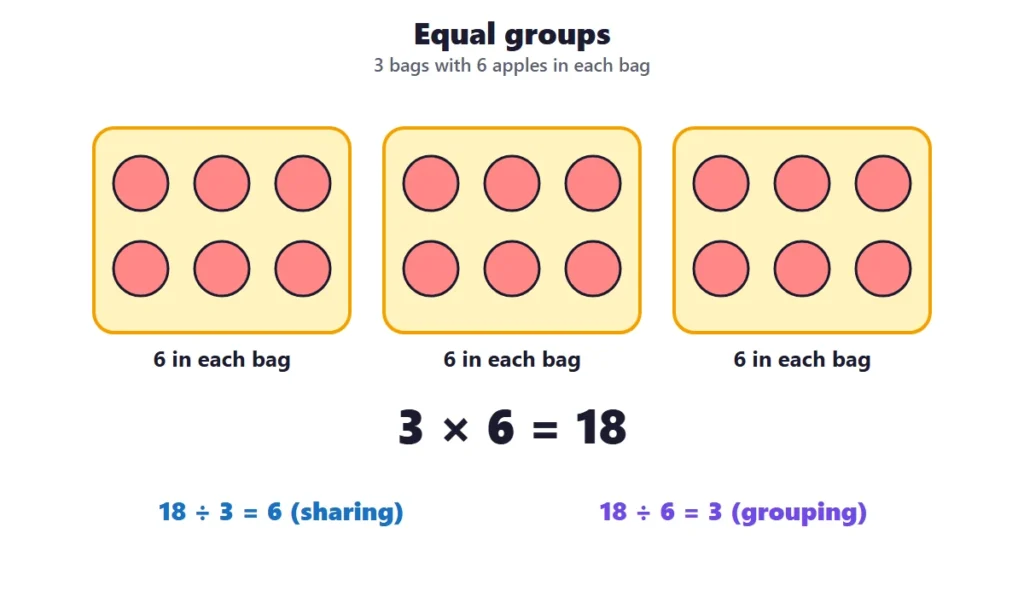
Equal groups. 3 bags of 6 apples.
Quick answer: Multiplication and division word problems are stories about equal groups, arrays and comparisons: the key is to decide whether the product, the group size or the number of groups is unknown. This page has 5 free printable worksheets with answer keys for grades 3 and 4. Updated October 2026.
Equal groups, both ways
Multiplication stories give the number of groups and the size of each group, and ask for the total. Division stories give the total and ask either how many in each group (sharing) or how many groups (grouping). Seeing both on the same page helps children notice that they are the same situation read in different directions.
Multiplication and division word problems worksheets: what is in the set
There are 5 multiplication and division word problems worksheets on this page, and every one has an answer key except for any cut-out games. Three sheets are multiplication stories with equal groups and arrays, and two sheets are division stories about sharing and grouping.
Worksheet
What children do
Standard
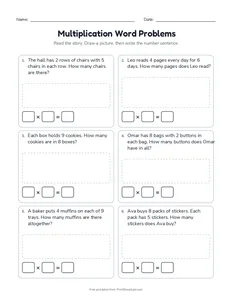
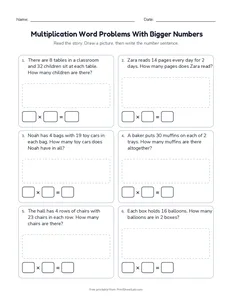
Multiplication Word Problems
Six equal-groups and array stories.
3.OA.A.3
Multiplication Word Problems With Bigger Numbers
Stories with a 2-digit number.
3.OA.A.3
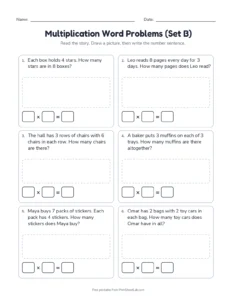
Multiplication Word Problems (Set B)
More equal groups and arrays stories.
3.OA.A.3
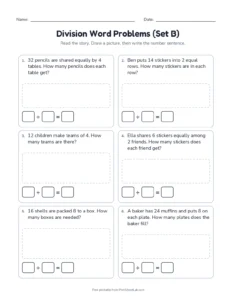
Division Word Problems (Set B)
More sharing and grouping stories.
3.OA.A.3
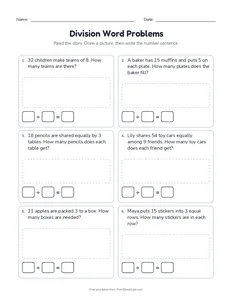
Division Word Problems
Six sharing and grouping stories.
3.OA.A.3
Equal groups word problems: nine kinds of story
The equal groups word problems have three main settings: equal groups, arrays and comparisons. In each setting, there are three kinds of story, depending on which of the three numbers is unknown: the total, the size of each group, or the number of groups. The Common Core standards describe all nine. Wikipedia’s article on word problems explains why children find some kinds much harder than others. This table shows the nine kinds with the numbers 3, 6 and 18:
Kind of story
What is unknown
Example
Number sentence
Answer
Equal groups
total unknown
3 bags have 6 plums in each bag. How many plums are there in all?
3 × 6 = ?
18
Equal groups
group size unknown (sharing)
18 plums are shared equally into 3 bags. How many plums are in each bag?
18 ÷ 3 = ?
6
Equal groups
number of groups unknown (grouping)
18 plums are put 6 to a bag. How many bags are needed?
18 ÷ 6 = ?
3
Arrays
total unknown
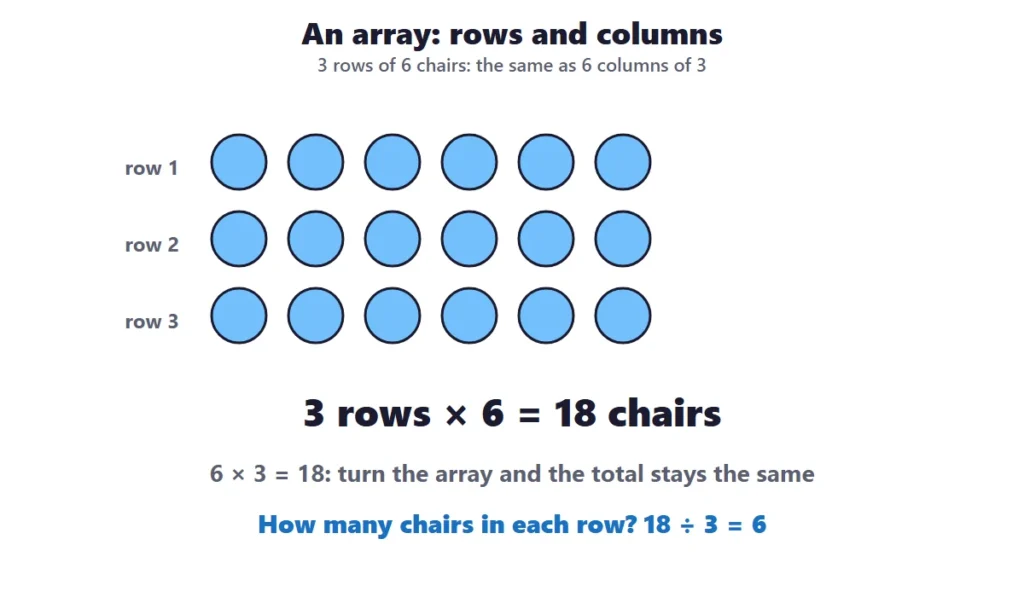
There are 3 rows of chairs with 6 chairs in each row. How many chairs are there?
3 × 6 = ?
18
Arrays
number of rows unknown
18 chairs are in rows of 6. How many rows are there?
18 ÷ 6 = ?
3
Arrays
number in a row unknown
18 chairs are in 3 equal rows. How many chairs are in each row?
18 ÷ 3 = ?
6
Compare
bigger amount unknown
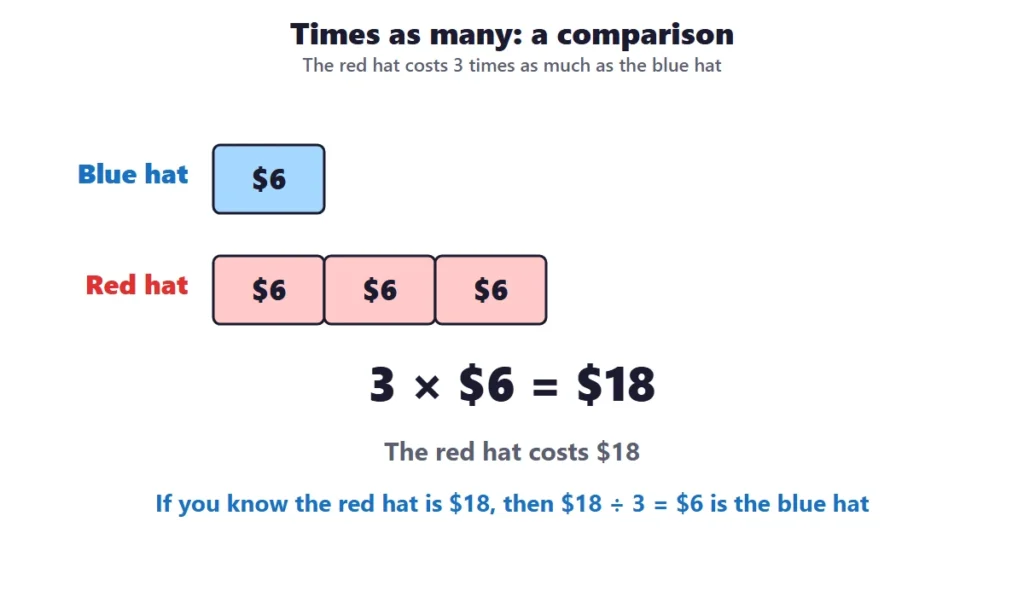
A blue hat costs $6. A red hat costs 3 times as much. How much is the red hat?
3 × 6 = ?
$18
Compare
smaller amount unknown
A red hat costs $18 and is 3 times as much as a blue hat. How much is the blue hat?
18 ÷ 3 = ?
$6
Compare
number of times unknown
A red hat costs $18 and a blue hat costs $6. How many times as much is the red hat?
18 ÷ 6 = ?
3
The three numbers 3, 6 and 18 appear in every story, so every story belongs to the fact family 3 × 6 = 18, 6 × 3 = 18, 18 ÷ 3 = 6 and 18 ÷ 6 = 3. Children who see the same fact family in nine different stories begin to understand that multiplication and division are two ways of looking at the same situation.
Multiplication word problems: equal groups and arrays
The multiplication word problems in this pack ask for the total when the number of groups and the size of each group are known. A group can be a bag, a row or a pack, and children draw the groups and then count or multiply. The idea is the same as in the multiplication arrays and equal groups page: a multiplication sentence is a short way to write repeated addition. 5 bags of 6 apples is 6 + 6 + 6 + 6 + 6 = 30, or 5 × 6 = 30. The times tables worksheets page has the facts, and the multiplication worksheets pages have more practice.
The worksheet with bigger numbers has a 2-digit number in each story, such as 8 rows of 12 seats. Children can find 8 × 12 by splitting 12 into 10 and 2: 8 × 10 = 80 and 8 × 2 = 16, so 96.
Division word problems: sharing and grouping
The division word problems have two kinds of story, which look different but use the same number sentence. In a sharing story, the total and the number of groups are known, and the size of each group is the answer. In a grouping story, the total and the size of each group are known, and the number of groups is the answer. This table shows six totals both ways:
Total and number
Sharing: divide into equal groups
Answer
Grouping: put in groups of the size
Answer
24 and 4
24 shared among 4
6
24 in groups of 4
6
18 and 3
18 shared among 3
6
18 in groups of 3
6
20 and 5
20 shared among 5
4
20 in groups of 5
4
36 and 6
36 shared among 6
6
36 in groups of 6
6
42 and 7
42 shared among 7
6
42 in groups of 7
6
56 and 8
56 shared among 8
7
56 in groups of 8
7
The answers are the same, since the two kinds of story use the same fact family. The division as sharing and equal groups page has pictures of both kinds. When children see that 24 ÷ 4 can mean “24 shared among 4” or “24 put in fours”, they find it easier to choose a picture for any division story.
Sharing word problems: how many ways can a total be shared?
The sharing word problems always have a total that can be shared evenly, so that the answer is a whole number. Not all totals can be shared in many ways. A total with many divisors can be shared in many ways, and a prime number can be shared in only two. This table shows six totals and all the ways to make equal groups:
The number 24 can be shared eight ways, which is why packs of 24 are so common, and 36 can be shared nine ways. A good activity is to give children 24 counters and ask them to find every way to make equal groups.
Division word problems with remainders: what is left over?
Some division word problems do not come out exactly, and children must decide what to do with what is left. If 20 apples are put in bags of 6, there are 3 full bags and 2 apples left over. If the question is “how many bags can be filled?”, the answer is 3. If it is “how many bags are needed to hold all the apples?”, the answer is 4. This table shows six problems:
An array. 3 rows of 6 chairs.
Problem
Division
Full bags
Left over
Bags needed to hold all the apples
20 apples, 6 in a bag
20 ÷ 6 = 3 R2
3
2
4
22 apples, 6 in a bag
22 ÷ 6 = 3 R4
3
4
4
25 apples, 6 in a bag
25 ÷ 6 = 4 R1
4
1
5
30 apples, 6 in a bag
30 ÷ 6 = 5 R0
5
0
5
33 apples, 6 in a bag
33 ÷ 6 = 5 R3
5
3
6
41 apples, 6 in a bag
41 ÷ 6 = 6 R5
6
5
7
Standard 4.OA.A.3 asks children to interpret remainders, and the division with remainders page explains the idea. The worksheets on this page use totals that divide exactly, so that children can concentrate on choosing the operation.
Word problems grade 3: the standard 3.OA.A.3
For word problems grade 3, the standard is 3.OA.A.3. Children use multiplication and division within 100 to solve stories about equal groups, arrays and measurement quantities, with drawings and equations that use a symbol for the unknown. The numbers in the problems are within 100, and the Common Core standards for grade 4 operations and algebraic thinking describe the next step, multiplicative comparison, in standard 4.OA.A.1 and 4.OA.A.2. This table shows how to choose the operation from what is known:
What you know
What to do
Example
You know the number of groups and the size of each group
multiply
4 groups of 6
You know the total and the number of groups
divide, to find the size of a group
24 shared among 4
You know the total and the size of each group
divide, to find the number of groups
24 in groups of 6
You know one amount and how many times as much
multiply, to find the bigger amount
3 times as much as $6
It is useful to ask children to say what they know and what they want to find before they choose an operation. This works better than key words, which can be wrong, as the next table shows:
Story
Key word
What to do
Number sentence
3 boxes have 4 pens each. How many pens are there?
each
multiply
3 × 4 = 12
A ribbon 24 cm long is cut into pieces of 4 cm. How many pieces?
cut into
divide
24 ÷ 4 = 6
Sam has 5 times as many cards as Jo. Jo has 7. How many does Sam have?
times as many
multiply
5 × 7 = 35
36 cards are shared among 4 children. How many does each get?
shared among
divide
36 ÷ 4 = 9
A bus holds 40 people. 4 buses are full. How many people in all?
in all
multiply, not add
4 × 40 = 160
Common mistakes with multiplication and division word problems
The most common mistake is to add the two numbers in a multiplication story. This table shows five mistakes, what went wrong and the fix:
What the child writes or says
What went wrong
The fix
5 bags of 6 apples is 5 + 6 = 11
adds the numbers, since the story has two numbers
there are 5 groups of 6: 5 × 6 = 30
24 shared among 4 is 4 − 24
divides in the wrong order
the total goes first: 24 ÷ 4 = 6
20 apples in bags of 6 need 3 bags
forgets the 2 apples that are left over
the 2 left need a bag as well: 4 bags are needed
A red hat is 3 times as much as a $6 hat, so it costs $9
adds 3 instead of multiplying
3 times as much means 3 × $6 = $18
Always multiplies when it sees “each”
uses the key word, not the story
draw the groups: sometimes “each” is the answer, as in “6 each”
Multiplication and division word problems word problems
Multiplication and division stories use bags, rows and packs. Ask children to draw the groups, write a number sentence and say what the answer counts:
Word problem
Working
Answer
There are 5 bags with 6 apples in each bag. How many apples are there?
5 × 6
30 apples
A teacher puts 24 pencils into 4 equal boxes. How many pencils are in each box?
24 ÷ 4
6 pencils
A baker puts 36 rolls into bags of 6. How many bags does he fill?
36 ÷ 6
6 bags
A theater has 8 rows with 12 seats in each row. How many seats are there?
8 × 12
96 seats
A string of 45 beads is cut into 9 equal parts. How many beads are in each part?
45 ÷ 9
5 beads
A small dog weighs 7 kg. A big dog weighs 4 times as much. How much does the big dog weigh?
4 × 7
28 kg
Games and activities for multiplication and division word problems
Children learn multiplication and division word problems best when they play with it. These games use things that are found at home or in a classroom:
Group it: use 24 counters, and find all the ways to make equal groups
Row builder: build arrays with 12 cubes and write the multiplication sentence for each
Story cards: draw three number cards and make up a multiplication story and a division story
Pack and share: share 30 stickers among 5 friends, and then put them in packs of 5
Times as many: make a bar that is 3 times as long as a strip of paper, and write the sentence
Word problem bingo: a bingo card with answers, and calling cards with stories
Extra support and extra challenge with multiplication and division word problems
For children who need more support: use real counters and make the groups with the child. Say each story aloud as “how many groups? how many in each?” and draw the groups before writing a number sentence. Do multiplication stories first and division stories later, and use the answer key to check the picture.
For children who need more challenge: ask for a story that fits 7 × 8, for two stories that fit 56 ÷ 7 (one sharing and one grouping), and for a story with a remainder that has to be rounded up. The sheet with 2-digit numbers and the comparison stories are good challenges.
How to tell that a child is ready to move on from multiplication and division word problems
Before moving on from multiplication and division word problems, check that the child can do all four of these things:
The child draws equal groups or an array for a story.
The child chooses to multiply or divide, and says why.
The child tells a sharing story from a grouping story.
The child checks the answer with the opposite operation.
A 20-minute lesson on multiplication and division word problems
A short lesson is the best way to introduce multiplication and division word problems. This 20-minute plan can be used in a classroom, at a tutoring session or at home, and it uses the worksheets at the end:
Times as many. A $6 hat and a hat 3 times as much.
Minutes
Activity
What to say or ask
0 to 3
Show 3 bags with 6 counters in each, and ask how many in all
How many groups? How many in each?
3 to 8
Write 3 × 6 = 18, and then ask 18 shared among 3
What is the same? What is different?
8 to 13
Do an array story and a comparison story
Is it groups or times as many?
13 to 18
Do a story with a remainder, such as 20 apples in bags of 6
How many bags do we need?
18 to 20
Start a worksheet and check one answer
Check with the opposite operation.
Where multiplication and division word problems fits across the grades
No skill stands alone. This table shows what children learn before and after multiplication and division word problems, with the standard that goes with each step:
Multiplicative comparison, and remainders in word problems
4.OA.A.2 and 4.OA.A.3
Grade 5
Fraction and decimal word problems
5.NF.B.6
This page is the center of the word problem sequence. The whole sequence is on the math word problems worksheets page.
Helping at home with multiplication and division word problems
Parents do not need to be experts to help with multiplication and division word problems. These suggestions work well, and each takes only a few minutes:
Ask about groups in real life: “how many wheels on 4 cars?”.
Share snacks equally and ask “how many each?”.
Ask the child to draw the groups before writing a sentence.
Look at a muffin tray, an egg carton or a window: they are arrays.
Check an answer with the opposite operation.
How to check progress in multiplication and division word problems
A teacher or parent can check progress in multiplication and division word problems with the answer key and a few questions. This table shows three common situations, what they mean and what to do next:
What you see
What it means
What to do next
The child adds the numbers in a multiplication story
The idea of equal groups is not yet clear
Draw the groups and write the repeated addition first
The child gets 9 of 10 right in every set
The skill is secure
Move on to two-step word problems
The child ignores the leftover in a division story
The meaning of the remainder is not yet clear
Ask “what do we do with the apples that are left?”
A five-day plan for multiplication and division word problems
Most children need about a week of short sessions for multiplication and division word problems. This plan follows the order of the worksheets on this page:
Day
What to do
Practice
Day 1
Make equal groups with objects, and write multiplication sentences
Multiplication Word Problems
Day 2
Arrays and stories with a 2-digit number
Multiplication Word Problems With Bigger Numbers
Day 3
Share things equally, and write division sentences
Division Word Problems
Day 4
Sharing and grouping stories, and what to do with leftovers
Types of multiplication and division word problems
The Common Core grade 3 standards ask children to solve problems with equal groups, arrays and measurement quantities. The same numbers, 4, 6 and 24, fit every type below, which shows why the question matters more than the numbers:
Problem type
Example
Equation
Equal groups, product unknown
4 bags with 6 apples each. How many apples?
4 × 6 = 24
Equal groups, group size unknown
24 apples shared among 4 bags. How many in each?
24 ÷ 4 = 6
Equal groups, number of groups unknown
24 apples, 6 in each bag. How many bags?
24 ÷ 6 = 4
Arrays
4 rows of 6 seats. How many seats?
4 × 6 = 24
Compare (times as many)
A red rope is 6 m. A blue rope is 4 times as long. How long?
4 × 6 = 24
Frequently asked questions
6 quick answers
How can I tell a multiplication story from a division story?
If you know the total, it is division. If you are finding the total from equal groups, it is multiplication.
What grade learns these problems?
Grade 3 solves multiplication and division word problems within 100 (3.OA.A.3).
How can I tell a multiplication story from a division story?
If you know the number of groups and the size of each group, and want the total, multiply. If you know the total and want the number of groups or the size of each group, divide.
What is the difference between sharing and grouping in division word problems?
In sharing, you divide the total into a given number of equal groups, and find how many are in each. In grouping, you put the total into groups of a given size, and find how many groups. Both use the same number sentence.
What grade learns multiplication and division word problems?
Grade 3 solves multiplication and division word problems within 100 (3.OA.A.3). Grade 4 adds multiplicative comparison and remainders (4.OA.A.2 and 4.OA.A.3).
Where can I download free multiplication and division word problems?
Open any worksheet in the gallery above, choose US Letter or A4, then print or save the PDF. They are free and each has an answer key.