Change the numbers, layout and number of problems, then download a new PDF with its answer key.
3 and 4-digit by 1-digit multiplication uses the same steps as 2-digit problems, repeated for each column, with a carry from one column to the next. The five PDFs on this page have 3-digit problems, 4-digit problems, grid paper and story problems, and every sheet has an answer key. They follow standard 4.NBT.B.5 of the Common Core standards for grade 4 number and operations in base ten, and the notes below show worked examples, how often carries happen and how to estimate.
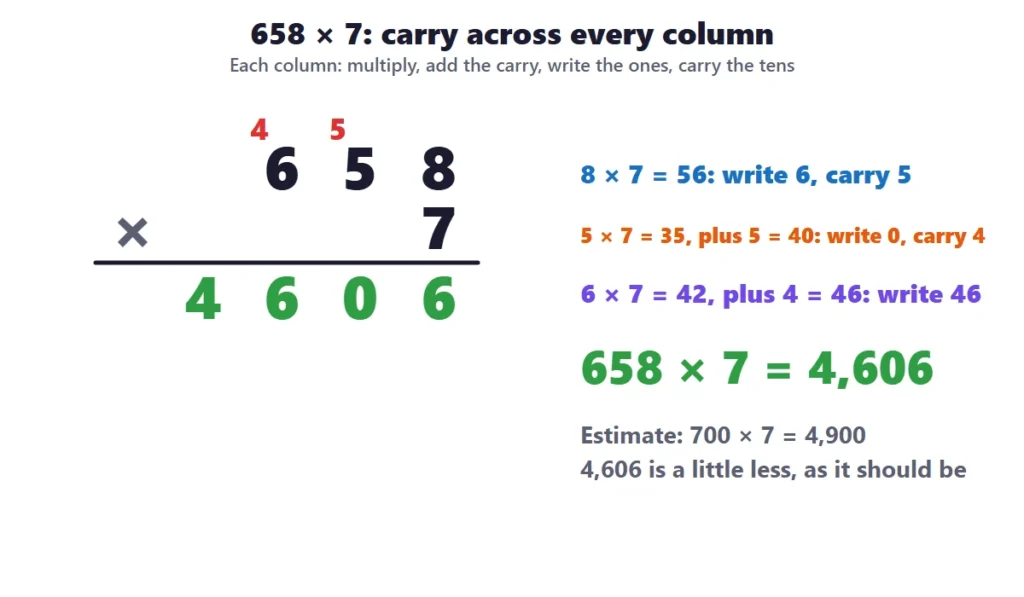
Three digits. 658 × 7 = 4,606.
About these worksheets
Multiplying a 3-digit or 4-digit number by one digit uses the same steps as 2-digit numbers, repeated for each column: multiply, write the ones, carry the tens. Grade 4 children do this with up to four digits (Common Core 4.NBT.B.5).
Worked example: 658 × 7
8 × 7 = 56. Write 6, carry 5.
5 × 7 = 35, plus 5 = 40. Write 0, carry 4.
6 × 7 = 42, plus 4 = 46. Write 46.
The answer is 4,606.
Estimate first to catch mistakes: 658 is close to 700, and 700 × 7 = 4,900, so 4,606 makes sense.
3 and 4-digit by 1-digit multiplication worksheets: what is in the set
There are 5 3 and 4-digit by 1-digit multiplication worksheets on this page, and every one has an answer key except for any cut-out games. Two sheets are 3-digit problems, one is on grid paper, one has 4-digit problems, and one has story problems.
Worksheet
What children do
Standard
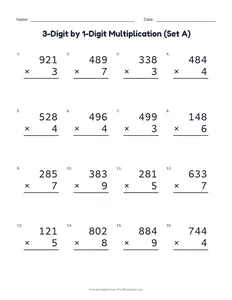
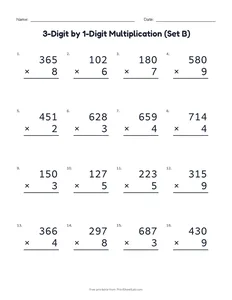
3-Digit by 1-Digit Multiplication (Set A)
16 column problems with regrouping.
4.NBT.B.5
3-Digit by 1-Digit Multiplication (Set B)
Another 16 problems.
4.NBT.B.5
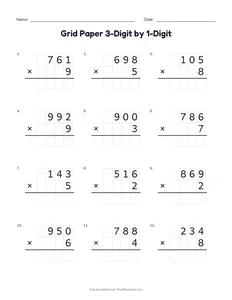
Grid Paper 3-Digit by 1-Digit
12 problems in boxes.
4.NBT.B.5
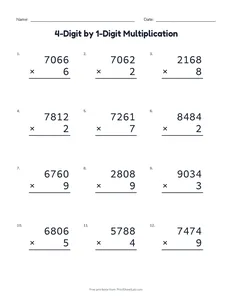
4-Digit by 1-Digit Multiplication
12 problems with 4-digit numbers.
4.NBT.B.5
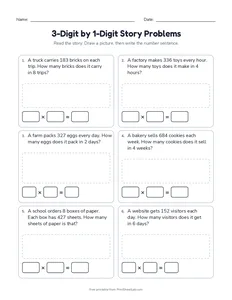
3-Digit by 1-Digit Story Problems
Six story problems with 3-digit numbers.
4.NBT.B.5
3 and 4-digit by 1-digit multiplication: four worked examples
3 and 4-digit by 1-digit multiplication goes one column at a time, from the right. In each column, multiply the digit by the multiplier, add the carry from the column before, write the ones digit, and carry the tens digit. Wikipedia’s article on multiplication algorithms describes this as the oldest method. These tables show four problems. First, 324 × 3, where only one column carries:
324 × 3 = 972
Column
Multiply the digit
Add the carry
Total
Write
Carry
ones
4 × 3 = 12
—
12
2
1
tens
2 × 3 = 6
+ 1 = 7
7
7
—
hundreds
3 × 3 = 9
—
9
9
—
Second, 658 × 7, which has a carry in every column:
658 × 7 = 4,606
Column
Multiply the digit
Add the carry
Total
Write
Carry
ones
8 × 7 = 56
—
56
6
5
tens
5 × 7 = 35
+ 5 = 40
40
0
4
hundreds
6 × 7 = 42
+ 4 = 46
46
6
4
Third, a 4-digit number, 2,413 × 4:
2,413 × 4 = 9,652
Column
Multiply the digit
Add the carry
Total
Write
Carry
ones
3 × 4 = 12
—
12
2
1
tens
1 × 4 = 4
+ 1 = 5
5
5
—
hundreds
4 × 4 = 16
—
16
6
1
thousands
2 × 4 = 8
+ 1 = 9
9
9
—
Fourth, a number with a zero in it, 4,056 × 3:
4,056 × 3 = 12,168
Column
Multiply the digit
Add the carry
Total
Write
Carry
ones
6 × 3 = 18
—
18
8
1
tens
5 × 3 = 15
+ 1 = 16
16
6
1
hundreds
0 × 3 = 0
+ 1 = 1
1
1
—
thousands
4 × 3 = 12
—
12
2
1
3 digit by 1 digit multiplication worksheets: how many carries?
The 3 digit by 1 digit multiplication worksheets have problems with up to three carries. How many carries a problem has depends on the multiplier. This table counts the 900 three-digit numbers, from 100 to 999, by the number of columns that carry, for four multipliers:
Multiplier
No carry
One carry
Two carries
Three carries
3
48 (5%)
198 (22%)
360 (40%)
294 (33%)
5
4 (0%)
64 (7%)
320 (36%)
512 (57%)
7
4 (0%)
49 (5%)
248 (28%)
599 (67%)
9
4 (0%)
40 (4%)
208 (23%)
648 (72%)
With a multiplier of 3, only 48 (5%) of the problems have no carry, but with a multiplier of 9, 648 (72%) of the problems have three carries. This is why the practice sets mix the multipliers, so that children meet every case. The 2-digit by 1-digit multiplication page has the same count for 2-digit numbers.
4 digit by 1 digit multiplication: how big can the product be?
For 4 digit by 1 digit multiplication, the product has four or five digits. A four-digit number gives a five-digit product when it is at least 10,000 divided by the multiplier. This table shows the smallest and biggest products, and how many four-digit numbers have a five-digit product, for each multiplier:
Multiplier
Smallest product of a 4-digit number
Biggest product
Four-digit numbers with a 5-digit product
Share
2
2,000
19,998
5,000
56%
3
3,000
29,997
6,666
74%
4
4,000
39,996
7,500
83%
5
5,000
49,995
8,000
89%
6
6,000
59,994
8,333
93%
7
7,000
69,993
8,571
95%
8
8,000
79,992
8,750
97%
9
9,000
89,991
8,888
99%
With a multiplier of 9, 99% of the four-digit numbers have a five-digit product, and with a multiplier of 2, 56% do. An estimate tells a child how many digits to expect before they start.
Multi digit multiplication worksheets: zeros in the number
A zero in the number needs care in multi digit multiplication worksheets. The product of a zero digit is zero, but a carry from the column before is added, so the digit written is the carry. This table shows five problems with zeros:
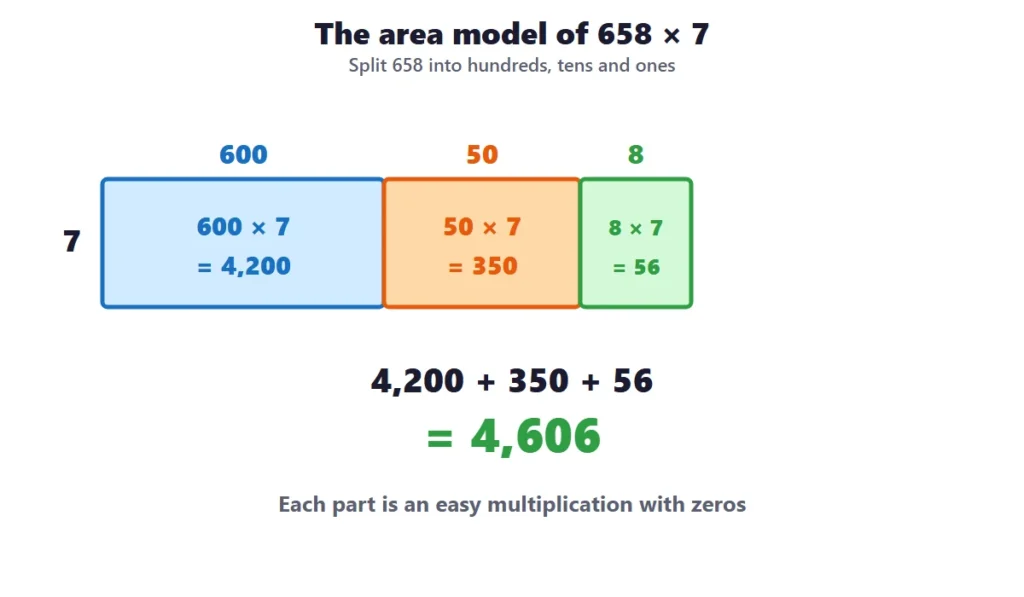
The area model. 4,200 + 350 + 56.
Problem
Zeros in the number
What happens to a carry
Product
4,056 × 3
1
a carry into a zero digit is written: 0 × 3 = 0, plus the carry
12,168
5,008 × 7
2
a carry into a zero digit is written: 0 × 7 = 0, plus the carry
35,056
3,090 × 4
2
a carry into a zero digit is written: 0 × 4 = 0, plus the carry
12,360
7,002 × 9
2
a carry into a zero digit is written: 0 × 9 = 0, plus the carry
63,018
1,009 × 8
2
a carry into a zero digit is written: 0 × 8 = 0, plus the carry
8,072
For 4,056 × 3, the hundreds digit is 0, and 0 × 3 = 0, plus the carry 1, so the digit written is 1. A child who skips the zero loses a digit and gets 1,268 instead of 12,168. The place value worksheets pages show why each digit has its own column.
4th grade multiplication worksheets: estimating and the area model
For 4th grade multiplication worksheets, the standard asks children to illustrate the calculation with equations, rectangular arrays or area models. The area model splits the number into hundreds, tens and ones, multiplies each part, and adds. This table shows four problems:
Problem
Split the number into parts
Multiply each part
Product
658 × 7
600 × 7 + 50 × 7 + 8 × 7
4,200 + 350 + 56
4,606
324 × 3
300 × 3 + 20 × 3 + 4 × 3
900 + 60 + 12
972
837 × 9
800 × 9 + 30 × 9 + 7 × 9
7,200 + 270 + 63
7,533
2,413 × 4
2,000 × 4 + 400 × 4 + 10 × 4 + 3 × 4
8,000 + 1,600 + 40 + 12
9,652
Each part is an easy multiplication with zeros. To estimate, round the number to the nearest hundred and multiply. This table shows six problems, with the estimate and the exact product:
Problem
Round to the nearest hundred
Estimate
Exact product
Difference
658 × 7
658 → 700
700 × 7 = 4,900
4,606
294
2,413 × 4
2,413 → 2,400
2,400 × 4 = 9,600
9,652
52
324 × 3
324 → 300
300 × 3 = 900
972
72
4,056 × 3
4,056 → 4,100
4,100 × 3 = 12,300
12,168
132
5,078 × 6
5,078 → 5,100
5,100 × 6 = 30,600
30,468
132
837 × 9
837 → 800
800 × 9 = 7,200
7,533
333
The estimating with rounding and rounding worksheets pages have more practice with rounding. A check is to divide the product by the multiplier, and this table checks five answers:
Problem
Product
Check: divide the product by the multiplier
Gives the start?
324 × 3
972
972 ÷ 3 = 324
yes
658 × 7
4,606
4,606 ÷ 7 = 658
yes
2,413 × 4
9,652
9,652 ÷ 4 = 2,413
yes
4,056 × 3
12,168
12,168 ÷ 3 = 4,056
yes
837 × 9
7,533
7,533 ÷ 9 = 837
yes
Common mistakes with 3 and 4-digit by 1-digit multiplication
The most common mistake is to forget a carry. This table shows five mistakes, what went wrong and the fix:
What the child writes or says
What went wrong
The fix
658 × 7 = 4,206
forgets the carry in the tens
5 × 7 = 35, plus 5 is 40: write 0, carry 4
4,056 × 3 = 12,168, but the child writes 1,268
skips the zero, and loses a digit
0 × 3 = 0, plus the carry 1 is 1: write 1
324 × 3 = 9,612
writes the products in the wrong order
start from the ones: 4 × 3 = 12, write 2 and carry 1
2,413 × 4 = 9,652, and the child doubts it
does not estimate
2,400 × 4 = 9,600, so 9,652 is reasonable
The carry is multiplied by the multiplier
multiplies the carry as well
the carry is added after the multiplication, not multiplied
3 and 4-digit by 1-digit multiplication word problems
Story problems use large numbers from stadiums, farms and factories. Ask children to estimate first, and then to multiply column by column:
Word problem
Working
Answer
A factory packs 324 boxes with 3 toys in each. How many toys is that?
324 × 3
972 toys
A library has 7 shelves with 658 books on each. How many books are there?
658 × 7
4,606 books
A stadium has 4 sections of 2,413 seats. How many seats are there?
2,413 × 4
9,652 seats
A farm has 3 fields of 4,056 plants. How many plants is that?
4,056 × 3
12,168 plants
A shop sells 9 boxes of 837 stickers. How many stickers is that?
837 × 9
7,533 stickers
A train travels 5,078 meters in each of 6 trips. How far is that in all?
5,078 × 6
30,468 meters
Games and activities for 3 and 4-digit by 1-digit multiplication
Children learn 3 and 4-digit by 1-digit multiplication best when they play with it. These games use things that are found at home or in a classroom:
Estimate and check: estimate each product by rounding to the nearest hundred, and then multiply
Digit cards: draw three or four digit cards and a multiplier card, and multiply
Carry detective: find the missing carry in a worked example
Zero hunt: find the problems in a list that have a zero in the number, and solve them
Area model race: split each number into hundreds, tens and ones and add the four products
Multiplication bingo: a bingo card with products, and calling cards with problems
Extra support and extra challenge with 3 and 4-digit by 1-digit multiplication
For children who need more support: make sure that 2-digit by 1-digit multiplication is secure. Use grid paper, one digit to a box, and write each carry above the next digit. Say each step: “8 times 7 is 56, write 6 and carry 5”. Do the 3-digit sheets with multipliers of 2, 3 and 4 first, and use the answer key to find the column of a mistake.
For children who need more challenge: ask for the biggest 4-digit number that gives a 5-digit product with a multiplier of 3, for a product with a zero in the middle, and for the missing digit in 4☐6 × 7 = 3,262. A story problem that needs two steps, such as finding the cost of 7 boxes of 658 and then the change, is a good challenge.
How to tell that a child is ready to move on from 3 and 4-digit by 1-digit multiplication
Before moving on from 3 and 4-digit by 1-digit multiplication, check that the child can do all four of these things:
The child multiplies each column and adds the carry.
The child writes a digit for a zero in the number.
The child estimates by rounding to the nearest hundred.
The child multiplies 4-digit numbers by one digit.
A 20-minute lesson on 3 and 4-digit by 1-digit multiplication
A short lesson is the best way to introduce 3 and 4-digit by 1-digit multiplication. This 20-minute plan can be used in a classroom, at a tutoring session or at home, and it uses the worksheets at the end:
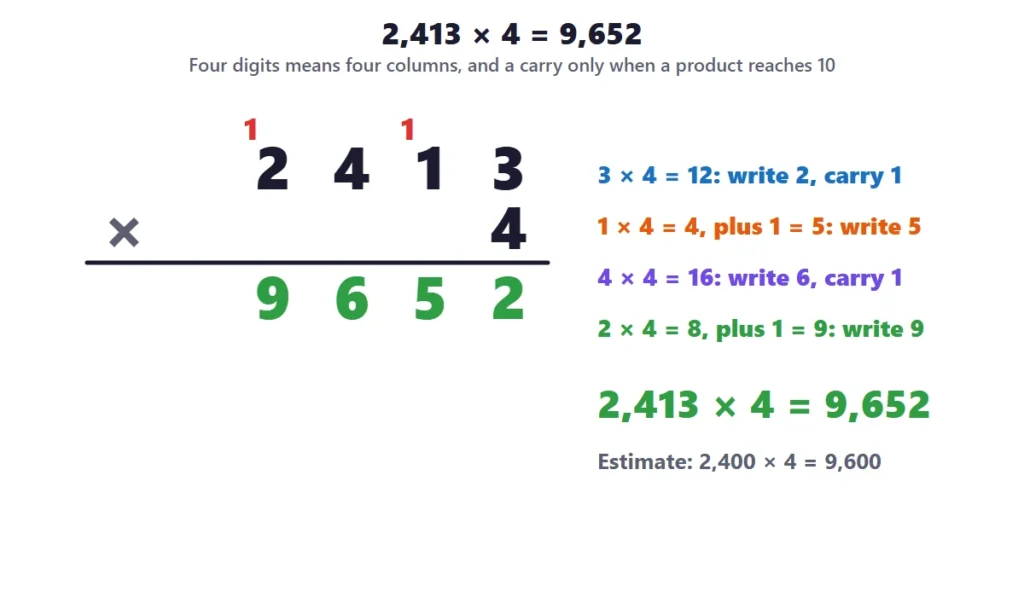
Four digits. 2,413 × 4 = 9,652.
Minutes
Activity
What to say or ask
0 to 3
Estimate 658 × 7 with 700 × 7
What is 700 × 7?
3 to 8
Do 658 × 7 one column at a time
What do we carry from the ones?
8 to 13
Do 4,056 × 3 and find the digit for the zero
What is written for the 0?
13 to 18
Check 658 × 7 with the area model
4,200 + 350 + 56 = ?
18 to 20
Start a worksheet and check one answer
Check with an estimate.
Where 3 and 4-digit by 1-digit multiplication fits across the grades
No skill stands alone. This table shows what children learn before and after 3 and 4-digit by 1-digit multiplication, with the standard that goes with each step:
This page is the middle of the multi-digit multiplication pages. The whole sequence is on the multiplication worksheets page.
Helping at home with 3 and 4-digit by 1-digit multiplication
Parents do not need to be experts to help with 3 and 4-digit by 1-digit multiplication. These suggestions work well, and each takes only a few minutes:
Ask the child to estimate before multiplying.
Use real large numbers: “4 sections of 2,413 seats”.
Look for the carries when checking the homework.
Use grid paper, one digit to a box.
Check each answer by dividing by the multiplier.
How to check progress in 3 and 4-digit by 1-digit multiplication
A teacher or parent can check progress in 3 and 4-digit by 1-digit multiplication with the answer key and a few questions. This table shows three common situations, what they mean and what to do next:
What you see
What it means
What to do next
The child forgets a carry
The carry step is not yet automatic
Write each carry above the next digit, and tick it off
The child gets 9 of 10 right in every set
3 and 4-digit by 1-digit multiplication is secure
Move on to 2-digit by 2-digit multiplication
The child loses a digit when there is a zero
The zero column is skipped
Say the digit of every column aloud, including the zero
A five-day plan for 3 and 4-digit by 1-digit multiplication
Most children need about a week of short sessions for 3 and 4-digit by 1-digit multiplication. This plan follows the order of the worksheets on this page:
How do you multiply a 4-digit number by a 1-digit number?
Multiply the ones digit, write the ones digit of the product, and carry the tens. Do the same for the tens, the hundreds and the thousands, adding the carry each time. For 2,413 × 4, the answer is 9,652.
How can you check a multiplication answer?
Estimate by rounding the number to the nearest hundred, or divide the product by the multiplier. For 658 × 7 = 4,606, 700 × 7 = 4,900 is close, and 4,606 ÷ 7 = 658.
What do you do when there is a zero in the number?
Multiply the zero by the multiplier, which gives zero, and add the carry from the column before. The digit you write is the carry, and the carry for the next column is zero.