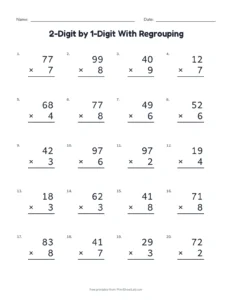
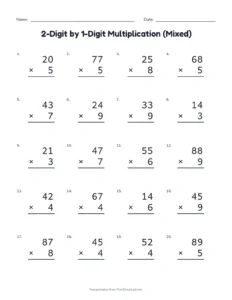
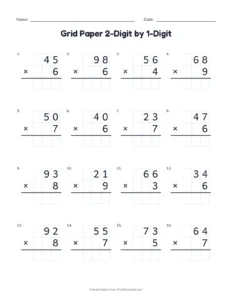
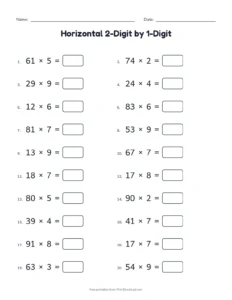
Change the numbers, layout and number of problems, then download a new PDF with its answer key.
2-digit by 1-digit multiplication is the first multi-digit multiplication that children do, and it uses the times tables with place value. The seven PDFs on this page have problems with and without regrouping, on plain paper and on grid paper, plus a riddle and story problems, and every sheet has an answer key. They follow standard 4.NBT.B.5 of the Common Core standards for grade 4 number and operations in base ten, and the notes below show the steps, how often regrouping happens, and two other ways to see the same answer.
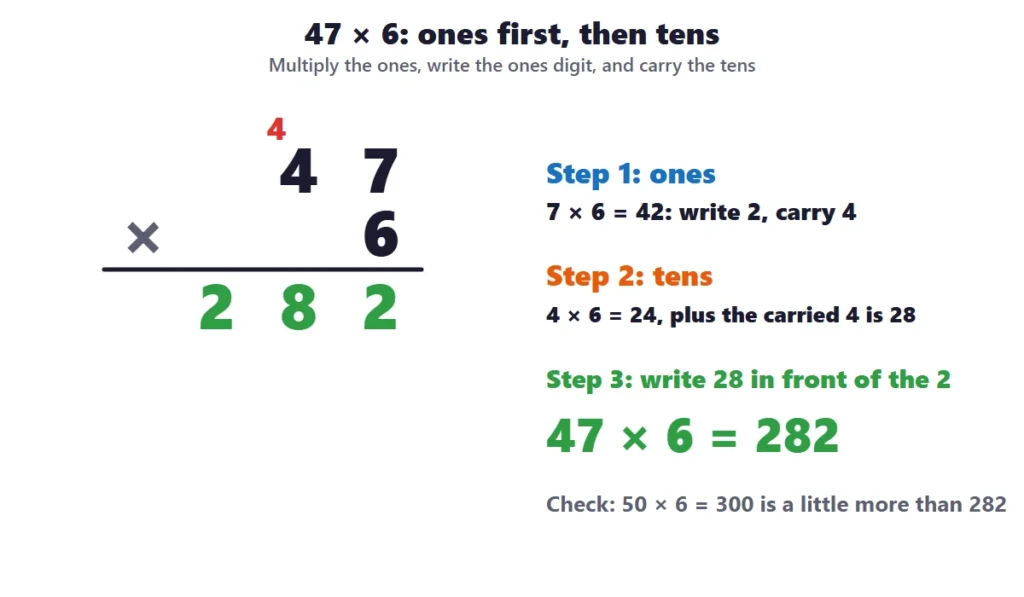
The column method. 47 × 6 = 282.
Quick answer: 2-digit by 1-digit multiplication multiplies a number from 10 to 99 by a single digit, such as 47 × 6 = 282, using place value and carrying. This page has 7 free printable worksheets with answer keys for grades 3 and 4. Updated October 2026.
How to multiply a 2-digit number by a 1-digit number
Multiply the ones first, then the tens. In 47 × 6:
Ones: 7 × 6 = 42. Write 2 and carry the 4 tens.
Tens: 4 × 6 = 24, plus the 4 carried is 28.
The answer is 282.
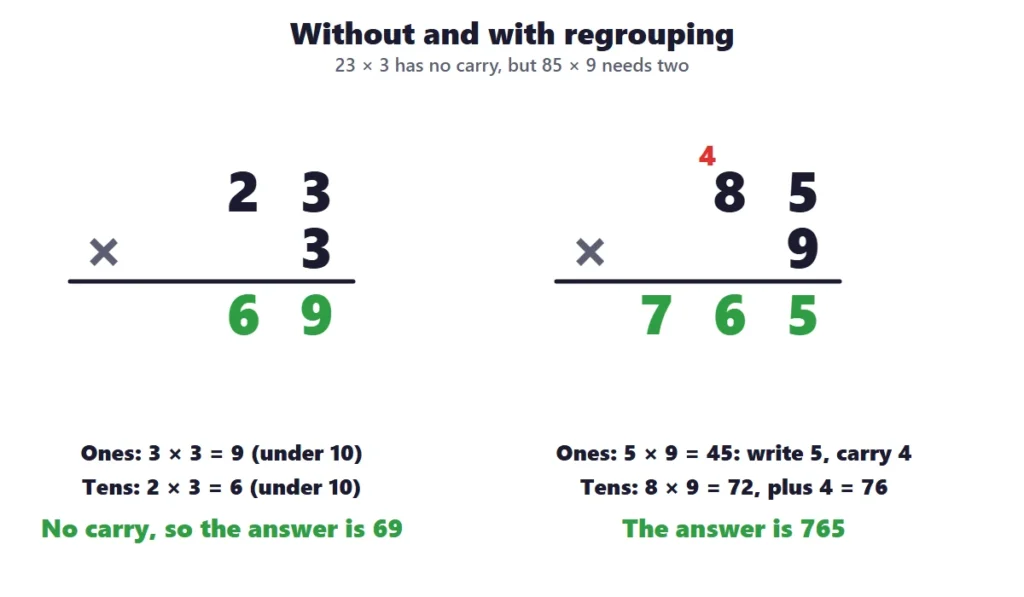
Without regrouping, no product is 10 or more, as in 23 × 3 = 69. That is why the “no regrouping” sheet comes first.
Another way: partial products
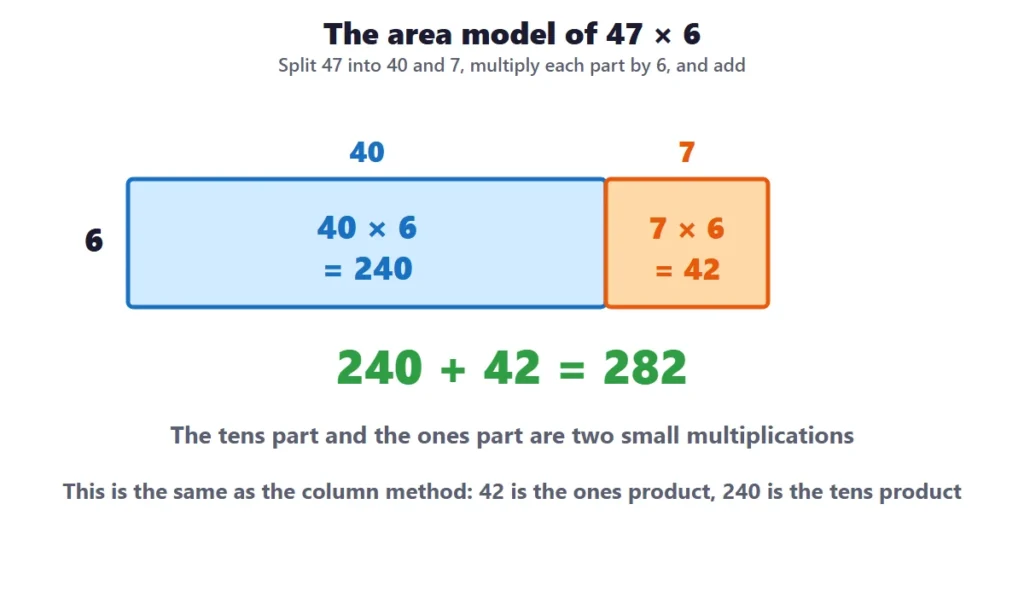
Split the 2-digit number into tens and ones: 47 × 6 = 40 × 6 + 7 × 6 = 240 + 42 = 282. This shows why the method works and is a good way to check answers.
What is on this page
No regrouping, always regrouping and mixed sets of column problems.
Grid paper to keep digits lined up.
A riddle and story problems.
2-digit by 1-digit multiplication worksheets: what is in the set
There are 7 2-digit by 1-digit multiplication worksheets on this page, and every one has an answer key except for any cut-out games. Three sheets are column problems (no regrouping, regrouping and mixed), two use grid paper or a horizontal layout, one is a riddle and one has story problems.
Worksheet
What children do
Standard
2-Digit by 1-Digit, No Regrouping
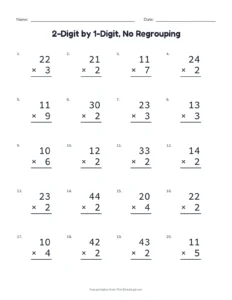
20 problems like 32 × 3 with no carrying.
4.NBT.B.5
2-Digit by 1-Digit With Regrouping
20 problems that all need carrying.
4.NBT.B.5
2-Digit by 1-Digit Multiplication (Mixed)
20 problems, some with carrying.
4.NBT.B.5
Grid Paper 2-Digit by 1-Digit
16 problems in boxes to keep the columns straight.
4.NBT.B.5
Horizontal 2-Digit by 1-Digit
20 problems written across the page, good for mental math.
4.NBT.B.5
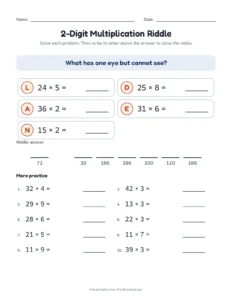
2-Digit Multiplication Riddle
Solve the problems to decode a riddle.
4.NBT.B.5
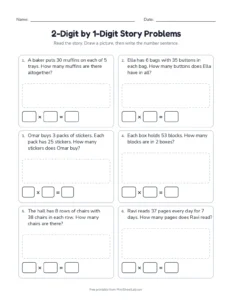
2-Digit by 1-Digit Story Problems
Six story problems with a 2-digit number.
4.NBT.B.5
2 digit by 1 digit multiplication worksheets: how the sets are built
The 2 digit by 1 digit multiplication worksheets in this pack start with problems that have no regrouping, so that children can see that the product of each digit is written under it. The next sheets need regrouping in every problem, and then the mixed sheet has some of both. Wikipedia’s article on multiplication algorithms shows how the same idea is used for large numbers. This table shows the formats on the page and what each is best for:
Format
What children do
Best for
Column form
multiply the ones, then the tens, with carries
most children, and the form on the answer keys
Grid paper
one digit in each box, so the columns stay straight
children whose digits drift out of line
Horizontal
write the problem across the page and solve it mentally
mental math and partial products
Area model
split the number into tens and ones and draw boxes
children who want to see why the method works
Story problem
a short story with a 2-digit number and a 1-digit number
choosing multiplication, and saying what the answer means
The answer keys show the carries as well as the answers, so that children can find a mistake in the exact column where it happened.
2-digit by 1-digit multiplication: the column method
The column method for 2-digit by 1-digit multiplication multiplies the ones first, writes the ones digit of the product, and carries the tens to the next column. These tables show three problems step by step. The first has no regrouping, since every product is less than 10:
23 × 3 = 69
Column
Multiply the digit
Add the carry
Total
Write
Carry
ones
3 × 3 = 9
—
9
9
—
tens
2 × 3 = 6
—
6
6
—
The second has a carry from the ones to the tens:
47 × 6 = 282
Column
Multiply the digit
Add the carry
Total
Write
Carry
ones
7 × 6 = 42
—
42
2
4
tens
4 × 6 = 24
+ 4 = 28
28
8
2
The third has a carry in both columns, so its product has three digits:
85 × 9 = 765
Column
Multiply the digit
Add the carry
Total
Write
Carry
ones
5 × 9 = 45
—
45
5
4
tens
8 × 9 = 72
+ 4 = 76
76
6
7
Multiplication with regrouping worksheets: what regrouping means
The multiplication with regrouping worksheets are about trading. When the ones product is 10 or more, ten ones are traded for one ten, as in addition. In 47 × 6 the ones product is 42, which is 4 tens and 2 ones, so the 2 is written and the 4 tens are added to the tens column. This table shows six problems and what happens to the ones:
Problem
Ones product
Ones written
Tens traded
Meaning
23 × 3
3 × 3 = 9
9
—
no ten is made
47 × 6
7 × 6 = 42
2
4
42 ones make 4 tens and 2 ones
85 × 9
5 × 9 = 45
5
4
45 ones make 4 tens and 5 ones
68 × 5
8 × 5 = 40
0
4
40 ones make 4 tens and 0 ones
39 × 4
9 × 4 = 36
6
3
36 ones make 3 tens and 6 ones
76 × 8
6 × 8 = 48
8
4
48 ones make 4 tens and 8 ones
This idea is the same as in the addition worksheets pages, and the place value worksheets pages show why ten ones make one ten. A child who understands the trade does not need to memorize the rule “carry the 4”.
2 digit multiplication: how often does regrouping happen?
In 2 digit multiplication, regrouping is more common than not. This table counts the 90 two-digit numbers from 10 to 99 for each multiplier from 2 to 9, and shows how many have no regrouping, how many regroup in the ones, and how many have a three-digit product:
The area model. 240 + 42 = 282.
Multiplier
Numbers with no regrouping
Share
Numbers that regroup in the ones
Products with 2 digits
Products with 3 digits
2
20
22%
45
40
50
3
12
13%
54
24
66
4
6
7%
63
15
75
5
2
2%
72
10
80
6
2
2%
72
7
83
7
2
2%
72
5
85
8
2
2%
72
3
87
9
2
2%
72
2
88
With a multiplier of 2, 20 of the 90 numbers need no regrouping, and with a multiplier of 9 only 2 do, which are 10 and 11. For a multiplier of 2 the products have three digits from 50 onwards, and for 9 they have three digits from 12 onwards. The no-regrouping sheet therefore uses small multipliers such as 2, 3 and 4, since for larger multipliers such problems are rare.
Double digit multiplication: partial products and the area model
Another way to see double digit multiplication is to split the 2-digit number into tens and ones, and to multiply each part. These are the partial products. In 47 × 6, 40 × 6 = 240 and 7 × 6 = 42, so the product is 282. The area model draws the two parts as two boxes, as the diagram above shows. This table shows six problems with the two partial products:
Problem
Tens part
Ones part
Add
Product
47 × 6
40 × 6 = 240
7 × 6 = 42
240 + 42
282
85 × 9
80 × 9 = 720
5 × 9 = 45
720 + 45
765
23 × 3
20 × 3 = 60
3 × 3 = 9
60 + 9
69
68 × 5
60 × 5 = 300
8 × 5 = 40
300 + 40
340
39 × 4
30 × 4 = 120
9 × 4 = 36
120 + 36
156
76 × 8
70 × 8 = 560
6 × 8 = 48
560 + 48
608
The tens part is always a multiple of 10, so it uses the times tables and a zero. The ones part is a single times table fact. Both methods give the same answer, and the partial products method is a good way to check the column method.
4th grade multiplication: estimating and checking
In 4th grade multiplication, children estimate before they calculate, and check afterwards. To estimate, round the 2-digit number to the nearest ten, and multiply. This table shows six problems, with the estimate and the exact answer:
Problem
Round the 2-digit number
Estimate
Exact product
Difference
47 × 6
47 → 50
50 × 6 = 300
282
18
85 × 9
85 → 90
90 × 9 = 810
765
45
68 × 5
68 → 70
70 × 5 = 350
340
10
39 × 4
39 → 40
40 × 4 = 160
156
4
76 × 8
76 → 80
80 × 8 = 640
608
32
23 × 3
23 → 20
20 × 3 = 60
69
9
The estimate is within 50 of the exact answer in every case, and the size of the answer is right. The check is to divide the product by the multiplier, which should give back the start. This table checks four answers:
Common mistakes with 2-digit by 1-digit multiplication
The most common mistake is to forget the carry. This table shows five mistakes, what went wrong and the fix:
What the child writes or says
What went wrong
The fix
47 × 6 = 242
forgets to add the carried 4
tens: 4 × 6 = 24, and 24 + 4 = 28: the answer is 282
47 × 6 = 2842
writes both products in full, 42 and 28, side by side
write only the ones digit 2 of 42, and carry the 4
23 × 3 = 66
adds 23 + 3 + … or multiplies only one digit
multiply both digits: 3 × 3 = 9 and 2 × 3 = 6, so 69
85 × 9 = 7245
does not carry, and writes 72 and 45 side by side
5 × 9 = 45: write 5, carry 4, then 8 × 9 = 72 plus 4 is 76
The carry is written in the wrong column
puts the carry under the line, not above the next digit
write the carry small, above the digit that it is added to
2-digit by 1-digit multiplication word problems
Story problems use packs, rows and boxes. Ask children to write the multiplication, estimate, and then solve with the column method:
Word problem
Working
Answer
A box holds 23 pencils. How many pencils are in 3 boxes?
23 × 3
69 pencils
A class buys 6 packs of 47 stickers. How many stickers is that?
47 × 6
282 stickers
A shop has 9 shelves with 85 books on each shelf. How many books are there?
85 × 9
765 books
A farmer plants 5 rows of 68 tomato plants. How many plants is that?
68 × 5
340 plants
There are 4 tanks with 39 fish in each. How many fish are there?
39 × 4
156 fish
A bus carries 76 people on each of its 8 trips. How many people is that in all?
76 × 8
608 people
Games and activities for 2-digit by 1-digit multiplication
Children learn 2-digit by 1-digit multiplication best when they play with it. These games use things that are found at home or in a classroom:
Tens and ones: build 47 with tens rods and ones cubes, and make 6 copies to count the product
Dice multiplication: roll two dice for a 2-digit number and one die for the multiplier, and multiply
Estimate first: estimate each problem by rounding, and then check with the exact answer
Carry detective: find a mistake in a worked example, such as a missing carry
Riddle race: solve the problems on the riddle sheet to decode the joke
Multiplication bingo: a bingo card with products, and calling cards with problems
Extra support and extra challenge with 2-digit by 1-digit multiplication
For children who need more support: make sure the times tables are secure, and use base-ten blocks or drawings of tens and ones. Do the no-regrouping sheet first. Use grid paper, and write the carry small above the next digit. Check every answer with the area model, and use the answer key to find the column where a mistake happened.
For children who need more challenge: ask for the biggest 2-digit number that gives a 2-digit product with a multiplier of 4, for two different problems that have the product 168, and for the missing digit in 3☐ × 6 = 204. Try to estimate which problems need regrouping before solving them.
How to tell that a child is ready to move on from 2-digit by 1-digit multiplication
Before moving on from 2-digit by 1-digit multiplication, check that the child can do all four of these things:
With and without regrouping. 23 × 3 and 85 × 9.
The child multiplies the ones and then the tens.
The child carries the tens, and adds the carry after multiplying.
The child estimates and checks the product.
The child solves a story problem with a 2-digit number.
A 20-minute lesson on 2-digit by 1-digit multiplication
A short lesson is the best way to introduce 2-digit by 1-digit multiplication. This 20-minute plan can be used in a classroom, at a tutoring session or at home, and it uses the worksheets at the end:
Minutes
Activity
What to say or ask
0 to 3
Show 23 × 3 with tens rods and ones cubes
How many tens? How many ones?
3 to 8
Write 23 × 3 in columns and multiply the ones, then the tens
Where does each product go?
8 to 13
Do 47 × 6 and trade 42 ones for 4 tens and 2 ones
What do we do with the 4?
13 to 18
Check 47 × 6 with the area model, 240 + 42
Do we get the same answer?
18 to 20
Start a worksheet and check one answer
Check with an estimate.
Where 2-digit by 1-digit multiplication fits across the grades
No skill stands alone. This table shows what children learn before and after 2-digit by 1-digit multiplication, with the standard that goes with each step:
This page is the first of the multi-digit multiplication pages. The whole sequence is on the multiplication worksheets page.
Helping at home with 2-digit by 1-digit multiplication
Parents do not need to be experts to help with 2-digit by 1-digit multiplication. These suggestions work well, and each takes only a few minutes:
Practice the times tables a few minutes a day.
Ask the child to estimate the answer before calculating.
Use real numbers: “6 packs of 47 cards, how many cards?”.
Look for the carry when checking the homework.
Use grid paper to keep the digits in columns.
How to check progress in 2-digit by 1-digit multiplication
A teacher or parent can check progress in 2-digit by 1-digit multiplication with the answer key and a few questions. This table shows three common situations, what they mean and what to do next:
What you see
What it means
What to do next
The child forgets to add the carry
The carry step is not yet automatic
Write the carry above the next digit, and tick it off after adding
The child gets 9 of 10 right in every set
2-digit by 1-digit multiplication is secure
Move on to 3-digit and 4-digit numbers
The child gets the ones right and the tens wrong
The tens product is read as ones
Say “40 times 6” and use the area model
A five-day plan for 2-digit by 1-digit multiplication
Most children need about a week of short sessions for 2-digit by 1-digit multiplication. This plan follows the order of the worksheets on this page:
Day
What to do
Practice
Day 1
Review the times tables, and multiply tens by one digit
No regrouping
Day 2
Multiply with no regrouping, and check with the area model
Grid paper
Day 3
Multiply with regrouping, writing the carry above the tens
2 digit by 1 digit multiplication worksheets: how many problems need regrouping?
We checked all 720 problems from 10 × 2 to 99 × 9. 672 of them (93%) need regrouping at least once, which is why a page of 2 digit multiply 1 digit problems feels harder than a page of single-digit facts.
Multiplication worksheets 2 digit by 1 digit, and 3 and 2 digit multiplication worksheets
This page is also searched as 2 digit multiply 1 digit worksheet pages, multiplication worksheets 2 digit by 1 digit, 2 digit by 1 digit multiplication worksheet, 2-digit multiplication worksheet, multiplication by 1 digit worksheets and 2 digit by 1 multiplication worksheets. All of these are the free PDFs above. When you are ready to go up, the 2 and 3 digit multiplication worksheets, the 3 and 2 digit multiplication worksheets and the 2 digit by 3 digit multiplication worksheets are on our multiplication worksheets page. A multiplication cheat sheet 1 digit by 2 digits is the partial product method in the table above: multiply the ones, then the tens, then add.
Frequently asked questions
6 quick answers
What grade learns 2-digit by 1-digit multiplication?
It is part of grade 4 in the Common Core (4.NBT.B.5), and many grade 3 classes start it after learning the facts.
What does regrouping mean in multiplication?
When a column’s product is 10 or more, you write the ones digit and carry the tens to the next column, just as in addition.
How do you multiply a 2-digit number by a 1-digit number?
Multiply the ones digit first, write the ones digit of the product, and carry the tens. Then multiply the tens digit, add the carry, and write the result. For 47 × 6, 7 × 6 = 42, write 2 and carry 4, then 4 × 6 = 24, plus 4 is 28, so 282.
What is regrouping in multiplication?
Regrouping means trading ten of a smaller place value for one of the next. In multiplication it is called carrying: when a column’s product is 10 or more, the ones digit is written and the tens digit is added to the next column.
Is 2-digit by 1-digit multiplication a grade 3 or grade 4 skill?
It is part of grade 4 in the Common Core (4.NBT.B.5). Many grade 3 classes start it after they have learned the times tables.
Where can I download free 2 digit by 1 digit multiplication worksheets?
Open any worksheet in the gallery above, choose US Letter or A4, then print or save the PDF. They are free and each has an answer key.