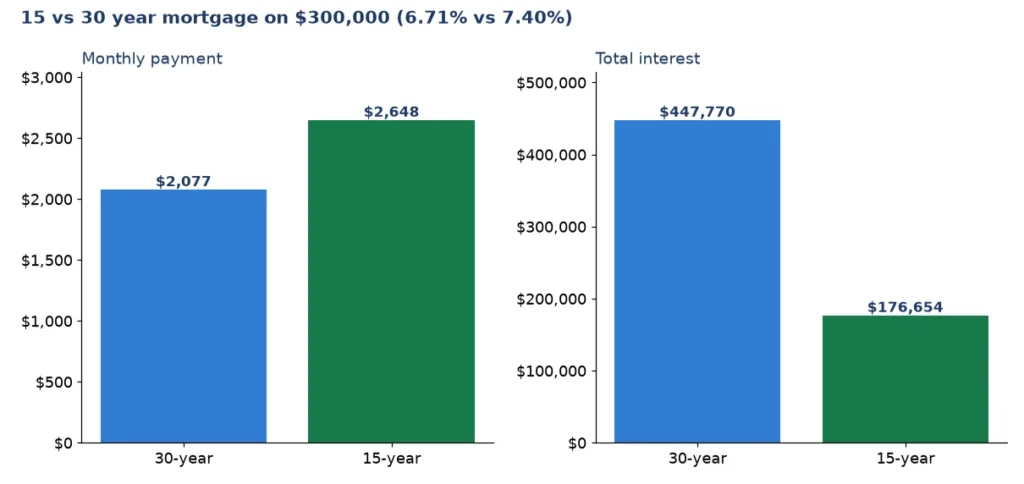
15 vs 30 year mortgage: a 15-year loan costs more each month but far less in total. At current rates (about 6.71% for 15 years and 7.40% for 30 years), a $300,000 loan costs $2,648.08 a month over 15 years versus $2,077.14 over 30, and saves $271,116 of interest. Here is the full comparison, and how to decide.
15 year vs 30 year mortgage: side by side
| Loan amount | 30-year payment | 15-year payment | 30-year interest | 15-year interest | Interest saved |
|---|---|---|---|---|---|
| $200,000 | $1,384.76 | $1,765.39 | $298,513 | $117,770 | $180,744 |
| $300,000 | $2,077.14 | $2,648.08 | $447,770 | $176,654 | $271,116 |
| $400,000 | $2,769.52 | $3,530.77 | $597,027 | $235,539 | $361,488 |
| $500,000 | $3,461.90 | $4,413.47 | $746,284 | $294,424 | $451,860 |
Principal and interest only, at 7.40% (30-year) and 6.71% (15-year). Taxes and insurance are the same for both.
Equity: how fast a 15-year mortgage builds ownership
Principal paid off on a $300,000 loan:
| 30-year loan | 15-year loan | |
|---|---|---|
| After 5 years | $16,431 | $68,968 |
| After 10 years | $40,192 | $165,338 |
| After 15 years | $74,552 | $300,000 |
After five years a 15-year borrower has paid off about 4 times as much of the loan as a 30-year borrower, which matters if you sell, refinance or need a home equity line.
What if you invest the difference?
| Yearly return on the invested $570.94 a month | Value after 15 years | 30-year balance still owed | Ahead or behind |
|---|---|---|---|
| 4% | $140,503 | $225,448 | −$84,945 |
| 6% | $166,040 | $225,448 | −$59,408 |
| 8% | $197,567 | $225,448 | −$27,881 |
| 10% | $236,638 | $225,448 | +$11,190 |
A 30-year borrower who invests the $570.94 difference every month needs a return of about 9.5% a year, after tax, just to match the 15-year borrower, who owns the home outright after 15 years. Investment returns are not guaranteed; the 15-year loan’s saving is.
How the rate gap changes the answer
| 15-year rate vs 30-year | 15-year rate | 15-year payment | Extra each month | Interest saved |
|---|---|---|---|---|
| 0.25 points lower | 7.15% | $2,721.71 | $644.57 | $257,863 |
| 0.50 points lower | 6.90% | $2,679.74 | $602.60 | $265,417 |
| 0.69 points lower | 6.71% | $2,648.08 | $570.94 | $271,116 |
| 1.00 points lower | 6.40% | $2,596.86 | $519.72 | $280,336 |
Even with no rate gap the 15-year loan saves most of the interest, because the money is borrowed for half as long. A wider gap simply adds to the saving.
Pros and cons of each term
- 15-year pros: lower rate, far less interest, debt-free sooner, faster equity.
- 15-year cons: a payment $570.94 higher each month, so you qualify for less house and have less slack in a bad month.
- 30-year pros: lower required payment, more room to save, invest or handle emergencies; you can still pay extra.
- 30-year cons: higher rate and much more total interest.
The middle way: a 30-year loan paid like a 15
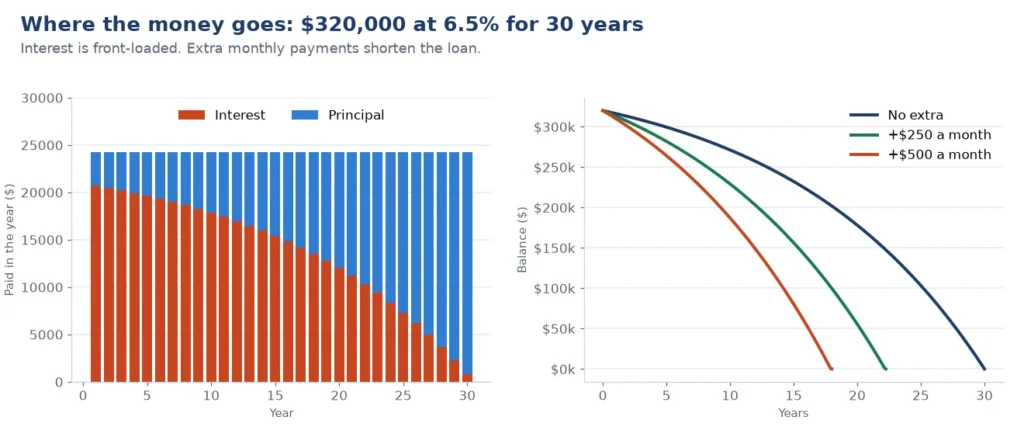
Take the 30-year loan but pay the 15-year amount ($570.94 extra a month). Because the 30-year rate is higher, it takes 16 years 4 months to pay off and costs $216,623 of interest, versus 15 years and $176,654 with a real 15-year loan. You pay $39,969 more for the flexibility of being able to drop back to the lower payment.
Which should you choose: a 15 or 30 year mortgage?
- Choose 15 years if the payment fits comfortably, you have an emergency fund and retirement savings on track, and you want to be debt-free sooner.
- Choose 30 years if the 15-year payment would strain your budget, your income is irregular, or you would rather invest the difference.
- Income check: under the 28% rule, a $375,000 home with 20% down needs about $110,181 of gross income on a 30-year loan and $134,650 on a 15-year loan (with our example tax and insurance).
The choice is really one between a lower total cost and a lower required payment. Compare your own numbers with the mortgage calculator or the amortization schedule calculator, and see paying off your mortgage early for extra payments.
These examples explain the math for planning. They are general information, not financial advice; your lender’s Loan Estimate gives the real figures.
Related calculators and guides
- Mortgage calculator
- Amortization schedule calculator
- Refinance calculator
- how much house can I afford
- biweekly mortgage payments
Sources
- Primary Mortgage Market Survey (Freddie Mac): 30-year 7.40% and 15-year 6.71% on October 15, 2026
Frequently asked questions
5 quick answers
Is a 15 or 30 year mortgage better?
A 15-year mortgage is cheaper overall; a 30-year mortgage is more flexible. On $300,000 the 15-year saves $271,116 of interest but costs $570.94 more a month.
How much more is a 15-year mortgage payment?
About 27% more on the same loan at current rates: $2,648.08 vs $2,077.14 on $300,000.
Are 15-year mortgage rates lower?
Yes. On October 15, 2026, Freddie Mac’s survey averaged 6.71% for 15 years and 7.40% for 30 years.
Can I pay a 30-year mortgage off in 15 years?
Yes, by paying extra each month. Because the rate is higher it costs a little more than a true 15-year loan.
Can I refinance from 30 to 15 years later?
Yes, if rates and your finances allow; the refinance calculator shows the break-even.
Did you like this?
Last updated: