How to fill out a W-4 in 2026: most people only need Step 1 and Step 5. Fill in Steps 2, 3 and 4 only if you have more than one job, a working spouse, children or other dependents, other income, or deductions such as overtime. This guide walks through each step of the 2026 Form W-4 with worked examples showing how each entry changes your paycheck.
How to fill out a W-4, step by step
Step 1: Personal information. Name, address, Social Security number and filing status: single or married filing separately; married filing jointly; or head of household (unmarried and paying more than half the cost of a home for yourself and a qualifying person). Filing status sets the standard deduction your withholding assumes: $16,100, $32,200 or $24,150 in 2026.
Step 2: Multiple jobs or spouse works. Choose one option: (a) use the IRS Tax Withholding Estimator, (b) use the Multiple Jobs Worksheet and enter the result in Step 4(c), or (c) check the box if there are only two jobs in total, on both W-4s. Option (c) is most accurate when the two jobs pay about the same. Fill in Steps 3 to 4(b) on the W-4 for the highest paying job only.
Step 3: Claim dependents. If your income will be $200,000 or less ($400,000 joint), enter $2,200 for each child under 17 and $500 for each other dependent. You can add other credits you expect, such as education credits.
Step 4: Other adjustments. (a) other income without withholding, such as interest or dividends; (b) deductions from the Deductions Worksheet; (c) extra tax to withhold each pay period.
Step 5: Sign and date. Give the form to your employer, not the IRS.
How each step changes your paycheck
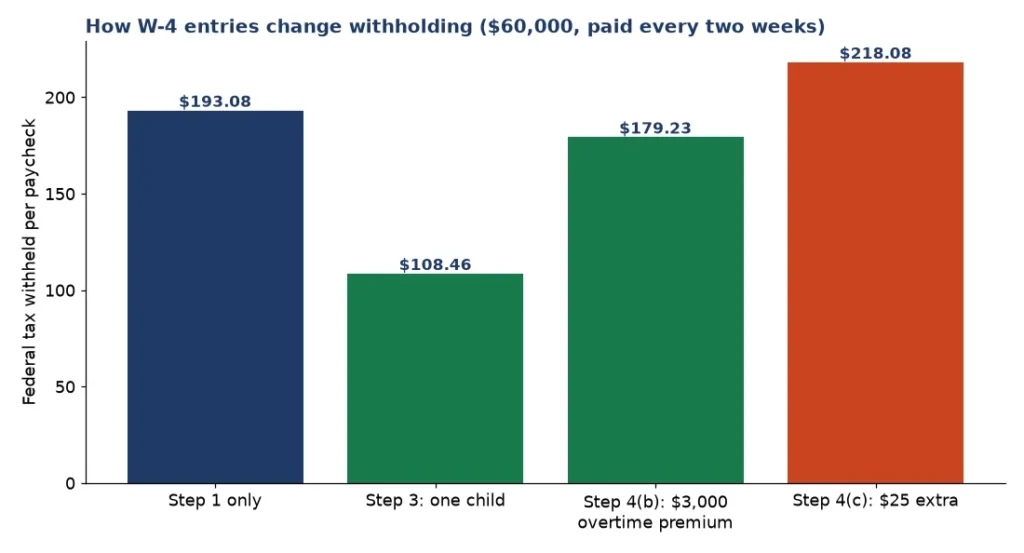
Single, $60,000 a year, paid every two weeks, federal income tax withheld per paycheck:
| W-4 entry | Withheld a year (about) | Per paycheck | Change per paycheck |
|---|---|---|---|
| Step 1 only (single) | $5,020 | $193.08 | – |
| Step 3: one child ($2,200) | $2,820 | $108.46 | +$84.62 take-home |
| Step 4(b): $3,000 overtime premium | $4,660 | $179.23 | +$13.85 take-home |
| Step 4(c): $25 extra | $5,670 | $218.08 | −$25.00 take-home |
The Step 4(b) Deductions Worksheet for 2026
The 2026 worksheet adds lines for the new federal deductions, so you can get them in each paycheck instead of waiting for a refund:
- Line 1a, qualified tips: up to $25,000 if your income is under $150,000 ($300,000 joint).
- Line 1b, qualified overtime: the “and-a-half” part of overtime, up to $12,500 ($25,000 joint), same income limits. See no tax on overtime.
- Line 1c, car loan interest: up to $10,000 if income is under $100,000 ($200,000 joint).
- Lines 3a and 3b, age 65 or older: $6,000 for you and $6,000 for your spouse if income is under $75,000 ($150,000 joint).
- Line 5: student loan interest, deductible IRA contributions and similar adjustments.
- Lines 6 to 14: itemized deductions above the standard deduction, including state and local taxes up to $40,400, mortgage interest and charity, plus up to $1,000 ($2,000 joint) of cash gifts to charity if you take the standard deduction.
W-4 examples for common situations
- Single, one job, no children: Step 1 and Step 5 only.
- Married, both work, similar pay: check Step 2(c) on both W-4s; claim children in Step 3 on the higher-paid spouse’s form only.
- Two jobs with very different pay: use the Multiple Jobs Worksheet or the IRS estimator and put the extra amount in Step 4(c) of the higher-paying job.
- Side income or interest: enter it in Step 4(a), or add extra withholding in Step 4(c), to avoid a bill in April.
- Want a bigger refund: add an amount in Step 4(c). Want a bigger paycheck: make sure Steps 3 and 4(b) include everything you qualify for.
Whichever situation fits, filling out a W-4 comes down to the same rule: enter only what applies, and use Steps 3 and 4(b) on one W-4 per household.
Can I claim exempt on my W-4?
Only if you had no federal income tax liability in 2025 and expect none in 2026. Then check the “Exempt from withholding” box and complete only Steps 1(a), 1(b) and 5. An exempt W-4 expires: you must give your employer a new one by February 16, 2027. If you claim exempt and do owe tax, you may face a bill and penalties.
When to fill out a new W-4
Filling out a W-4 once is not enough; update it when your life changes:
- You marry, divorce or have a child.
- You or your spouse start or leave a job.
- You start earning regular overtime or tips and want the new deductions in your paycheck.
- You got a large refund or owed money last April.
- You turn 65.
Run the IRS Tax Withholding Estimator with your latest pay stub, then check the result in our paycheck estimator.
These are estimates for planning, using 2026 rules. Your employer’s payroll system, your W-4 and your tax return decide the real figures. This is general information, not tax advice.
Related calculators and guides
- paycheck estimator
- all 51 state paycheck calculators
- How to read a pay stub
- Bonus tax rate by state
Sources
- Form W-4 (2026), Employee’s Withholding Certificate (IRS): every step, the Deductions Worksheet and exemption rules
- Tax Withholding Estimator (IRS)
- Publication 505 (2026), Tax Withholding and Estimated Tax (IRS)
- Rev. Proc. 2025-32: 2026 tax brackets and standard deduction (IRS)
Frequently asked questions
5 quick answers
How do I fill out a W-4 for 2026?
Complete Step 1 (personal details and filing status) and sign Step 5. Add Step 2 for two jobs or a working spouse, Step 3 for dependents, and Step 4 for other income, deductions or extra withholding.
What should I put on my W-4 to get more money in my paycheck?
Claim every child and dependent in Step 3 and any deductions you qualify for, such as overtime or tips, in Step 4(b). Remove extra withholding from Step 4(c).
How much is a dependent worth on a W-4 in 2026?
$2,200 for each child under 17 and $500 for each other dependent, if your income is $200,000 or less ($400,000 joint).
Should I check the box in Step 2(c)?
Yes if there are exactly two jobs in your household with similar pay; check it on both W-4s. If the pay is very different, the worksheet or estimator is more accurate.
Do I need a new W-4 every year?
No, unless you claim exempt, which must be renewed by February 16, 2027. Update it whenever your situation changes.
Did you like this?
Last updated: