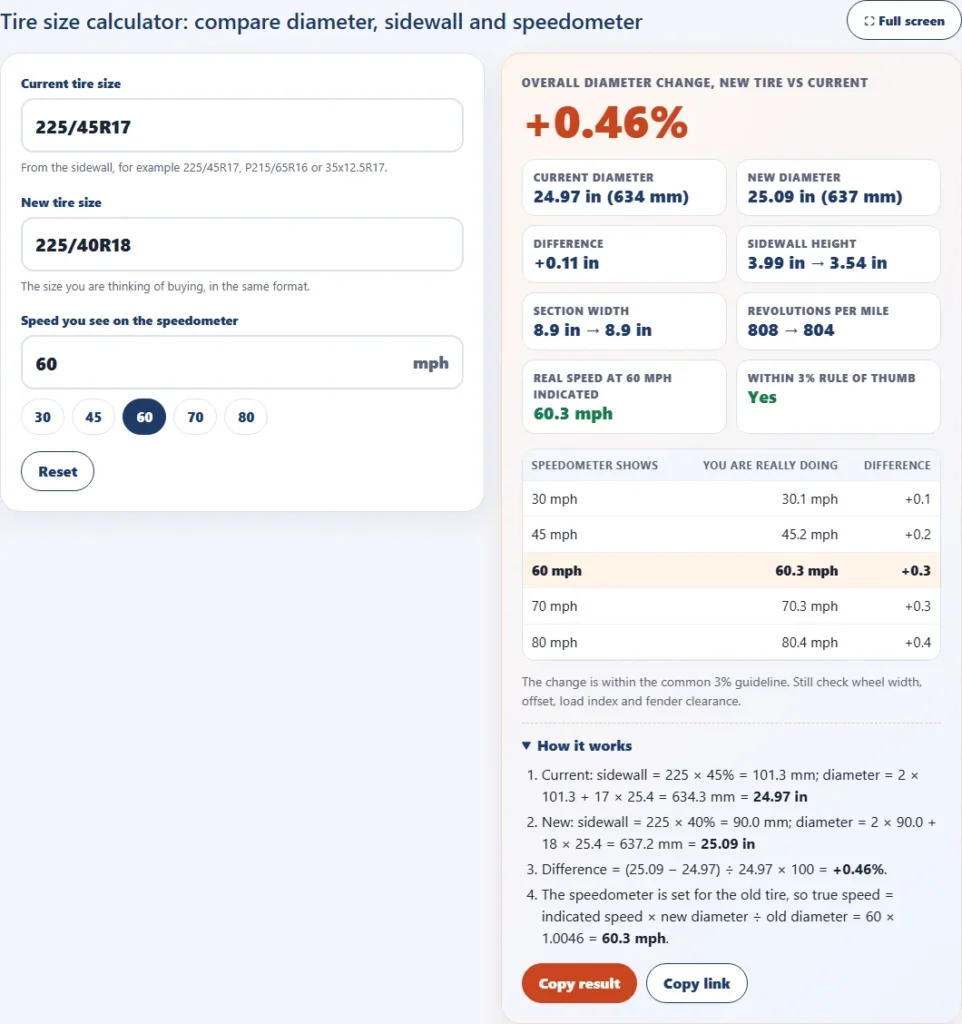
A tire size calculator turns the numbers on a tire sidewall into its overall diameter, sidewall height and circumference, then compares two sizes so you can see how a change affects your speedometer. Type the current and new sizes, such as 225/45R17 and 225/40R18, and read the difference.
Quick answer: Overall diameter in inches = width in mm × aspect ratio ÷ 1,270 + rim diameter. A 195/55R16 tire is 195 × 55 ÷ 1,270 + 16 = 24.44 inches tall. Compare two sizes by dividing the difference by the old diameter, and keep it within about 3 percent.
How to use the tire size calculator
- Read the size on your tire sidewall, for example P225/45R17 91W. Type 225/45R17 for the current tire.
- Type the size you are considering as the new tire, in the same format. Flotation sizes such as 35×12.5R17 also work.
- Enter the speed your speedometer shows to see what your real speed would be.
- Read the diameter change, the sidewall and width differences, the revolutions per mile and the speedometer table.
- Check the 3 percent guideline, then confirm the fit, load index and clearance with a tire shop.
The calculator runs in your browser. It compares nominal sizes, and real tires vary a little by brand and wear.
How to read tire size on the sidewall before using the tire size calculator
Wikipedia's tire code article explains a size such as P195/55R16 85H piece by piece: P means a passenger vehicle tire, 195 is the nominal width in millimeters at the widest point, 55 is the sidewall height as a percent of that width, R means radial construction, 16 is the rim diameter in inches, 85 is the load index and H is the speed rating.
| Part | Example | Meaning |
|---|---|---|
| Type | P | Passenger vehicle tire (LT is light truck) |
| Section width | 195 | Nominal width in millimeters |
| Aspect ratio | 55 | Sidewall height as a percent of width |
| Construction | R | Radial |
| Rim diameter | 16 | Wheel diameter in inches |
| Load index | 85 | Maximum load per tire (515 kg in this case) |
| Speed rating | H | Maximum speed rating (210 km/h in this case) |
Tire diameter calculator and tire size calculator formula
The same article gives the direct calculation. For a size written T/A R W, the theoretical diameter is 2 × T × A ÷ 100 + W × 25.4 in millimeters, or T × A ÷ 1,270 + W in inches. For 195/55R16 that is 621 millimeters, or 24.44 inches. The tire sidewall height calculator step is the first half: width times aspect ratio divided by 100.
- Sidewall height (mm) = width × aspect ratio ÷ 100.
- Overall diameter (mm) = 2 × sidewall height + rim diameter in inches × 25.4.
- Circumference = π × diameter, and revolutions per mile = 63,360 ÷ circumference in inches.
| Tire size | Overall diameter | Sidewall | Section width | Revs per mile |
|---|---|---|---|---|
| 185/65R15 | 24.47 in | 4.73 in | 7.3 in | 824 |
| 195/65R15 | 24.98 in | 4.99 in | 7.7 in | 807 |
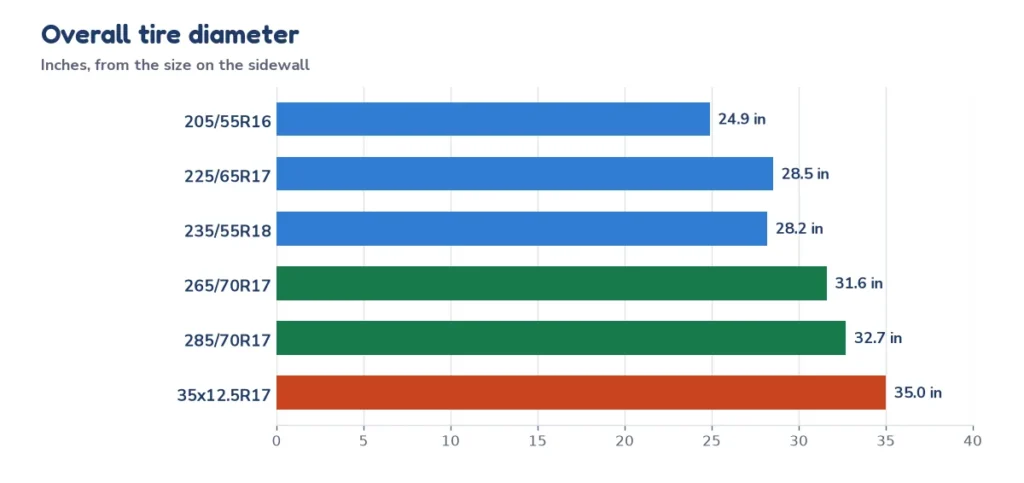
| 205/55R16 | 24.88 in | 4.44 in | 8.1 in | 811 |
| 215/60R16 | 26.16 in | 5.08 in | 8.5 in | 771 |
| 225/65R17 | 28.52 in | 5.76 in | 8.9 in | 707 |
| 235/55R18 | 28.18 in | 5.09 in | 9.3 in | 716 |
| 245/45R19 | 27.68 in | 4.34 in | 9.6 in | 729 |
| 265/70R17 | 31.61 in | 7.30 in | 10.4 in | 638 |
| 275/65R18 | 32.07 in | 7.04 in | 10.8 in | 629 |
| 285/70R17 | 32.71 in | 7.85 in | 11.2 in | 617 |
| 35×12.5R17 | 35.00 in | 9.00 in | 12.5 in | 576 |
Tire size comparison calculator: plus sizing
Plus sizing means fitting a larger wheel with a lower-profile tire so the overall diameter stays close to the original. The table compares options with 225/45R17 as the starting point. A small change leaves the speedometer nearly untouched, and a large one does not.
| New size | Diameter | Change | Real speed at 60 mph | Within 3% |
|---|---|---|---|---|
| 225/40R18 | 25.09 in | +0.46% | 60.3 mph | Yes |
| 235/40R18 | 25.40 in | +1.72% | 61.0 mph | Yes |
| 225/35R19 | 25.20 in | +0.91% | 60.5 mph | Yes |
| 235/35R19 | 25.48 in | +2.02% | 61.2 mph | Yes |
| 245/40R18 | 25.72 in | +2.98% | 61.8 mph | Yes |
| 245/45R18 | 26.68 in | +6.84% | 64.1 mph | No |
| 255/45R18 | 27.04 in | +8.26% | 65.0 mph | No |
Tire speedometer calculator: how the speedometer error works
The speedometer counts wheel rotations, so it assumes the circumference of the original tire. A taller tire covers more ground per rotation, which makes you travel faster than the dial shows. The calculator multiplies the indicated speed by the ratio of the new diameter to the old one. The table shows what a few diameter changes do at 60 mph indicated.
| Diameter change | Real speed at 60 indicated | Speed difference | Real distance per 100 on the odometer |
|---|---|---|---|
| -5% | 57.0 mph | -3.0 mph | 95 miles |
| -3% | 58.2 mph | -1.8 mph | 97 miles |
| -1% | 59.4 mph | -0.6 mph | 99 miles |
| +0% | 60.0 mph | +0.0 mph | 100 miles |
| +1% | 60.6 mph | +0.6 mph | 101 miles |
| +3% | 61.8 mph | +1.8 mph | 103 miles |
| +5% | 63.0 mph | +3.0 mph | 105 miles |
| +10% | 66.0 mph | +6.0 mph | 110 miles |
Tire size calculator examples
Here are three common questions the tire size calculator answers, using the formulas above.
| Change | Sizes | Diameter | Difference | Ground clearance | Real speed at 60 |
|---|---|---|---|---|---|
| A plus-size upgrade to a larger wheel | 225/45R17 to 225/40R18 | 24.97 to 25.09 in | +0.46% | +0.06 in | 60.3 mph |
| A wider tire on a larger wheel | 205/55R16 to 215/55R17 | 24.88 to 26.31 in | +5.76% | +0.72 in | 63.5 mph |
| A modest truck upgrade | 265/70R17 to 285/70R17 | 31.61 to 32.71 in | +3.49% | +0.55 in | 62.1 mph |
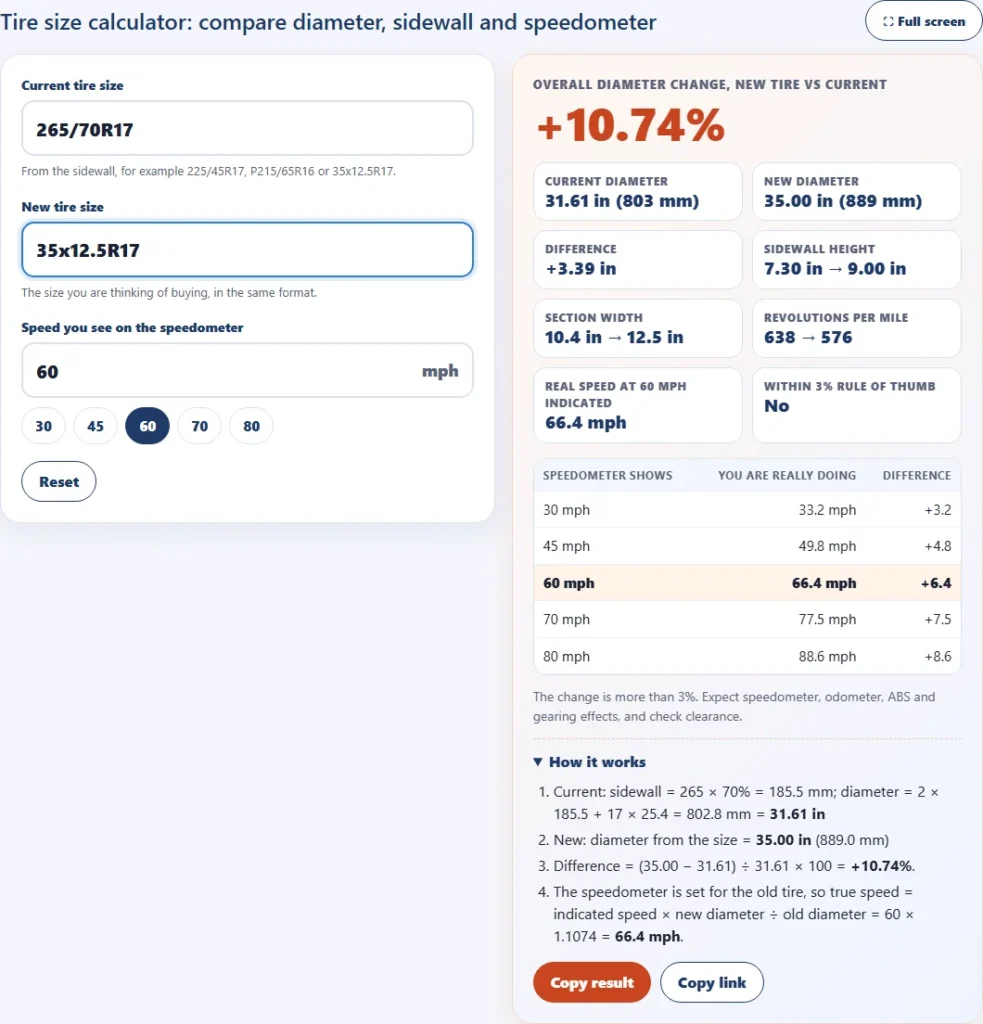
| A big lift-style swap | 265/70R17 to 35×12.5R17 | 31.61 to 35.00 in | +10.74% | +1.70 in | 66.4 mph |
Ground clearance rises by half the change in diameter, because only the radius lifts the axle. A 3.4 inch taller tire raises the axle about 1.7 inches, but it also changes the gearing, which is why the tire size calculator reports revolutions per mile as well.
What changes when you change tire size
- Speedometer and odometer: they read slow with a taller tire and fast with a shorter one.
- Gearing: a taller tire acts like a taller final drive ratio, which lowers engine speed at a given road speed and can dull acceleration.
- Sidewall: a lower aspect ratio means a shorter sidewall, a firmer ride and less cushion against potholes.
- Fit: width and diameter must clear the fender, suspension and brakes at full steering lock.
- Load and speed rating: the new tire should meet or exceed the load index and speed rating on the label.
A tire size calculator cannot see clearance, so use it to narrow your options and then confirm the fit with a shop. It also shows the effect on the odometer: at a 5 percent larger diameter a trip that really covers 100 miles is logged as about 95.
The 3% rule for tire size
Jalopnik explains the 3% rule as a guideline that a replacement tire should stay within about three percent of the original diameter. It notes that speedometer and odometer calibration rely on the original tire's circumference and that anti-lock braking and traction control systems also use wheel-speed readings, so larger deviations can cause inaccurate readings and warning lights. Treat the number as a rule of thumb and not a legal limit, and check fender clearance, wheel width and load index separately.
On a 225/45R17 tire, 3 percent is about 0.75 inches, so a new overall diameter from 24.22 to 25.72 inches stays inside the guideline.
Choosing the correct tire size for your vehicle
NHTSA says to check your owner's manual or the Tire and Loading Information Label on the driver's side door edge or post to find the correct size for your car or truck. The same label gives the recommended inflation pressure, and NHTSA stresses that the correct pressure is the vehicle manufacturer's figure, not the maximum printed on the tire. If your front and rear tires are different sizes you may not be able to rotate them, so check the manual.
Tire size conversion: metric, inch and flotation sizes
Light trucks and off-road tires are often written in inches, such as 35×12.5R17, which means 35 inches overall diameter, 12.5 inches section width and a 17-inch rim. The calculator converts both formats so you can compare a metric 265/70R17 with a flotation size.
| Size | Diameter | Section width | Sidewall |
|---|---|---|---|
| 265/70R17 | 31.61 in | 10.4 in | 7.30 in |
| 285/70R17 | 32.71 in | 11.2 in | 7.85 in |
| 33×12.5R17 | 33.00 in | 12.5 in | 8.00 in |
| 35×12.5R17 | 35.00 in | 12.5 in | 9.00 in |
Frequently asked questions
10 quick answers
How do you calculate tire diameter?
Multiply the width in millimeters by the aspect ratio and divide by 1,270, then add the rim diameter in inches. For 195/55R16 that is 24.44 inches.
What does 225/45R17 mean?
The tire is 225 millimeters wide, its sidewall is 45 percent of that width, it has radial construction and it fits a 17-inch wheel.
How much can I change tire size without affecting the speedometer?
A common guideline is to stay within about 3 percent of the original overall diameter. Beyond that, the speedometer, odometer and wheel-speed systems read incorrectly.
Will bigger tires make my speedometer read slow?
Yes. A taller tire covers more ground per rotation, so you are going faster than the speedometer shows.
What is the aspect ratio of a tire?
It is the sidewall height as a percent of the tire width. A 45 aspect ratio on a 225 mm wide tire is a 101 mm sidewall.
How many revolutions per mile does my tire make?
Divide 63,360 inches by the circumference in inches. A 24.44-inch tire makes about 825 revolutions per mile.
Can I put a different size tire on my car?
Often yes, within clearance and load limits. Check the owner's manual or the label on the door edge, and confirm with a tire shop.
What is plus sizing?
It is fitting a larger wheel with a lower-profile tire so the overall diameter stays about the same.
How do I convert 35×12.5R17 to metric?
35 inches is 889 mm overall diameter and 12.5 inches is about 318 mm wide, on a 17-inch wheel. The calculator handles it directly.
Does tire size affect fuel economy or gearing?
Yes. A taller tire acts like a taller gear, which lowers engine speed and can change acceleration. Larger or wider tires can also change rolling resistance.
Related calculators
- MPG calculator for fuel economy after a tire change
- Car loan calculator for vehicle payments
- Unit converter for inches, millimeters and miles
- Percentage calculator for percent differences
- All free calculators
Sources and further reading
- Tire code (Wikipedia): how to read a size and the diameter formula
- NHTSA: Tire safety: finding the correct size and pressure, and tire ratings
- Jalopnik: What the 3% rule means for your tires: the guideline and its effects on speedometer and ABS
Last reviewed: October 2026. Confirm any tire change with a qualified tire shop or your owner's manual.