A deck calculator tells you how many deck boards, joists and screws a deck needs. Enter the length and width, choose the board and the joist spacing, and it returns the number of boards to buy with extra for cuts, the joists and the fasteners.
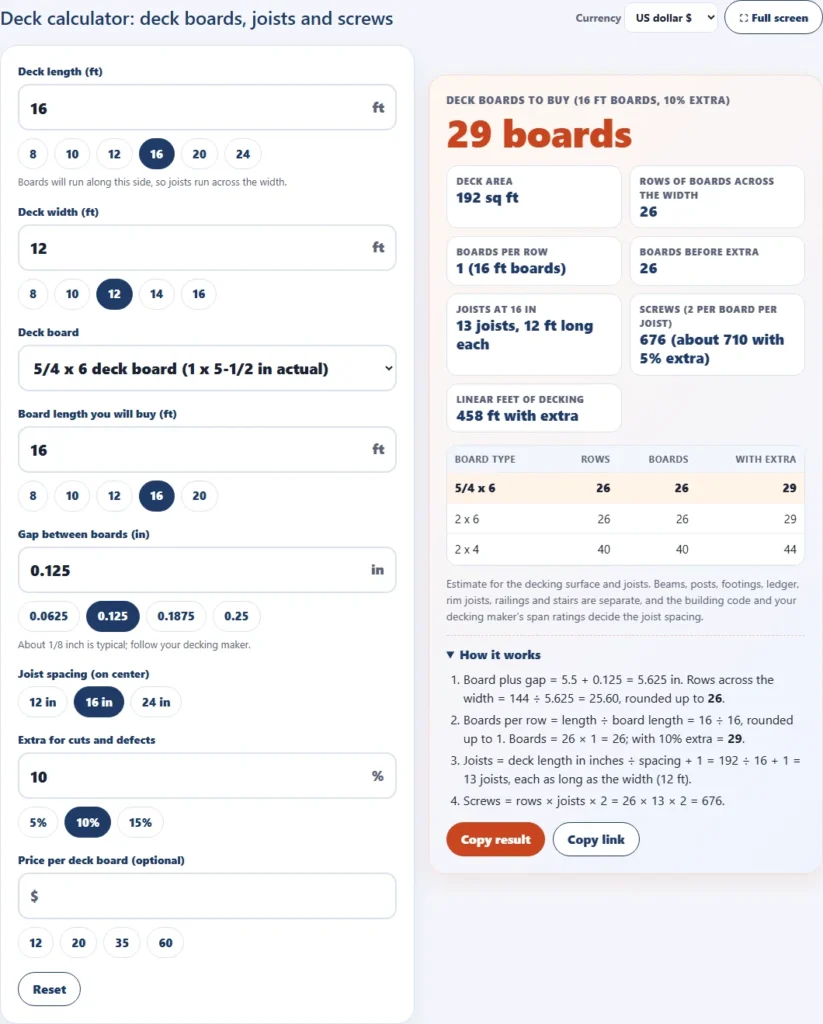
Quick answer: Rows of boards = deck width in inches ÷ (board width + gap). A 12 ft wide deck with 5/4 × 6 boards (5.5 in) and a 1/8 in gap is 144 ÷ 5.625 = 25.6, so 26 rows. For a 16 ft long deck with 16 ft boards that is 26 boards, or 29 with 10% extra.
How to use the deck calculator
- Enter the deck length and width in feet. Boards run along the length, so the joists run across the width.
- Choose the board type. 5/4 × 6 deck boards and 2 × 6 boards are 5-1/2 inches wide, and a 2 × 4 is 3-1/2 inches.
- Choose the length of the boards you will buy, the gap between boards and the joist spacing.
- Add extra for cuts and defects, and optionally a price per board.
- Read the rows, the boards to buy, the joists with their length, the screws and the board comparison table.
The calculator runs in your browser and keeps your numbers on your device. It covers the decking surface and the joists. Posts, footings, beams and the ledger depend on your site and the local building code.
How many deck boards do I need? The formula
- Rows across the width = deck width in inches ÷ (board width + gap), rounded up.
- Boards per row = deck length ÷ board length, rounded up.
- Boards to buy = rows × boards per row × (1 + extra for waste).
Nominal sizes are bigger than actual sizes. According to Wikipedia's dimensional lumber table, a 2 × 4 is actually 1-1/2 by 3-1/2 inches, a 2 × 6 is 1-1/2 by 5-1/2 inches, and a 1 × 6 is 3/4 by 5-1/2 inches. The article adds that softwood decking is sometimes sold as 5/4 even though it is actually one inch thick. That is why the calculator uses 5-1/2 inches for a 6-inch board.
| Nominal size | Actual size (in) | Width used in the calculator |
|---|---|---|
| 5/4 × 6 decking | 1 × 5-1/2 | 5.5 in |
| 2 × 6 | 1-1/2 × 5-1/2 | 5.5 in |
| 2 × 4 | 1-1/2 × 3-1/2 | 3.5 in |
Deck board calculator: boards by deck size
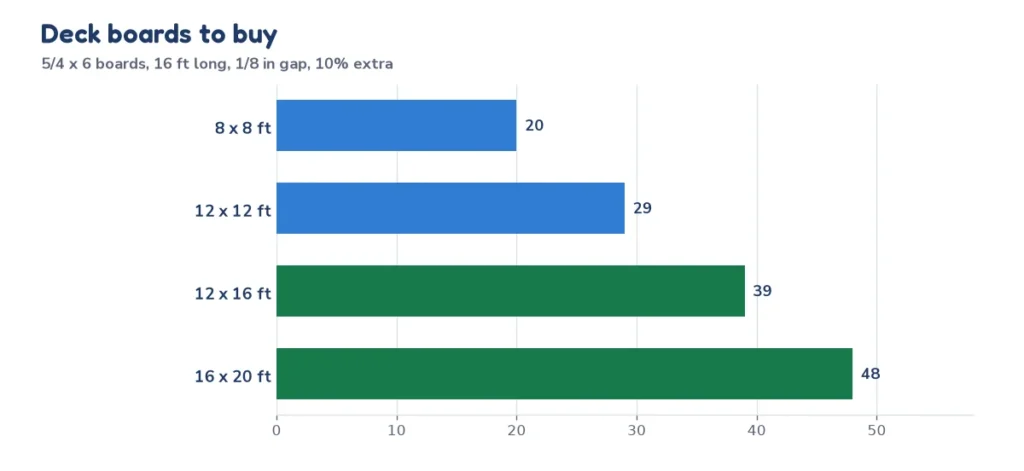
The table uses 5/4 × 6 boards, a 1/8 inch gap and 10% extra. It shows the boards to buy for common deck sizes with 12 ft and 16 ft board lengths.
| Deck size | Area | Rows | Boards (12 ft) | Boards (16 ft) |
|---|---|---|---|---|
| 8 x 8 ft | 64 sq ft | 18 | 20 | 20 |
| 10 x 10 ft | 100 sq ft | 22 | 25 | 25 |
| 12 x 12 ft | 144 sq ft | 26 | 29 | 29 |
| 12 x 16 ft | 192 sq ft | 35 | 39 | 39 |
| 14 x 20 ft | 280 sq ft | 43 | 95 | 48 |
| 16 x 20 ft | 320 sq ft | 43 | 95 | 48 |
| 20 x 24 ft | 480 sq ft | 52 | 115 | 115 |
How to measure and plan a deck
- Sketch the deck and write down the length along the house and the width out from it. Use the finished surface size, not the frame size.
- Decide the direction of the boards. Most boards run parallel to the house, so the joists run out from it.
- Pick the board and the length you will buy. Boards that match the deck length avoid joints.
- Pick the joist spacing from the decking maker and the local code, then read the joist count from the calculator.
- Add the frame and fasteners that the calculator does not cover: beams, posts, footings, ledger, rim joists, hangers, railings and stairs.
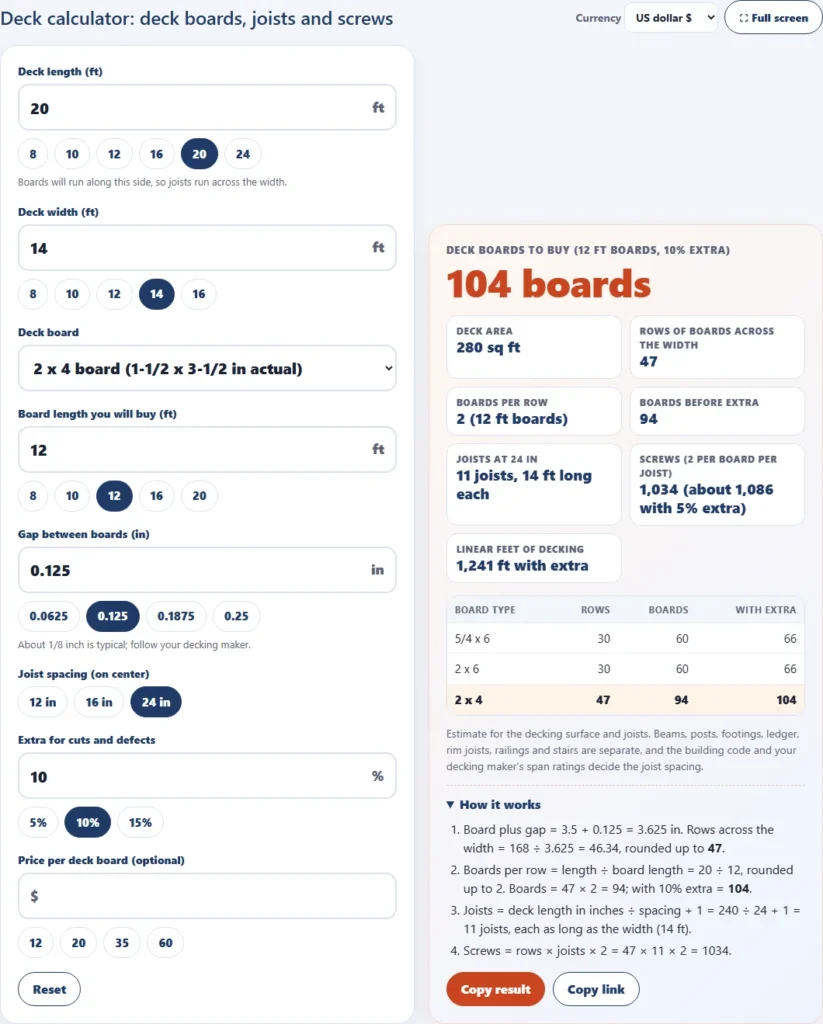
The calculator also helps compare options. A larger deck with 2 × 4 boards uses more rows than one with 5/4 × 6 boards, which changes both the board count and the number of screws. Try 20 by 14 feet with 2 × 4 boards in 12 ft lengths and 24 inch joists, and the calculator shows 47 rows and 104 boards with 10 percent extra.
Decking calculator: effect of board width and gap
A narrower board means more rows, and a wider gap means fewer. For a 12 ft wide deck, here is how the number of rows changes:
| Board | 1/16 in gap | 1/8 in gap | 3/16 in gap | 1/4 in gap |
|---|---|---|---|---|
| 2 × 4 (3.5 in) | 41 | 40 | 40 | 39 |
| 5/4 × 6 or 2 × 6 (5.5 in) | 26 | 26 | 26 | 26 |
Deck joist spacing and how many joists
Joists carry the deck boards, and the spacing is set by the decking material and the code. The International Residential Code deck provisions, as adopted by Washington State and published by Cornell Law School, say that the maximum joist spacing shall be limited by the decking materials, and the joist span table lists 12, 16 and 24 inch spacings. Check your decking maker's span rating and your local code before you decide. The number of joists is the deck length in inches divided by the spacing, plus one.
| Deck length | 12 in on center | 16 in on center | 24 in on center |
|---|---|---|---|
| 8 ft | 9 | 7 | 5 |
| 10 ft | 11 | 9 | 6 |
| 12 ft | 13 | 10 | 7 |
| 16 ft | 17 | 13 | 9 |
| 20 ft | 21 | 16 | 11 |
| 24 ft | 25 | 19 | 13 |
Deck screws calculator: fasteners per deck
The same code text calls for wood decking to be attached to each supporting member with at least two 8d threaded nails or two No. 8 wood screws, so the deck screws calculator uses two fasteners for every board at every joist. A 16 by 12 ft deck with 26 rows and 13 joists needs 26 × 13 × 2 = 676 screws before extra. The table scales that up.
| Deck size | Rows | Joists at 16 in | Screws | With 5% extra |
|---|---|---|---|---|
| 8 x 8 ft | 18 | 7 | 252 | 265 |
| 12 x 12 ft | 26 | 10 | 520 | 546 |
| 12 x 16 ft | 35 | 10 | 700 | 735 |
| 16 x 20 ft | 43 | 13 | 1,118 | 1,174 |
Deck material calculator: cost example
Type a price per board to see the cost of the decking. At $20 a board, the 29 boards for the 16 by 12 ft example cost $580, and at $35 they cost $1,015. Joists, hardware, footings and finishes are extra, and prices vary by species, region and season.
| Price per board | Cost of 29 boards | Cost of 52 boards (16 x 20 ft) |
|---|---|---|
| $12 | $348 | $576 |
| $20 | $580 | $960 |
| $35 | $1,015 | $1,680 |
| $60 | $1,740 | $2,880 |
Tips for ordering deck boards
- Plan board lengths so butt joints land on a joist, and stagger them for a clean look.
- Choose a length that matches the deck: a 16 ft board on a 16 ft deck avoids joints altogether.
- Order a little extra, since some boards are cut at the edges and some have defects.
- Check the decking maker's span rating, gap and fastener guidance before you build.
- Boards running diagonally use more material because of angled cuts, so add more waste.
Frequently asked questions
10 quick answers
How many deck boards do I need?
Divide the deck width in inches by the board width plus the gap, round up for rows, and multiply by the boards per row. Add about 10 percent for cuts.
How many 5/4 x 6 boards for a 12 x 12 deck?
A 12 ft wide deck needs 26 rows at a 1/8 inch gap. With 12 ft boards that is 26 boards, or 29 with 10 percent extra.
How much space between deck boards?
About 1/8 inch is common, but follow the decking maker's instructions because some products need more for drainage or expansion.
What is the actual width of a 6 inch deck board?
Five and a half inches. A 5/4 × 6 deck board is about 1 inch thick and 5-1/2 inches wide.
How far apart should deck joists be?
The code limits the joist spacing by the decking material, and typical spacings are 12, 16 and 24 inches on center. Check your decking rating and local code.
How many screws do I need for a deck?
Two per board at every joist. For a 16 x 12 deck with 26 rows and 13 joists that is 676 screws.
Does the calculator include the frame?
It counts the joists. Beams, posts, footings, the ledger and rim joists depend on the site, so use the code and a design guide for those.
Should I buy longer boards?
Longer boards mean fewer joints, but they cost more and are harder to carry. Pick the length that fits the deck size best.
How much extra should I buy?
Ten percent is a common figure. Complex shapes, diagonal patterns and stairs need more.
Is this enough to get a permit?
No. It is an estimate of materials. A permit needs plans that meet your local building code.
Related calculators
- Square footage calculator for the deck area
- Concrete calculator for footings and post holes
- Flooring calculator for boards and planks indoors
- Paint calculator for stain and paint coverage
- Area calculator for irregular decks
- Unit converter for feet and inches
- All free calculators
Sources and further reading
- Dimensional lumber (Wikipedia): nominal and actual sizes, and 5/4 decking
- Section R507 Decks, International Residential Code as adopted in Washington (Cornell Law School): joist spacing limits and decking fastening
Last reviewed: October 2026. Always follow your local building code and your decking maker's instructions.