An insulation calculator turns a target R-value into inches of insulation and a volume to buy. Choose your climate zone and where the insulation goes, and it shows the R-value to add, the thickness for fiberglass, rock wool or cellulose, and the cubic feet for your area.
Quick answer: Inches to add = R-value to add ÷ R-value per inch. For an uninsulated attic in Zones 4A and 4B, ENERGY STAR recommends R60, which is 60 ÷ 3.2 = 18.8 inches of fiberglass batts, or 16.2 inches of cellulose at R-3.7 per inch.
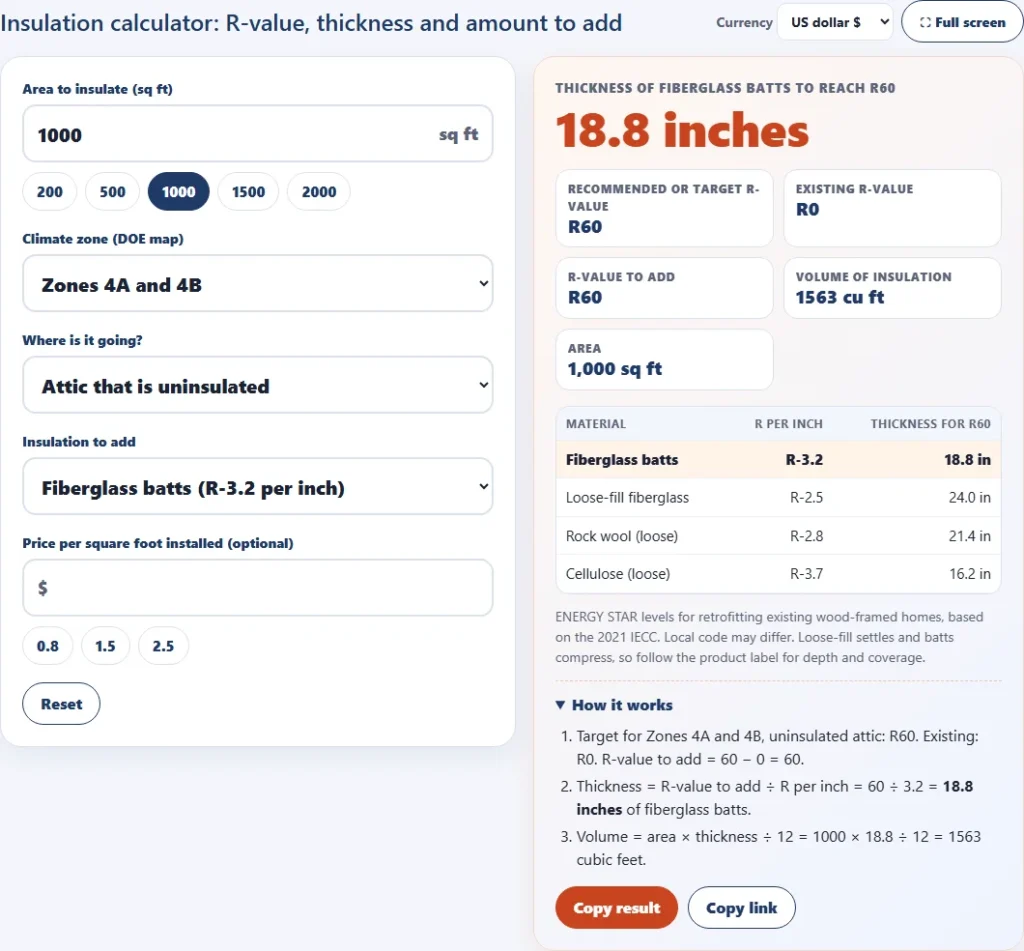
How to use the insulation calculator
- Enter the area you will insulate in square feet.
- Pick your climate zone from the DOE map, then say where the insulation goes: an uninsulated attic, an attic with 3 to 4 inches already, or a floor over an unheated basement or crawl space.
- Choose the material you plan to use. The calculator uses the R-value per inch in the table below.
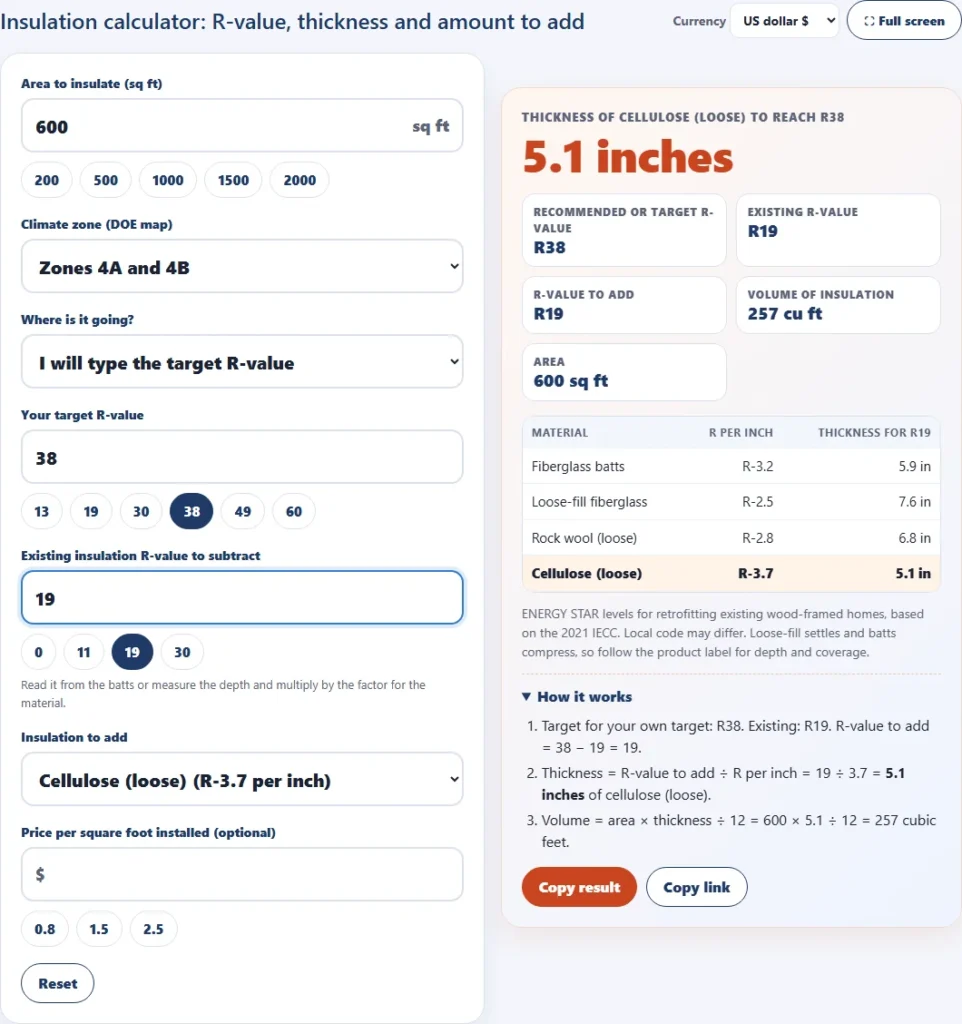
- Or choose your own target R-value and subtract the R-value you already have.
- Read the R-value to add, the thickness, the volume in cubic feet and, with a price per square foot, the estimated cost.
The calculator runs in your browser and keeps your numbers on your device. Always follow the label of the product you buy, because depth and coverage depend on the density and the installation method.
Recommended R-value by climate zone
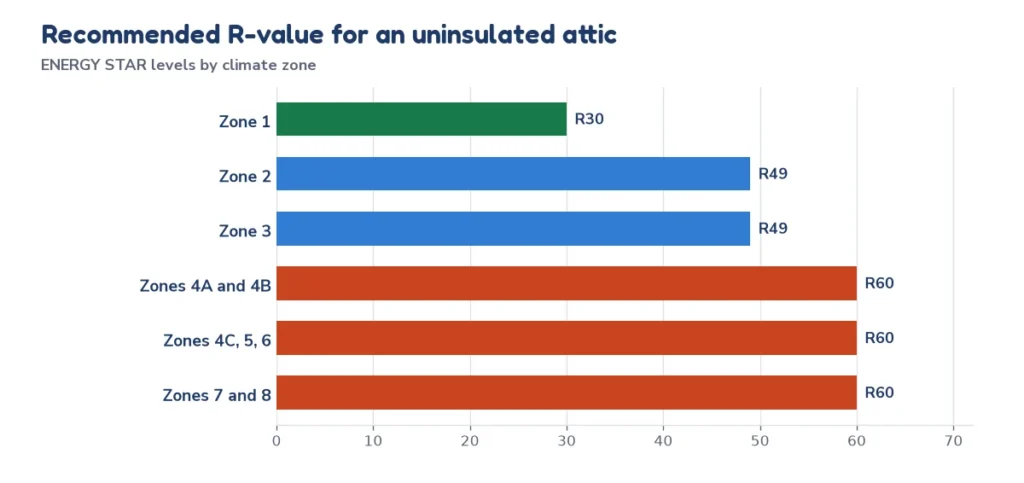
ENERGY STAR lists recommended insulation levels for retrofitting existing wood-framed homes, based on the 2021 International Energy Conservation Code. R-value measures an insulation's ability to resist heat traveling through it, and a higher R-value means better thermal performance.
| Climate zone | Attic, uninsulated | Attic with 3 to 4 inches | Floor over unheated space |
|---|---|---|---|
| Zone 1 | R30 | R25 | R13 |
| Zone 2 | R49 | R38 | R13 |
| Zone 3 | R49 | R38 | R19 |
| Zones 4A and 4B | R60 | R49 | R19 |
| Zones 4C, 5 and 6 | R60 | R49 | R30 |
| Zones 7 and 8 | R60 | R49 | R38 |
How much insulation do I need? The formula
- R-value to add = target R-value − existing R-value.
- Thickness in inches = R-value to add ÷ R-value per inch of the material.
- Volume in cubic feet = area in square feet × thickness in inches ÷ 12.
ENERGY STAR gives the following depth multipliers for estimating the R-value of existing attic insulation: loose fiberglass 2.5 per inch, rock wool 2.8, cellulose 3.7, vermiculite or perlite 2.7, and fiberglass batts 3.2. The insulation calculator uses these figures for the thickness estimate.
| Material | R per inch | R19 | R30 | R38 | R49 | R60 |
|---|---|---|---|---|---|---|
| Fiberglass batts | 3.2 | 5.9 in | 9.4 in | 11.9 in | 15.3 in | 18.8 in |
| Loose-fill fiberglass | 2.5 | 7.6 in | 12.0 in | 15.2 in | 19.6 in | 24.0 in |
| Rock wool (loose) | 2.8 | 6.8 in | 10.7 in | 13.6 in | 17.5 in | 21.4 in |
| Cellulose (loose) | 3.7 | 5.1 in | 8.1 in | 10.3 in | 13.2 in | 16.2 in |
Attic insulation calculator: how deep should it be?
The attic is where added insulation usually pays back first, and the table above shows the targets. To check what you already have, measure the depth and multiply by the factor for the material. For example, 6 inches of loose fiberglass is about R15 (6 × 2.5), and 10 inches of cellulose is about R37 (10 × 3.7). Subtract that from the target to find what to add.
| Existing insulation | Depth | Estimated R-value | To add for R49 | Thickness of the same material |
|---|---|---|---|---|
| Loose fiberglass | 6 in | R15 | R34 | 13.6 in |
| Fiberglass batts | 6 in | R19 | R30 | 9.3 in |
| Cellulose | 10 in | R37 | R12 | 3.2 in |
| Rock wool | 8 in | R22 | R27 | 9.5 in |
R-value calculator: depth to R-value and back
As an R-value calculator, the same multipliers work in both directions. Multiply depth by the factor to get the R-value you have, and divide the R-value you want by the factor to get the depth you need. The table shows the R-value for common depths.
| Depth | Fiberglass batts | Loose-fill fiberglass | Rock wool (loose) | Cellulose (loose) |
|---|---|---|---|---|
| 3 in | R10 | R8 | R8 | R11 |
| 6 in | R19 | R15 | R17 | R22 |
| 9 in | R29 | R22 | R25 | R33 |
| 12 in | R38 | R30 | R34 | R44 |
| 16 in | R51 | R40 | R45 | R59 |
Insulation thickness calculator: a worked example
Say you have a 600 sq ft attic with about R19 of insulation and your target is R38. The R-value to add is 38 − 19 = 19. With loose cellulose at R-3.7 per inch, you need 19 ÷ 3.7 = 5.1 inches, which is 600 × 5.1 ÷ 12 = 257 cubic feet of insulation. With fiberglass batts at R-3.2 it is 5.9 inches, and with loose fiberglass at R-2.5 it is 7.6 inches. Choose the custom target option in the insulation thickness calculator to try your own numbers.
Blown in insulation calculator: loose-fill coverage
For loose-fill, the insulation calculator reports thickness and volume. Many bags state a coverage chart that links bags per 1,000 square feet to the final R-value, so use the volume to compare products and the label to count bags. Loose-fill settles over time, and the installed depth on the label usually assumes settling, so install to the depth shown for the R-value you want.
Walls, floors and basements
ENERGY STAR's retrofit guidance for walls above ground is to blow insulation into an empty wall cavity whenever siding is removed, and to add insulative sheathing under new siding: R5 in Zone 3 and R5 to R10 in Zones 4 to 8. For basement or crawl space walls it suggests R5 sheathing or an R13 batt in Zone 3, R10 sheathing or an R13 batt in Zones 4A and 4B, and R15 sheathing or an R19 batt in the colder zones.
| Location | Zone 3 | Zones 4A and 4B | Zones 4C and 5 to 8 |
|---|---|---|---|
| Basement or crawl space wall | R5 sheathing or R13 batt | R10 sheathing or R13 batt | R15 sheathing or R19 batt |
| Wall sheathing under new siding | R5 | R5 to R10 | R5 to R10 |
Cost: price per square foot
Type a price per square foot to see the material or installed cost of your area. Prices vary by product, region and whether you install it yourself, so use a local quote. The table shows the effect of area at a range of prices.
| Area | $0.80 per sq ft | $1.50 per sq ft | $2.50 per sq ft |
|---|---|---|---|
| 500 sq ft | $400 | $750 | $1,250 |
| 1,000 sq ft | $800 | $1,500 | $2,500 |
| 1,500 sq ft | $1,200 | $2,250 | $3,750 |
| 2,000 sq ft | $1,600 | $3,000 | $5,000 |
Frequently asked questions
10 quick answers
How much insulation do I need in my attic?
ENERGY STAR recommends R30 to R60 depending on your climate zone for an uninsulated attic, and R25 to R49 if you already have 3 to 4 inches. Zones 4A and 4B call for R60.
What does R-value mean?
R-value measures an insulation's resistance to heat flow. A higher number means better insulating performance.
How many inches is R60?
It depends on the material. At R-3.2 per inch for fiberglass batts, R60 is about 18.8 inches. At R-3.7 per inch for cellulose, it is about 16.2 inches.
How do I find my climate zone?
Use the DOE climate zone map for the United States and find your county. The calculator offers the zone groups that ENERGY STAR uses.
How do I know what insulation I already have?
Measure the depth and multiply by the factor for the material: 2.5 for loose fiberglass, 3.2 for batts, 3.7 for cellulose, 2.8 for rock wool.
Can I add new insulation on top of old insulation?
Usually yes, as long as the old insulation is dry and not compressed. Do not cover soffit vents or recessed lights that are not rated for it, and check local code.
Is blown-in cellulose better than fiberglass?
Cellulose has a higher R-value per inch in ENERGY STAR's table, 3.7 versus 2.5 for loose fiberglass, so it needs less depth for the same R-value.
Do I need a vapor barrier?
That depends on climate and construction, so check local code or ask a professional. The calculator only computes R-value and thickness.
Should I air seal first?
ENERGY STAR's guidance pairs insulating with sealing air leaks, because leaks can undermine the benefit of added insulation.
How accurate is the calculator?
It follows ENERGY STAR's published levels and multipliers. Real products vary, so follow the label of the insulation you buy.
Related calculators
- Square footage calculator for the area of rooms and attics
- Area calculator for roof and gable shapes
- Electricity cost calculator for heating and cooling costs
- Paint calculator for the walls after the work
- Unit converter for inches and centimeters
- All free calculators
Sources and further reading
- ENERGY STAR: Recommended Home Insulation R-Values: levels by zone, based on the 2021 IECC
- ENERGY STAR: DIY checks and inspections: measuring existing insulation with depth multipliers
Last reviewed: October 2026. Check local code and the product label before you buy.