An Ohms law calculator finds the missing values in a simple circuit. Enter any two of voltage, current, resistance and power, and it returns the other two using V = I × R and P = V × I, with the steps shown.
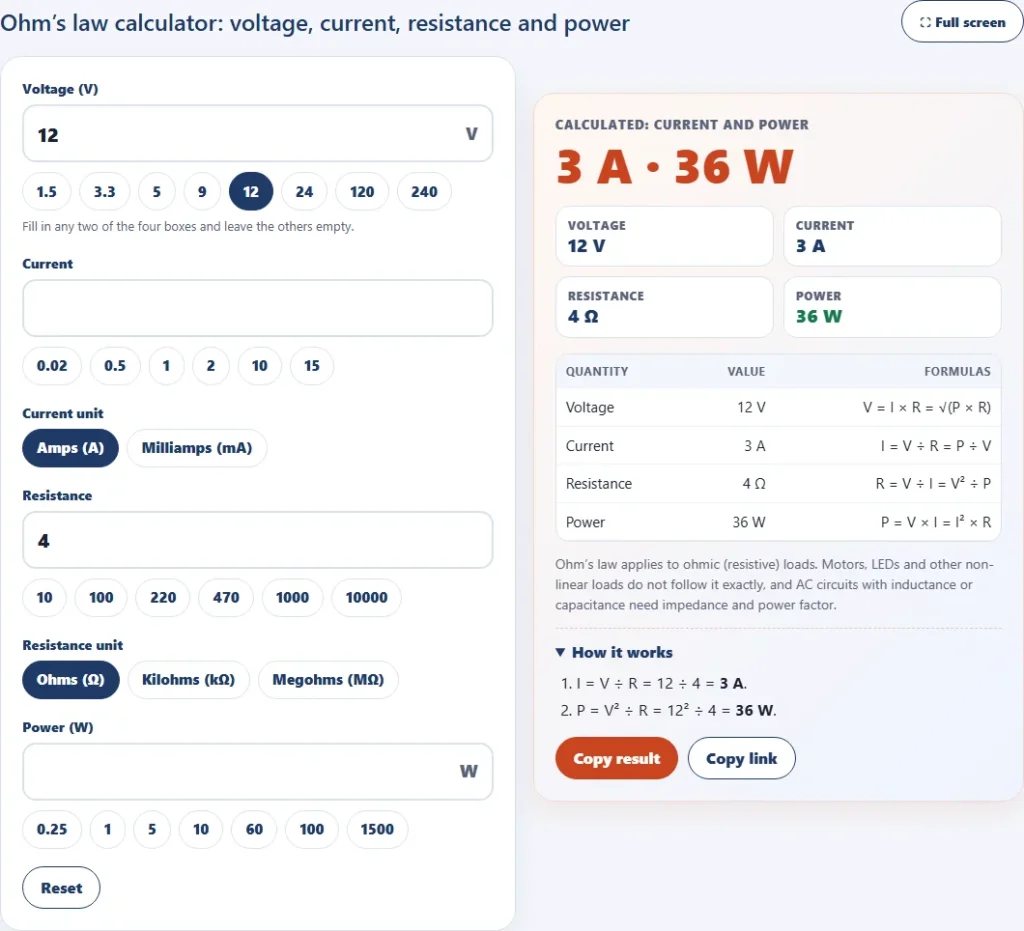
Quick answer: Ohm's law is V = I × R: voltage in volts equals current in amps times resistance in ohms. A 12-volt supply across a 4-ohm resistor drives 3 amps and dissipates 36 watts, because I = 12 ÷ 4 and P = 12 × 3.
How to use the Ohms law calculator
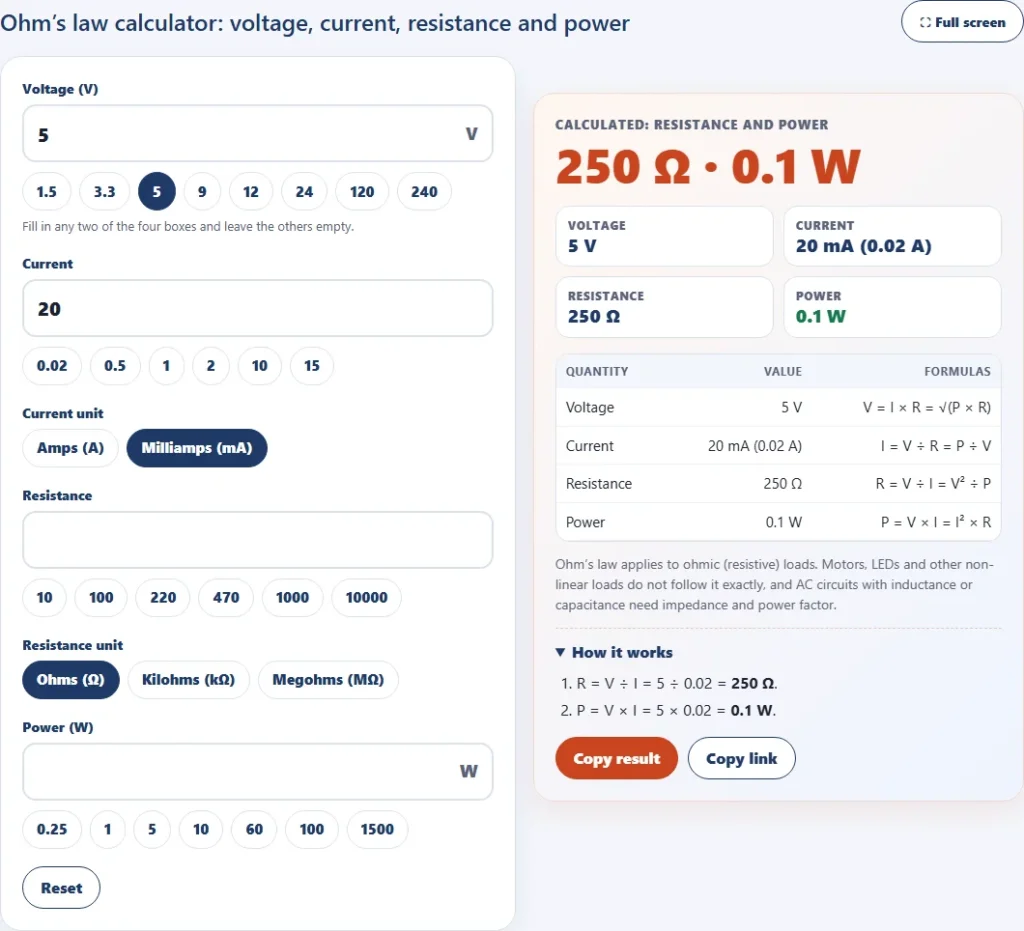
- Fill in any two of the four boxes: voltage, current, resistance or power. Leave the other two empty.
- Choose milliamps if your current is small, and kilohms or megohms if the resistance is large.
- Read the other two values, the four values together and the formulas used in the table.
- Open How it works for each step, and press Reset to start again.
The calculator runs in your browser and works for DC circuits and for AC circuits with a resistive load. It is a learning and planning tool, not a substitute for a proper electrical design.
Ohms law formula
Wikipedia states Ohm's law as the current between two points in a conductor being directly proportional to the voltage across them, with resistance as the constant of proportionality, which gives V = IR. The same article gives the reciprocal form I = GV with conductance G. For resistive loads, the Electric power article combines this with P = IV and Joule's law P = I2R to give the full set of power forms.
| Symbol | Quantity | Unit |
|---|---|---|
| V | Voltage (potential difference) | Volt (V) |
| I | Current | Ampere (A) |
| R | Resistance | Ohm (Ω) |
| P | Power | Watt (W) |
Ohms law triangle and Ohms law wheel: all 12 formulas
The Ohms law triangle covers V, I and R. The Ohms law wheel adds power and gives three ways to find each quantity. Use whichever pair of values you already know.
| To find | Know V and I | Know V and R | Know I and R | Know P and one other |
|---|---|---|---|---|
| Voltage (V) | – | – | V = I × R | V = P ÷ I or V = √(P × R) |
| Current (I) | – | I = V ÷ R | – | I = P ÷ V or I = √(P ÷ R) |
| Resistance (R) | R = V ÷ I | – | – | R = V2 ÷ P or R = P ÷ I2 |
| Power (P) | P = V × I | P = V2 ÷ R | P = I2 × R | – |
Using the Ohms law calculator step by step
The default values show the simplest case. With 12 volts across 4 ohms, the calculator finds the current as 12 ÷ 4 = 3 amps and the power as 12 × 3 = 36 watts. Clear the resistance box and type 36 in the power box instead, and it works backwards: current = 36 ÷ 12 = 3 amps and resistance = 122 ÷ 36 = 4 ohms. Any two values lead to the same circuit.
How to calculate resistance
To calculate resistance, divide the voltage across a component by the current through it: R = V ÷ I. If you know power instead, R = V2 ÷ P. A 120-volt appliance that draws 12.5 amps has a resistance of 120 ÷ 12.5 = 9.6 ohms, and a 60-watt bulb at 120 volts has 1202 ÷ 60 = 240 ohms.
Volts amps watts calculator: appliances at 120 volts
| Appliance | Power | Current at 120 V | Resistance (V ÷ I) |
|---|---|---|---|
| LED bulb | 9 W | 0.07 A | 1600.0 Ω |
| Incandescent bulb | 60 W | 0.50 A | 240.0 Ω |
| Laptop charger | 65 W | 0.54 A | 221.5 Ω |
| Microwave | 800 W | 6.67 A | 18.0 Ω |
| Space heater | 1500 W | 12.50 A | 9.6 Ω |
| Hair dryer | 1800 W | 15.00 A | 8.0 Ω |
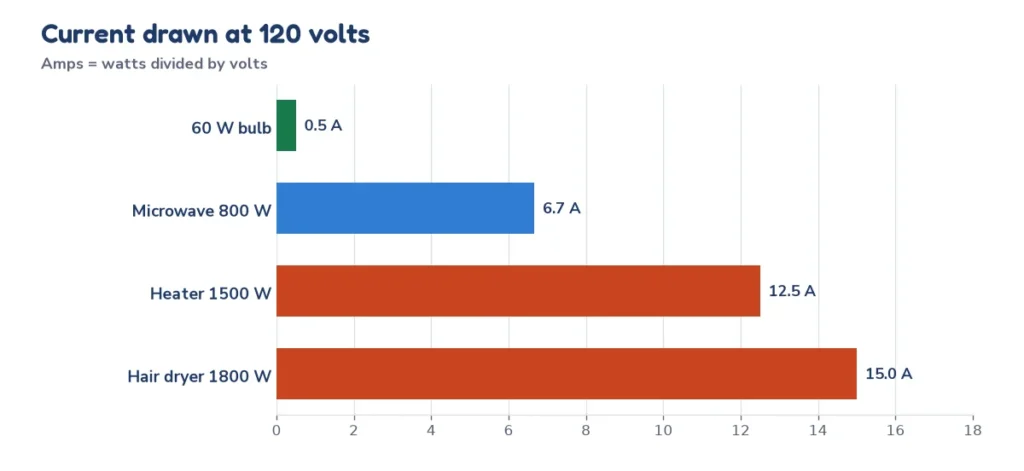
This volts amps watts calculator view shows why a space heater and a hair dryer trip a 15-amp breaker more easily than a lamp: current equals watts divided by volts, so 1,500 watts at 120 volts is 12.5 amps. Real appliances are not always purely resistive, and motors draw more at start-up, so treat the numbers as the running current of a resistive load.
Ohms law examples
| Situation | Known | Result |
|---|---|---|
| Resistor in a 12 V circuit | V = 12 V, R = 4 Ω | I = 3 A, P = 36 W |
| LED with a series resistor | Supply 5 V, LED drop 2 V, I = 20 mA | R = (5 − 2) ÷ 0.02 = 150 Ω |
| Heater element | P = 1,500 W, V = 120 V | I = 12.5 A, R = 9.6 Ω |
| Phone charger | V = 5 V, I = 2 A | P = 10 W, R = 2.5 Ω |
| Wire segment | I = 20 A, R = 0.05 Ω | V drop = 1 V, P lost = 20 W |
Power loss in wires: why current matters
Because power is P = I2R, wire losses grow with the square of the current. Doubling the current quadruples the heat in the same wire. That is also why high-power equipment often runs at 240 volts instead of 120: the same power needs half the current, so the same wire wastes a quarter of the power. The table compares 1,500 watts on a wire with 0.1 ohm of total resistance.
| Supply | Current for 1,500 W | Heat lost in 0.1 Ω of wire | Voltage lost in the wire |
|---|---|---|---|
| 12 V | 125.0 A | 1562 W | 12.5 V |
| 24 V | 62.5 A | 391 W | 6.2 V |
| 120 V | 12.5 A | 16 W | 1.2 V |
| 240 V | 6.2 A | 4 W | 0.6 V |
Common mistakes with Ohm's law
| Mistake | What goes wrong | Fix |
|---|---|---|
| Mixing milliamps and amps | The result is 1,000 times off | Convert 20 mA to 0.02 A, or use the unit selector |
| Mixing kilohms and ohms | The result is 1,000 times off | Convert 4.7 kΩ to 4,700 Ω |
| Using the supply voltage for one component | The wrong voltage is across the part | Use the voltage across that part, for example supply minus the LED drop |
| Treating an LED as a resistor | LEDs are not ohmic | Use a series resistor sized from (supply − LED voltage) ÷ current |
| Using the peak AC voltage | Power is overstated | Use RMS values, such as 120 V |
Resistor color code reference
The standard resistor color code gives each digit a color, which helps you read the value you enter into the calculator. The first two bands are digits, the third is the multiplier and the fourth is the tolerance.
| Color | Digit | Multiplier |
|---|---|---|
| Black | 0 | × 1 |
| Brown | 1 | × 10 |
| Red | 2 | × 100 |
| Orange | 3 | × 1 k |
| Yellow | 4 | × 10 k |
| Green | 5 | × 100 k |
| Blue | 6 | × 1 M |
| Violet | 7 | × 10 M |
| Gray | 8 | – |
| White | 9 | – |
Resistors in series and parallel
- In series, resistances add: Rtotal = R1 + R2 + …. Two 100 Ω resistors in series give 200 Ω.
- In parallel, the reciprocals add: 1 ÷ Rtotal = 1 ÷ R1 + 1 ÷ R2 + …. Two 100 Ω resistors in parallel give 50 Ω.
- Find the total first, then apply Ohm's law to the whole circuit.
| Resistors | In series | In parallel |
|---|---|---|
| 100 Ω and 100 Ω | 200 Ω | 50.0 Ω |
| 220 Ω and 330 Ω | 550 Ω | 132.0 Ω |
| 1000 Ω and 4700 Ω | 5700 Ω | 824.6 Ω |
| 10000 Ω and 10000 Ω | 20000 Ω | 5000.0 Ω |
Units and prefixes
| Prefix | Symbol | Multiplier | Example |
|---|---|---|---|
| milli | m | 0.001 | 20 mA = 0.02 A |
| kilo | k | 1,000 | 4.7 kΩ = 4,700 Ω |
| mega | M | 1,000,000 | 2.2 MΩ = 2,200,000 Ω |
Where Ohm's law does not apply
Ohm's law describes ohmic conductors, where the current is proportional to the voltage. Diodes, LEDs, transistors and some lamps are non-linear: their resistance changes with voltage and temperature. In AC circuits with coils or capacitors, resistance is replaced by impedance and power depends on the power factor. In those cases the calculator is a starting point, not the full answer.
Frequently asked questions
10 quick answers
What is Ohm's law?
It states that the current through a conductor is proportional to the voltage across it: V = I × R, where R is the resistance in ohms.
How do you calculate current from voltage and resistance?
Divide the voltage by the resistance: I = V ÷ R. At 12 volts across 4 ohms the current is 3 amps.
How do you calculate power in watts?
Multiply voltage by current, P = V × I. You can also use P = I2 × R or P = V2 ÷ R.
How do you calculate resistance?
Divide voltage by current, R = V ÷ I, or use R = V2 ÷ P when you know the power.
What is the Ohms law triangle?
A memory aid with V on top and I and R below. Cover the quantity you want and the others show the formula.
What are the units of Ohm's law?
Volts for voltage, amperes for current, ohms for resistance and watts for power.
How many amps is 1,000 watts at 120 volts?
1,000 ÷ 120 = 8.33 amps. At 240 volts the same power is 4.17 amps.
Does Ohm's law work for AC?
For resistive loads, yes, using RMS values. With inductance or capacitance you need impedance and the power factor.
Why does the calculator ask for exactly two values?
Two independent values fix the other two. Entering three could contradict each other, so the calculator asks you to clear the extras.
Is this safe to use for wiring decisions?
It gives the electrical relationships, but wire sizes, fuses and breakers must follow the electrical code and be checked by a qualified person.
Related calculators
- Voltage drop calculator for wire size and run length
- Electricity cost calculator for the cost of running appliances
- Unit converter for electrical and other units
- Percentage calculator for percent differences
- All free calculators
Sources and further reading
- Ohm's law (Wikipedia): the law, conductance and its limits
- Electric power (Wikipedia): P = IV and the resistive forms
- Electronic color code (Wikipedia): reading resistor values
This page is general information and not a substitute for the electrical code or a licensed electrician. Last reviewed: October 2026.