A paycheck estimator turns a salary or hourly rate into the amount that lands in your account. Enter your pay, filing status and state, and this take home pay calculator subtracts 2026 federal income tax, Social Security, Medicare, state income tax and any deductions to show take-home pay for each paycheck and for the year.
Quick answer: Take-home pay = gross pay − federal income tax − Social Security − Medicare − state income tax − deductions. A single filer earning $65,000 takes home about $2,092.60 every two weeks in Texas and $1,983.85 in Kansas.
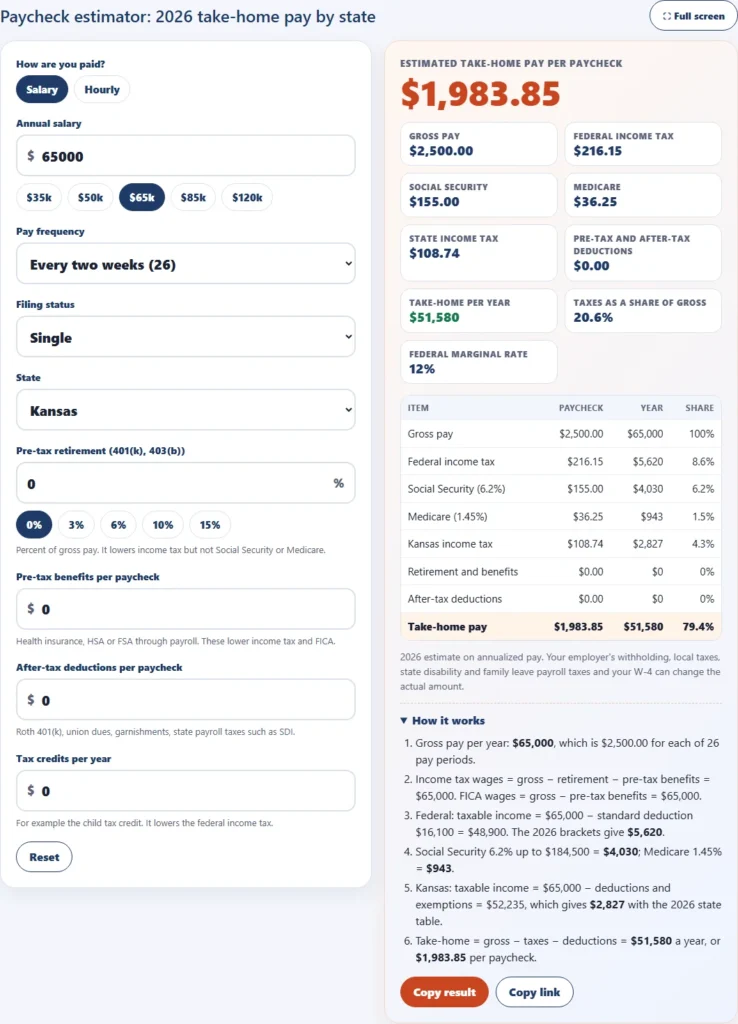
How to use the paycheck estimator
- Choose Salary or Hourly. For hourly pay, enter the rate and the hours per week.
- Pick the pay frequency, your filing status and your state.
- Add a pre-tax retirement percentage, pre-tax benefits and after-tax deductions if you have them.
- Enter any yearly tax credits, such as the child tax credit, to lower the federal tax.
- Read the take-home pay for each paycheck, the tax lines and the yearly total. Open How it works for the steps.
The paycheck estimator runs in your browser and does not store your numbers. Rates are for 2026.
How to calculate take home pay
Four taxes come out of most paychecks, and some pay is set aside before tax. The order matters, because pre-tax retirement and benefits reduce the wages that income tax is based on.
- Gross pay: salary divided by the number of paychecks, or hourly rate times hours.
- Pre-tax deductions: traditional 401(k) and benefits such as health insurance and HSA. A 401(k) lowers income tax wages but not Social Security and Medicare wages.
- Federal income tax: the 2026 bracket tax on pay after the standard deduction.
- FICA: Social Security 6.2% up to a wage base and Medicare 1.45% on all pay.
- State income tax: from the state's rates, deductions and exemptions, or none in nine states.
- After-tax deductions: Roth contributions, union dues and similar items.
Federal income tax brackets 2026
The IRS published the 2026 tax rate tables in Revenue Procedure 2025-32. The standard deduction for 2026 is $16,100 for single filers, $32,200 for married couples filing jointly and $24,150 for heads of household. The table shows where each rate starts on taxable income, which is pay after the standard deduction.
| Rate | Single, over | Married filing jointly, over | Head of household, over |
|---|---|---|---|
| 10% | $0 | $0 | $0 |
| 12% | $12,400 | $24,800 | $17,700 |
| 22% | $50,400 | $100,800 | $67,450 |
| 24% | $105,700 | $211,400 | $105,700 |
| 32% | $201,775 | $403,550 | $201,750 |
| 35% | $256,225 | $512,450 | $256,200 |
| 37% | $640,600 | $768,700 | $640,600 |
Social Security and Medicare in 2026
The IRS lists the Social Security rate as 6.2% for the employee and the Medicare rate as 1.45%. For 2026 the Social Security wage base is $184,500, so pay above that is not taxed for Social Security. Medicare has no limit, and employers withhold an extra 0.9% Additional Medicare tax on wages above $200,000, whatever the filing status. A person earning $65,000 pays $4,030 of Social Security and $942.50 of Medicare.
State income tax: no tax, flat tax and graduated tax
The Tax Foundation's 2026 tables show three groups of states. Nine states do not tax wages: Alaska, Florida, Nevada, New Hampshire, South Dakota, Tennessee, Texas, Washington and Wyoming. Many others use one flat rate, and the rest have graduated brackets. The paycheck estimator applies each state's standard deduction and personal exemption from that table.
| State (flat rate) | Rate | Taxed above | Standard deduction, single |
|---|---|---|---|
| Arizona | 2.50% | $0 | $8,350 |
| Colorado | 4.40% | $0 | $16,100 |
| Georgia | 5.19% | $0 | $12,000 |
| Idaho | 5.30% | $4,811 | $16,100 |
| Illinois | 4.95% | $0 | none |
| Indiana | 2.95% | $0 | none |
| Iowa | 3.80% | $0 | $16,100 |
| Kentucky | 3.50% | $0 | $3,360 |
| Louisiana | 3% | $0 | $12,875 |
| Michigan | 4.25% | $0 | none |
| Mississippi | 4% | $10,000 | $2,300 |
| North Carolina | 3.99% | $0 | $12,750 |
| Ohio | 2.75% | $26,050 | none |
| Pennsylvania | 3.07% | $0 | none |
| Utah | 4.50% | $0 | none |
Take home pay calculator results by salary and state
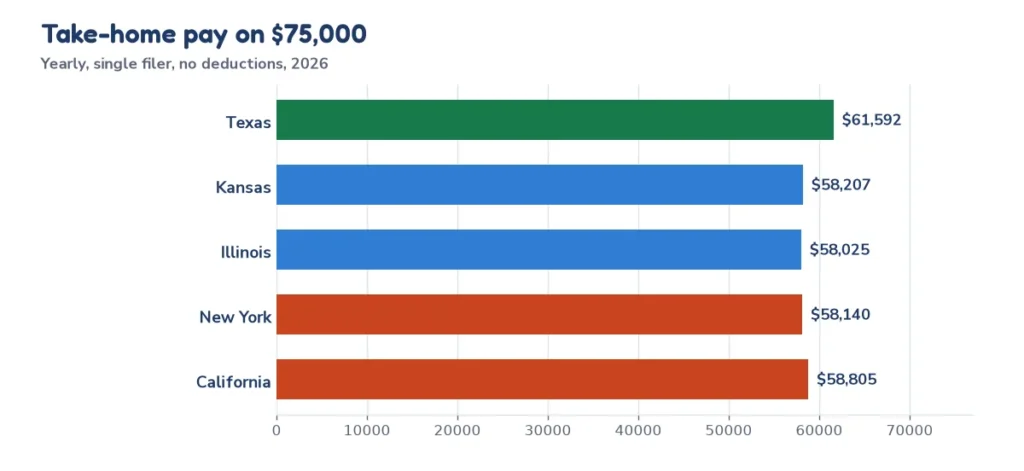
The same salary can leave very different amounts in different states, and a take home pay calculator should show that. This table shows yearly take-home pay for a single filer with no deductions. It includes federal tax, Social Security, Medicare and the state income tax.
| Salary | Texas | Kansas | Illinois | New York | California |
|---|---|---|---|---|---|
| $30,000 | $26,285 | $25,389 | $24,945 | $25,262 | $26,060 |
| $50,000 | $42,355 | $40,365 | $40,025 | $40,252 | $41,306 |
| $75,000 | $61,592 | $58,207 | $58,025 | $58,140 | $58,805 |
| $100,000 | $79,180 | $74,400 | $74,375 | $74,320 | $74,110 |
| $150,000 | $113,791 | $106,221 | $106,511 | $105,981 | $104,071 |
Salary after tax calculator: 0,000 in three states
Most people searching for a salary after tax calculator want to see where the money goes. This table follows a $100,000 salary for a single filer with no deductions. The federal tax and FICA are the same everywhere, so the difference between states is the state tax.
| State | Federal tax | Social Security and Medicare | State tax | Take-home per year | Per paycheck (26) | Share kept |
|---|---|---|---|---|---|---|
| Texas | $13,170 | $7,650 | $0 | $79,180 | $3,045.38 | 79.2% |
| Kansas | $13,170 | $7,650 | $4,780 | $74,400 | $2,861.53 | 74.4% |
| California | $13,170 | $7,650 | $5,070 | $74,110 | $2,850.37 | 74.1% |
The estimate keeps between 74% and 79% of a $100,000 salary after federal, FICA and state taxes in these states. Add a 401(k) contribution and the share kept falls, but the tax bill falls too.
Paycheck estimator for hourly pay
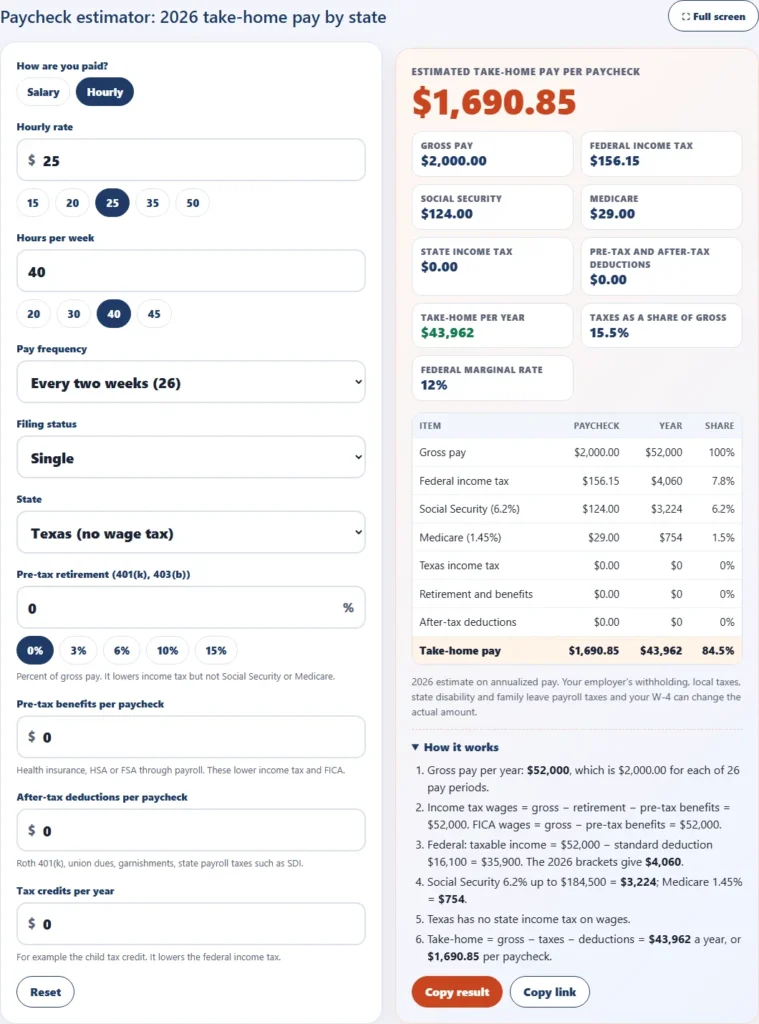
For hourly work, the paycheck estimator multiplies the rate by the hours per week and by 52. The table assumes 40 hours a week for a single filer and shows the weekly take-home in Texas, where there is no state tax, and in Kansas.
| Hourly rate | Gross per year | Take-home per year (Texas) | Weekly take-home (Texas) | Weekly take-home (Kansas) |
|---|---|---|---|---|
| $15 | $31,200 | $27,249 | $524.02 | $505.59 |
| $20 | $41,600 | $35,606 | $684.72 | $655.46 |
| $25 | $52,000 | $43,962 | $845.42 | $805.00 |
| $30 | $62,400 | $52,318 | $1,006.12 | $954.54 |
| $40 | $83,200 | $67,361 | $1,295.41 | $1,221.51 |
| $50 | $104,000 | $81,994 | $1,576.81 | $1,480.59 |
Paycheck estimator Utah: a flat 4.5% state tax
Utah taxes income at a flat rate of 4.5%, according to the Tax Foundation table, and it has no standard deduction or personal exemption in that table. A single filer earning $50,000 owes $2,250 of state tax on the table figures, so the paycheck estimator Utah result is about $1,542.50 every two weeks. Some states, including Utah, also have credits that are not modeled here, so the actual figure can be a little lower.
How a 401(k) changes take-home pay
A traditional 401(k) contribution lowers your taxable pay, so take-home pay falls by less than the contribution. This table uses a $65,000 salary, a single filer in Texas and 26 paychecks.
| Contribution | Into the 401(k) per paycheck | Take-home per paycheck | Take-home reduced by | Tax saved per paycheck |
|---|---|---|---|---|
| 0% | $0.00 | $2,092.60 | $0.00 | $0.00 |
| 5% | $125.00 | $1,982.60 | $110.00 | $15.00 |
| 10% | $250.00 | $1,872.60 | $220.00 | $30.00 |
| 15% | $375.00 | $1,762.60 | $330.00 | $45.00 |
Take-home pay by pay frequency
Yearly pay is the same, but each paycheck depends on how often you are paid. A $65,000 salary in Texas gives these amounts for a single filer.
| Pay frequency | Paychecks per year | Gross per paycheck | Take-home per paycheck |
|---|---|---|---|
| Weekly | 52 | $1,250.00 | $1,046.30 |
| Every two weeks | 26 | $2,500.00 | $2,092.60 |
| Twice a month | 24 | $2,708.33 | $2,266.98 |
| Monthly | 12 | $5,416.67 | $4,533.96 |
Paycheck calculator limits: what is not included
- Local income taxes, such as city and county taxes, and school district taxes.
- State payroll programs such as disability and paid family leave, which differ by state.
- Your Form W-4 settings. Employers use IRS withholding tables, and extra withholding changes each paycheck.
- Bonuses and overtime, which are often withheld at a flat supplemental rate.
- Itemized deductions, other income and credits beyond the yearly credit amount you enter.
The estimate is the tax on annualized pay, which is close to what is withheld for a single job with a standard W-4. Your final tax is settled when you file your return.
Frequently asked questions
10 quick answers
How do I calculate my take-home pay?
Subtract federal income tax, Social Security, Medicare, state income tax and deductions from gross pay. The paycheck estimator does this from your salary, filing status and state.
How much is $65,000 a year after taxes?
About $54,408 a year for a single filer in Texas, or $2,092.60 every two weeks. In Kansas it is about $51,580 a year.
What are the 2026 federal tax brackets?
For single filers they run from 10% up to $12,400 to 37% above $640,600, with a $16,100 standard deduction. The table above lists every bracket and status.
How much Social Security tax is taken out?
6.2% of wages up to $184,500 in 2026, plus 1.45% Medicare on all wages and 0.9% on wages above $200,000.
Which states have no income tax?
Alaska, Florida, Nevada, New Hampshire, South Dakota, Tennessee, Texas, Washington and Wyoming do not tax wages.
Does a 401(k) reduce my take-home pay?
Yes, but by less than the contribution, because a traditional 401(k) lowers the pay that income tax is based on.
Why is my real paycheck different?
Local taxes, state payroll programs, W-4 choices, bonuses and other deductions can change it. The estimate uses annualized pay and standard deductions.
Can I use it for hourly pay?
Yes. Choose Hourly and enter the rate and hours per week. The paycheck estimator multiplies by 52 weeks.
Does it include overtime?
No. Enter your average weekly hours, including overtime hours at their pay rate, as a single hourly rate if you want an estimate.
Is the paycheck estimator free?
Yes. It is free, runs in your browser and does not ask for personal details.
Related calculators
- Kansas paycheck calculator for Kansas take-home pay
- Hourly to salary calculator to convert pay rates
- Overtime calculator for time-and-a-half pay
- Self-employment tax calculator for 1099 income
- Budget calculator to plan with your take-home pay
- All free calculators
Sources and further reading
- IRS Revenue Procedure 2025-32: 2026 tax rate tables and standard deduction
- IRS: tax inflation adjustments for tax year 2026: the brackets and standard deduction in plain language
- IRS Topic 751: Social Security and Medicare withholding rates: 6.2%, 1.45%, the $184,500 base and Additional Medicare tax
- Tax Foundation: State income tax rates and brackets, 2026: state rates, deductions and exemptions
This page is general information and not tax advice. Rates were checked in October 2026. Last reviewed: October 2026.