A property tax calculator estimates the yearly tax on a home from its value and a tax rate. Pick a state to use its average effective rate, or type your own rate or mill rate, set the assessment ratio and exemptions, and read the annual and monthly amount.
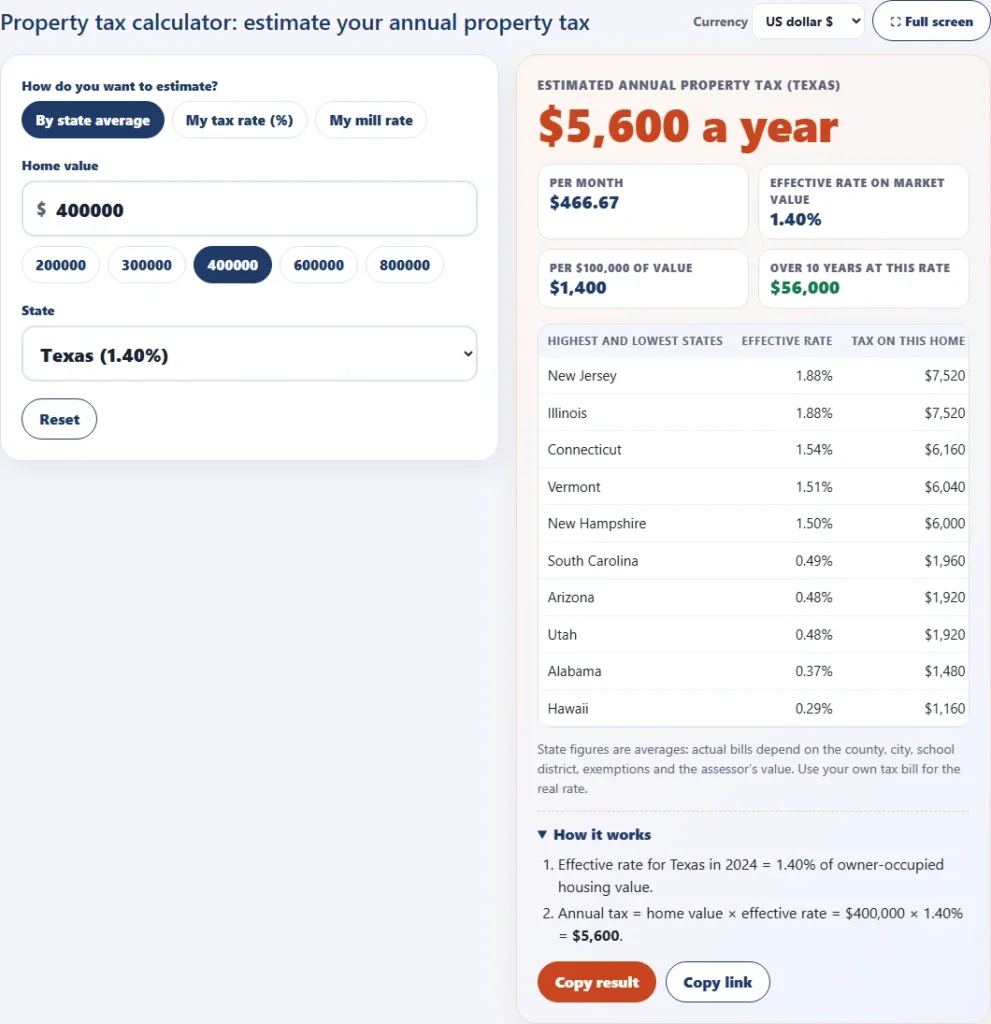
Quick answer: Property tax = assessed value × tax rate. Assessed value is the market value times the assessment ratio, less exemptions. On a $400,000 home in Texas, where the 2024 average effective rate was 1.40%, the estimate is $5,600 a year, or about $467 a month.
How to use the property tax calculator
- Enter the market value of the home.
- Choose By state average to use the state's effective rate, or My tax rate or My mill rate if you know your local rate.
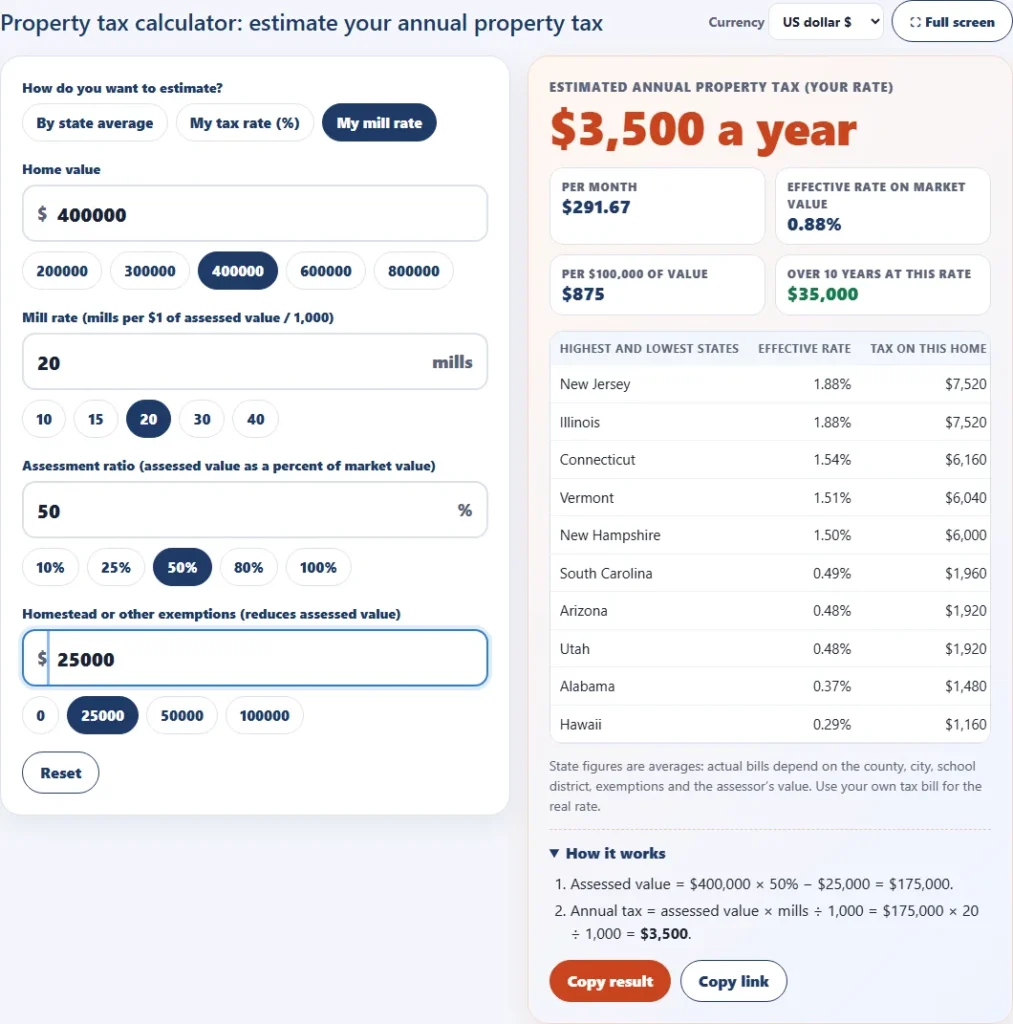
- For your own rate, enter the assessment ratio and any homestead or other exemptions. Exemptions reduce the assessed value.
- Read the annual tax, the monthly amount, the effective rate and a table of the highest and lowest states for the same home.
- Compare the result with your actual bill. The bill is the number that matters.
The calculator runs in your browser and keeps your numbers on your device. State figures are averages, so a county, city or school district can be well above or below them.
How to calculate property tax: the formula
Wikipedia describes a property tax as an ad valorem tax on the value of a property, levied by the jurisdiction where the property sits, with the rate expressed as a percentage or per mille, also called millage. To calculate it, the authority multiplies the assessed value by the mill rate and divides by 1,000. Its example: a property assessed at $50,000 in a municipality with a mill rate of 20 mills has a bill of $1,000 a year.
- Assessed value = market value × assessment ratio − exemptions.
- Tax with a percent rate = assessed value × rate ÷ 100.
- Tax with a mill rate = assessed value × mills ÷ 1,000.
- Effective rate = annual tax ÷ market value.
Mill rate calculator: converting mills to a percent
One mill is one-thousandth of a dollar, which is $1 of tax for every $1,000 of assessed value. A rate of 20 mills equals 2.0 percent of assessed value, and 12.5 mills equals 1.25 percent. As a mill rate calculator, the tool does the division for you.
| Mill rate | Percent of assessed value | Tax on $100,000 assessed | Tax on $250,000 assessed |
|---|---|---|---|
| 5 mills | 0.50% | $500 | $1,250 |
| 10 mills | 1.00% | $1,000 | $2,500 |
| 15 mills | 1.50% | $1,500 | $3,750 |
| 20 mills | 2.00% | $2,000 | $5,000 |
| 30 mills | 3.00% | $3,000 | $7,500 |
| 40 mills | 4.00% | $4,000 | $10,000 |
Assessed value calculator: market value, ratio and exemptions
Not every place taxes the full market value. Some jurisdictions use an assessment ratio, so the assessed value is a fraction of market value, and the rate is set to match. Wikipedia's article on property tax in the United States also notes that nearly all jurisdictions provide a homestead exemption that reduces the taxable value of an owner-occupied home, and many provide additional exemptions for veterans. As an assessed value calculator, the tool applies the ratio and subtracts the exemption before it multiplies by the rate.
| Assessment ratio | Exemption | Assessed value | Mills | Tax on a $400,000 home |
|---|---|---|---|---|
| 100% | $0 | $400,000 | 12 | $4,800 |
| 100% | $50,000 | $350,000 | 12 | $4,200 |
| 50% | $0 | $200,000 | 24 | $4,800 |
| 50% | $25,000 | $175,000 | 24 | $4,200 |
| 80% | $0 | $320,000 | 15 | $4,800 |
Property tax by state: effective rates
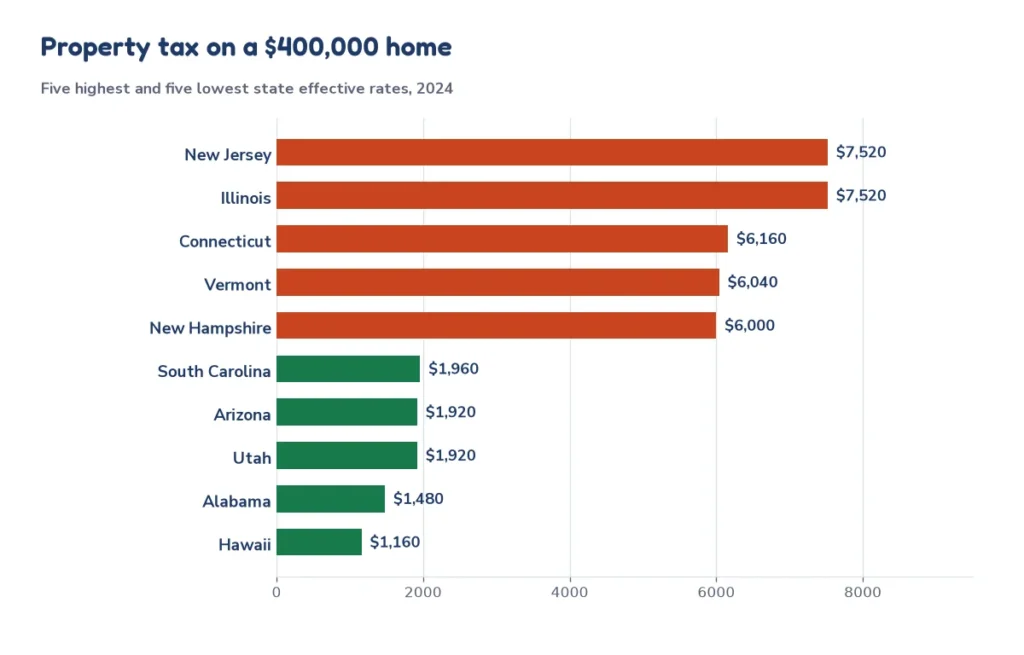
The Tax Foundation reports property taxes paid as a percentage of owner-occupied housing value for 2024, using American Community Survey data. New Jersey and Illinois were at 1.88 percent, and Hawaii was lowest at 0.29 percent. The table applies each state's effective rate to a $400,000 home, and the calculator uses the same rates in the state mode.
| Rank (highest = 1) | State | Effective rate (2024) | Tax on $400,000 per year | Per month |
|---|---|---|---|---|
| 1 | New Jersey | 1.88% | $7,520 | $627 |
| 2 | Illinois | 1.88% | $7,520 | $627 |
| 3 | Connecticut | 1.54% | $6,160 | $513 |
| 4 | Vermont | 1.51% | $6,040 | $503 |
| 5 | New Hampshire | 1.50% | $6,000 | $500 |
| 6 | Nebraska | 1.44% | $5,760 | $480 |
| 7 | Texas | 1.40% | $5,600 | $467 |
| 8 | Ohio | 1.36% | $5,440 | $453 |
| 9 | Iowa | 1.33% | $5,320 | $443 |
| 10 | Wisconsin | 1.32% | $5,280 | $440 |
| 11 | New York | 1.30% | $5,200 | $433 |
| 12 | Pennsylvania | 1.26% | $5,040 | $420 |
| 13 | Kansas | 1.21% | $4,840 | $403 |
| 14 | Michigan | 1.19% | $4,760 | $397 |
| 15 | Rhode Island | 1.12% | $4,480 | $373 |
| 16 | Massachusetts | 1.00% | $4,000 | $333 |
| 17 | Minnesota | 1.00% | $4,000 | $333 |
| 18 | South Dakota | 1.00% | $4,000 | $333 |
| 19 | Maine | 0.98% | $3,920 | $327 |
| 20 | Alaska | 0.94% | $3,760 | $313 |
| 21 | Maryland | 0.92% | $3,680 | $307 |
| 22 | North Dakota | 0.92% | $3,680 | $307 |
| 23 | Missouri | 0.89% | $3,560 | $297 |
| 24 | Oregon | 0.81% | $3,240 | $270 |
| 25 | Georgia | 0.79% | $3,160 | $263 |
| 26 | Oklahoma | 0.79% | $3,160 | $263 |
| 27 | Florida | 0.78% | $3,120 | $260 |
| 28 | Virginia | 0.78% | $3,120 | $260 |
| 29 | Indiana | 0.76% | $3,040 | $253 |
| 30 | Washington | 0.75% | $3,000 | $250 |
| 31 | Kentucky | 0.74% | $2,960 | $247 |
| 32 | California | 0.70% | $2,800 | $233 |
| 33 | North Carolina | 0.66% | $2,640 | $220 |
| 34 | New Mexico | 0.63% | $2,520 | $210 |
| 35 | Montana | 0.61% | $2,440 | $203 |
| 36 | District of Columbia | 0.60% | $2,400 | $200 |
| 37 | Mississippi | 0.58% | $2,320 | $193 |
| 38 | Arkansas | 0.56% | $2,240 | $187 |
| 39 | Louisiana | 0.55% | $2,200 | $183 |
| 40 | Delaware | 0.54% | $2,160 | $180 |
| 41 | Wyoming | 0.53% | $2,120 | $177 |
| 42 | Tennessee | 0.52% | $2,080 | $173 |
| 43 | West Virginia | 0.51% | $2,040 | $170 |
| 44 | Nevada | 0.50% | $2,000 | $167 |
| 45 | Colorado | 0.50% | $2,000 | $167 |
| 46 | Idaho | 0.50% | $2,000 | $167 |
| 47 | South Carolina | 0.49% | $1,960 | $163 |
| 48 | Arizona | 0.48% | $1,920 | $160 |
| 49 | Utah | 0.48% | $1,920 | $160 |
| 50 | Alabama | 0.37% | $1,480 | $123 |
| 51 | Hawaii | 0.29% | $1,160 | $97 |
Why a state average is only a starting point
- Counties, cities and school districts each set their own levies, so two homes in one state can pay very different rates.
- The assessed value can be below market value, and it may be updated on a schedule, so your bill can lag a rising or falling market.
- Exemptions, caps and credits change the bill, and they differ by place and by owner.
- The effective rate is a ratio across all owner-occupied homes, so a single home can be above or below it.
Frequently asked questions
10 quick answers
How is property tax calculated?
The jurisdiction multiplies the assessed value by the tax rate. If the rate is in mills, it divides by 1,000. The assessed value may be a fraction of market value and may be reduced by exemptions.
What is a mill rate?
A mill is one-thousandth of a dollar, so a mill rate states the tax per $1,000 of assessed value. 20 mills means $20 per $1,000, or 2 percent.
What is the effective property tax rate?
It is the property tax paid divided by the market value of the home, which makes rates comparable across places with different assessment methods.
Which state has the highest property taxes?
In the Tax Foundation's 2024 figures New Jersey and Illinois were tied at 1.88 percent of owner-occupied housing value, and Hawaii had the lowest at 0.29 percent.
What is a homestead exemption?
It is a reduction in the taxable value of an owner-occupied home. Nearly all jurisdictions provide one, and the amount varies.
How much is property tax on a $300,000 home?
At the 2024 US state effective rates, from about $870 in Hawaii to about $5,640 in New Jersey and Illinois. Your county rate decides the real figure.
Is property tax paid monthly?
The tax bill is annual or semiannual, but many lenders collect one-twelfth each month with the mortgage and pay the bill from an escrow account.
Can I lower my property tax?
You may be able to claim exemptions, check that the assessment is accurate and appeal if it is not. Rules and deadlines are local.
Does the calculator include special assessments or fees?
No. It estimates the general property tax only.
How accurate is the estimate?
It is a planning figure. Your bill, assessor's record or the county tax collector gives the exact amount.
Related calculators
- Mortgage calculator with property tax and insurance in the payment
- Closing cost calculator for the cash needed at closing
- HELOC calculator for borrowing against equity
- Percentage calculator for rates and percent changes
- All free calculators
Sources and further reading
- Tax Foundation: Property Taxes by State and County, 2026: effective rates by state for 2024 from American Community Survey data
- Property tax (Wikipedia): the formula and the mill rate
- Property tax in the United States (Wikipedia): assessment ratios and exemptions
This page is general information and not tax advice. Last reviewed: October 2026.