A random animal generator picks an animal for you from a list, and this one lets you narrow the list first by animal group, diet and habitat. Press the button, and you get a name plus the group, diet, habitat and where it lives, ready for a drawing, a story or a quiz.
Quick answer: The list has 106 animals, so with no filters each one has a 1 in 106 chance, about 0.94%, and the chance is 1 in the number of matches once you filter. Choose Mammal and Ocean, for example, and the generator draws from 6 animals.
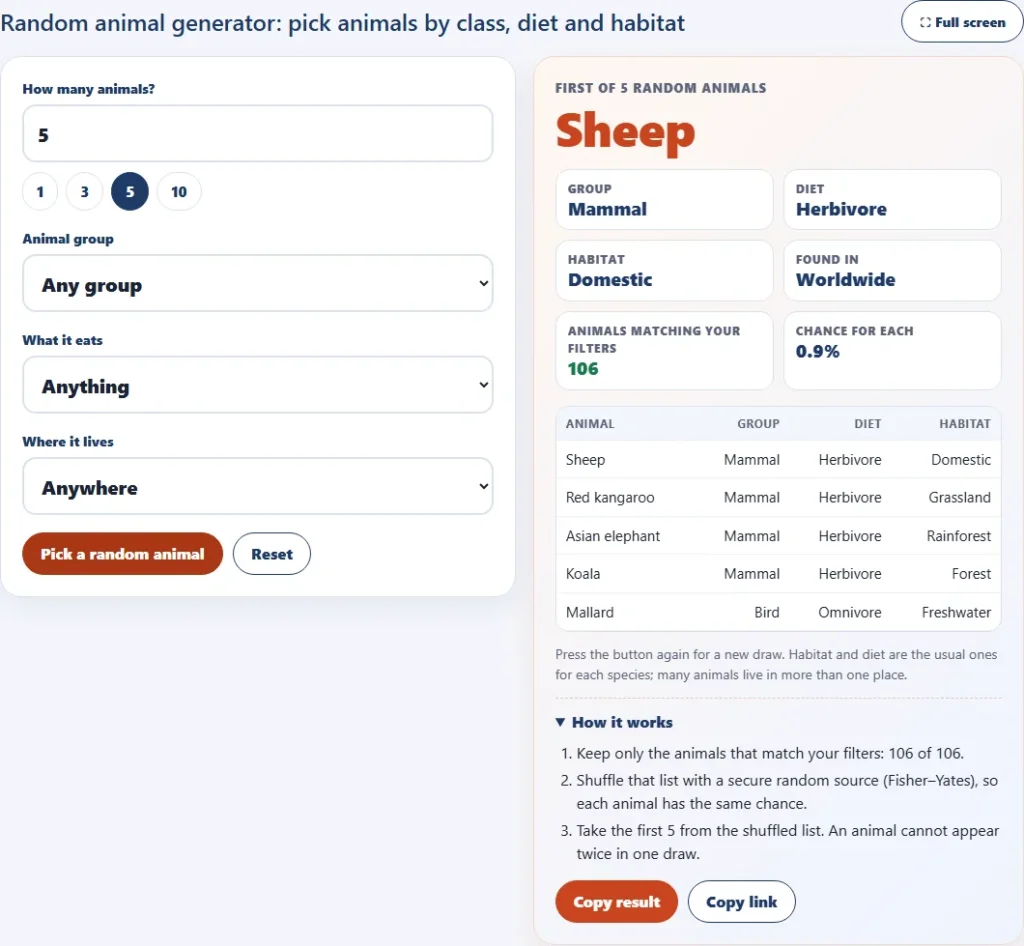
How to use the random animal generator
- Choose how many animals you want, from one to as many as match.
- Optionally pick an animal group, what it eats and where it lives. Leave a filter on Any to keep every animal.
- Press Pick a random animal. The first result is shown large, and the full list appears in the table below.
- Press the button again for a new draw. An animal never appears twice in the same draw.
- Use Copy result to paste the names into a document or a message.
The generator runs in your browser and uses a secure random source, so every animal that matches your filters has the same chance. Nothing you do is saved or uploaded.
Random animal picker: what is on the list
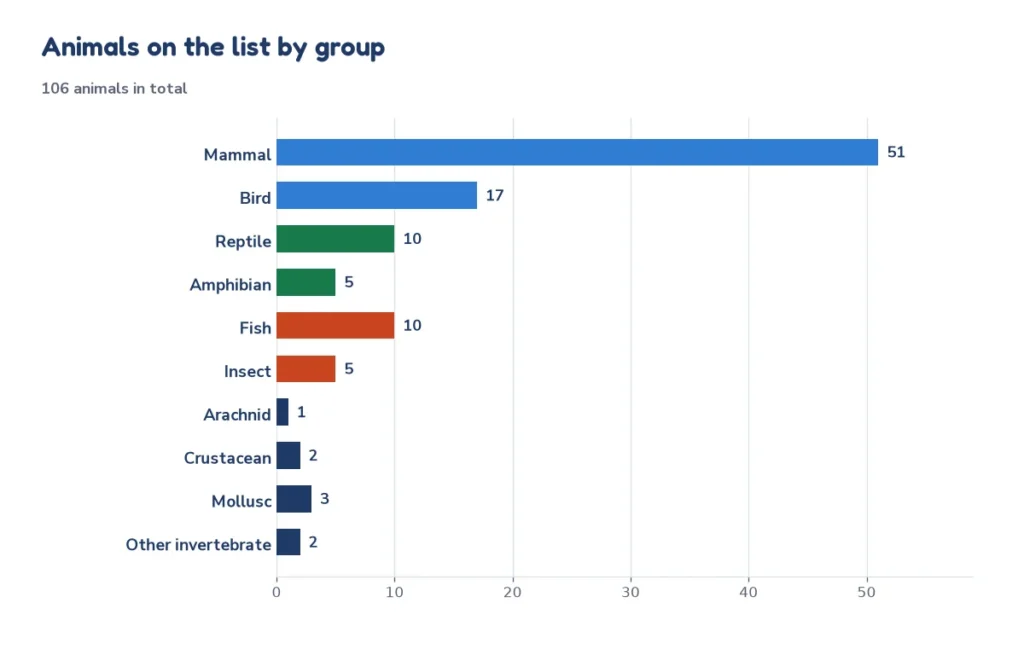
The list is a hand-picked set of 106 well-known animals from every major group, including mammals, birds, reptiles, amphibians, fish and invertebrates. Each entry has a group, a usual diet, a usual habitat and the places it is found. Many animals live in more than one habitat, so the habitat shown is the one most people associate with the species.
| Animal group | Animals on the list | Share of the list |
|---|---|---|
| Mammal | 51 | 48% |
| Bird | 17 | 16% |
| Reptile | 10 | 9% |
| Amphibian | 5 | 5% |
| Fish | 10 | 9% |
| Insect | 5 | 5% |
| Arachnid | 1 | 1% |
| Crustacean | 2 | 2% |
| Mollusc | 3 | 3% |
| Other invertebrate | 2 | 2% |
Animal groups explained
The group filter uses the everyday classes that school science and field guides use. Vertebrates, the animals with a backbone, are the first five on the list below, and the rest are invertebrates.
| Group | What defines it | Examples on the list |
|---|---|---|
| Mammal | Warm-blooded, has hair or fur, and feeds its young milk | Lion, blue whale, koala |
| Bird | Has feathers and a beak, and lays eggs | Emperor penguin, ostrich, bald eagle |
| Reptile | Cold-blooded with dry, scaly skin | Nile crocodile, king cobra, green sea turtle |
| Amphibian | Moist skin, and most start life in water | Red-eyed tree frog, axolotl |
| Fish | Lives in water and breathes through gills | Great white shark, clownfish, seahorse |
| Insect | Six legs and a body in three parts | Honeybee, monarch butterfly, dragonfly |
| Arachnid | Eight legs and two body parts | Emperor scorpion |
| Crustacean | Hard shell and jointed legs, mostly in water | Hermit crab, American lobster |
| Mollusc | Soft body, often with a shell | Common octopus, garden snail |
| Other invertebrate | Animals without a backbone in other groups | Moon jellyfish, common starfish |
Fish are the odd one out for habitat: nearly every fish on the list is filed under Ocean or Freshwater, while mammals spread across almost every habitat.
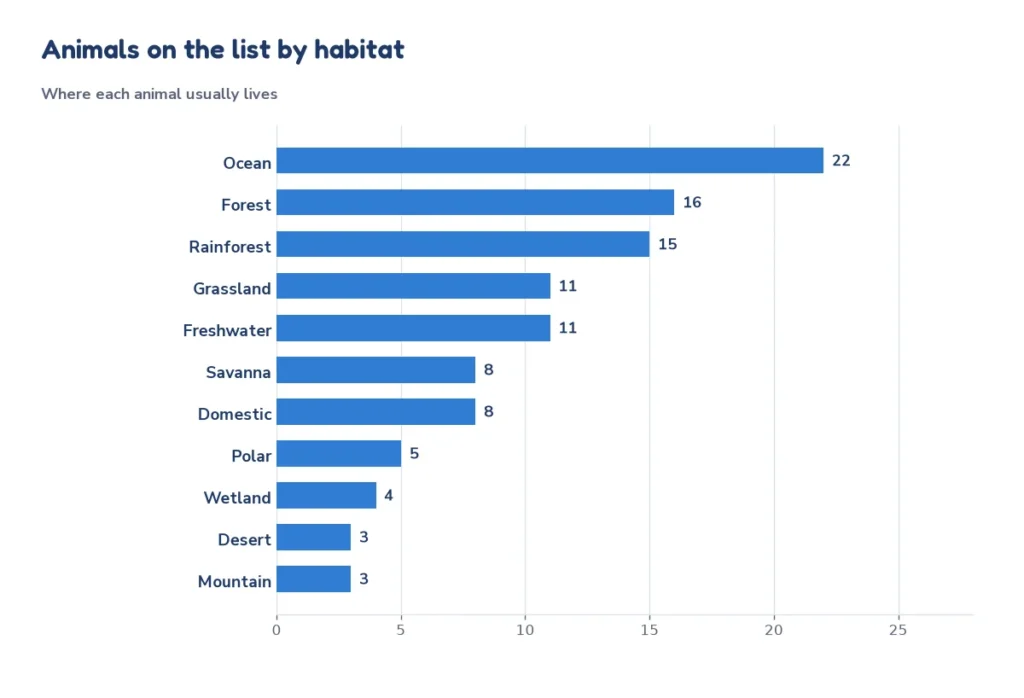
Random animal generator by habitat
The habitat filter is the easiest way to make a themed draw. Choose Ocean for a sea unit, Rainforest for a jungle lesson or Domestic for farm and pet animals. The random animal generator by habitat uses these groups:
| Habitat | Animals | Examples |
|---|---|---|
| Savanna | 8 | African elephant, Lion, Cheetah, Giraffe, Zebra, White rhinoceros, Ostrich, Komodo dragon |
| Grassland | 11 | Red kangaroo, American bison, European rabbit, Barn owl, Emu, Red-tailed hawk, Galapagos tortoise, Monarch butterfly, Honeybee, Ladybug, Praying manti… |
| Forest | 16 | Leopard, Koala, Brown bear, Gray wolf, Red fox, Moose, European hedgehog, Raccoon, Eastern gray squirrel, Bald eagle, Indian peafowl, Ruby-throated hu… |
| Rainforest | 15 | Asian elephant, Tiger, Gorilla, Chimpanzee, Orangutan, Three-toed sloth, Jaguar, Scarlet macaw, Toco toucan, King cobra, Green iguana, Burmese python,… |
| Desert | 3 | Dromedary camel, Meerkat, Western diamondback rattlesnake |
| Mountain | 3 | Giant panda, Red panda, Llama |
| Polar | 5 | Polar bear, Arctic fox, Reindeer, Walrus, Emperor penguin |
| Freshwater | 11 | Hippopotamus, Beaver, Platypus, Mute swan, Mallard, Nile crocodile, American bullfrog, Axolotl, Goldfish, Red-bellied piranha, Electric eel |
| Wetland | 4 | Capybara, Greater flamingo, American alligator, Dragonfly |
| Ocean | 22 | Sea otter, Bottlenose dolphin, Blue whale, Orca, Humpback whale, Harbor seal, Brown pelican, Wandering albatross, Green sea turtle, Great white shark,… |
| Domestic | 8 | Horse, Cow, Pig, Sheep, Goat, Dog, Cat, Chicken |
Diet filter: carnivore, herbivore, omnivore and insectivore
Wikipedia describes a carnivore as an organism that eats mostly or exclusively animal tissue. The same article notes that the polar bear eats meat almost exclusively, that almost all other bear species are omnivorous, and that the giant panda is nearly exclusively herbivorous. That is a good reminder that a diet label is a simplification, and the generator uses the diet that best describes each species.
| Diet | Animals | Share |
|---|---|---|
| Carnivore | 43 | 41% |
| Herbivore | 33 | 31% |
| Omnivore | 21 | 20% |
| Insectivore | 7 | 7% |
| Filter feeder | 2 | 2% |
Random mammal generator and other group draws
Use the group filter for a random mammal generator, a bird picker or a reptile draw. Mammals are the largest group on the list, so an unfiltered draw lands on a mammal about 48% of the time. Filtering is also how you make a fair mix: draw three times with a different group each time to get one mammal, one bird and one reptile.
Chances: how many animals match your filters
| Filters | Animals that match | Chance for each animal |
|---|---|---|
| No filters | 106 | 0.9% |
| Mammal | 51 | 2.0% |
| Bird | 17 | 5.9% |
| Ocean habitat | 22 | 4.5% |
| Carnivore | 43 | 2.3% |
| Mammal and Ocean | 6 | 16.7% |
| Bird and Freshwater | 2 | 50.0% |
| Reptile and Rainforest | 3 | 33.3% |
Random animal generator for kids: classroom and family ideas
- Use it as a random animal generator for kids at circle time. Draw one animal and ask the class what it eats, where it lives and how it moves.
- Play 20 questions: one child draws an animal, and the others ask yes or no questions to guess it.
- Make an animal alphabet or habitat chart by drawing several animals and sorting them by group or habitat.
- Start a story: draw two animals and write a short story in which they meet.
- Set a timer for a one-minute sketch of whatever the generator gives you.
Random animal to draw: a drawing prompt that never repeats
As a random animal to draw, the generator solves the blank page problem. Pick the number of animals to match your session, from one quick sketch to a ten-animal sheet, and filter to a group if you want to practice fur, feathers or scales. Pair the result with a constraint, such as drawing it from the side, in a single color or in under five minutes, to turn it into an animal drawing prompt.
Writing and game ideas
| Use | How to set the generator | What you do |
|---|---|---|
| Character names and mascots | Any group, 3 animals | Pick the animal that fits a team or a brand idea |
| Science quiz | Habitat set to Ocean or Rainforest | Ask for diet, group and habitat from the table |
| Story starter | Any group, 2 animals | Write a scene where the two meet |
| Party game | Domestic or Mammal, 10 animals | Charades or draw-and-guess rounds |
| Classification practice | Any group, 10 animals | Sort by group, diet and habitat |
Frequently asked questions
10 quick answers
How does the random animal generator work?
It filters the list by the group, diet and habitat you choose, shuffles the matching animals with a secure random source and returns the first ones. Each match has the same chance.
Is the random animal generator fair?
Yes. Every animal that matches your filters has an equal chance, and the shuffle method gives every possible order the same probability.
How many animals are in the list?
There are 106 animals across mammals, birds, reptiles, amphibians, fish and several invertebrate groups.
Can I get more than one animal at a time?
Yes. Set the number up to the number of matches, and the generator returns that many different animals.
Can I pick only sea animals or only birds?
Yes. Set the habitat to Ocean or the group to Bird. You can combine filters, and if nothing matches the generator tells you which filter to relax.
What are the diet categories?
Carnivore, herbivore, omnivore, insectivore and filter feeder. They describe what an animal mostly eats.
Why is a panda a herbivore if it is a bear?
Bears are classed as carnivorans, but the giant panda is nearly exclusively herbivorous according to Wikipedia, so its diet is listed as herbivore.
Can I use it for drawing prompts?
Yes. Draw one animal at a time, or ten for a practice sheet, and add a constraint to make it a challenge.
Is it suitable for children?
Yes. All entries are familiar animals, and the filters make it easy to match a topic such as habitats or farm animals.
Does the page save my results?
No. Everything happens in your browser, and nothing is stored or sent anywhere.
Related generators and games
- Random name picker to pick a winner or make teams
- Random number generator for any range
- Dice roller for board games
- Coin flip for quick decisions
- All random generators
- Animal bingo to play with the animals you draw
Sources and further reading
- Carnivore (Wikipedia): definition of the diet, with the polar bear, other bears and the giant panda as examples
- Vertebrate (Wikipedia): the vertebrate groups of fish, amphibians, reptiles, birds and mammals
Last reviewed: October 2026.