A CAGR calculator finds the steady yearly growth rate that would take an investment, a revenue figure or any other value from its starting amount to its ending amount over a set number of years. Enter the starting value, the ending value and the years, and it returns the compound annual growth rate with the working shown.
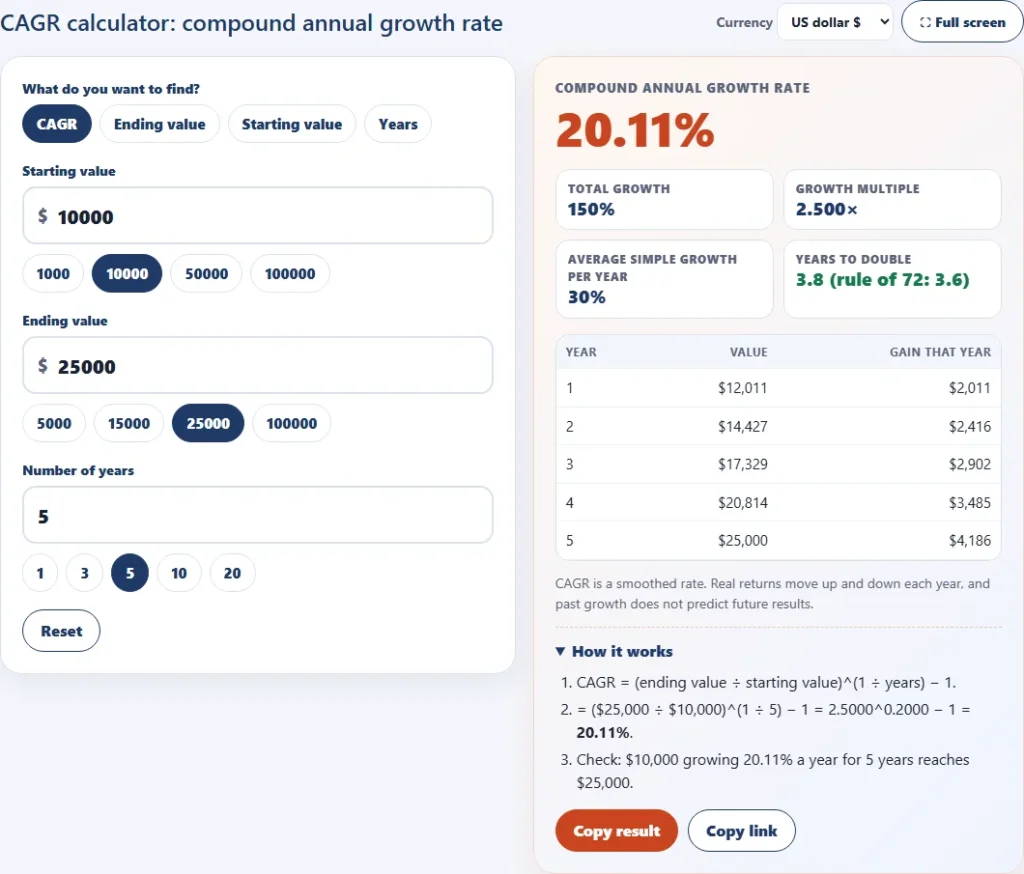
Quick answer: CAGR = (ending value ÷ starting value)1 ÷ years − 1. Growing from $10,000 to $25,000 in 5 years is (25,000 ÷ 10,000)1÷5 − 1 = 20.11% a year.
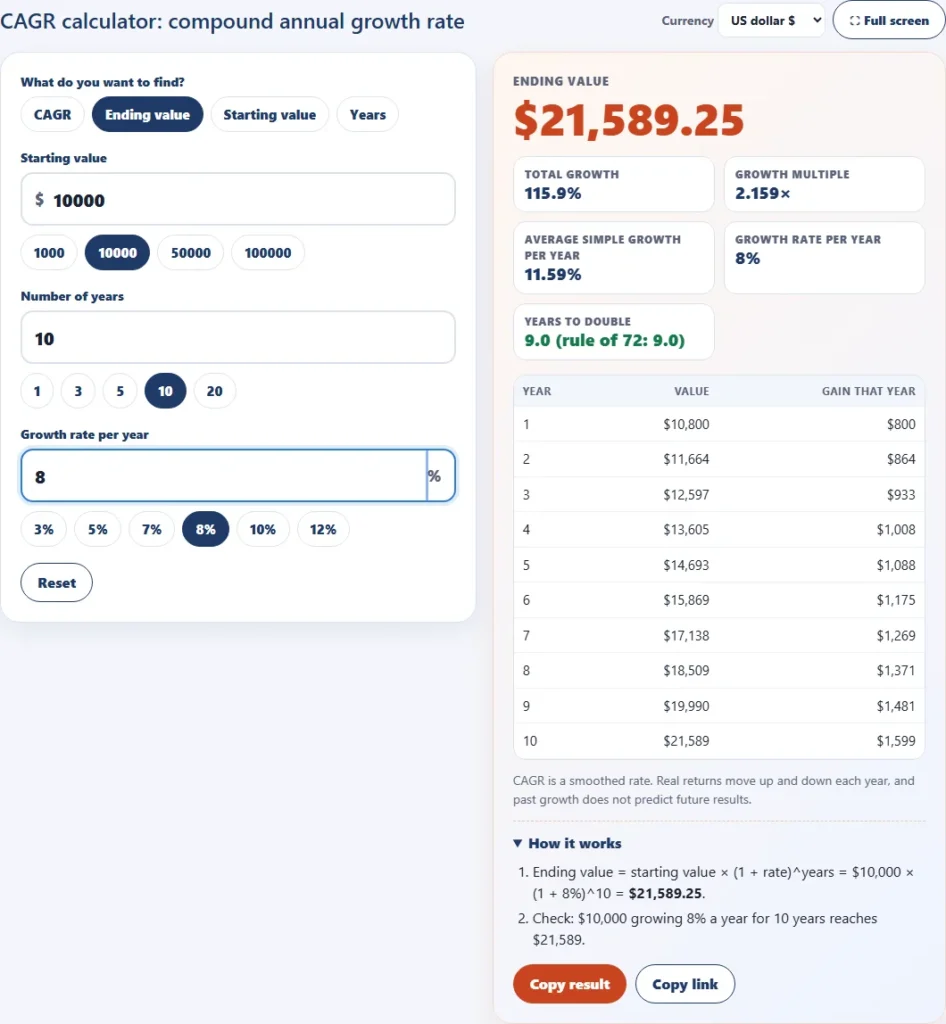
How to use the CAGR calculator
- Choose what to find: CAGR, ending value, starting value or years.
- Enter the values you know. For CAGR, that is the starting value, the ending value and the number of years.
- Read the answer and the supporting numbers: total growth, the growth multiple, the average simple growth and the years to double.
- Scroll the year-by-year table to see the value at the end of every year, and open How it works for the steps.
The calculator runs in your browser and keeps your numbers on your device. It is for planning and learning, and it is not investment advice.
CAGR formula: how to calculate CAGR
Wikipedia defines the compound annual growth rate as the mean annualized growth rate for compounding values over a given period, and gives the formula as the ending value divided by the starting value, raised to one over the number of years, minus one. It adds that CAGR smooths the effect of volatility of periodic values that can make arithmetic means less meaningful.
- CAGR = (ending value ÷ starting value)1 ÷ years − 1.
- Ending value = starting value × (1 + CAGR)years.
- Starting value = ending value ÷ (1 + CAGR)years.
- Years = ln(ending ÷ starting) ÷ ln(1 + CAGR).
Compound annual growth rate calculator: what the result means
A compound annual growth rate calculator gives one number, but it says three things. It tells you the steady rate, the total growth over the period and how long the value takes to double. For the $10,000 to $25,000 example, the CAGR of 20.11% is also a 150% total gain and a 2.5 times multiple, and at that rate the value doubles in about 3.8 years.
How to calculate CAGR: worked examples
| Example | Start | End | Years | CAGR |
|---|---|---|---|---|
| Investment | $10,000 | $25,000 | 5 | 20.11% |
| Company revenue | $2,400,000 | $3,900,000 | 4 | 12.91% |
| Home value | $300,000 | $420,000 | 7 | 4.92% |
| Savings account | $5,000 | $5,800 | 3 | 5.07% |
| Subscribers | 12,000 | 48,000 | 3 | 58.74% |
Annual growth rate calculator by multiple and time
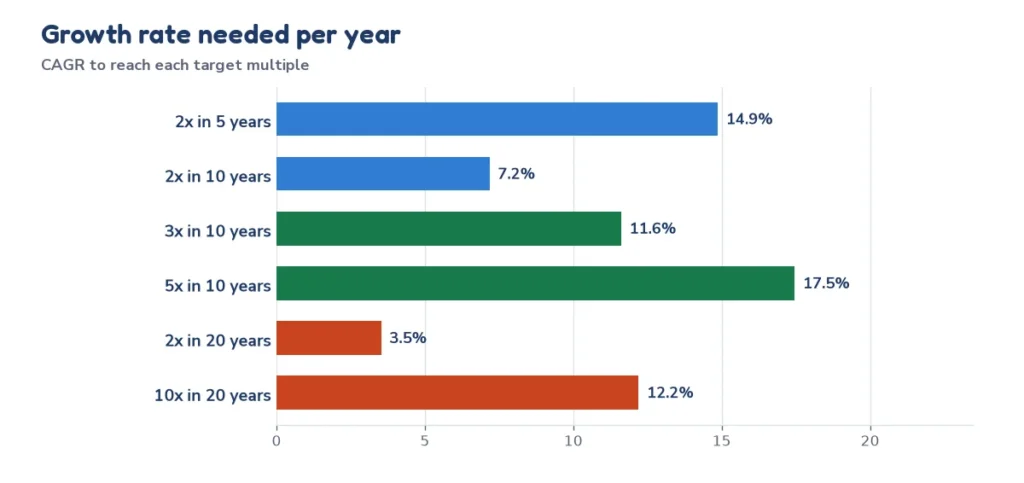
This table works the formula backwards. It shows the annual growth rate needed to reach a growth multiple over a number of years, which is useful for goal setting.
| Target multiple | 3 years | 5 years | 10 years | 20 years |
|---|---|---|---|---|
| 1.5x | 14.5% | 8.4% | 4.1% | 2.0% |
| 2x | 26.0% | 14.9% | 7.2% | 3.5% |
| 3x | 44.2% | 24.6% | 11.6% | 5.6% |
| 5x | 71.0% | 38.0% | 17.5% | 8.4% |
| 10x | 115.4% | 58.5% | 25.9% | 12.2% |
CAGR versus the average of yearly returns
The average of yearly percentages is not the same as the growth you actually got. Suppose a value rises 50% in year one, falls 20% in year two and rises 30% in year three. The arithmetic average is 20% a year, but $10,000 becomes $10,000 × 1.5 × 0.8 × 1.3 = $15,600, which is a CAGR of 15.98%. The gap grows with the size of the swings, which is why CAGR is the better summary of what happened.
| Year | Return | Value at year end |
|---|---|---|
| Start | $10,000 | |
| 1 | +50% | $15,000 |
| 2 | -20% | $12,000 |
| 3 | +30% | $15,600 |
| Average return | 20.00% | |
| CAGR | 15.98% |
Real CAGR: adjusting for inflation
A nominal CAGR does not remove inflation. To see growth in purchasing power, divide one plus the nominal rate by one plus the inflation rate and subtract one. The table shows how a nominal 8% growth rate changes with inflation.
| Nominal CAGR | Inflation | Real CAGR |
|---|---|---|
| 8.00% | 0% | 8.00% |
| 8.00% | 2% | 5.88% |
| 8.00% | 3% | 4.85% |
| 8.00% | 4% | 3.85% |
| 8.00% | 6% | 1.89% |
Using CAGR to set a goal
You can also use the calculator in reverse. To turn $100,000 into $1,000,000 in 20 years you need a CAGR of 12.20%. To reach $250,000 in 10 years from $150,000 you need 5.24%, and to double $50,000 in 7 years you need 10.41%. If the required rate looks unrealistic, extend the time, add contributions or lower the target.
Negative CAGR: when a value falls
The same formula works for declines. A value that falls from $80,000 to $60,000 in 3 years has a CAGR of -9.14%, and a drop from 500 customers to 350 in 2 years is -16.33% a year. Remember that recovering from a fall needs a bigger gain than the loss: after a 25% fall, the value must rise 33.3% to get back to where it started.
CAGR, IRR and cash flows
CAGR looks at two values only. If you added or withdrew money along the way, the growth rate that matches your experience is an internal rate of return, which weighs each cash flow by its timing. Use CAGR for a lump sum, a company metric or a market index, and use an IRR calculation for a portfolio with regular contributions.
Rule of 72 calculator and doubling time
Wikipedia describes the rule of 72 as a method for estimating an investment's doubling time: divide 72 by the interest percentage per period to get the approximate number of periods. It notes that the rule applies to exponential growth, so it works for compound growth and not simple interest. The calculator shows both the rule of 72 estimate and the exact doubling time.
| Annual growth | Rule of 72 (years) | Exact doubling time (years) |
|---|---|---|
| 2% | 36.0 | 35.00 |
| 4% | 18.0 | 17.67 |
| 6% | 12.0 | 11.90 |
| 8% | 9.0 | 9.01 |
| 10% | 7.2 | 7.27 |
| 12% | 6.0 | 6.12 |
CAGR calculator Excel and Google Sheets formula
In a spreadsheet, put the starting value in A1, the ending value in B1 and the years in C1. The formula =(B1/A1)^(1/C1)-1 returns the CAGR, formatted as a percent. Excel and Google Sheets also have an RRI function, =RRI(C1,A1,B1), that gives the same result. For ending value, use =A1*(1+rate)^years.
Months, quarters and part years
The number of years does not have to be whole. For 18 months enter 1.5 years. The Bureau of Economic Analysis describes its average annual growth formula as a variant of the compound interest formula with a periodicity of 1 for annual, 4 for quarterly or 12 for monthly data, which is the same idea as dividing the periods by the number per year.
What CAGR does not tell you
- It ignores the path. Two investments with the same CAGR can have very different ups and downs.
- It depends on the start and end dates. A different window gives a different CAGR.
- It is a historical measure and does not predict future returns.
- It does not include contributions or withdrawals in between. Use a calculator with cash flows if you added money.
- It is before taxes, fees and inflation unless the numbers already include them.
Frequently asked questions
10 quick answers
What is CAGR?
Compound annual growth rate is the steady yearly rate that would take a starting value to an ending value over a number of years. It smooths out ups and downs.
How do you calculate CAGR?
Divide the ending value by the starting value, raise the result to the power of one over the number of years, and subtract one. Multiply by 100 for a percent.
What is a good CAGR?
It depends on the asset and the period. Compare it with similar investments and with inflation, and remember it is a historical figure.
Is CAGR the same as average annual return?
No. The average of yearly returns ignores compounding. CAGR reflects the growth you actually got, and is lower when returns are volatile.
Can CAGR be negative?
Yes. If the ending value is below the starting value, the CAGR is negative, which is a steady yearly decline.
How do I calculate CAGR in Excel?
Use =(end/start)^(1/years)-1, or the RRI function: =RRI(years, start, end).
How do I find the ending value from a CAGR?
Multiply the starting value by (1 + CAGR) raised to the number of years. The calculator does this in Ending value mode.
How long will it take to double my money?
Divide 72 by the annual growth percentage for a quick estimate, or use ln(2) divided by ln(1 + rate) for the exact figure.
Can I use months instead of years?
Yes. Convert months to years by dividing by 12, so 18 months is 1.5 years.
Does CAGR include dividends or additional deposits?
Only if your ending value includes them. CAGR compares two values and ignores cash flows in between.
Related calculators
- Compound interest calculator for regular deposits and compounding frequency
- Simple interest calculator for interest without compounding
- Percentage calculator for percent change between two numbers
- Retirement calculator for long-term savings
- All free calculators
Sources and further reading
- Compound annual growth rate (Wikipedia): the definition and the formula
- U.S. Bureau of Economic Analysis: How is average annual growth calculated?: the compound formula with periodicity
- Rule of 72 (Wikipedia): estimating doubling time
This page is general information and not financial advice. Last reviewed: October 2026.