Bring some quiet to a busy December afternoon with these Christmas spot the difference puzzles. Each page shows two festive pictures that look identical, with a set number of changes hidden in the bottom one. There are three themed packs, and every PDF has three puzzles (5, 7 and 10 differences) followed by an answer page for each. Each Christmas spot the difference puzzle is free to print.
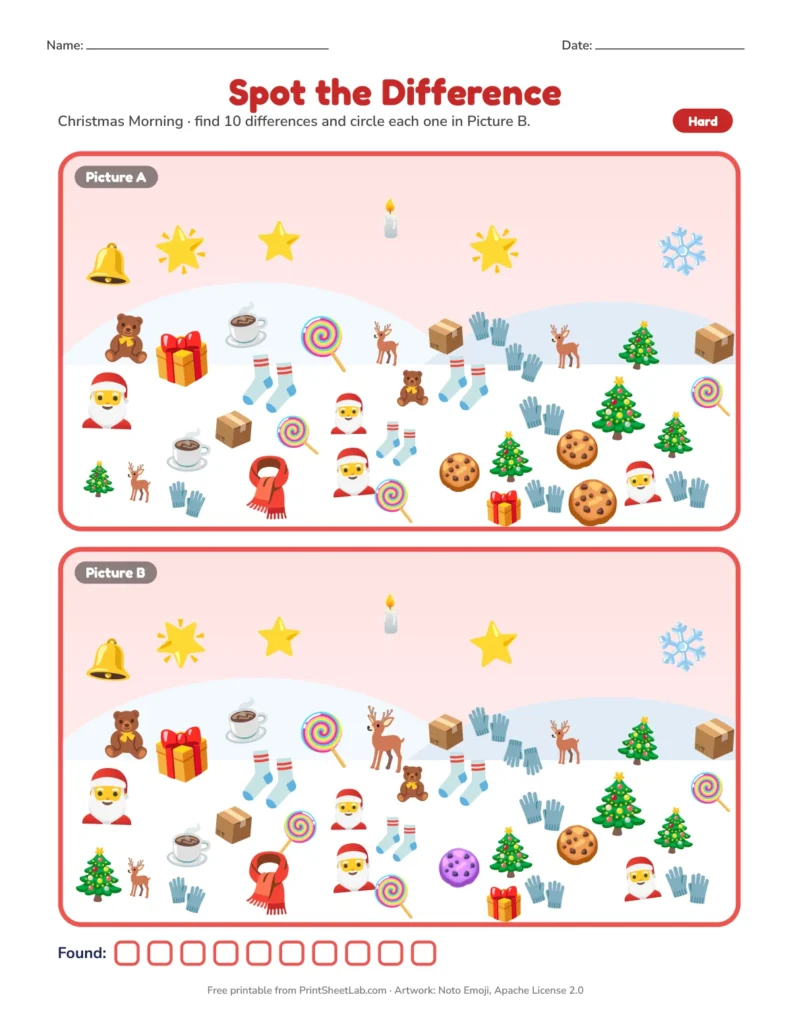
Quick answer: choose a pack below and print the PDF. Compare Picture A (top) with Picture B (bottom), circle each difference in Picture B and tick a box for every one. The answer pages circle every change and write it out.
Christmas spot the difference printables (PDF)
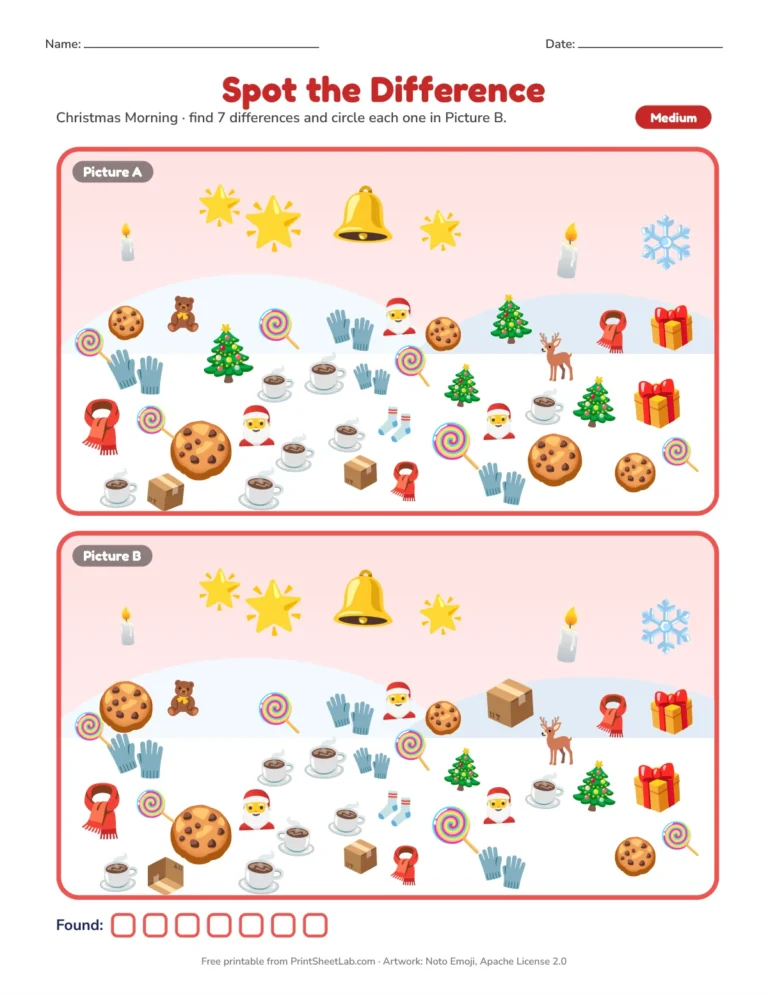
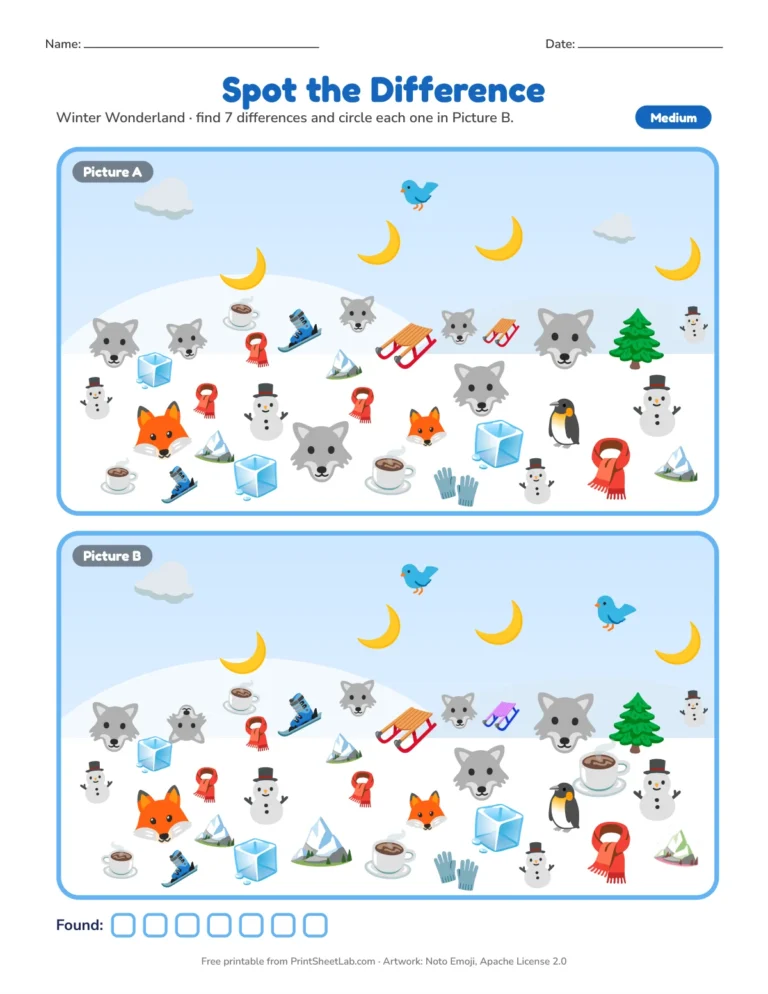
Each pack is a six-page PDF: three puzzles, then three answer pages. Click a picture to open the PDF; the preview shows the medium puzzle.
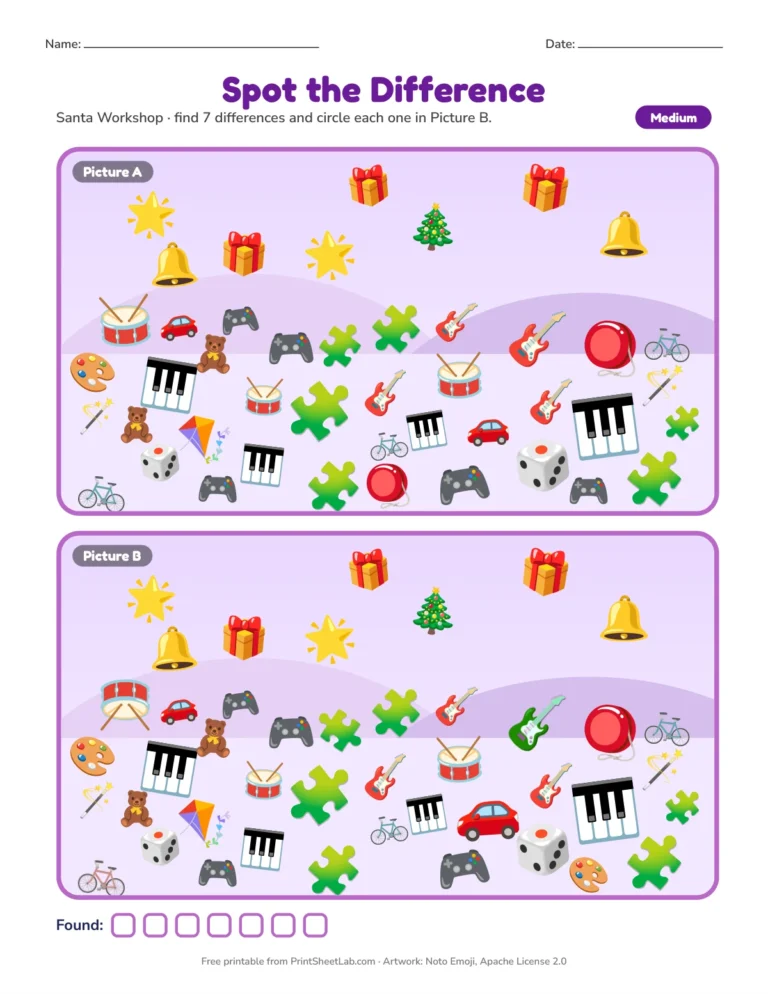
Easy, medium and hard Christmas puzzles
The number of differences grows with each puzzle, and the kinds of change get trickier, from missing items to mirrored ones.
| Level | Differences | What changes | Good for |
|---|---|---|---|
| Easy | 5 | Missing, bigger, added or swapped items | Ages 4 to 6 |
| Medium | 7 | Adds mirrored, upside-down and color changes | Ages 6 to 8 |
| Hard | 10 | All seven kinds, many small items | Ages 8 and up, family game night |
How to play Christmas spot the difference at home or in the classroom
- Print a pack. One set per child, or one set per team for a class game.
- Read the goal. The line under the title tells you how many differences to find, and the boxes at the bottom let you tick them off.
- Search in zones. Compare the sky, the middle and the ground one after the other.
- Circle in Picture B. Keep Picture A clean so you can keep comparing.
- Check the answer page. Picture B is shown again with every change circled and described.
Add a Christmas spot the difference puzzle to a holiday activity pack for the car or a class party.
More ways to play
- Advent challenge: solve one puzzle a day during the week before the holiday, starting with easy and finishing on Christmas Eve with a hard one.
- Team contest: two teams get the same puzzle; the team with the most correct circles after five minutes wins a candy cane.
- Holiday card: after finishing, children can write a Christmas wish on the back and give the page to a family member.
- Quiet corner: keep a folder of puzzles and pencils near the tree for children who need a break from the noise.
What changes in each puzzle
| Puzzle | Differences | Kinds of change |
|---|---|---|
| Easy | 5 | Missing, bigger, added or swapped items |
| Medium | 7 | Adds mirrored, upside-down and color changes |
| Hard | 10 | All seven kinds, many small items |
Younger children can circle with a crayon, and older children can describe each change in a full sentence, such as “The stocking in Picture B is bigger.”
Tips for sharp eyes
- Cover one half of both pictures with a sheet of paper, compare the other halves, then swap.
- Say the name of each item aloud: “gift”, “snowman”, “bell”. A changed name is a clue.
- Look for colors last. A gift that changed from red to green is easy to miss if you only compare shapes.
- Check both edges of the picture; missing items often hide near the border.
Choosing puzzles for a group
Holiday gatherings mix ages. A pack gives you three levels of the same theme, so everyone works on a similar picture at a suitable pace.
| Guest | Puzzle | Tip |
|---|---|---|
| Young child | Easy (5 differences) | An adult points to each zone and asks, what looks different here? |
| Child of 6 to 8 | Medium (7 differences) | Circle and tick alone, then check with the answer page. |
| Older child or adult | Hard (10 differences) | Time it, then try another pack and beat the first time. |
The puzzles also make a tidy stocking stuffer: fold a pack, add a pencil and a candy cane and tie it with a ribbon.
How these puzzles are made
Each puzzle is generated by a program. It builds a picture from scattered artwork, copies it, and then changes the copy in a set number of ways: it removes an item, swaps one for a different picture, makes one bigger, adds a new one, mirrors one, turns one upside down or shifts its color. The answer page is drawn from the same list of changes, so the circles and the written answers always match the puzzle.
The pictures are Noto Emoji artwork from Google, used under the Apache License 2.0; the project is on GitHub. A credit line is printed on every page.
Frequently asked questions
6 quick answers
Are these Christmas spot the difference printables free?
Yes. Print as many copies as you like for your own children or class, with no account or sign-up.
How many differences are in each puzzle?
Easy puzzles have 5 differences, medium puzzles 7 and hard puzzles 10. Every pack has one of each.
What age are the puzzles for?
Easy puzzles suit roughly ages 4 to 6, medium puzzles ages 6 to 8, and hard puzzles older children and adults.
Do the puzzles come with answers?
Yes. Each pack ends with three answer pages that circle every difference and list the changes in words.
Can I print them in black and white?
Yes. Color changes are harder to see in grayscale, but missing, added, mirrored and upside-down items still show clearly.
Where are the everyday spot the difference pages?
The garden, farm, ocean, space and school puzzles are on our main spot the difference printables page.
More Christmas and picture puzzles
- Spot the difference printables in five everyday themes.
- Christmas I spy find-and-count pages.
- Christmas scavenger hunt for the house and the tree.
- Christmas worksheets with a word search and bingo.
- Christmas bingo cards.
- Christmas coloring pages.
- Every puzzle and brain teaser on PrintSheetLab.
Did you like this?
Last updated: