Should I pay off my mortgage early? It depends mostly on your interest rate. Every extra dollar of principal earns a guaranteed return equal to your mortgage rate: 7.40% on a new loan today, but only 3% or so on many loans from 2020 and 2021. Here is what extra payments save, and a checklist for deciding whether paying off your mortgage early beats the alternatives.
What extra payments save
Monthly extra payments from the first month, 30-year fixed loan:
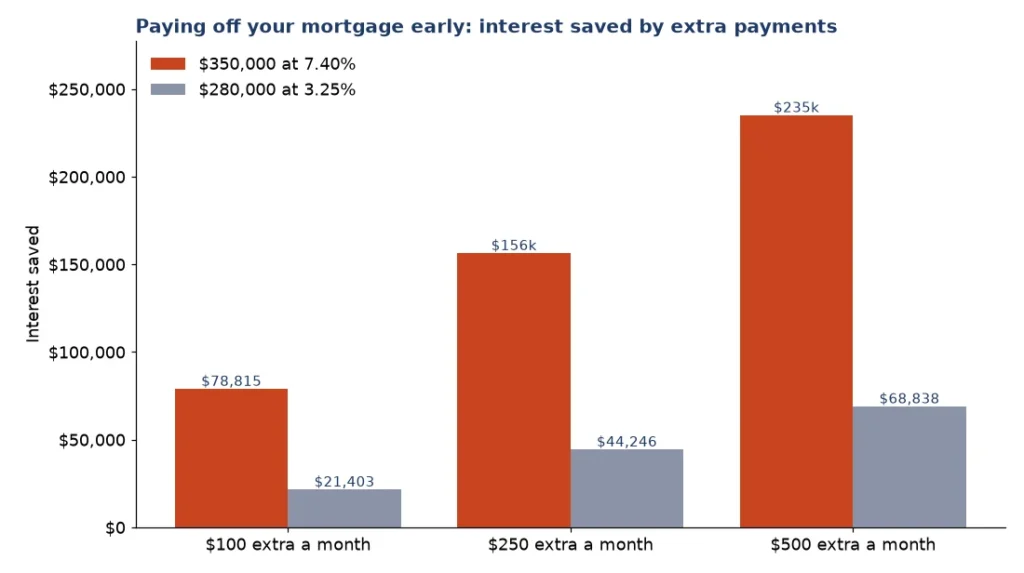
| Loan | Extra a month | Paid off in | Time saved | Interest saved |
|---|---|---|---|---|
| New loan at 7.40% | $100 | 26 years 3 months | 3 years 9 months | $78,815 |
| New loan at 7.40% | $250 | 22 years 4 months | 7 years 8 months | $156,237 |
| New loan at 7.40% | $500 | 18 years 3 months | 11 years 9 months | $234,921 |
| Older loan at 3.25% | $100 | 26 years 5 months | 3 years 7 months | $21,403 |
| Older loan at 3.25% | $250 | 22 years 5 months | 7 years 7 months | $44,246 |
| Older loan at 3.25% | $500 | 18 years | 12 years | $68,838 |
On the $350,000 loan, $500 extra a month saves $234,921 of interest. A single $20,000 lump sum at the start saves $129,864 and ends the loan 5 years 1 month early. The same extra money saves far less on a 3.25% loan, because there is less interest to avoid.
Pay off the mortgage or invest? The rate test
- Mortgage rate above 6% to 7%: extra payments give a high, risk-free return. Paying down principal is usually a strong choice once the basics below are covered.
- Mortgage rate under 4%: savings accounts, bonds or retirement accounts may earn more than the loan costs, so extra payments are less compelling.
- In between: it comes down to your goals. Being debt-free by retirement is worth something even if the math is close.
- Taxes: if you itemize and deduct mortgage interest, your effective rate is a little lower; most people take the standard deduction, so it makes no difference.
Should I pay off my mortgage early? A 5-point checklist
- Keep an emergency fund. Money paid into the house is hard to get back out.
- Get any employer 401(k) match first; it is an instant return.
- Pay off high-interest debt first. Credit cards average about 22.15% for people who carry a balance, far above any mortgage rate.
- Check your loan for a prepayment penalty and ask the servicer to apply extra money to principal.
- If you want a lower payment rather than an earlier payoff, compare a recast: see mortgage recast vs refinance.
How to pay off your mortgage early: 4 ways
- Extra each month: the simplest; even $100 helps.
- One extra payment a year: the effect of biweekly mortgage payments.
- Lump sums: bonuses or tax refunds applied to principal.
- Refinance to 15 years: a lower rate, but a higher required payment; see 15 vs 30 year mortgage.
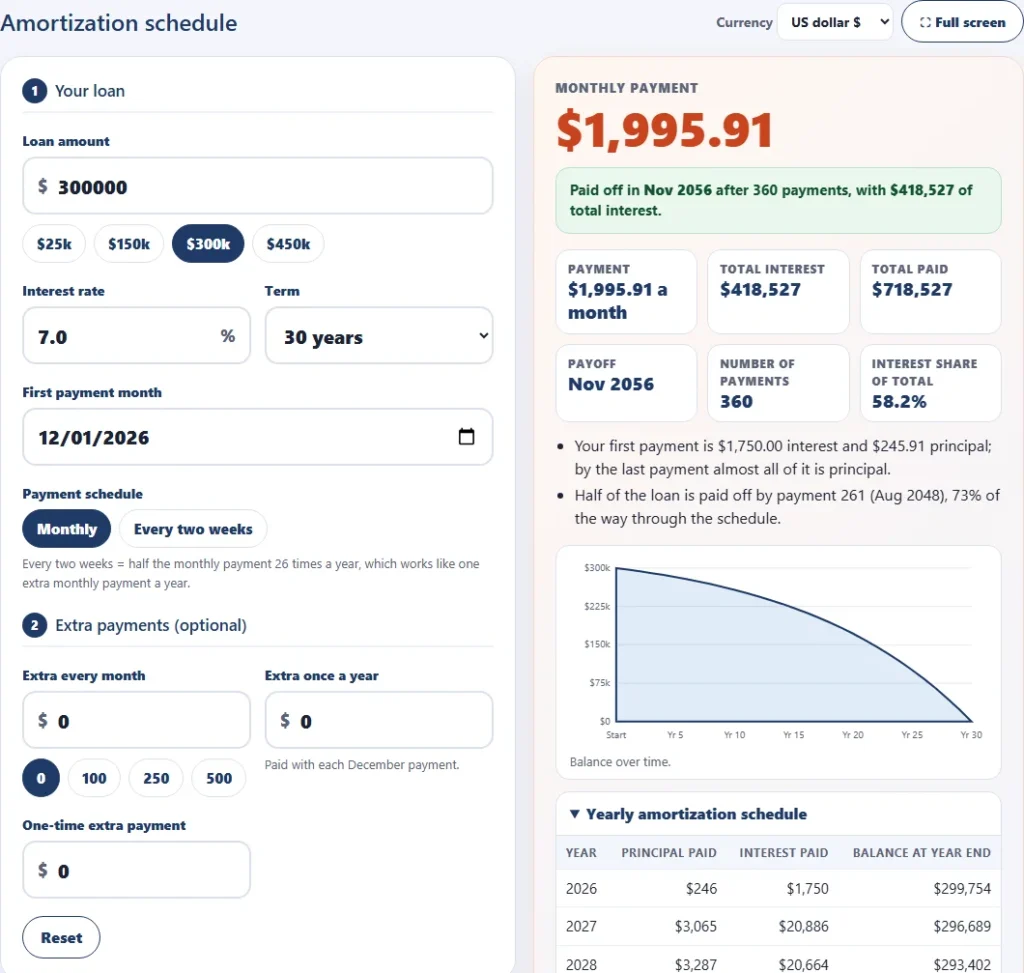
So, is paying off your mortgage early worth it? If your rate is high and the checklist is done, extra mortgage payments are one of the safest returns available. Model your own loan with the amortization schedule calculator, which shows the payoff date and interest saved for any extra payment.
These examples explain the math for planning. They are general information, not financial advice; your lender’s Loan Estimate gives the real figures.
Related calculators and guides
- Amortization schedule calculator
- Mortgage calculator
- Refinance calculator
- biweekly mortgage payments
- mortgage recast vs refinance
Sources
- Primary Mortgage Market Survey (Freddie Mac): 30-year fixed 7.40% on October 15, 2026
- G.19 Consumer Credit (Federal Reserve): credit card rate 22.15% (Q2 2026, accounts assessed interest)
- What is a prepayment penalty? (CFPB)
Frequently asked questions
5 quick answers
Is it smart to pay off your mortgage early?
It can be, especially at a rate above 6%, once you have an emergency fund, your 401(k) match and no high-interest debt. At a rate under 4% the money may do more elsewhere.
How much does $500 extra a month save on a mortgage?
On a $350,000 loan at 7.40%, about $234,921 of interest, and the loan ends 11 years 9 months early.
Is it better to pay extra monthly or a lump sum?
Earlier money saves more interest, so a lump sum now beats the same total spread over later years. Monthly extra is easier to keep up.
Does paying extra lower my monthly payment?
No, it shortens the loan. To lower the payment you would need a recast or refinance.
Will paying off my mortgage hurt my credit?
Closing an installment loan can change your score slightly, but it is rarely a reason not to pay off debt.
Did you like this?
Last updated: