How much house can I afford? A common answer is the 28/36 rule: keep the full housing payment under 28% of gross monthly income and all debt payments under 36%. At today’s rates (about 7.40% for a 30-year fixed), that means a home price of roughly $290,218 on a $100,000 salary with 10% down, before other debts. Below are the numbers for every income, and what changes them.
How much house can I afford by salary?
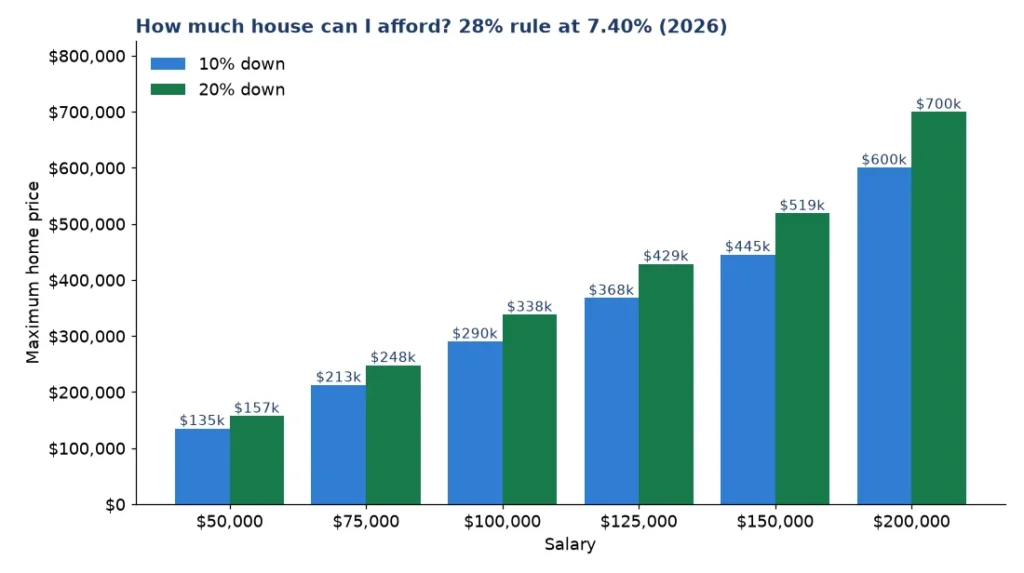
Maximum home price under the 28% rule with a 30-year fixed loan at 7.40%, property tax of 1.1% of the price a year, home insurance of $1,800 a year and PMI of 0.5% of the loan a year when the down payment is under 20%. No other debts.
| Salary | Max housing payment (28%) | Home price, 10% down | Home price, 20% down |
|---|---|---|---|
| $50,000 | $1,167 | $135,140 | $157,483 |
| $75,000 | $1,750 | $212,679 | $247,843 |
| $100,000 | $2,333 | $290,218 | $338,202 |
| $125,000 | $2,917 | $367,757 | $428,562 |
| $150,000 | $3,500 | $445,296 | $518,921 |
| $200,000 | $4,667 | $600,374 | $699,640 |
On $100,000 a year the 28% limit is $2,333 a month. A $290,218 home with 10% down needs a $261,196 loan: $1,808 of principal and interest, plus about $266 of tax, $150 of insurance and $109 of PMI. That payment is 35% of a single Texas worker’s take-home pay of $6,598 a month, which is why many buyers aim lower than the maximum.
The 28/36 rule, and how lenders really decide
- 28% front-end: mortgage principal, interest, property tax, insurance, PMI and HOA dues, divided by gross monthly income.
- 36% back-end: the housing payment plus car loans, student loans, card minimums and other debts.
- Lender limits are higher: Fannie Mae allows a total debt-to-income ratio of 36% on manually underwritten loans, up to 45% with strong credit and reserves, and up to 50% through its automated system. Being approved for more does not mean the payment fits your budget.
Debts matter: with $800 a month of car and student loan payments, the 36% limit cuts the $100,000 example from $290,218 to $272,495.
How interest rates change what you can afford
Same $100,000 salary, 10% down, 28% rule:
| 30-year rate | Maximum home price |
|---|---|
| 6.00% | $326,474 |
| 6.50% | $312,786 |
| 7.00% | $299,934 |
| 7.40% | $290,218 |
| 8.00% | $276,527 |
Each half point of rate moves the budget by roughly $12,852 to $13,688 at this income. Points can buy a lower rate; see are mortgage points worth it.
Cash you need besides the down payment
- Closing costs: often a few percent of the loan; estimate yours with the closing cost calculator.
- Reserves: lenders may want a few months of payments in savings, and you need an emergency fund.
- Moving and repairs: new homes rarely come with nothing to fix.
For the down payment itself, including 3% and 3.5% options, see how much down payment for a house.
A safer way to set your budget
- Start from take-home pay, not gross: run your salary through the paycheck estimator.
- List fixed costs and savings goals in the budget calculator.
- Choose a housing payment that leaves room for both, then work back to a price with the mortgage calculator.
- Check that the payment still works if property tax or insurance rise next year.
These examples explain the math for planning. They are general information, not financial advice; your lender’s Loan Estimate gives the real figures.
Related calculators and guides
- Mortgage calculator
- Closing cost calculator
- Paycheck estimator
- how much down payment for a house
- how to get rid of PMI
- 15 vs 30 year mortgage
Sources
- Primary Mortgage Market Survey (Freddie Mac): 30-year fixed 7.40% on October 15, 2026
- B3-6-02, Debt-to-income ratios (Fannie Mae Selling Guide): 36%, 45% and 50% DTI limits
- Property tax, insurance and PMI rates above are examples for illustration; use local quotes for your own estimate.
Frequently asked questions
5 quick answers
How much house can I afford on $100k a year?
About $290,218 with 10% down and no other debts, using the 28% rule at 7.40%. With 20% down it is about $338,202.
How much house can I afford on $50,000 a year?
About $135,140 with 10% down under the same assumptions.
What is the 28/36 rule?
Spend no more than 28% of gross monthly income on housing and no more than 36% on all debt payments including housing.
Do lenders use the 28/36 rule?
Many use it as a guide, but Fannie Mae allows total debt ratios up to 45% or 50% for qualified borrowers.
Should I buy the most house I can afford?
Usually not. A payment at the maximum leaves little room for savings, repairs and rate or tax increases.
Did you like this?
Last updated: