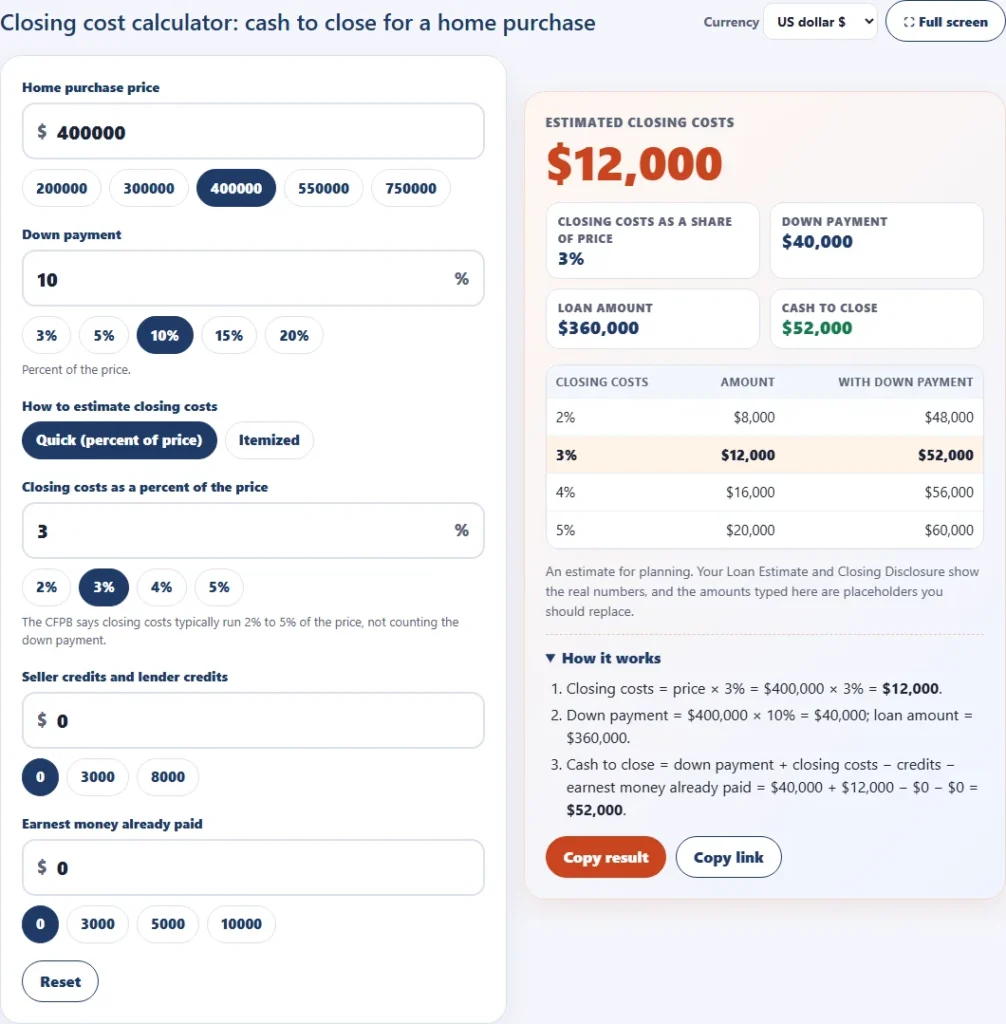
A closing cost calculator estimates the fees you pay to finish a home purchase on top of the down payment, then adds them up into the cash you need to bring to the table. Enter the price and down payment, pick a quick percentage or itemize the fees, and read the total.
Quick answer: Closing costs typically run 2% to 5% of the home price, not counting the down payment, according to the Consumer Financial Protection Bureau. On a $400,000 home that is $8,000 to $20,000, so with 10% down you would need roughly $48,000 to $60,000 in cash to close.
How to use the closing cost calculator
- Enter the purchase price and the down payment as a percent of the price.
- Choose Quick to estimate closing costs as a percent of the price, or Itemized to enter each fee.
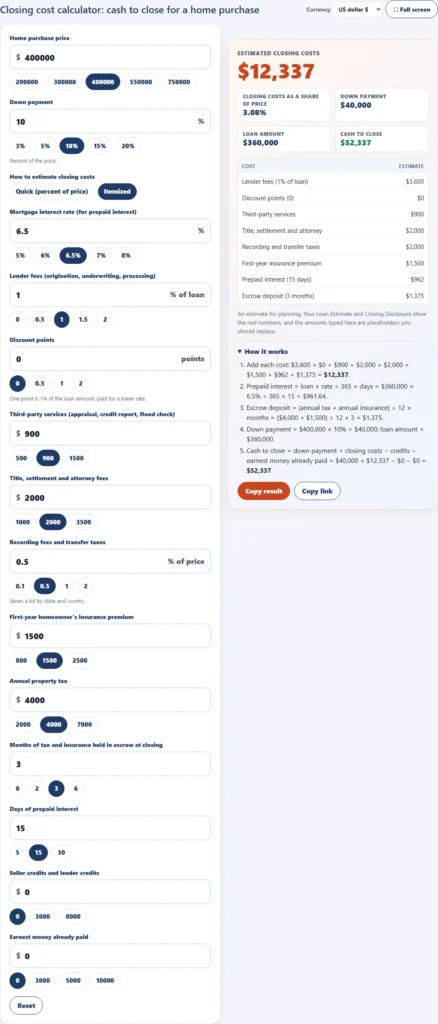
- In itemized mode, replace the placeholder amounts with the numbers from your Loan Estimate: lender fees, points, third-party services, title and settlement fees, government fees, insurance and escrow.
- Add any seller credits or lender credits, and any earnest money you have already paid.
- Read the estimated closing costs, the share of the price, the loan amount and the cash to close.
The calculator runs in your browser and keeps your numbers on your device. It is a planning tool and not a quote. Your lender must give you a Loan Estimate with the real figures once you apply.
How much are closing costs?
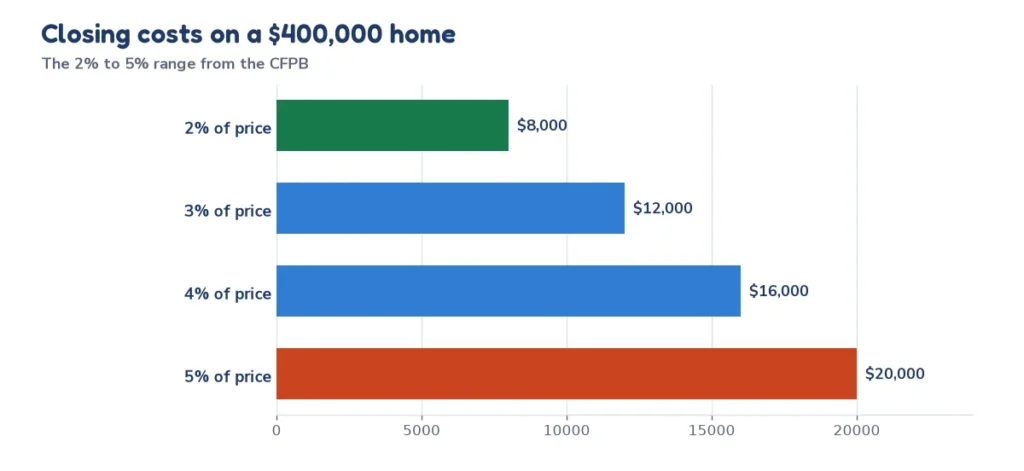
The CFPB says closing costs depend on the price of the home, your down payment, the lender's costs, the kind of loan you choose and the location of the home. For an early estimate it suggests using a typical price for the neighborhoods you like, and it says closing costs, not including your down payment, typically range from 2% to 5% of the home purchase price. The table applies that range to common prices.
| Home price | 2% | 3% | 4% | 5% |
|---|---|---|---|---|
| $200,000 | $4,000 | $6,000 | $8,000 | $10,000 |
| $300,000 | $6,000 | $9,000 | $12,000 | $15,000 |
| $400,000 | $8,000 | $12,000 | $16,000 | $20,000 |
| $550,000 | $11,000 | $16,500 | $22,000 | $27,500 |
| $750,000 | $15,000 | $22,500 | $30,000 | $37,500 |
Closing costs percentage: what it is based on
Some closing costs scale with the loan, such as points and lender fees, and some scale with the price, such as transfer taxes in places that charge them. Others are flat amounts, such as an appraisal or a credit report. That is why the closing costs percentage is a range and not a single number, and why a cheaper home often shows a higher percentage than an expensive one.
Cash to close calculator: price, down payment and closing costs
Cash to close is the money you bring on closing day: the down payment plus closing costs, less any credits or earnest money already paid. The CFPB's down payment guidance says that in most cases you need a down payment of at least 3 percent of your target home price, many loan types and lenders require 5 percent or more, and you can often save money by putting down at least 10 percent, and the most by putting down at least 20 percent. The grid shows cash to close with costs at 3%.
| Price | 3% down | 5% down | 10% down | 20% down |
|---|---|---|---|---|
| $200,000 | $12,000 | $16,000 | $26,000 | $46,000 |
| $300,000 | $18,000 | $24,000 | $39,000 | $69,000 |
| $400,000 | $24,000 | $32,000 | $52,000 | $92,000 |
| $550,000 | $33,000 | $44,000 | $71,500 | $126,500 |
| $750,000 | $45,000 | $60,000 | $97,500 | $172,500 |
Mortgage closing cost calculator: the itemized fees
The Loan Estimate groups costs into origination charges, services you cannot shop for, services you can shop for, taxes and government fees, prepaids and escrow. The itemized mode of this mortgage closing cost calculator follows the same groups so the numbers line up with the form you will receive.
| Group on the Loan Estimate | Examples | Calculator field |
|---|---|---|
| Origination charges | Application, origination, underwriting and processing fees, plus points | Lender fees and discount points |
| Services you cannot shop for | Appraisal, credit report and other services the lender chooses | Third-party services |
| Services you can shop for | Title and settlement services you can compare | Title, settlement and attorney fees |
| Taxes and government fees | Recording fees and transfer taxes | Recording fees and transfer taxes |
| Prepaids | First-year homeowner's insurance and prepaid interest | Insurance premium and days of prepaid interest |
| Escrow | Property taxes and insurance paid into an escrow account | Months held in escrow |
The CFPB tells buyers that for origination charges it is the total that matters, because lenders itemize them differently. It also says points are an upfront fee you pay in exchange for a lower interest rate.
Worked example: a 0,000 home with 10% down
With a $400,000 price and 10% down, the down payment is $40,000 and the loan is $360,000. The placeholder amounts below, which you should replace with your own, add up to $12,337, or 3.08% of the price. The cash to close is $52,337.
| Cost | Estimate |
|---|---|
| Lender fees (1% of the loan) | $3,600 |
| Third-party services | $900 |
| Title, settlement and attorney | $2,000 |
| Recording and transfer taxes (0.5% of price) | $2,000 |
| First-year insurance premium | $1,500 |
| Prepaid interest, 15 days at 6.5% | $962 |
| Escrow, 3 months of tax and insurance | $1,375 |
| Total closing costs | $12,337 |
Closing costs calculator for buyers: how much to save
Using a closing costs calculator for buyers early helps you set one savings target for the whole purchase instead of two. The CFPB suggests subtracting your closing costs estimate from the cash you have available for closing to find your maximum down payment. The table turns that into a target for a few prices at 5% down and closing costs of 3%, plus a 2% cushion for moving and first repairs.
| Home price | Down payment (5%) | Closing costs (3%) | Cushion (2%) | Total to save |
|---|---|---|---|---|
| $200,000 | $10,000 | $6,000 | $4,000 | $20,000 |
| $300,000 | $15,000 | $9,000 | $6,000 | $30,000 |
| $400,000 | $20,000 | $12,000 | $8,000 | $40,000 |
| $550,000 | $27,500 | $16,500 | $11,000 | $55,000 |
The cushion is a planning choice and not a rule. The point is that the cash you need on closing day is more than the down payment, and it is easy to underestimate.
What closing costs do not include
The estimate covers the fees to finish the purchase. It does not include moving costs, repairs, furniture, or the ongoing monthly payment of principal, interest, property tax and insurance. Use the mortgage calculator for the monthly payment, and keep money aside for the first months in the home. The CFPB also reminds buyers to think about retirement and other savings goals when they decide how much to put toward a down payment.
How loan type and location change closing costs
The CFPB's Loan Estimate explainer notes that some fees depend on the kind of loan you chose, for example an FHA or VA loan, and it lists mortgage insurance premiums among the items that can appear. Location matters too, because recording fees and transfer taxes are set by states, counties and cities. That is why the closing cost calculator keeps the government fees as its own field and does not hide them in a single average.
Home buyer closing costs: ways to lower them
- Shop the services you can shop for. The CFPB says you can save money by shopping for these services separately, and the lender should give you a list of providers.
- Compare the total of origination charges across Loan Estimates, since lenders itemize them differently.
- Ask whether points are worth it. A similar loan may be available without points, and the CFPB suggests asking what other options exist and how they change the rate and total cost.
- Ask for seller credits. Credits reduce your cash to close but they are limited by the loan type and the seller's agreement.
- Time the closing. Prepaid interest depends on the closing date within the month.
Check the Loan Estimate against the calculator
When your lender sends a Loan Estimate, compare it with this estimate. The CFPB advises checking that the loan amount plus your down payment equals the sale price, and that the estimated cash to close is what you expect. If a number looks different from what you discussed, ask the lender to explain it before you commit.
Property tax is part of owning a home. Estimate it with the property tax calculator.
Frequently asked questions
10 quick answers
How much are closing costs on a house?
The CFPB says closing costs, not including the down payment, typically range from 2% to 5% of the home purchase price. On a $300,000 home that is $6,000 to $15,000.
What is included in closing costs?
Lender origination charges, points, appraisal and credit report fees, title and settlement services, recording fees and transfer taxes, first-year insurance and prepaid interest, and escrow deposits.
What is cash to close?
It is the money you bring on closing day: down payment plus closing costs, minus credits and any earnest money you already paid.
Do closing costs include the down payment?
No. The 2% to 5% range from the CFPB does not include the down payment. Add the down payment to find the total cash you need.
Can I roll closing costs into the loan?
Some loan programs and lender credits allow part of the costs to be covered, but this usually raises the rate or the balance. Ask your lender about the specific loan.
Who pays closing costs, the buyer or the seller?
Both can pay some costs. Buyers pay most lender and title charges, and sellers often pay agent commissions. Seller credits are negotiated in the contract.
Are points part of closing costs?
Yes. Points are an upfront fee paid to the lender in exchange for a lower interest rate, and one point is 1% of the loan amount.
Can I shop around for closing services?
Yes for the services listed as ones you can shop for. The CFPB says you can save money by shopping for these services separately.
How much should I save for a down payment and closing costs?
In most cases you need at least 3% down, and many loans need 5% or more. Add 2% to 5% of the price for closing costs, and keep a cash cushion afterward.
How accurate is this calculator?
It is an estimate. The itemized defaults are placeholders, so replace them with the numbers from your Loan Estimate for the best result.
Related calculators
- Mortgage calculator for the monthly payment with taxes and insurance
- HELOC calculator for borrowing against home equity
- Loan calculator for any fixed-rate loan
- Sales tax calculator for percent-of-price math
- Percentage calculator for any percent of a number
- All free calculators
Sources and further reading
- Consumer Financial Protection Bureau: Determine your down payment: the 2% to 5% closing cost range and down payment guidance
- Consumer Financial Protection Bureau: Loan Estimate explainer: origination charges, services you can and cannot shop for, points and what to check
This page is general information and not financial advice. Last reviewed: October 2026.