An electricity cost calculator turns an appliance’s watts and the hours you use it into kilowatt-hours (kWh) and then into money: cost = watts ÷ 1,000 × hours × price per kWh. This free electricity cost calculator has 27 appliance presets, an editable price, and shows the cost per day, month and year.
Quick answer: Electricity cost = watts ÷ 1,000 × hours × price per kWh. A 1,000 W window air conditioner running 8 hours uses 1,000 ÷ 1,000 × 8 = 8 kWh, which costs 8 × $0.18 = $1.44 a day at 18 cents per kWh. Type the price from your own bill into the electricity cost calculator for an accurate result.
How to use this electricity cost calculator
Pick an appliance or choose Other appliance and type its watts, say how long it runs, and enter your price per kWh. The answer updates as you type. You can also switch to Energy in kWh if you already know how many kWh you used.
- Choose the appliance from the list. The watts appear in the name; for a custom device, type the watts from its label.
- Enter how many you run, the hours per day, and the share of that time it draws full power (50% for a fridge or air conditioner that cycles on and off).
- Enter the days per month and the months per year you use it. Seasonal items such as heaters and air conditioners need fewer months.
- Type the price per kWh from your bill, in dollars or pounds, or switch to cents or pence.
- Read the cost per day, per month of use and per year, and open How it works for the steps.
| Input | Where to find it | What it changes |
|---|---|---|
| Watts | The label on the appliance, or the preset in the list | The kWh used each hour |
| Hours per day | Your own habit, 0 to 24 | Daily kWh and cost |
| Share of time at full power | Use 100% unless the device cycles | Scales the average draw |
| Days and months of use | How often you run it | Monthly and yearly totals |
| Price per kWh | Your electricity bill (the unit rate) | Every cost figure |
How to calculate electricity cost: the formulas
The U.S. Department of Energy teaches the same method in its energy education material: energy equals power multiplied by time, in kilowatt-hours, with watts converted to kilowatts first. Then you multiply the kWh by the price, and the electricity cost calculator repeats these steps for you.
- Watts to kWh: kWh = watts × hours ÷ 1,000.
- Cost: cost = kWh × price per kWh.
- Per month: cost per day × days used.
- Per year: cost per month × months used.
- If only amps are shown: watts = volts × amps. A 120 V device at 3 A is 360 W.
Example 1: a window air conditioner in summer
A 1,000 W unit runs 8 hours a day, 30 days a month, 4 months a year, at $0.18 per kWh. Daily energy is 1,000 × 8 ÷ 1,000 = 8 kWh, so a day costs 8 × 0.18 = $1.44. A month of use is 8 × 30 = 240 kWh, which is $43.20. Four months use 960 kWh and cost $172.80.
Example 2: a gaming PC
A gaming PC draws about 450 W for 4 hours a day. Daily energy is 450 × 4 ÷ 1,000 = 1.8 kWh, which costs 1.8 × 0.18 = $0.324 a day. Over 30 days that is 54 kWh and $9.72; over 12 months it is 648 kWh and $116.64.
Example 3: a television in pence per kWh
A 100 W television runs 5 hours a day. The price is 26.32 pence per kWh. Daily energy is 100 × 5 ÷ 1,000 = 0.5 kWh, which is 0.5 × 26.32 = 13.16 pence a day. A month of 30 days uses 15 kWh and costs 15 × 0.2632 = £3.95, and 12 such months use 180 kWh and cost £47.38. Choose Cents or pence per kWh in the electricity cost calculator and type 26.32.
Watts to kWh: a quick lookup table
This watts to kWh table gives the energy used for common appliance sizes and run times. Multiply any figure by your price per kWh to get the cost, or use the electricity cost calculator above.
| Watts | 1 hour | 4 hours | 8 hours | 24 hours |
|---|---|---|---|---|
| 10 W | 0.01 kWh | 0.04 kWh | 0.08 kWh | 0.24 kWh |
| 100 W | 0.1 kWh | 0.4 kWh | 0.8 kWh | 2.4 kWh |
| 500 W | 0.5 kWh | 2 kWh | 4 kWh | 12 kWh |
| 1,000 W | 1 kWh | 4 kWh | 8 kWh | 24 kWh |
| 1,500 W | 1.5 kWh | 6 kWh | 12 kWh | 36 kWh |
| 3,000 W | 3 kWh | 12 kWh | 24 kWh | 72 kWh |
Electricity cost per kWh: what you pay
Your electricity cost per kWh is the unit rate on your bill. It is quoted in cents or pence, so 18 cents is $0.18. The table shows what a few quantities of energy cost at different unit rates.
| Price per kWh | Cost of 1 kWh | Cost of 100 kWh | Cost of 900 kWh |
|---|---|---|---|
| 10 cents | $0.10 | $10.00 | $90.00 |
| 12 cents | $0.12 | $12.00 | $108.00 |
| 15 cents | $0.15 | $15.00 | $135.00 |
| 18 cents | $0.18 | $18.00 | $162.00 |
| 20 cents | $0.20 | $20.00 | $180.00 |
| 25 cents | $0.25 | $25.00 | $225.00 |
| 30 cents | $0.30 | $30.00 | $270.00 |
| 40 cents | $0.40 | $40.00 | $360.00 |
Electricity cost per kWh in the US, UK, Canada and Australia
United States
The U.S. Energy Information Administration (EIA) reports that the average residential price in the United States was 18.31 cents per kWh in July 2026, up from 17.45 cents in July 2025. State prices vary widely: from 12.72 cents in Louisiana to 48.00 cents in Hawaii in July 2026. The default price in the electricity cost calculator is 18 cents, close to the national figure; replace it with your own rate.

| State | July 2026 (cents per kWh) | July 2025 (cents per kWh) | A month of 899 kWh |
|---|---|---|---|
| Louisiana | 12.72 | 13.12 | $114.35 |
| Utah | 13.12 | 13.45 | $117.95 |
| Florida | 15.03 | 15.11 | $135.12 |
| Texas | 15.88 | 15.36 | $142.76 |
| Virginia | 17.55 | 15.78 | $157.77 |
| Illinois | 19.22 | 17.22 | $172.79 |
| Pennsylvania | 21.72 | 19.51 | $195.26 |
| New York | 29.90 | 26.22 | $268.80 |
| Massachusetts | 30.49 | 30.07 | $274.11 |
| California | 33.61 | 32.66 | $302.15 |
| Hawaii | 48.00 | 39.36 | $431.52 |
| U.S. average | 18.31 | 17.45 | $164.61 |
The last column uses 899 kWh, the average monthly amount of electricity purchased by a U.S. home in 2022 according to the EIA. Your own use will differ.
United Kingdom
In Great Britain the energy price cap sets maximum unit rates. For 1 October to 31 December 2026, Ofgem lists an average electricity rate of 26.32 pence per kWh and a daily standing charge of 54.83 pence for Direct Debit customers in England, Scotland and Wales. Ofgem also notes there is no VAT on electricity from 1 October 2026 to 31 March 2027.
Canada and Australia
Electricity prices in Canada depend on the province and the utility, and in Australia on the state, the network and the retailer. Many plans use different rates at different times of day. This page does not state a figure for either country because it should come from your own bill. The Canada Energy Regulator publishes provincial and territorial energy profiles, and the Australian government site Energy Made Easy compares retail offers.
Appliance wattage: typical watts and cost per hour
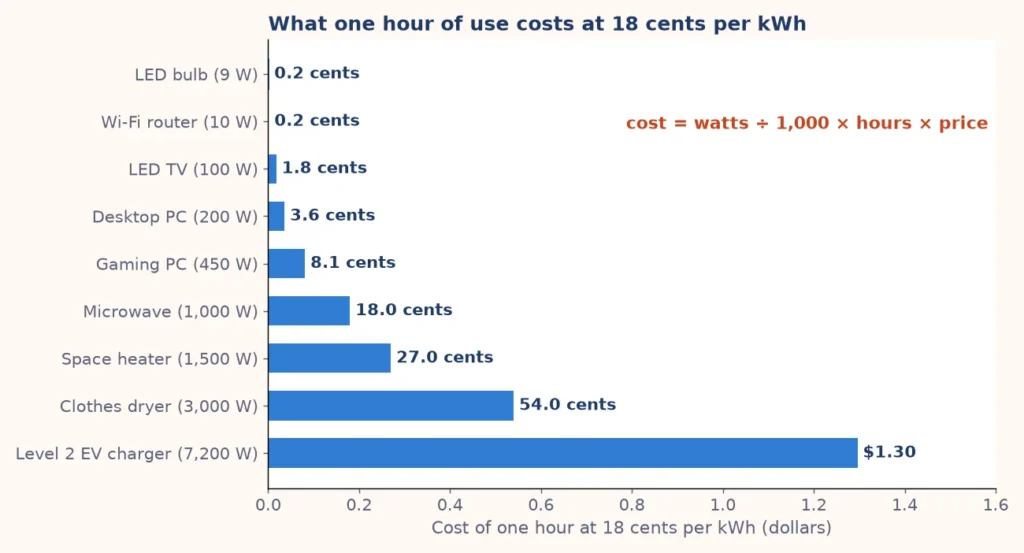
These are the rounded appliance wattage values built into the electricity cost calculator, with the cost of one hour at 18 cents per kWh. They are typical figures, not exact: watts vary by model, age and setting. A university table from Penn State lists ranges such as 900 to 1,200 W for a coffee maker, 1,800 to 5,000 W for a clothes dryer, 1,200 to 2,400 W for a dishwasher, 750 to 1,500 W for a hair dryer and 1,000 to 1,800 W for a portable heater.
| Appliance | Typical watts | Cost per hour at 18 cents |
|---|---|---|
| LED light bulb | 9 | $0.00 |
| Incandescent light bulb | 60 | $0.01 |
| Ceiling fan | 75 | $0.01 |
| Wi-Fi router | 10 | $0.00 |
| Phone charger | 5 | $0.00 |
| Laptop | 60 | $0.01 |
| Desktop computer | 200 | $0.04 |
| Gaming PC | 450 | $0.08 |
| LED television (55 in) | 100 | $0.02 |
| Game console | 150 | $0.03 |
| Refrigerator (while the compressor runs) | 150 | $0.03 |
| Microwave oven | 1,000 | $0.18 |
| Electric kettle | 1,500 | $0.27 |
| Toaster | 1,200 | $0.22 |
| Coffee maker | 1,000 | $0.18 |
| Dishwasher | 1,800 | $0.32 |
| Clothes washer | 450 | $0.08 |
| Electric clothes dryer | 3,000 | $0.54 |
| Hair dryer | 1,200 | $0.22 |
| Clothes iron | 1,000 | $0.18 |
| Portable space heater | 1,500 | $0.27 |
| Window air conditioner | 1,000 | $0.18 |
| Central air conditioner | 3,500 | $0.63 |
| Dehumidifier | 785 | $0.14 |
| Electric water heater (40 gallon) | 4,500 | $0.81 |
| Electric car charger, Level 1 (120 V × 12 A) | 1,440 | $0.26 |
| Electric car charger, Level 2 (240 V × 30 A) | 7,200 | $1.30 |
The wattage on a label is the maximum the device can draw, according to the Department of Energy education material, and real use is often lower. A refrigerator, for example, only draws its listed power while the compressor runs, so use the share-of-time box to average it. For the most accurate watts, plug the device into an inexpensive electricity usage monitor.
Electricity cost per month for common habits
Monthly cost adds up when a large load runs for hours, and the electricity cost calculator shows by how much. The chart shows six habits at 18 cents per kWh; you can recreate each one in the electricity cost calculator.
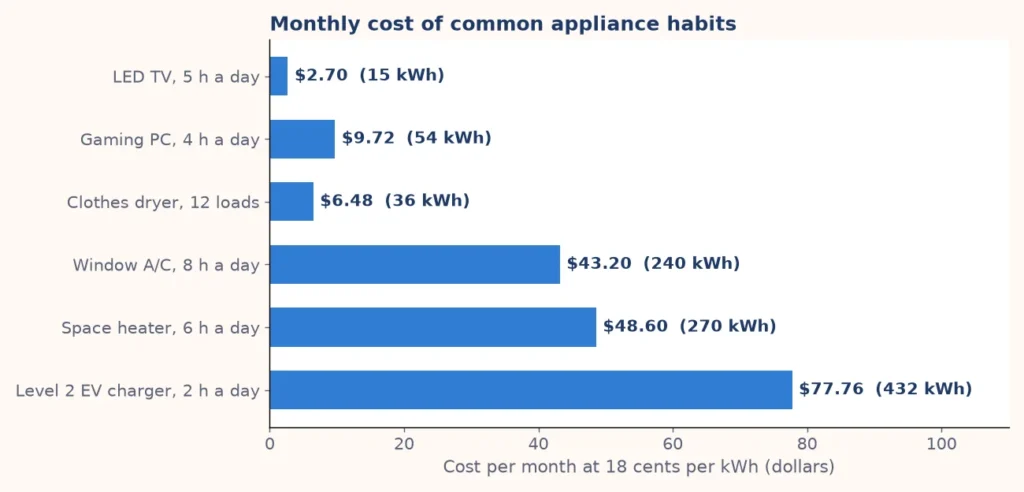
| Habit | kWh per month | Cost per month at 18 cents |
|---|---|---|
| LED TV, 5 hours a day | 15.0 | $2.70 |
| Gaming PC, 4 hours a day | 54.0 | $9.72 |
| Clothes dryer, 12 loads of 1 hour | 36.0 | $6.48 |
| Window air conditioner, 8 hours a day | 240.0 | $43.20 |
| Space heater, 6 hours a day | 270.0 | $48.60 |
| Level 2 car charger, 2 hours a day | 432.0 | $77.76 |
Electricity bill calculator: from kWh to your bill
Switch the electricity cost calculator to Energy in kWh and it works as an electricity bill calculator: bill = kWh × unit price + standing charge. A household using 900 kWh in a month at 18 cents pays 900 × 0.18 = $162.00 for energy. In the U.S. average case, 899 kWh at 18.31 cents is $164.61. Add the fixed charges shown on your bill.
With a daily standing charge, the UK arithmetic looks like this: 250 kWh in 30 days at 26.32 pence is 250 × 0.2632 = £65.80, and the standing charge is 30 × 0.5483 = £16.45, so the bill is about £82.25.
How to lower the electricity cost of an appliance
- Swap bulbs. Replacing a 60 W bulb with a 9 W LED saves 51 W. Used 5 hours a day for a year, that is 0.051 × 5 × 365 = 93.1 kWh, or $16.75 at 18 cents.
- Cut standby power. Lawrence Berkeley National Laboratory says most products draw less than 0.5 watts on standby, but together standby power adds up to 5% to 10% of residential electricity use.
- Shorten the run. A 1,500 W heater costs 27 cents an hour at 18 cents, so two fewer hours a day saves about $16 a month.
- Check the price. A different plan or time-of-use rate can change every cost figure on this page.
Common mistakes when you use an electricity cost calculator
- Mixing cents and dollars. 18 cents is $0.18, not $18. Use the cents or pence switch if your bill shows cents.
- Using nameplate watts for everything. Fridges and air conditioners cycle, so full-time use at full watts overstates the cost.
- Forgetting days and months. A heater that runs five months a year does not cost twelve months of bills.
- Leaving out fixed charges. Standing charges and taxes are not included in an appliance estimate.
- Confusing kW and kWh. Kilowatts measure power at a moment; kilowatt-hours measure energy over time, and bills use kWh.
How much does it cost to run common appliances?
How much does it cost to run a space heater with the electricity cost calculator?
A 1,500 W space heater costs 27 cents per hour at 18 cents per kWh. Running 8 hours uses 12 kWh and costs $2.16 a day, or $64.80 over 30 days.
Frequently asked questions
10 quick answers
How do I calculate the cost of electricity for an appliance?
Multiply watts by hours and divide by 1,000 to get kWh, then multiply by your price per kWh. A 100 W bulb for 10 hours uses 1 kWh and costs 18 cents at $0.18 per kWh.
How do I convert watts to kWh?
Divide the watts by 1,000 and multiply by the hours. A 2,000 W heater on for 3 hours uses 2 × 3 = 6 kWh.
What is a kWh?
A kilowatt-hour is the energy used by a 1,000 watt device running for one hour. It is the unit electricity is billed in.
How much does 1 kWh cost?
It depends on where you live. The U.S. average residential price was 18.31 cents in July 2026 according to the EIA, and the Ofgem cap lists 26.32 pence for Great Britain from October to December 2026.
How much electricity does a refrigerator use?
A running compressor draws about 150 W, but it cycles on and off. At about one third of the time that is 150 × 24 × 0.33 = 1.2 kWh a day, or about 22 cents a day at 18 cents per kWh.
How do I find my price per kWh?
Look for the unit rate or energy charge on your bill. If you only see a total, divide the energy charge by the kWh used. Do not include the fixed charges.
How much does it cost to leave a light on all day?
A 9 W LED bulb on for 24 hours uses 0.216 kWh, which costs 3.9 cents a day at 18 cents per kWh. A 60 W bulb costs 25.9 cents.
How many kWh does a house use per month?
The EIA reports an average of about 899 kWh a month for a U.S. home in 2022. Use varies with climate, house size and heating type.
Does this electricity cost calculator include taxes and standing charges?
No. It prices the energy used by one appliance, so add your standing charge and taxes if you want a full bill.
Is this financial advice?
No. The electricity cost calculator gives estimates from the numbers you enter, so check your own bill and tariff before you make a decision about a plan or purchase.
Related calculators
- MPG calculator to compare fuel and electric running costs
- Percentage calculator for savings and price changes
- Time calculator to add up hours of use
- Unit converter for energy and power units
- All calculators
Sources and further reading
- U.S. EIA Electric Power Monthly, Table 5.6.A (average residential price by state, July 2026)
- U.S. EIA: How much electricity does an American home use?
- Ofgem: energy price cap unit rates and standing charges (1 October to 31 December 2026)
- U.S. Department of Energy education material: Watt Does It Cost to Use It?
- Penn State: typical range of power consumption of common appliances
- Lawrence Berkeley National Laboratory: standby power
- Canada Energy Regulator: provincial and territorial energy profiles and Energy Made Easy (Australia)
Prices change often, so use the rate on your own bill. Last updated: October 2026.