A voltage drop calculator tells you how many volts a wire loses between the source and the load, and what percent of the supply that is. Enter the wire size, the one-way length, the current and the voltage, or switch to the wire size mode to find the smallest conductor that stays within your limit.
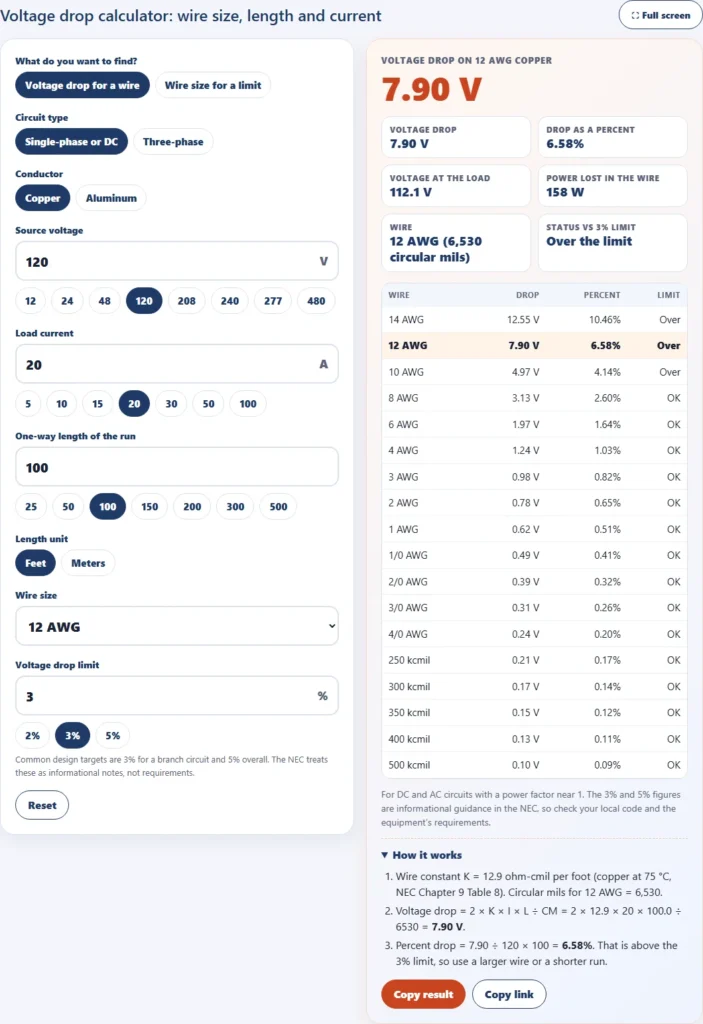
Quick answer: Voltage drop = 2 × K × current × one-way length ÷ circular mils, with K = 12.9 for copper and 21.2 for aluminum. A 12 AWG copper wire carrying 20 amps over 100 feet at 120 volts drops 7.90 volts, or 6.58%.
How to use the voltage drop calculator
- Choose Voltage drop for a wire to check a given conductor, or Wire size for a limit to find the smallest one that fits.
- Pick single-phase or DC with the 2 multiplier, or three-phase with 1.732, and choose copper or aluminum.
- Enter the source voltage, the load current in amps and the one-way length of the run, in feet or meters.
- In the first mode, choose the wire size. Set the limit you want to stay within, such as 3 percent.
- Read the volts dropped, the percent drop, the voltage at the load, the power lost in the wire and the table of every size.
The calculator runs in your browser. It is a planning aid for circuits with a power factor near one. Wire must also be rated for the current, and the electrical code and the equipment instructions in your area decide what is permitted.
Voltage drop formula and the K constant
The National Center for Construction Education and Research (NCCER) formula sheet gives the voltage drop for a single-phase circuit as 2 × L × K × I ÷ CM, and for a three-phase circuit as 1.732 × L × K × I ÷ CM. L is the one-way length in feet, I is the current in amps and CM is the conductor area in circular mils.
- K = 12.9 ohm-circular-mils per foot for copper and 21.2 for aluminum, taken from NEC Chapter 9, Table 8 at 75 °C.
- The multiplier is 2 for single-phase or DC because current flows out and back, and 1.732 for three-phase.
- Percent drop = volts dropped ÷ source voltage × 100.
IAEI Magazine explains the K factor as the conductor's resistance per foot times its circular mils. For 1 AWG copper that is 0.000154 ohm per foot times 83,690 circular mils, which is 12.9.
How to calculate voltage drop: a worked example
Take a 120-volt circuit feeding a 20-amp load 100 feet away on 12 AWG copper, which is 6,530 circular mils. Voltage drop = 2 × 12.9 × 20 × 100 ÷ 6,530 = 7.90 volts. As a percent, 7.90 ÷ 120 × 100 = 6.58%. The load sees 112.1 volts, and the wire wastes about 158 watts as heat.
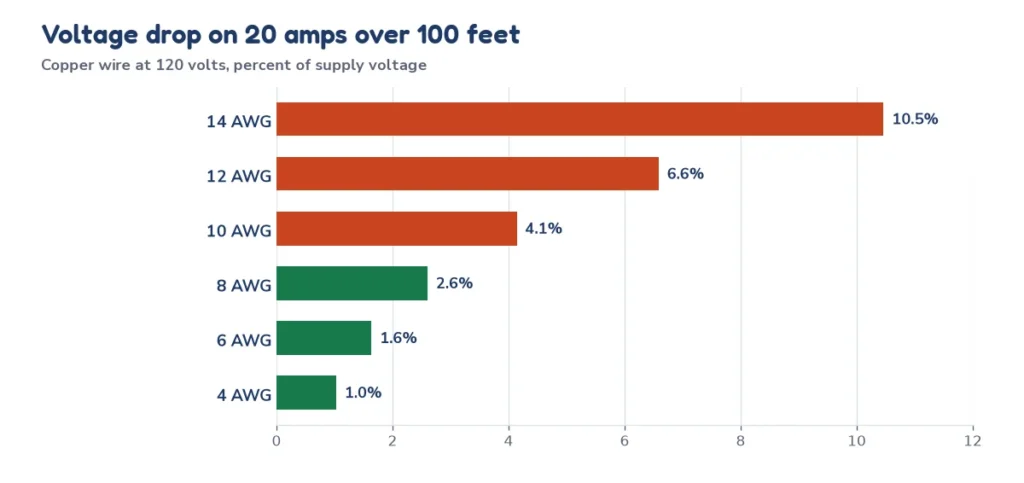
To bring that under 3 percent you would move to a larger wire. The wire size mode checks each size for you. At 10 AWG the same run drops 4.97 volts, or 4.14%, and at 8 AWG it drops 3.13 volts, or 2.60%.
Choosing a wire size for a limit
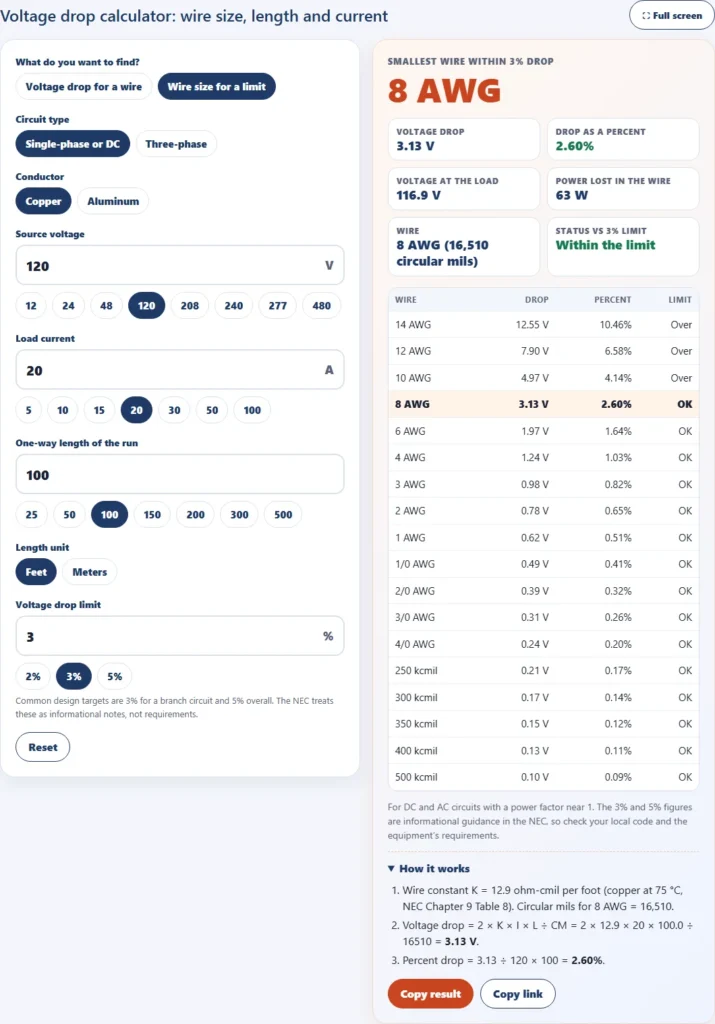
Switch to Wire size for a limit when you know the load and the distance and want the smallest conductor that stays under your target. For a 20-amp load 100 feet away on a 120-volt circuit with a 3 percent limit, the calculator picks 8 AWG copper at 3.13 volts, or 2.60%. The table beside the answer shows every size so you can see how close the next smaller one comes.
Voltage drop and ampacity are two different checks
Voltage drop is about how much voltage reaches the load. Ampacity is about how much current a conductor can carry without overheating, and it depends on insulation, temperature and the wiring method. A wire can pass one check and fail the other, so a voltage drop calculator should be used alongside the code tables and not instead of them. IAEI Magazine adds that manufacturers' installation instructions must be followed, and these can set stricter limits than the general guidance.
Wire size voltage drop calculator: circular mils by AWG size
This wire size voltage drop calculator uses the circular mil area of each conductor. A circular mil is the area of a circle one mil (a thousandth of an inch) in diameter. AWG diameters follow a fixed formula, 0.005 inch × 92(36 − n) ÷ 39, so each gauge step changes the area by a constant ratio.
| Wire size | Circular mils | Drop at 20 A, 100 ft (V) | Percent at 120 V |
|---|---|---|---|
| 14 AWG | 4,110 | 12.55 | 10.46% |
| 12 AWG | 6,530 | 7.90 | 6.58% |
| 10 AWG | 10,380 | 4.97 | 4.14% |
| 8 AWG | 16,510 | 3.13 | 2.60% |
| 6 AWG | 26,240 | 1.97 | 1.64% |
| 4 AWG | 41,740 | 1.24 | 1.03% |
| 3 AWG | 52,620 | 0.98 | 0.82% |
| 2 AWG | 66,360 | 0.78 | 0.65% |
| 1 AWG | 83,690 | 0.62 | 0.51% |
| 1/0 AWG | 105,600 | 0.49 | 0.41% |
Acceptable voltage drop: 3% and 5%
The NEC mentions voltage drop in informational notes, and IAEI Magazine points out that informational notes are not mandatory code requirements. It adds that five percent maximum is generally suggested on a circuit, and many designers split that into 3 percent on the branch circuit and 2 percent on the feeder. Manufacturers' installation instructions and local amendments can set stricter limits, and you should follow them.
| Limit | Common use | Allowed drop at 120 V | Allowed drop at 240 V |
|---|---|---|---|
| 2% | Sensitive electronics and long feeders | 2.4 V | 4.8 V |
| 3% | Branch circuit target | 3.6 V | 7.2 V |
| 5% | Total from the service to the load | 6.0 V | 12.0 V |
Maximum run length by wire size
Rearranged, the voltage drop formula gives the longest run for a given limit: length = circular mils × allowed volts ÷ (2 × K × I). The table shows the longest one-way run of copper wire for a 3 percent drop at 120 volts.
| Wire size | 10 A | 15 A | 20 A | 30 A |
|---|---|---|---|---|
| 14 AWG | 57 ft | 38 ft | 28 ft | 19 ft |
| 12 AWG | 91 ft | 60 ft | 45 ft | 30 ft |
| 10 AWG | 144 ft | 96 ft | 72 ft | 48 ft |
| 8 AWG | 230 ft | 153 ft | 115 ft | 76 ft |
| 6 AWG | 366 ft | 244 ft | 183 ft | 122 ft |
| 4 AWG | 582 ft | 388 ft | 291 ft | 194 ft |
| 3 AWG | 734 ft | 489 ft | 367 ft | 244 ft |
Three phase voltage drop calculator
For three-phase circuits the same calculator swaps the multiplier of 2 for 1.732, because the phase currents partly cancel. As a three phase voltage drop calculator, use the line-to-line voltage, such as 208, 240 or 480 volts, for the percent. A 4 AWG copper feeder carrying 60 amps over 200 feet on a 480-volt system drops 6.42 volts, which is 1.34%.
Copper or aluminum
Aluminum has a higher K, 21.2 against 12.9, so for the same drop it needs about 1.64 times the circular mils. The table shows the same 100-foot, 20-amp run at 120 volts on both metals.
| Wire size | Copper drop | Aluminum drop |
|---|---|---|
| 10 AWG | 4.97 V | 8.17 V |
| 8 AWG | 3.13 V | 5.14 V |
| 6 AWG | 1.97 V | 3.23 V |
| 4 AWG | 1.24 V | 2.03 V |
| 3 AWG | 0.98 V | 1.61 V |
| 2 AWG | 0.78 V | 1.28 V |
12V voltage drop calculator for low-voltage and DC circuits
Low voltages are far more sensitive. Used as a 12V voltage drop calculator, the same formula shows that 1 volt lost is 8.3 percent of a 12-volt supply but only 0.8 percent of 120 volts. A 10-amp load 25 feet from a 12-volt source on 12 AWG copper drops 0.99 volts, which is 8.2%, so vehicles, boats, solar and lighting runs often need heavier wire than their current alone would suggest.
| Source | Load | Length (one way) | 12 AWG drop | Percent |
|---|---|---|---|---|
| 12 V DC | 10 A | 25 ft | 0.99 V | 8.2% |
| 12 V DC | 10 A | 25 ft on 8 AWG | 0.39 V | 3.3% |
| 24 V DC | 10 A | 25 ft | 0.99 V | 4.1% |
| 120 V AC | 10 A | 25 ft | 0.99 V | 0.8% |
How to reduce voltage drop
- Use a larger conductor, which raises the circular mils and lowers the resistance.
- Shorten the run, since drop rises in direct proportion to length.
- Raise the voltage, for example by moving a long run from 120 to 240 volts, which halves the percent drop for the same power.
- Switch aluminum to copper, which has a lower K for the same size.
- Reduce the current by splitting the load across more circuits.
Need the relationship between volts, amps, ohms and watts? Use the Ohms law calculator.
Frequently asked questions
10 quick answers
How do you calculate voltage drop?
Multiply 2 by K, the current and the one-way length, then divide by the wire's circular mils. Use 12.9 for copper and 21.2 for aluminum. Divide by the source voltage for the percent.
What is an acceptable voltage drop?
Five percent total is generally suggested, often split as 3 percent on the branch circuit. The NEC gives these in informational notes, so check your local code and equipment instructions.
What is the voltage drop formula for three-phase?
Replace the 2 with 1.732: voltage drop = 1.732 × K × I × L ÷ CM, where L is the one-way length in feet.
What is the K value for copper and aluminum?
K is 12.9 for copper and 21.2 for aluminum at 75 °C, according to NEC Chapter 9 Table 8 as summarized by NCCER.
Why is the length counted one way?
The formula includes the factor of 2 for the out-and-back path, so you enter the distance from the source to the load.
How much voltage drop is too much?
Beyond the guidance of 3 to 5 percent, motors and electronics may run poorly or overheat. Check the equipment's rated voltage range.
Does voltage drop depend on wire size?
Yes. A larger wire has more circular mils and less resistance, so the drop is smaller for the same current and length.
Can I use this for DC and 12V systems?
Yes. Use the single-phase or DC setting. The percent drop is larger at low voltage, so a short run can still be significant.
What size wire do I need for 100 feet at 20 amps?
At 120 volts and a 3 percent limit, 8 AWG copper drops about 2.6 percent. Check the code for the ampacity and the wiring method as well.
Is this calculator a substitute for a code check?
No. It estimates voltage drop only. Ampacity, insulation, temperature and local code decide what is allowed.
Related calculators
- Electricity cost calculator for the cost of running appliances
- Percentage calculator for percent of a number
- Unit converter for feet, meters and more
- Area calculator for circles, including conductor area
- All free calculators
Sources and further reading
- NCCER Electrical Formula Sheet: the single-phase and three-phase voltage drop formulas and K values
- IAEI Magazine: Voltage Drop Formulas: the K factor, informational notes and the 5 percent guidance
- American wire gauge (Wikipedia): the AWG diameter formula and circular mils
This page is general information and not a substitute for the electrical code or a licensed electrician. Last reviewed: October 2026.