A sand calculator turns the size of the job into the amount of sand to order. Enter the length, width and depth, and it returns cubic yards, tons and bags, with an extra allowance for settling and an editable weight per cubic yard. It works for pavers, a sandbox, a pool base, a playground or a leveling layer.
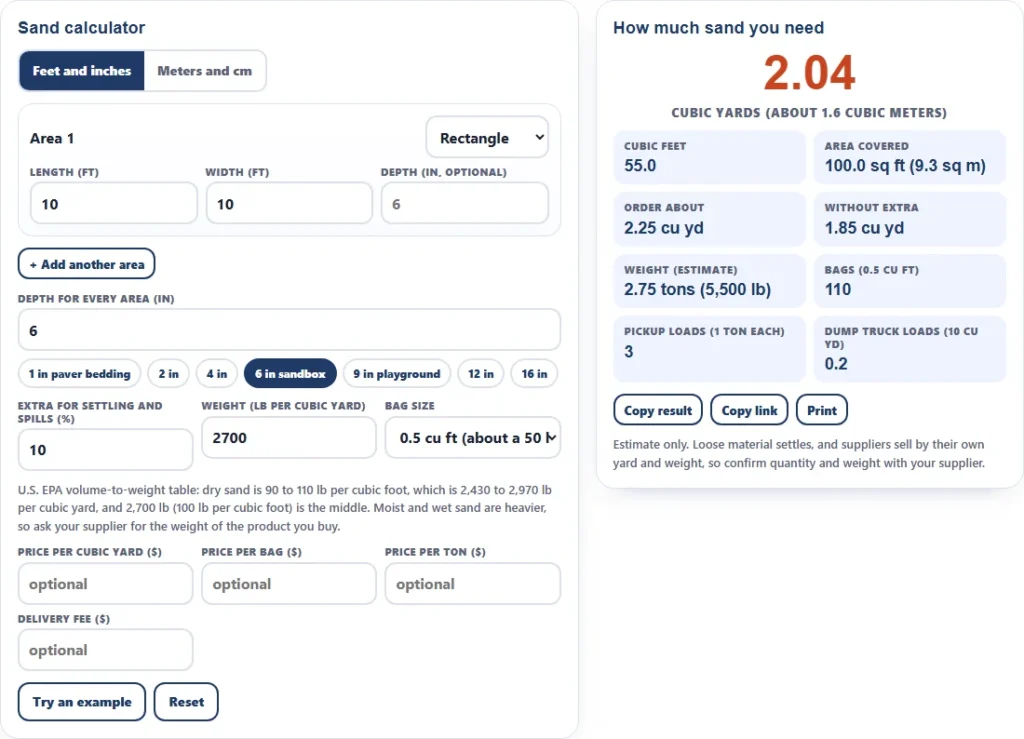
Quick answer: Sand needed = length × width × depth, divided by 27 for cubic yards. A 10 ft × 10 ft area at 6 in deep is 50 cubic feet, 1.85 cubic yards, and with 10% extra it is 2.04 cubic yards, about 2.75 tons at 2,700 lb per cubic yard.
How to use the sand calculator
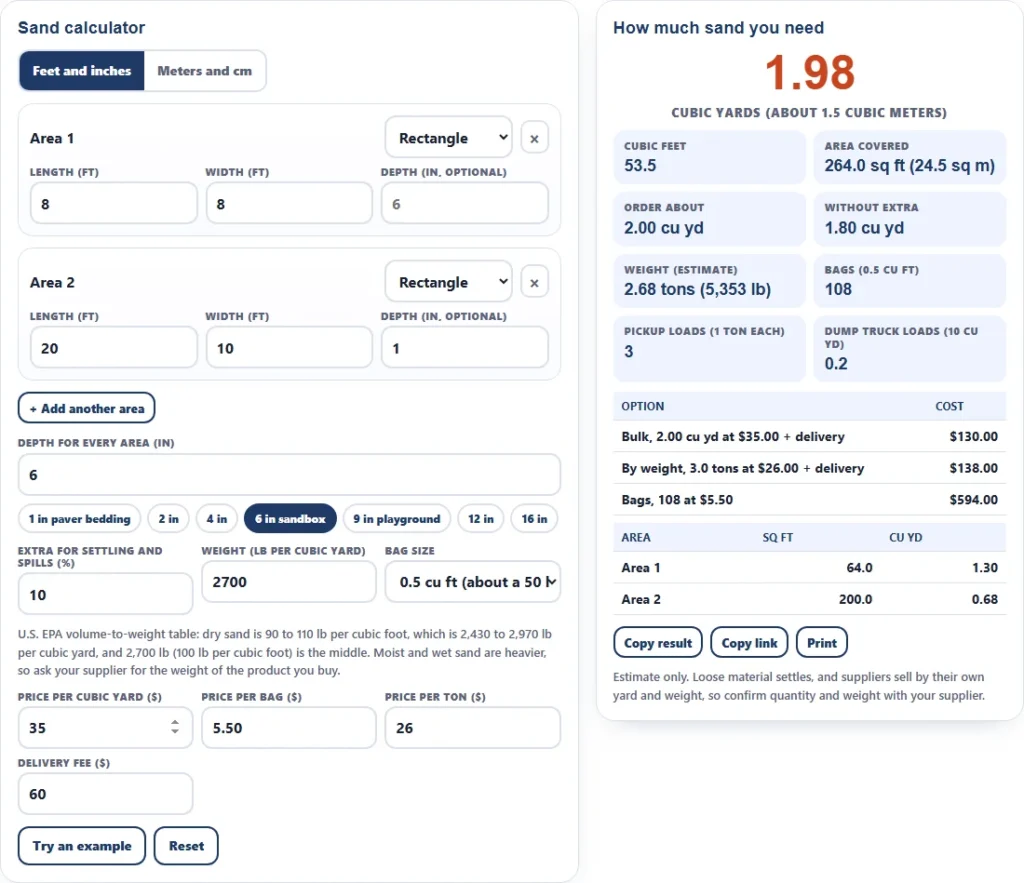
- Choose feet and inches or meters and centimeters.
- Enter the length and width of each area, or pick a circle, triangle or known area. Add more areas for a patio and a sandbox in one estimate.
- Set the depth with the shortcut buttons or type your own. An area can have its own depth.
- Leave 10% extra for settling and spills, or change it. Edit the weight if your supplier gives a different figure.
- Read cubic yards, tons, bags and loads. Add prices to compare bulk, by weight and bags.
The sand calculator runs in your browser and saves your numbers on your device only.
How much sand do I need? The formula
Sand is sold by volume or by weight, so the calculation has two steps: volume from the area and depth, then weight from the density. The formula is the same for any loose material.
- Cubic feet = length (ft) × width (ft) × depth (in) ÷ 12.
- Cubic yards = cubic feet ÷ 27.
- Tons = cubic yards × pounds per cubic yard ÷ 2,000.
- Add 5% to 15% for settling, compaction and spills, depending on the job.
Sand calculator cubic yards: area and depth
A cubic yard covers 324 square feet at 1 inch deep, so the area one yard covers is 324 divided by the depth in inches. The table gives the coverage and the amount for every 100 square feet, before any extra allowance.
| Depth | Square feet per cubic yard | Cubic yards per 100 sq ft | Tons per 100 sq ft (2,700 lb/yd) |
|---|---|---|---|
| 1 in | 324 | 0.31 | 0.42 |
| 2 in | 162 | 0.62 | 0.83 |
| 3 in | 108 | 0.93 | 1.25 |
| 4 in | 81 | 1.23 | 1.67 |
| 6 in | 54 | 1.85 | 2.50 |
| 9 in | 36 | 2.78 | 3.75 |
| 12 in | 27 | 3.70 | 5.00 |
How many tons of sand per cubic yard
Sand weighs about 1.35 tons per cubic yard when it is dry, but the weight changes with moisture. The U.S. EPA volume-to-weight table lists dry sand at 90 to 110 pounds per cubic foot, moist sand at 100 to 110 and wet sand at 110 to 130. It also lists loose sand at 2,441 pounds per cubic yard. Multiply the cubic feet figure by 27 to get a cubic yard.
| Condition | EPA figure | Pounds per cubic yard | Tons per cubic yard |
|---|---|---|---|
| Loose sand (EPA, per cubic yard) | 2,441 lb | 2,441 | 1.22 |
| Dry sand | 90 to 110 lb per cu ft | 2,430 to 2,970 | 1.22 to 1.49 |
| Moist sand | 100 to 110 lb per cu ft | 2,700 to 2,970 | 1.35 to 1.49 |
| Wet sand | 110 to 130 lb per cu ft | 2,970 to 3,510 | 1.49 to 1.75 |
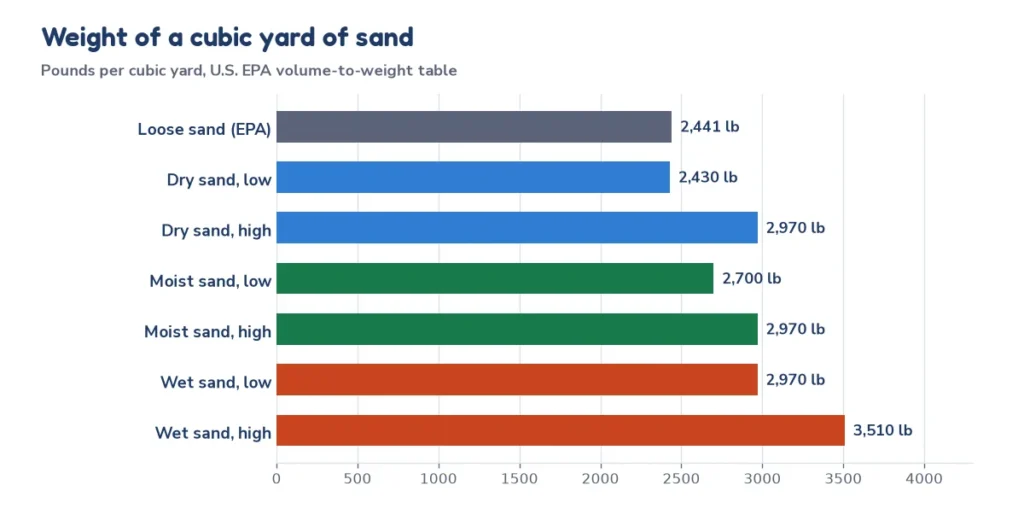
The sand calculator starts at 2,700 pounds per cubic yard, which is 100 pounds per cubic foot and the middle of the dry range. If your sand is wet when delivered, ask for the weight ticket, because the same volume weighs more. Bulk sand is often priced by the ton, which is why the sand calculator also shows tons.
Paver sand calculator: bedding sand depth
Pavers sit on a bedding layer of sand screeded to a uniform thickness. An interlocking concrete pavement inspection checklist gives the sand as screeded to 1 inch, and no less than three-quarters of an inch over a concrete or asphalt base. That thin layer is compacted with the pavers, so a small patio needs little sand: a 12 ft × 12 ft patio is 12 cubic feet, under half a cubic yard.
| Patio size | Area | Bedding sand at 1 in (+10%) | Cubic yards | Tons | 50 lb bags |
|---|---|---|---|---|---|
| 10 ft × 10 ft | 100 sq ft | 9.2 cu ft | 0.34 | 0.46 | 19 |
| 12 ft × 12 ft | 144 sq ft | 13.2 cu ft | 0.49 | 0.66 | 27 |
| 15 ft × 20 ft | 300 sq ft | 27.5 cu ft | 1.02 | 1.38 | 56 |
| 20 ft × 30 ft | 600 sq ft | 55.0 cu ft | 2.04 | 2.75 | 111 |
| 30 ft × 40 ft | 1,200 sq ft | 110.0 cu ft | 4.07 | 5.50 | 221 |
Joint sand for the gaps is a separate, smaller quantity, and polymeric sand is sold by the bag with coverage on the label. Bedding sand and joint sand also differ in grading, so buy the type your paver supplier names.
Sandbox sand calculator: how much play sand
For a play area, fill depth matters more than footprint. A sandbox needs enough depth for digging and to cover the base, so 6 inches is a common size. The playground table below uses the 9 inch minimum for sand under equipment.
| Sandbox size | Depth | Sand (+10%) | Cubic yards | Tons | 50 lb bags |
|---|---|---|---|---|---|
| 4 ft × 4 ft | 6 in | 8.8 cu ft | 0.33 | 0.44 | 18 |
| 6 ft × 6 ft | 6 in | 19.8 cu ft | 0.73 | 0.99 | 40 |
| 8 ft × 8 ft | 6 in | 35.2 cu ft | 1.30 | 1.76 | 71 |
| 10 ft × 10 ft | 9 in | 82.5 cu ft | 3.06 | 4.12 | 165 |
| Round, 8 ft across | 6 in | 27.6 cu ft | 1.02 | 1.38 | 56 |
How many bags of sand do I need
Bags make sense for small jobs. A bag is sold by weight, but the calculator needs its volume. At 100 pounds per cubic foot, a 50 lb bag is about half a cubic foot, so a cubic yard (27 cubic feet) is about 54 bags. Pick the bag size in the sand calculator, and it counts the bags from the cubic feet.
| Sand needed | 50 lb bags (0.5 cu ft) | 60 lb bags (0.6 cu ft) | 80 lb bags (0.8 cu ft) |
|---|---|---|---|
| 5 cu ft | 10 | 9 | 7 |
| 10 cu ft | 20 | 17 | 13 |
| 25 cu ft | 50 | 42 | 32 |
| 50 cu ft | 100 | 84 | 63 |
| 100 cu ft | 200 | 167 | 125 |
| 200 cu ft | 400 | 334 | 250 |
| 1 cubic yard (27 cu ft) | 54 | 45 | 34 |
Bulk or bags: which costs less
Bulk is almost always cheaper for anything beyond a few bags, but delivery fees and minimum loads change the picture for small jobs. Using example prices of $35 a cubic yard, $26 a ton and $5.50 a bag, one cubic yard is $35 in bulk, about $35 by weight at 1.35 tons, and 54 × $5.50 = $297 in bags. Type your own prices in the sand calculator, and it compares the three.
Sand under a pool, a playground and a court
Depth drives these jobs. Follow the pool maker's manual for the sand base under an above-ground pool, and enter that depth. For play equipment, the North Dakota State University Extension reproduces the Consumer Product Safety Commission table: 9 inches of compressed sand protects against a fall from up to 4 feet. Loose fill compresses, so measure the depth after it has settled and top it up.
| Job | Sand (+10%) | Cubic yards | Tons | 50 lb bags |
|---|---|---|---|---|
| Above-ground pool base, 15 ft round, 2 in | 32.4 cu ft | 1.20 | 1.62 | 65 |
| Playground area, 20 ft × 20 ft, 9 in | 330.0 cu ft | 12.22 | 16.50 | 660 |
| Sand court, 30 ft × 60 ft, 12 in | 1980.0 cu ft | 73.33 | 99.00 | 3,961 |
| Lawn leveling, 1,000 sq ft, 1 in | 91.7 cu ft | 3.40 | 4.58 | 184 |
Trucks, pickups and delivery
Sand is heavy for its volume, so the limit on a pickup is weight and not space. The sand calculator counts pickup loads at one ton each and dump truck loads at 10 cubic yards. A 2.75 ton job is three pickup loads or about a fifth of a dump truck load, and a minimum load fee usually makes a single delivery the better choice above a yard or two.
Types of sand: bedding, joint, play and concrete sand
The sand calculator works for any of them, since it only needs volume and weight, but the products are not interchangeable. The paver inspection checklist names bedding sand with a gradation that conforms to ASTM C33 or CSA A3.1 and joint sand that conforms to ASTM C144. Play sand is washed and screened for children's use, and concrete sand is the coarse sand mixed into concrete. Ask the supplier for the product and the weight per cubic yard, then type that weight into the sand calculator.
Sand calculator for odd shapes and several areas
Real sites are rarely a single rectangle. The sand calculator lets you add up to eight areas and choose a rectangle, circle, triangle or known area for each. A kidney-shaped sandbox can be a circle plus a rectangle, and a curved patio can be a rectangle plus two triangles. Each area can have its own depth, so a thin bedding layer and a deep play area can sit in one estimate. The table in the result shows cubic yards for each area, which helps you see what drives the total.
Order checklist for sand
- Measure each area and the depth you need after compaction.
- Ask whether the price is per cubic yard, per ton or per bag, and whether the sand is dry or wet.
- Add 10% for settling, then round up to the next quarter yard or half ton.
- Check delivery fees and the minimum load before you compare prices.
- Plan where the pile goes, and keep it covered if rain is likely, since wet sand weighs more.
Frequently asked questions
10 quick answers
How do I calculate how much sand I need?
Multiply length by width by depth in feet, with depth in inches divided by 12, then divide by 27 for cubic yards. Add 10% for settling.
How many tons of sand are in a cubic yard?
About 1.35 tons for dry sand at 2,700 pounds per cubic yard. Moist and wet sand weigh more, up to about 1.75 tons.
How much does a cubic yard of sand weigh?
Roughly 2,400 to 3,500 pounds depending on moisture. The EPA lists loose sand at 2,441 pounds and wet sand up to 130 pounds per cubic foot.
How many bags of sand are in a cubic yard?
About 54 bags of 50 pounds, since a bag is roughly half a cubic foot and a cubic yard is 27 cubic feet.
How much sand do I need for pavers?
Bedding sand is screeded to about 1 inch. A 12 by 12 foot patio needs about 13 cubic feet, under half a cubic yard.
How much sand do I need for a sandbox?
An 8 by 8 foot sandbox at 6 inches deep is 32 cubic feet, or 35 with 10% extra. That is about 1.3 cubic yards or 70 bags.
How much extra sand should I order?
Ten percent is a common allowance for settling and spills. Use more on uneven ground or for a pool base you will compact.
Is sand sold by the yard or by the ton?
Both. Bulk sand is often priced by the ton and bagged sand by the bag, so the calculator shows tons, yards and bags.
What depth of sand is needed under a playground?
The CPSC table reproduced by NDSU Extension lists 9 inches of compressed sand, which protects to a 4 foot fall height.
Can I use the sand calculator for gravel or soil?
The area and depth part is the same. Change the weight to the figure for your material, or use the topsoil calculator for soil.
Related calculators
- Topsoil calculator for soil, with the same area and depth inputs
- Concrete calculator for slabs, footings and bags
- Mulch calculator for garden beds
- Asphalt calculator for driveways in tons
- Square footage calculator for the area of rooms and yards
- All free calculators
Sources and further reading
- U.S. EPA: Standard Volume-to-Weight Conversion Factors: dry, moist, wet and loose sand weights
- NDSU Extension: Playground surfacing: minimum compressed loose-fill depths, with sand at 9 inches
- Interlocking concrete pavements inspection checklist: bedding sand screeded to 1 inch
This page gives estimates for planning. Weights and prices vary by supplier, so confirm quantity and weight before you order. Last reviewed: October 2026.