An asphalt calculator turns the size of a driveway, parking lot or patch and the compacted thickness you want into tons of hot mix asphalt to order. Enter the length and width, choose a thickness, and the calculator gives tons, cubic yards, truckloads and an estimated cost.
Quick answer: Tons of asphalt = square feet ÷ 9 × thickness in inches × 110 ÷ 2,000. A 1,000 sq ft driveway at 2 inches is 1,000 ÷ 9 × 2 × 110 ÷ 2,000 = 12.22 tons, and at 3 inches it is 18.33 tons, before any extra for waste.
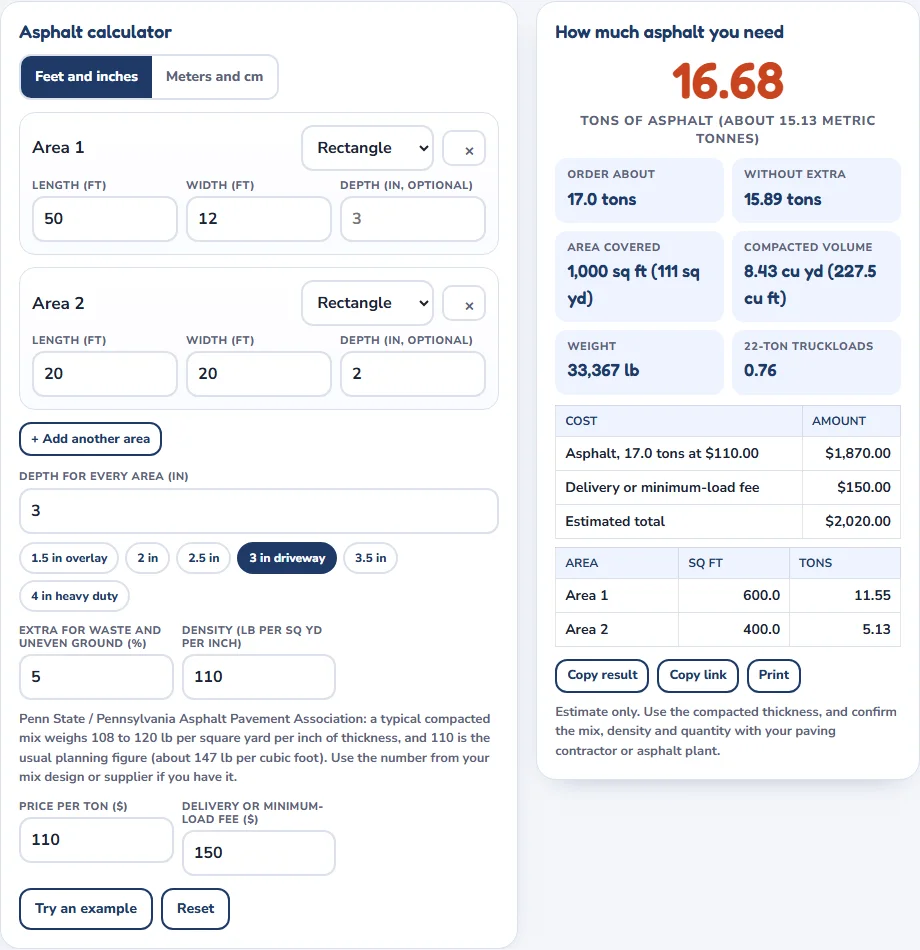
This free asphalt calculator covers the jobs people actually search for: a new driveway, an overlay, a small parking lot, a patch or a whole site split into several areas with different thicknesses. You can mix shapes in one estimate, give each area its own thickness and switch between feet and meters, so one asphalt calculator replaces separate worksheets for each part of the job.
How to use the asphalt calculator
- Pick feet and inches or meters and centimeters.
- Add each area: a rectangle (length and width), a circle (diameter), a triangle (base and height) or a known area.
- Set the compacted thickness for every area, or give one area its own thickness if it differs, such as a thicker apron or a thin overlay.
- Leave 5 percent extra for waste and uneven ground, or change it. Keep the density at 110 pounds per square yard per inch unless your supplier gives another number.
- Add a price per ton and a delivery or minimum-load fee to see the estimated cost, then read the tons to order.
The calculator runs in your browser and keeps your numbers on your device. Use Copy result to paste the tonnage into a message to your paving contractor, or Print for a job sheet.
How much asphalt do I need? The formula
Asphalt is bought by the ton, so the calculation turns area and thickness into weight. A square yard of compacted asphalt one inch thick weighs about 110 pounds. The Penn State Superpave checklist, written with the Pennsylvania Asphalt Pavement Association, uses that figure and says a typical compacted mix weighs 108 to 120 pounds per square yard per inch, or 144 to 160 pounds per cubic foot, depending on the aggregate, the binder content and the in-place density.
- Area in square yards = square feet ÷ 9, because a square yard is 9 square feet.
- Weight in pounds = square yards × thickness in inches × 110.
- Tons = pounds ÷ 2,000.
Written out for the shortcut, tons = square feet × thickness in inches ÷ 163.6. That is why 1,000 square feet at 2 inches comes to about 12.2 tons.
| Shape | Area formula | Example | Area |
|---|---|---|---|
| Rectangle | length × width | 50 ft × 12 ft | 600 sq ft |
| Circle | π × (diameter ÷ 2)² | 30 ft turnaround | 706.9 sq ft |
| Triangle | base × height ÷ 2 | 20 ft × 12 ft | 120 sq ft |
| Irregular | split into the shapes above and add | a driveway and a pad | sum of the parts |
Asphalt calculator square feet: tons by area and thickness
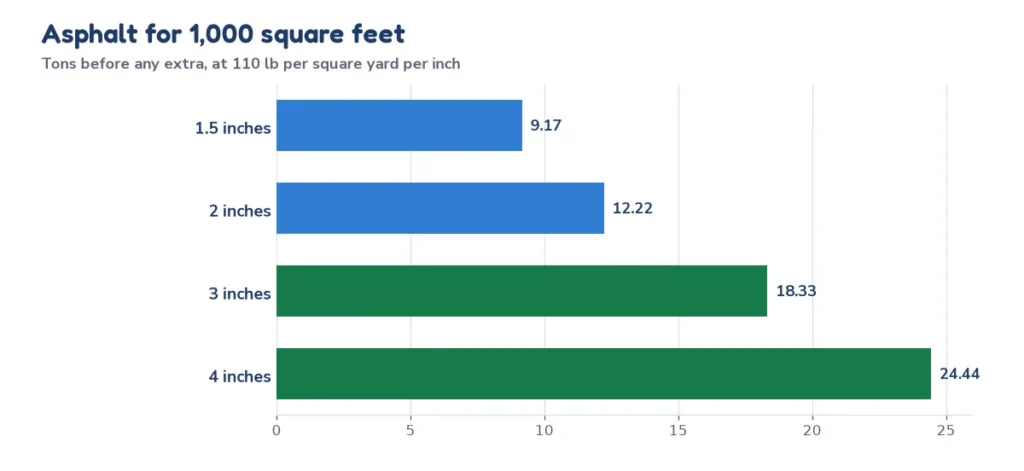
This asphalt calculator square feet table gives tons before any extra for waste. Each extra inch of thickness adds the same amount, which is about 6.11 tons for every 1,000 square feet.
| Area | 1.5 in | 2 in | 3 in | 4 in |
|---|---|---|---|---|
| 500 sq ft | 4.58 | 6.11 | 9.17 | 12.22 |
| 1,000 sq ft | 9.17 | 12.22 | 18.33 | 24.44 |
| 2,000 sq ft | 18.33 | 24.44 | 36.67 | 48.89 |
| 5,000 sq ft | 45.83 | 61.11 | 91.67 | 122.22 |
| 10,000 sq ft | 91.67 | 122.22 | 183.33 | 244.44 |
Asphalt driveway calculator: how thick should it be?
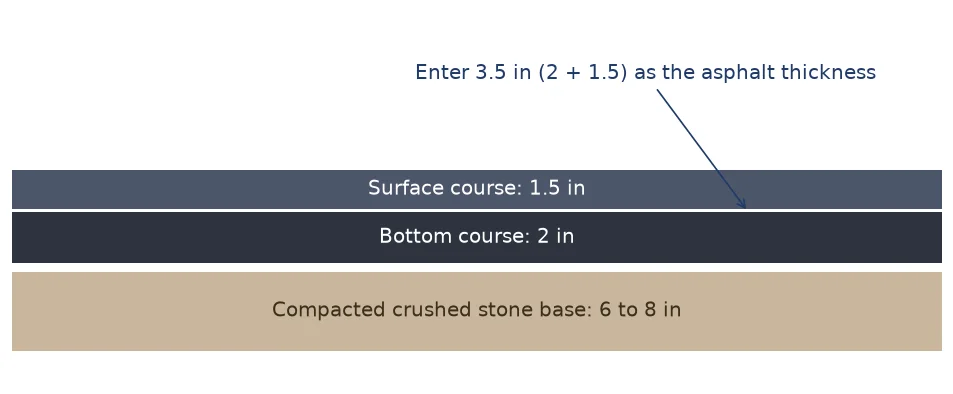
For an asphalt driveway calculator the thickness is the number that moves the answer most, and it is the compacted thickness, not the depth of loose mix on the truck. The Colorado Asphalt Pavement Association says a base of 6 to 8 inches of crushed aggregate is usually adequate and that an ordinary residential driveway should have a 2-inch bottom course covered with a 1.5-inch surface course, which is 3.5 inches in total. For an overlay on an existing driveway it says 1.5 to 2 inches of surface mix is usually sufficient.
| Job | Compacted thickness to enter | Source and note |
|---|---|---|
| New residential driveway | 3.5 in (2 in bottom course plus 1.5 in surface) | Colorado Asphalt Pavement Association technical brief |
| Overlay on a sound driveway | 1.5 to 2 in | Same brief: patch holes and large cracks first |
| Parking lot example | 3 in compacted | Penn State Superpave checklist worked example |
| Heavy trucks, RVs or a service lane | Ask a contractor or engineer | Thickness depends on soil, climate and traffic |
| Crushed aggregate base under the asphalt | 6 to 8 in of stone | Colorado Asphalt Pavement Association brief |
Asphalt tonnage calculator: a worked example
Here is the asphalt tonnage calculator at work. Say you are paving a 50 ft × 12 ft driveway at 3 inches and a 20 ft × 20 ft parking pad at 2 inches. The driveway is 600 sq ft, which is 11.00 tons. The pad is 400 sq ft, which is 4.89 tons. Together that is 15.89 tons, and with 5 percent extra the asphalt calculator shows 16.68 tons, which you would order as 17 tons.
Doing the same sum by hand takes a few lines, which is why an asphalt calculator that keeps several areas on one screen saves time. If a bid comes back in square yards or in cubic yards instead of tons, convert it with the weight per square yard per inch before you compare quotes.
Asphalt calculator tons: how far does one ton go?
Contractors often think in length of lane per ton. The Penn State checklist publishes that table using 110 pounds per square yard per inch, and the asphalt calculator tons results match it. Divide the length you need by the feet per ton to get the tonnage, or multiply the tons in a truck by the feet per ton to see how far it will go.
| Mat width | 1 in | 1.5 in | 2 in | 3 in |
|---|---|---|---|---|
| 8 ft | 20.5 ft | 13.6 ft | 10.2 ft | 6.8 ft |
| 10 ft | 16.4 ft | 10.9 ft | 8.2 ft | 5.5 ft |
| 12 ft | 13.6 ft | 9.1 ft | 6.8 ft | 4.5 ft |
| 14 ft | 11.7 ft | 7.8 ft | 5.8 ft | 3.9 ft |
| 16 ft | 10.2 ft | 6.8 ft | 5.1 ft | 3.4 ft |
The same checklist works a 12-foot lane for one mile at 1.5 inches: 5,280 ft ÷ 9.1 ft per ton is about 581 tons. A 22-ton truckload on that lane at 2 inches covers about 150 feet.
Asphalt tons, cubic yards and weight
The asphalt calculator also shows compacted volume, which helps when a quote or a plant ticket is in cubic yards. At 110 pounds per square yard per inch, one cubic yard of compacted asphalt (a square yard 36 inches thick) weighs 3,960 pounds, or 1.98 tons.
| Job | Area | Thickness | Tons | Cubic yards | 22-ton loads |
|---|---|---|---|---|---|
| Small patch | 100 sq ft | 2 in | 1.22 | 0.62 | 0.06 |
| Single-car driveway | 600 sq ft | 3 in | 11.00 | 5.56 | 0.50 |
| Two-car driveway | 1,000 sq ft | 3 in | 18.33 | 9.26 | 0.83 |
| Small parking lot | 5,000 sq ft | 3 in | 91.67 | 46.30 | 4.17 |
| Large lot | 45,000 sq ft | 3 in | 825.00 | 416.67 | 37.50 |
Asphalt cost calculator: tons times price
As an asphalt cost calculator, the tool multiplies the tons you order by your price per ton and adds a delivery or minimum-load fee. Hot mix prices vary with region, mix type, haul distance and season, so enter the price from a local plant or contractor quote. The table uses round example prices only to show how the total moves.
| Order | At $90 per ton | At $110 per ton | At $130 per ton |
|---|---|---|---|
| 5 tons | $450 | $550 | $650 |
| 12 tons | $1,080 | $1,320 | $1,560 |
| 17 tons | $1,530 | $1,870 | $2,210 |
| 25 tons | $2,250 | $2,750 | $3,250 |
| 50 tons | $4,500 | $5,500 | $6,500 |
A paving contractor's quote usually includes base preparation, rolling, labor and equipment, so it will be higher than the material cost shown here. Use the number as a check on the material line, not as a replacement for a quote.
Base stone for the driveway
The asphalt sits on a compacted crushed aggregate base. Using the 6 to 8 inch range from the Colorado brief, 1,000 square feet needs about 18.5 to 24.7 cubic yards of compacted stone, before extra for compaction. Use the mulch and gravel calculator for the stone volume.
Measuring a driveway for the asphalt calculator
Walk the area with a tape measure and write down each section as a rectangle, circle or triangle. Measure the width at both ends of a tapered driveway and use the average. Add flared aprons and turnarounds as separate areas, because they are usually the places people forget.
Use the thickness you want after compaction. If the paver lays the mix loose, the contractor allows for the compression under the roller, so ask which thickness a quote assumes. Entering parts as separate areas also makes it easy to see which job drives the total, and which part to trim if the budget is tight.
Common mistakes when ordering asphalt
| Mistake | What goes wrong | Fix |
|---|---|---|
| Entering loose depth instead of compacted thickness | The order is too small or the quote does not match | Always use compacted thickness |
| Entering feet instead of inches | The result is 12 times too big | Check the unit label next to the thickness box |
| Mixing square yards and square feet | Tonnage is off by a factor of 9 | Divide square feet by 9 once |
| Using one thickness for every area | A thin pad and a thick apron get the same amount | Give each area its own thickness |
| Skipping extra for waste | The last pass is short | Keep 5 to 10 percent extra |
| Ignoring the density on the mix design | Quantities differ by up to 10 percent | Use the supplier or mix design figure |
Frequently asked questions
10 quick answers
How many tons of asphalt do I need for 1,000 square feet?
At 2 inches compacted you need about 12.2 tons, and at 3 inches about 18.3 tons, using 110 pounds per square yard per inch. Add about 5 percent for waste.
How do you calculate tons of asphalt?
Divide square feet by 9 to get square yards, multiply by the thickness in inches and by 110 pounds, then divide by 2,000. The asphalt calculator does this for every area you add.
How thick should an asphalt driveway be?
The Colorado Asphalt Pavement Association suggests a 2-inch bottom course with a 1.5-inch surface course over 6 to 8 inches of crushed stone. Heavier use may need more, so ask a contractor.
How much does a ton of asphalt cover?
At 2 inches thick a ton covers about 82 square feet, and at 3 inches about 55 square feet, at 110 pounds per square yard per inch.
What does a cubic yard of asphalt weigh?
About 3,960 pounds, or 1.98 tons, when compacted at 110 pounds per square yard per inch. The exact figure depends on the mix design.
How much asphalt is in a truckload?
The Penn State checklist uses a 22-ton truckload in its examples. Your supplier may use a different size, so confirm the load before you order.
Should I order extra asphalt?
Most people add 5 to 10 percent for waste, uneven subgrade and the end of the lane. The calculator lets you set the percent.
Can I use this asphalt calculator for an overlay?
Yes. Enter the overlay thickness, such as 1.5 or 2 inches, and the area. Repair holes and large cracks first, as the Colorado brief advises.
Does the calculator include the stone base?
No. It calculates the hot mix asphalt. Use a gravel calculator for the crushed aggregate base underneath.
Is this a quote?
No. It is an estimate. Confirm the mix, density, thickness and price with your paving contractor or asphalt plant.
Related calculators
- Concrete calculator for slabs, footings and post holes
- Mulch calculator for mulch, gravel and cubic yards
- Topsoil calculator for lawns and beds
- Area calculator to measure irregular shapes
- Square footage calculator for yard and lot areas
- Volume calculator for boxes, cylinders and cones
- Unit converter for feet, meters and tons
- All free calculators
Sources and further reading
- Penn State Superpave and Pennsylvania Asphalt Pavement Association: Constructing Quality Asphalt Pavements checklist: 110 lb per square yard per inch, the 108 to 120 range and the worked tonnage examples
- Colorado Asphalt Pavement Association: Best Practices for the Use of Asphalt Driveways: base, course thickness and overlay guidance
Last reviewed: October 2026.