A batting average calculator divides hits by at-bats to give the average used in baseball and softball, written to three decimal places. This one also finds on-base percentage, slugging and OPS from the full stat line, works out how many hits in a row you need to reach a target such as .300, and calculates the cricket batting average.
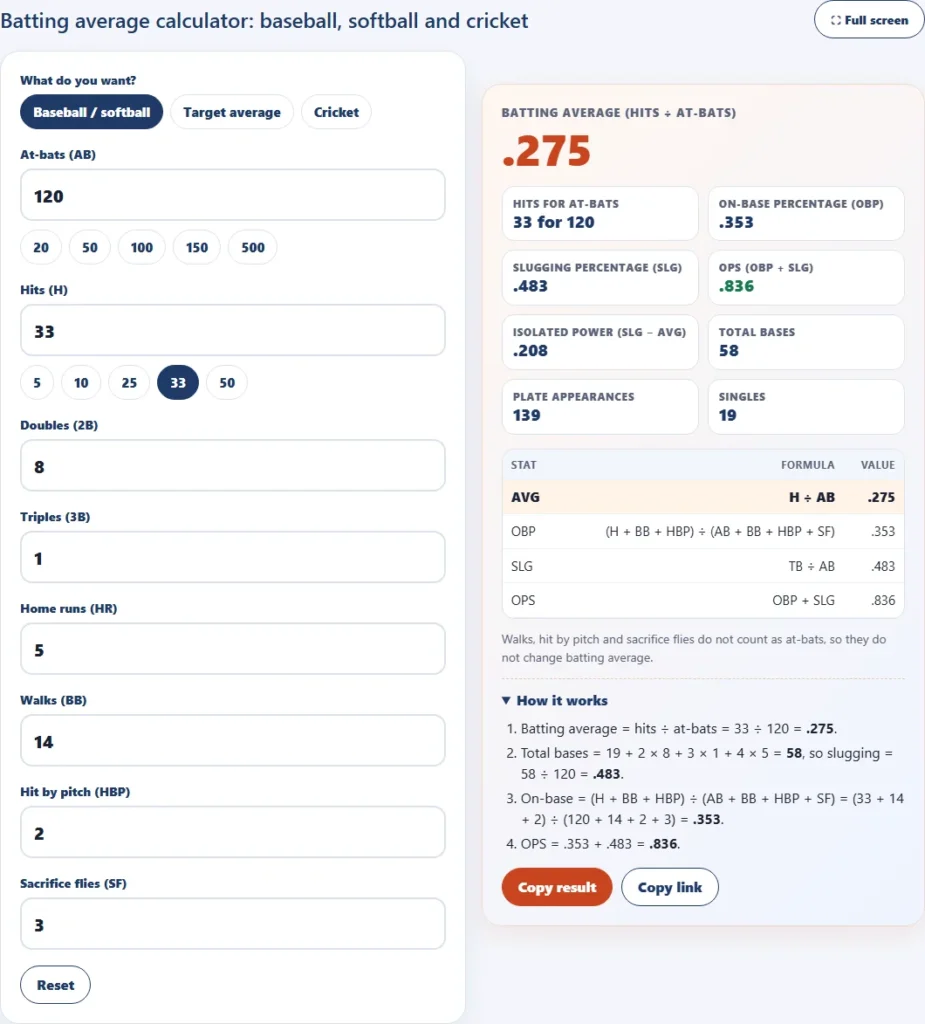
Quick answer: Batting average = hits ÷ at-bats. A player with 33 hits in 120 at-bats has an average of 33 ÷ 120 = .275. Walks, hit by pitch and sacrifice flies are not at-bats, so they do not change it.
How to use the batting average calculator
- Choose Baseball / softball, Target average or Cricket.
- For baseball and softball, enter at-bats and hits, then doubles, triples, home runs, walks, hit by pitch and sacrifice flies if you want OBP, SLG and OPS.
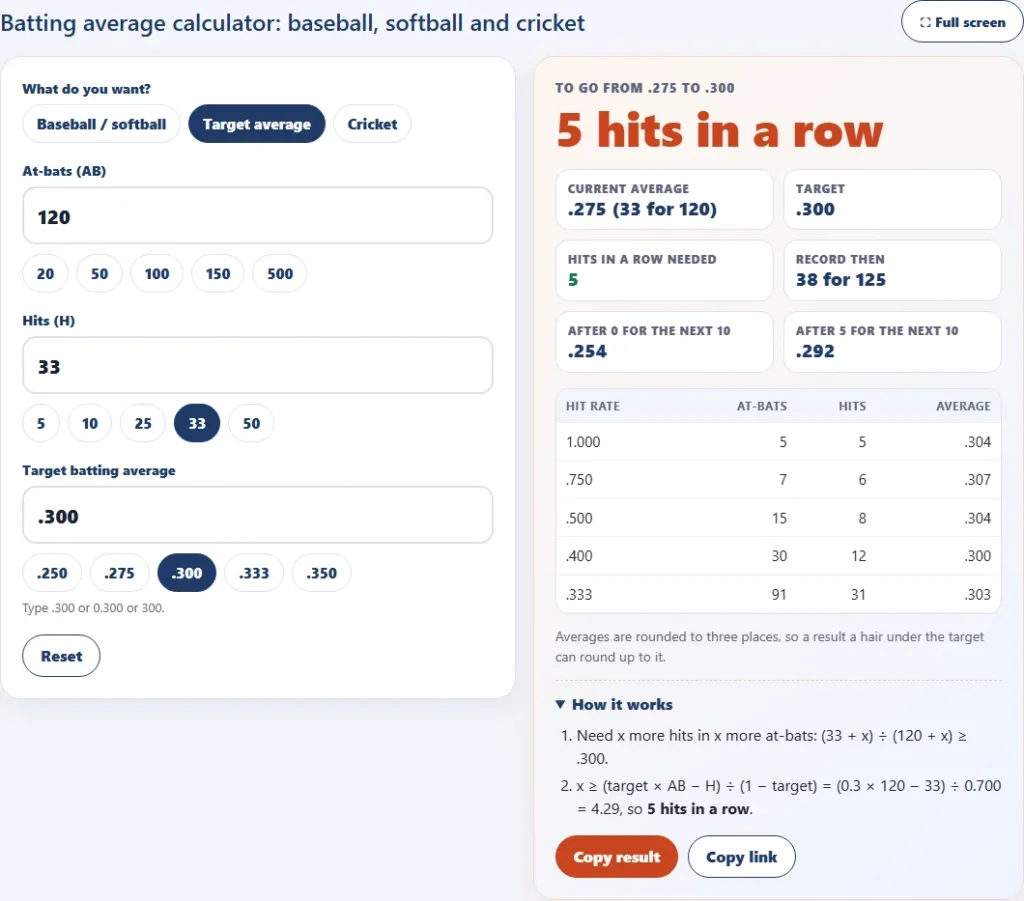
- For Target average, enter at-bats, hits and the average you want, such as .300. The calculator gives the hits in a row needed.
- For Cricket, enter total runs, innings and not outs. The average is runs divided by dismissals.
- Read the result and open How it works for each step.
The batting average calculator runs in your browser and keeps your numbers on your device.
Batting average formula: hits divided by at-bats
Wikipedia explains that batting average is determined by dividing a player's hits by their total at-bats, usually rounded to three decimal places and read without the decimal. A player with a .300 average is said to be batting three hundred. A difference of .001 is a point, so a .235 batter is five points higher than a .230 batter.
- AVG = H ÷ AB
- H is hits: singles, doubles, triples and home runs.
- AB is official at-bats, which leave out walks, hit by pitch and sacrifices.
- Round to three decimals, and drop the leading zero when you write it: .275.
How to calculate batting average: worked examples
| Example | Hits | At-bats | Batting average |
|---|---|---|---|
| A Little League season | 18 | 60 | .300 |
| A high school season | 52 | 187 | .278 |
| A college season | 101 | 365 | .277 |
| A short stretch | 7 | 25 | .280 |
| A hot weekend | 9 | 14 | .643 |
| A slump | 3 | 41 | .073 |
To work one by hand, divide the hits by the at-bats on a calculator and round to three places. 52 ÷ 187 is 0.27807, which rounds to .278. The batting average calculator does the same and also keeps full precision, so a .2995 average is not rounded up before it is compared with a goal.
What is a good batting average?
In modern Major League Baseball, Wikipedia says a season average of .300 or higher is considered excellent, and an average above .400 is a nearly unachievable goal. The last player to hit .400 with enough plate appearances to qualify was Ted Williams of the Boston Red Sox, who hit .406 in 1941. The highest single-season average in the American and National Leagues since then is .394 by Tony Gwynn in 1994.
| Record | Average | Who and when |
|---|---|---|
| Season average in 1894 | .440 | Hugh Duffy |
| Last .400 season with enough plate appearances | .406 | Ted Williams, 1941 |
| Highest since 1941 in the AL and NL | .394 | Tony Gwynn, 1994 |
| Season average, Negro National League, 1943 | .466 | Josh Gibson |
| Highest career average in MLB records | .371 | Josh Gibson |
| Next on the career list | .367 | Ty Cobb (four points lower, per Wikipedia) |
For youth and school levels there is no official standard. A useful way to read a number is against teammates and opponents in the same league. A .300 hitter gets a hit in about three of every ten at-bats, whatever the level.
Hits needed to raise your batting average
The Target average mode answers the question every player asks mid-season: how many hits in a row do I need to get to .300? If you have H hits in AB at-bats and want average T, then x consecutive hits in x at-bats satisfy (H + x) ÷ (AB + x) ≥ T, so x is the smallest whole number at or above (T × AB − H) ÷ (1 − T).
| Record | Average now | Straight hits to reach .300 | Straight hits to reach .333 |
|---|---|---|---|
| 10 for 40 | .250 | 3 | 5 |
| 15 for 60 | .250 | 5 | 8 |
| 20 for 80 | .250 | 6 | 10 |
| 26 for 100 | .260 | 6 | 11 |
| 33 for 120 | .275 | 5 | 11 |
| 40 for 150 | .267 | 8 | 15 |
| 54 for 200 | .270 | 9 | 19 |
| 86 for 300 | .287 | 6 | 21 |
The more at-bats you have, the more slowly the average moves. At 40 at-bats, a hit moves the average by about .02, while at 300 at-bats it moves it by less than .003. The same is true in reverse, so an early-season slump is easier to climb out of than a late one.
How many hits for a given batting average
A different question: after a set number of at-bats, how many hits make a given average? Multiply the at-bats by the average and round up. The table shows the hits needed to be at or above each average, which is handy for goals in a season or a tournament.
| At-bats | Hits for .250 | Hits for .275 | Hits for .300 | Hits for .325 | Hits for .350 |
|---|---|---|---|---|---|
| 20 | 5 | 6 | 6 | 7 | 7 |
| 30 | 8 | 9 | 9 | 10 | 11 |
| 50 | 13 | 14 | 15 | 17 | 18 |
| 75 | 19 | 21 | 23 | 25 | 27 |
| 100 | 25 | 28 | 30 | 33 | 35 |
| 150 | 38 | 42 | 45 | 49 | 53 |
| 200 | 50 | 55 | 60 | 65 | 70 |
| 300 | 75 | 83 | 90 | 98 | 105 |
| 400 | 100 | 110 | 120 | 130 | 140 |
| 502 | 126 | 139 | 151 | 164 | 176 |
Batting average against: the pitcher's version
The MLB glossary notes that batting average can also be applied to pitchers, where it is called opponents' batting average or batting average against. It is the hits against a pitcher divided by the at-bats against him, so the same calculator works: enter the hits allowed as hits and the at-bats faced as at-bats. A lower number is better for a pitcher.
On base percentage calculator: OBP, SLG and OPS
Batting average ignores walks and gives a single the same value as a home run. Three other numbers fill in the picture. Wikipedia defines on-base percentage as the ratio of times on base (hits, walks and hit by pitch) to the sum of at-bats, walks, hit by pitch and sacrifice flies. The MLB glossary gives slugging as total bases divided by at-bats, where a double counts two bases, a triple three and a home run four. OPS is OBP plus SLG.
- OBP = (H + BB + HBP) ÷ (AB + BB + HBP + SF)
- SLG = (1B + 2 × 2B + 3 × 3B + 4 × HR) ÷ AB
- OPS = OBP + SLG
- ISO (isolated power) = SLG − AVG
Take a player with 120 at-bats, 33 hits (8 doubles, 1 triple, 5 home runs), 14 walks, 2 hit by pitch and 3 sacrifice flies. The batting average is .275, the on-base percentage is .353, slugging is .483 and OPS is .836. Wikipedia says an OPS of .800 or higher in MLB puts a player in the upper echelon of hitters.
| Stat | What it measures | Example |
|---|---|---|
| AVG | Hits per at-bat | .275 |
| OBP | How often the batter reaches base | .353 |
| SLG | Bases per at-bat, power | .483 |
| OPS | OBP plus SLG | .836 |
What counts as an at-bat
Batting average divides by at-bats and not by plate appearances. Wikipedia lists the plate appearances that are not charged as an at-bat: a walk, being hit by a pitch, a sacrifice fly or sacrifice bunt, and being awarded first base for catcher's interference or fielder's obstruction. Everything else, including a strikeout, a ground out, a hit or a reach on an error, is an at-bat.
| Result of the plate appearance | At-bat? | Hit? |
|---|---|---|
| Single, double, triple or home run | Yes | Yes |
| Strikeout or any out in play | Yes | No |
| Reached on an error or fielder's choice | Yes | No |
| Walk or hit by pitch | No | No |
| Sacrifice fly or sacrifice bunt | No | No |
| Catcher's interference | No | No |
To qualify for the batting title in MLB, Wikipedia notes that a player needs 502 plate appearances in the season. Smaller samples can have very high or low averages, which is why the calculator also shows how a few at-bats change the result.
Batting average calculator softball and Little League
The formula is the same in softball and youth baseball: hits divided by at-bats. Typical averages differ between baseball and softball and between age groups, so compare your average with players in the same league and age group. Use the same inputs in the batting average calculator, and keep the scorebook figures for at-bats and hits.
Cricket batting average: runs divided by dismissals
In cricket, Wikipedia defines a batter's batting average as the total runs scored divided by the number of times they have been out, usually given to two decimal places. Innings that end not out add runs but no dismissal, so they raise the average. It notes that most players have career averages between 20 and 40, and that an average above 50 was long considered exceptional.
- Dismissals = innings − not outs.
- Cricket batting average = runs ÷ dismissals.
- Example: 1,850 runs in 42 innings with 5 not outs is 1,850 ÷ 37 = 50.00.
| Not outs (1,850 runs in 42 innings) | Dismissals | Batting average |
|---|---|---|
| 0 | 42 | 44.05 |
| 2 | 40 | 46.25 |
| 5 | 37 | 50.00 |
| 8 | 34 | 54.41 |
| 10 | 32 | 57.81 |
Batting average formula in Excel and Google Sheets
In a spreadsheet, put hits in B2 and at-bats in C2. The formula =B2/C2 gives the average, and the number format 0.000 shows three places. For a team roster, use =SUM(B2:B12)/SUM(C2:C12) for the team average, which weighs each player by at-bats and is not the same as the average of the individual averages. For cricket, use =runs/(innings-notouts).
Frequently asked questions
10 quick answers
How do you calculate batting average?
Divide hits by at-bats and round to three decimals. A player with 33 hits in 120 at-bats has 33 ÷ 120 = .275.
What is a good batting average?
In MLB, a season average of .300 or higher is considered excellent, and .400 is nearly unachievable. At youth and school levels, compare with others in the same league.
Do walks count in batting average?
No. Walks, hit by pitch and sacrifice flies are not at-bats, so they do not change batting average. They do count in on-base percentage.
What is the batting average formula?
AVG = H ÷ AB, where H is hits and AB is official at-bats.
How many hits in a row do I need to reach .300?
Use x ≥ (.300 × AB − H) ÷ .700. From 33 for 120, it takes 5 hits in a row to reach .300.
What is on-base percentage?
The share of plate appearances where the batter reaches base by a hit, a walk or a hit by pitch. The formula is (H + BB + HBP) ÷ (AB + BB + HBP + SF).
What is OPS?
On-base plus slugging, the sum of on-base percentage and slugging percentage. An OPS of .800 or higher is considered excellent in MLB.
How is batting average different in cricket?
In cricket it is runs scored divided by times out, written to two decimals. Not-out innings do not count as dismissals.
Can the batting average calculator be used for softball?
Yes. Softball and youth baseball use the same formula, hits divided by at-bats.
Why does the calculator round to three decimals?
Because baseball records batting averages to three places. The tool keeps full precision for goals and rounds only what it shows.
Related calculators
- Percentage calculator for hit rates and percent change
- Ratio calculator for hits to at-bats
- Mean, median and mode calculator for a list of scores
- Standard deviation calculator for the spread of results
- All free calculators
Sources and further reading
- Batting average (baseball) (Wikipedia): the formula, records and what is considered excellent
- MLB Glossary: Slugging percentage: the slugging formula
- On-base percentage (Wikipedia): the OBP definition
- At bat (Wikipedia): what is and is not an at-bat
- Batting average (cricket) (Wikipedia): runs divided by times out
This page is general information for learning and score keeping. Last reviewed: October 2026.