How to read a Loan Estimate: check three things in order: the loan terms on page 1, the closing costs on page 2, and the comparisons on page 3. The Loan Estimate is the standard three-page form every lender must give you within three business days of your mortgage application, including when you refinance, so offers from different lenders line up line by line.

The Loan Estimate explained at a glance
| Page | What is on it | What to check first |
|---|---|---|
| 1 | Loan terms, projected payments, costs at closing | Loan amount, rate, monthly principal and interest, prepayment penalty |
| 2 | Closing cost details (sections A to J), cash to close | Origination charges (A) and total closing costs (J) |
| 3 | Comparisons, other considerations, lender details | In 5 Years, APR and Total Interest Percentage |
How to read a Loan Estimate, page 1: loan terms and payments
- Loan amount, interest rate and monthly principal and interest. Check they match what you discussed. Each line says whether it can increase after closing.
- Prepayment penalty and balloon payment. For most borrowers both should say NO.
- Rate lock. The top of the page says whether the rate is locked and until when. An unlocked rate can still change.
- Projected payments. The estimated total monthly payment adds mortgage insurance and escrow for taxes and insurance.
- Costs at closing. Estimated closing costs and estimated cash to close. Both are explained on page 2.
Page 2: closing cost details
Page 2 splits the costs into lettered sections. The ones that differ most between lenders are A and B, so compare those first.
| Section | What it covers | Can you shop for it? |
|---|---|---|
| A. Origination charges | Lender fees and any points you pay to lower the rate | Compare across lenders |
| B. Services you cannot shop for | Services the lender chooses, such as the appraisal and credit report | No |
| C. Services you can shop for | Services such as title work, from a list the lender gives you | Yes |
| D. Total loan costs | A + B + C | – |
| E. Taxes and other government fees | Recording fees and transfer taxes | No |
| F to H. Prepaids, initial escrow, other | Prepaid interest, insurance, escrow deposits | Partly |
| I. Total other costs | E + F + G + H | – |
| J. Total closing costs | D + I, minus lender credits | This is the number for the break-even |
On a refinance, the cash to close table on page 2 usually shows the loan amount, total closing costs and the payoff of your old mortgage, rather than a down payment. Under federal rules (12 CFR 1026.19(e)), lender fees and services you cannot shop for generally cannot rise at closing above the Loan Estimate, and services you shop for from the lender’s list can rise by no more than 10% in total. Your Closing Disclosure shows the final figures.
Page 3: comparisons
- In 5 Years: the total you will have paid in principal, interest, mortgage insurance and loan costs in the first five years, and how much of that went to principal.
- Annual Percentage Rate (APR): the yearly cost of the loan including fees, so it is usually higher than the interest rate.
- Total Interest Percentage (TIP): the total interest over the loan as a percentage of the loan amount.
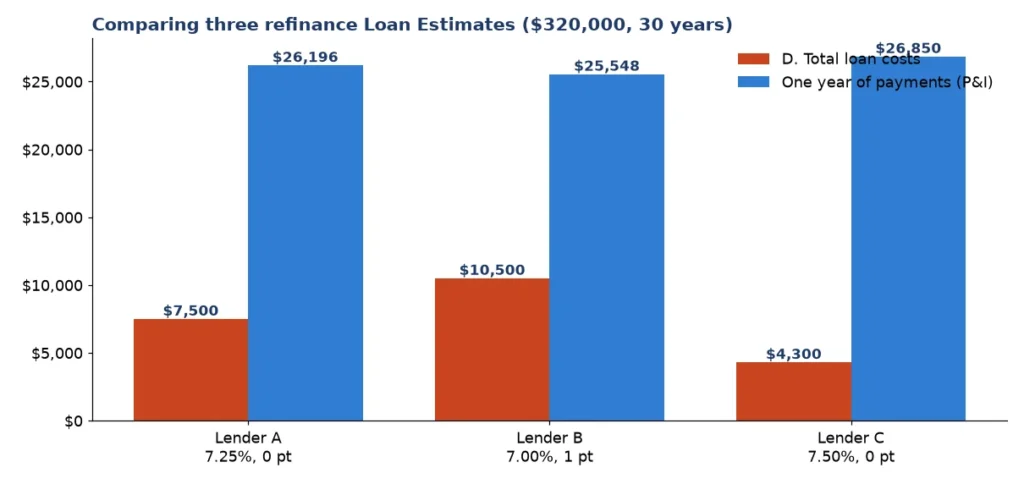
How to compare Loan Estimates: three refinance offers
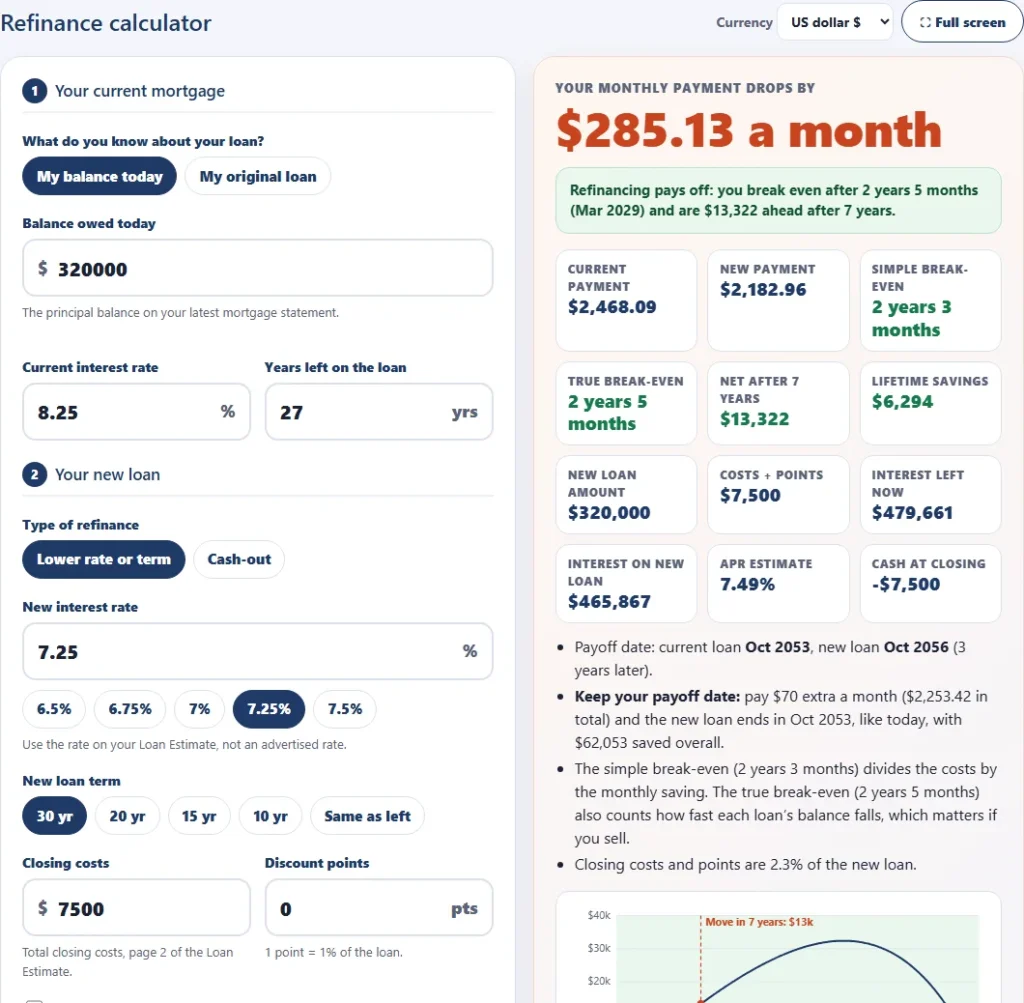
Here are three made-up offers for a $320,000, 30-year refinance, read the way the form lays them out. The borrower currently pays $2,468.09 a month at 8.25%. The figures in the last four columns are worked out with the same formulas as our refinance calculator.
| Offer | Rate | Points | Payment | A. Origination | D. Loan costs | Paid in 5 years | Break-even |
|---|---|---|---|---|---|---|---|
| Lender A | 7.25% | 0 | $2,182.96 | $3,100 | $7,500 | $138,478 | 27 months |
| Lender B | 7.00% | 1 | $2,128.97 | $6,300 | $10,500 | $138,238 | 31 months |
| Lender C | 7.50% | 0 | $2,237.49 | $0 | $4,300 | $138,549 | 19 months |
Lender B has the lowest rate but charges a point ($3,200), so its origination charges are the highest. Over five years it is still the cheapest in total ($138,238 paid). Lender C breaks even soonest. If you might move within two or three years, the offer with the lowest costs can be the better deal even with a higher rate. “Paid in 5 years” here is principal and interest plus loan costs (section D); the form’s own figure also includes any mortgage insurance.
Mistakes to avoid when comparing Loan Estimates
- Comparing an advertised rate with a Loan Estimate. Only compare Loan Estimates with each other.
- Comparing estimates from different days without a rate lock, when rates may have moved.
- Looking only at the rate and ignoring points in section A.
- Forgetting lender credits, which lower section J but often come with a higher rate.
- Treating sections F and G as costs of the loan: prepaid interest and escrow deposits are needed with any lender.
Our free refinance comparison worksheet (also in A4) has a column for each lender and the sections in the order they appear on the form.

This guide explains the math for planning. It is general information, not financial advice; your lender’s documents give the real figures.
Related calculators and guides
- Refinance calculator
- Closing cost calculator
- Mortgage calculator
- Mortgage recast vs refinance
- Cash-out refinance vs HELOC
Sources
- What is a Loan Estimate? (Consumer Financial Protection Bureau): three-page form, delivered within three business days of the application
- Loan Estimate explainer (CFPB): page-by-page sample with points, lender credits and comparisons
- 12 CFR 1026.19(e), good faith estimates and tolerances (eCFR): which charges can and cannot increase
- A Consumer’s Guide to Mortgage Refinancings (Federal Reserve Board)
Frequently asked questions
5 quick answers
How long does a lender have to give me a Loan Estimate?
Three business days from receiving your application, according to the CFPB. Every lender uses the same three-page form.
Where are the closing costs on a Loan Estimate?
On page 2. Section J, Total Closing Costs, is the total of loan costs (D) and other costs (I) minus lender credits. Use it for the break-even.
Why is the APR higher than the interest rate?
The APR adds fees such as points and origination charges to the interest, expressed as a yearly rate. A big gap between the two means high fees.
Is a Loan Estimate a loan approval?
No. It shows the terms the lender expects to offer if you go ahead. The lender has not yet approved or denied your application.
Can closing costs go up after the Loan Estimate?
Some can. Lender fees and services you cannot shop for generally cannot increase, and services you shop for from the lender’s list can rise by up to 10% in total. Compare with the Closing Disclosure.
Did you like this?
Last updated: