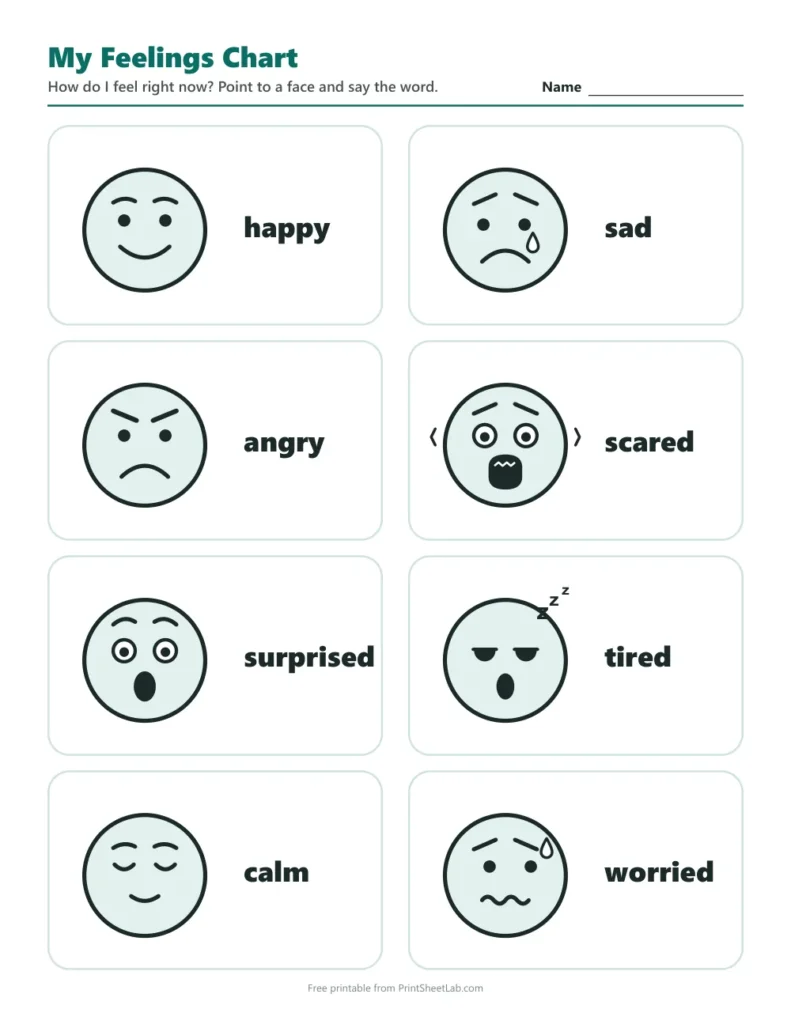
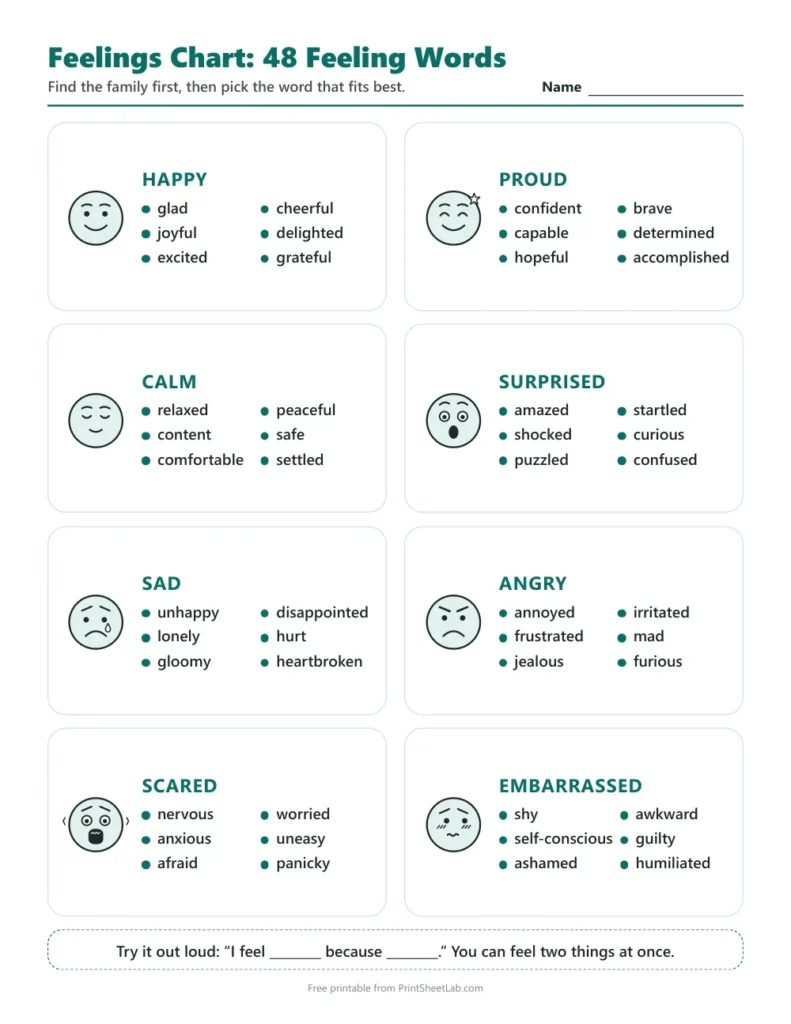
This free feelings chart set gives you six printables for naming emotions: a basic chart with eight big faces for children ages 3 to 7, a chart of 48 feeling words for older kids, teens and adults, a “How big is my feeling?” scale from 1 to 5, a daily check-in sheet, a coping choices chart and 24 feeling cards to cut out. Every face is drawn for PrintSheetLab, prints well in black and white, and comes in US Letter and A4. The feelings chart is free to print.
Quick answer: A feelings chart is a page of faces or words that helps a person point to and name what they feel. Use the 8-face chart with children ages 3 to 7, the 48-word chart from about age 8 to adult, then rate the feeling from 1 (tiny) to 5 (huge) and pick a calm-down choice. All six printables here are free.
Feelings chart printables
Click a picture to open the PDF. Each printable is one page except the feeling cards, which run over two pages, and the all-in-one pack has all seven pages in order.
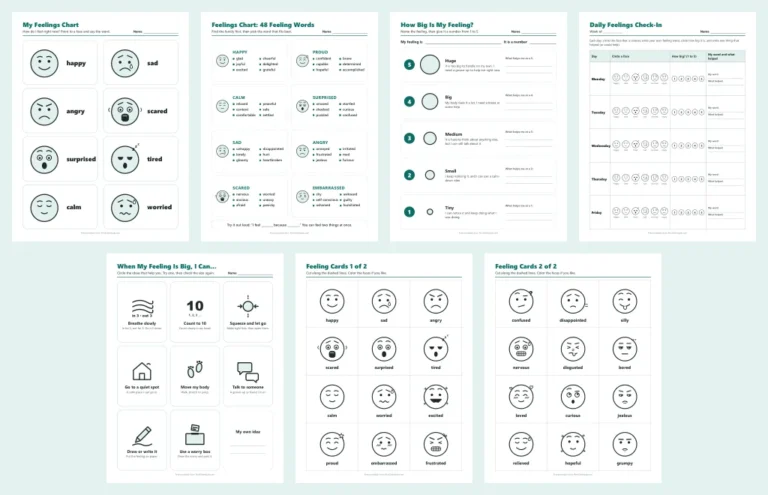
Which feelings chart is right for your child?
The right chart depends on how many feeling words the person already uses: start young children on eight faces and move to the 48-word chart once a child can read and wants more exact words.
| Printable | What is on it | Best for | Use it to |
|---|---|---|---|
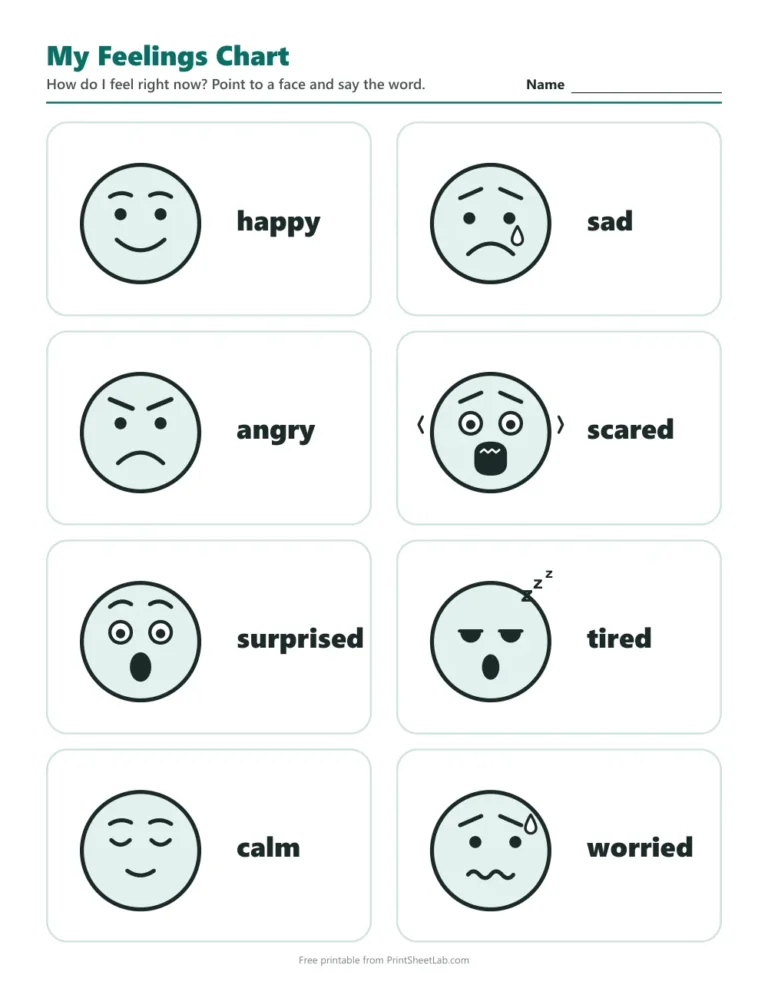
| Basic chart | 8 faces: happy, sad, angry, scared, surprised, tired, calm, worried | Ages 3 to 7, pre-readers, toddlers with help | Point and say one word |
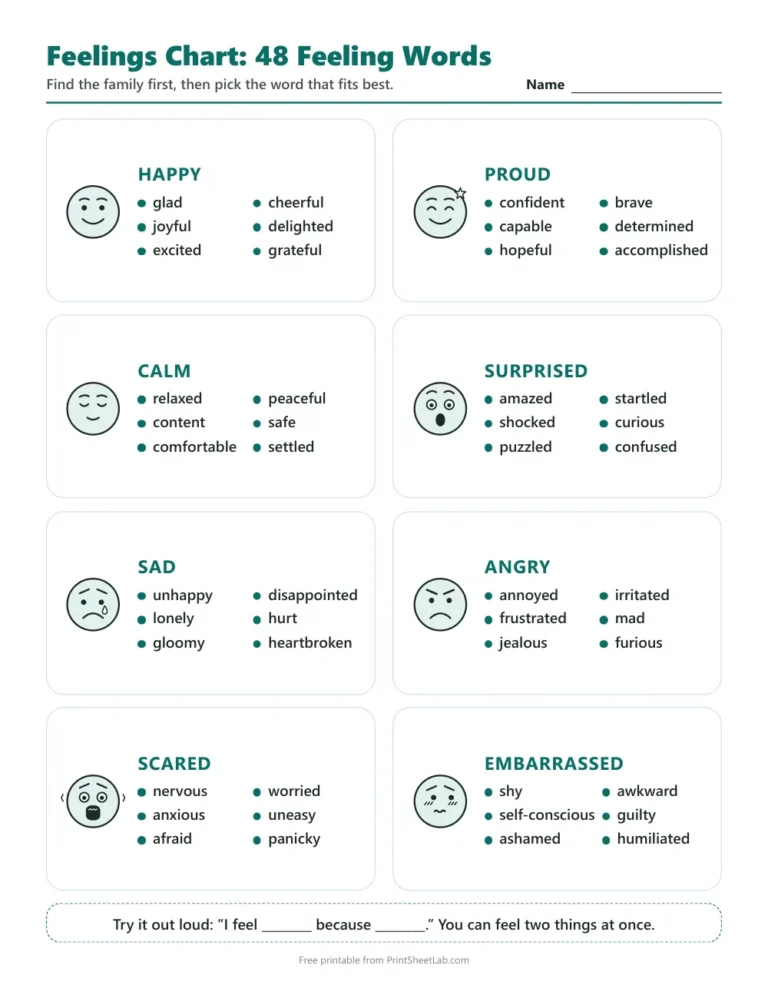
| Feeling words chart | 48 words in 8 families, each with a face | Ages 8 to adult, teens, journaling | Find a more exact word |
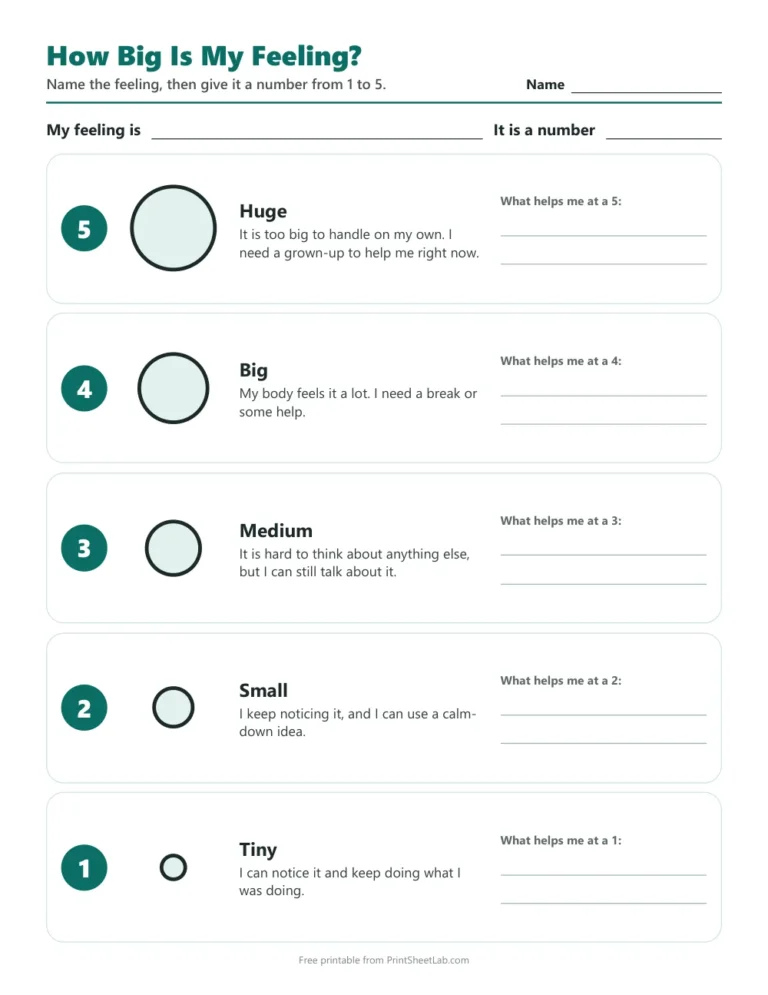
| How big is my feeling? | A 1 to 5 scale from tiny to huge | Ages 4 and up | Show the size of a feeling |
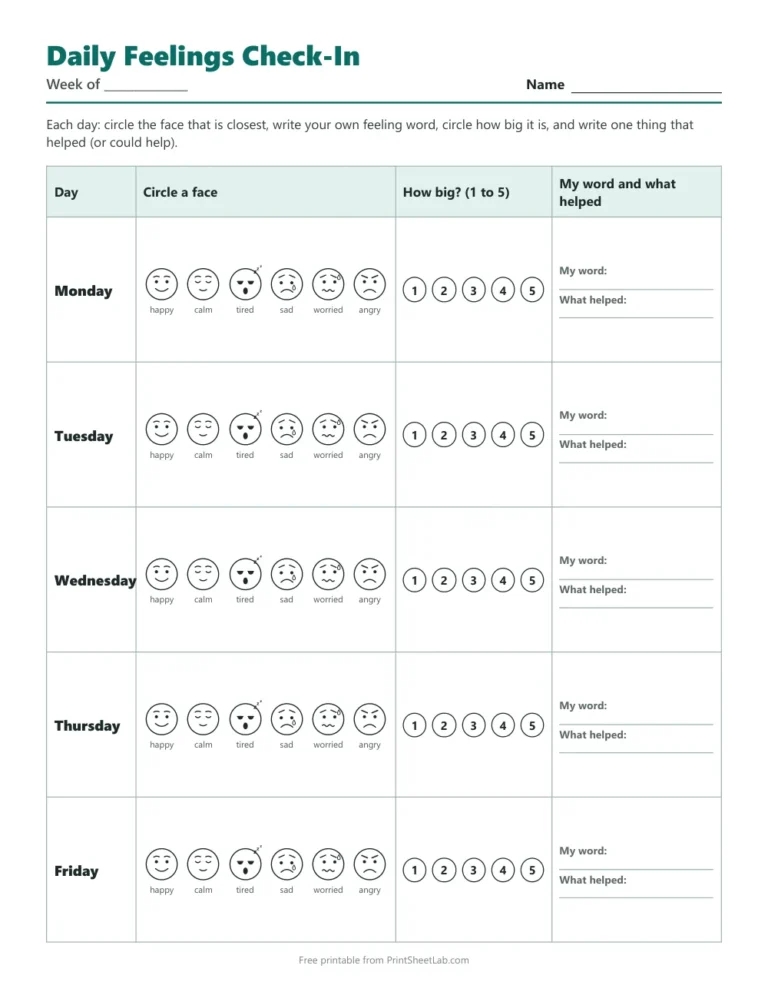
| Daily check-in sheet | 6 faces, a size scale and lines, Monday to Friday | Classrooms and home, ages 5 and up | Notice patterns over a week |
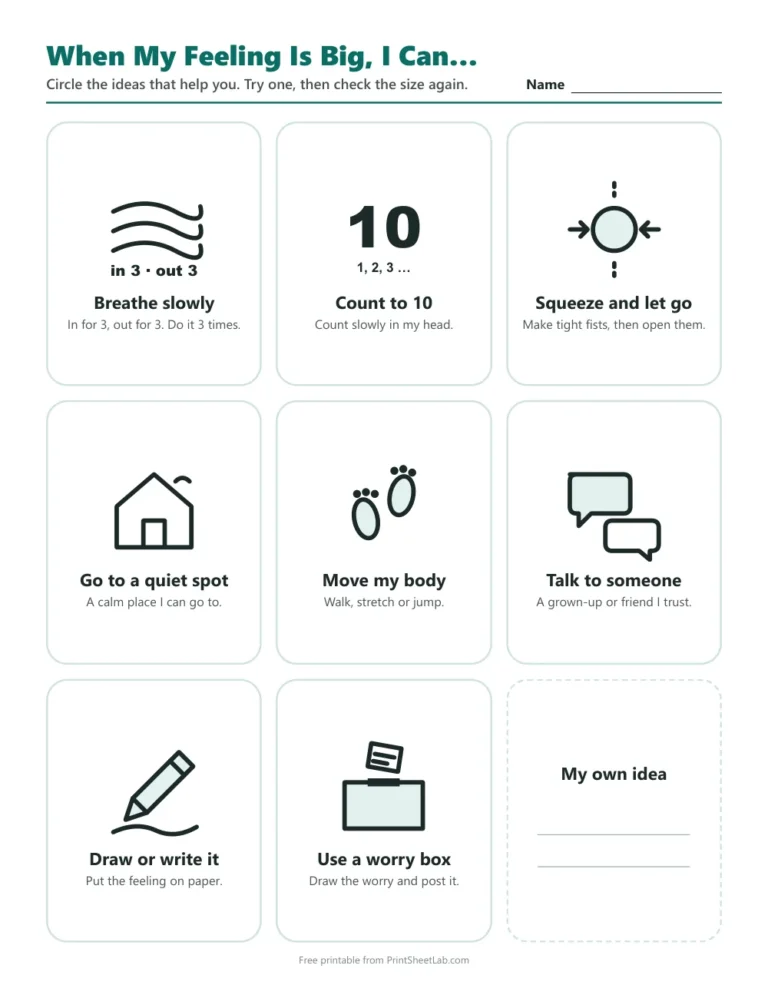
| Coping choices chart | 8 calm-down ideas and a blank | Ages 4 and up | Choose what to do next |
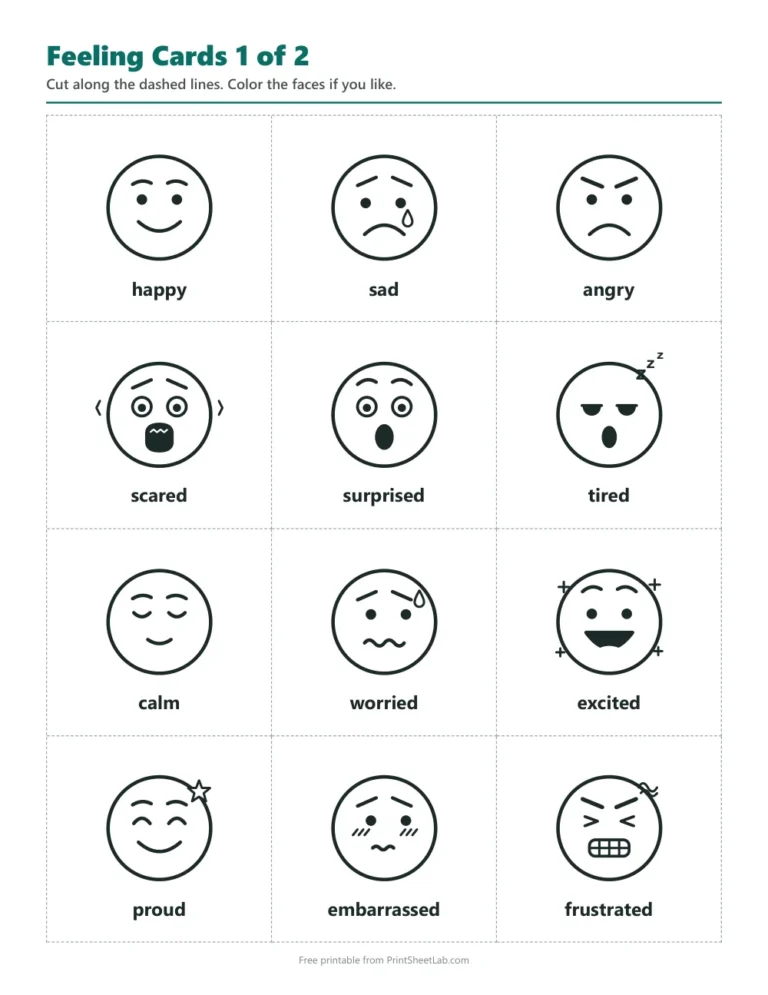
| Feeling cards | 24 faces with words, 12 to a page | Ages 3 to 10, groups | Games, sorting and charades |
The eight faces on the basic chart were chosen to cover the feelings young children meet every day, including tired and calm, two states that are easy to overlook. Hungry is not on the chart, so draw it on the back of a feeling card if it matters in your house.
How do you use a feelings chart?
You use a feelings chart in five short steps: point to a face, say the word, give it a size, choose what to do, then check again a few minutes later.
- Point. Ask “Which face looks like you right now?” and let the child choose. A guess is fine.
- Name it. Say the word together in a full sentence: “I feel worried.” Older children can add a reason: “I feel worried because the test is tomorrow.”
- Size it. Use the 1 to 5 scale. A 2 needs a different response from a 5.
- Choose. Pick one idea from the coping choices chart and try it.
- Check again. After a few minutes, ask for the number again. If it went from 4 to 2, say so: that is the child learning what works.
At home
Put the basic chart on the fridge or a bedroom door and use it at the same two times every day, such as after school and at bedtime, when there is time to talk. Name your own feelings on it too (“I am frustrated, I am at a 3, so I am going to take three slow breaths”). That way children hear the words used in real life.
In the classroom
For a morning check-in, enlarge the basic chart and let each student clip a clothespin or name magnet to a face. Some children may not want classmates to see a hard feeling, so offer the daily check-in sheet as a private option that only the teacher reads. Keep the coping choices chart in a calm corner so students can pick a strategy on their own.
With teens and adults
The words chart works for journaling, counseling waiting rooms and family meetings. Ask for two words instead of one, because people can feel two things at once: proud and nervous before a performance, or relieved and sad when something ends.
The feeling words chart, family by family
The words chart groups 48 feeling words into eight families, so a reader finds the family first and then the exact word. Here is the full list as text, which is handy for a word wall or spelling list. The feeling words chart groups similar emotions so children can find a more exact word.
| Family | Words on the chart |
|---|---|
| Happy | glad, cheerful, joyful, delighted, excited, grateful |
| Proud | confident, brave, capable, determined, hopeful, accomplished |
| Calm | relaxed, peaceful, content, safe, comfortable, settled |
| Surprised | amazed, startled, shocked, curious, puzzled, confused |
| Sad | unhappy, disappointed, lonely, hurt, gloomy, heartbroken |
| Angry | annoyed, irritated, frustrated, mad, jealous, furious |
| Scared | nervous, worried, anxious, uneasy, afraid, panicky |
| Embarrassed | shy, awkward, self-conscious, guilty, ashamed, humiliated |
Some words could sit in more than one family. Jealous is listed with angry, and confused with surprised, because that is how many children describe them, but there is no wrong answer if a child puts them somewhere else and can explain why.
How to read the faces
Each face on the basic chart shows its feeling with three changes: the eyebrows, the eyes and the mouth, plus one extra clue such as a tear or a sweat drop. Pointing these out turns the chart into a lesson in reading other people’s faces, and it is a good emotions chart for kids who are still learning that faces carry information. Each face on the feelings chart shows one clear emotion.
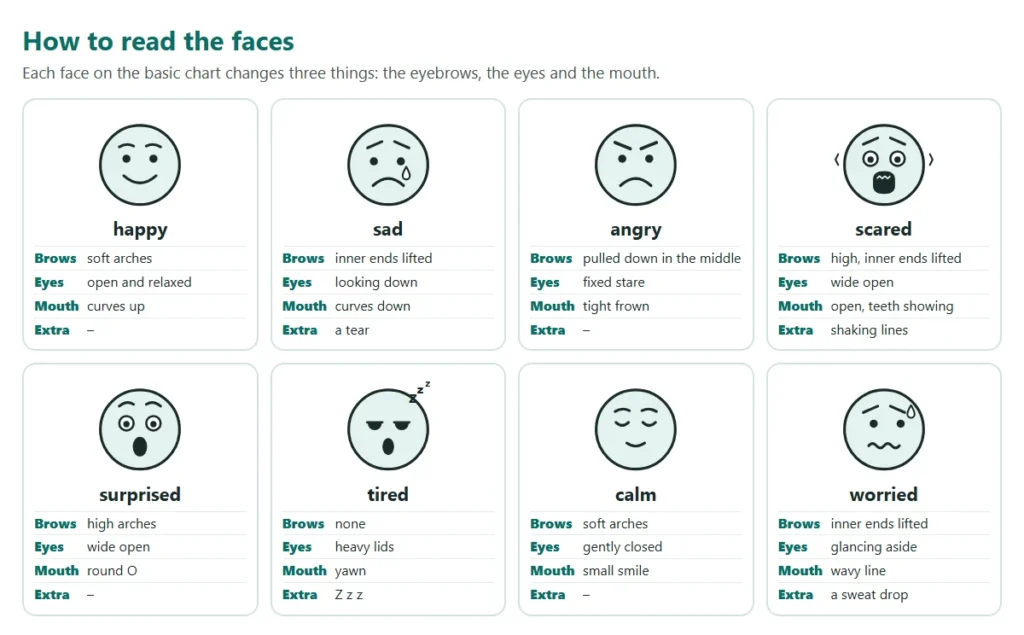
Sad and worried look alike in the eyebrows. The difference is in the mouth (a downturned curve or a wavy line) and the extra clue (a tear or a sweat drop). Ask children to spot it.
What does the 1 to 5 scale mean?
The 1 to 5 scale measures how big a feeling is, not whether it is good or bad. The words on the printable are a guide you can change for your child: The scale on the feelings chart shows how big a feeling is, not just which one it is.
| Number | Size | What it can look like |
|---|---|---|
| 1 | Tiny | I can notice it and keep doing what I was doing. |
| 2 | Small | I keep noticing it, and I can use a calm-down idea. |
| 3 | Medium | It is hard to think about anything else, but I can still talk about it. |
| 4 | Big | My body feels it a lot. I need a break or some help. |
| 5 | Huge | It is too big to handle on my own. I need a grown-up to help me right now. |
Each row has two lines for “What helps me at this number”. Fill them in on a calm day, not in the middle of a 5, so the plan is ready when it is needed.
Coping choices that go with the chart
The coping choices chart lists eight ideas, and each one comes from NHS advice for parents. The NHS page on helping your child with anger suggests counting to 10, breathing slowly and deeply, clenching and unclenching fists, talking to a trusted person, going to a private place to calm down and walking away. It also suggests that younger children give anger a name and try drawing it, and says staying active can be a way to reduce feelings of anger, which is where the “move my body” idea comes from. Keep the coping choices next to the feelings chart so children can pick a next step.
The NHS page on anxiety in children suggests three slow breaths in for a count of 3 and out for 3, and a “worry box” made from an empty tissue box, where a child writes or draws a worry and posts it for you to sort through together later. Both are on the chart.
- Body clues come first. The NHS lists early signs of anger such as a faster heartbeat, tense muscles, clenched teeth, a fist or a churning stomach. Noticing them early gives a child time to pick a choice.
- Say what you see. The same NHS page suggests that when you notice the early signs, you say so, which gives the child a chance to use a strategy.
- Leave the ninth box blank for the child’s own idea, such as hugging a pet or listening to one song.
Why naming feelings is worth practicing
Naming feelings is a skill that grows with practice, and education and health organizations treat it as part of normal development. CASEL describes five areas of social and emotional competence, and the first, self-awareness, includes identifying one’s emotions. Its second area, self-management, includes managing them. Using a feelings chart every day makes naming feelings a habit.
- The CDC says toddlers aged 2 to 3 should be able to express a wide range of emotions, and its positive parenting tips for toddlers include teaching acceptable ways to show they are upset.
- By age 2, most children notice when others are hurt or upset, according to the CDC’s milestones by 2 years. The CDC defines a milestone as something 75% or more of children can do by that age.
- By age 4, most children comfort others who are hurt or sad, such as hugging a crying friend (CDC milestones by 4 years).
- The NHS notes that when young children feel anxious, they cannot always understand or express what they are feeling. A chart gives them something to point to instead.
When to talk to a professional
A feelings chart is a teaching tool, not a test, and it cannot tell you whether a child needs help. Talk to your child’s doctor if a hard feeling is very strong, keeps going or gets in the way of everyday life.
- HealthyChildren.org, from the American Academy of Pediatrics, advises consulting your pediatrician if a two-year-old seems very passive or withdrawn, perpetually sad, or highly demanding and unsatisfied most of the time (Emotional Development: 2 Year Olds).
- The NHS says that if a child’s anxiety is severe, persists and interferes with everyday life, a GP is a good place to start, and to talk to the school if it is affecting school life.
- If anger seems harmful to the child or others, the NHS suggests talking to a GP, health visitor or school nurse.
Printing tips
- Print at 100% (actual size). All pages are black and white friendly, with a light tint behind the faces that prints as pale gray.
- Use cardstock for the feeling cards and laminate the basic chart and scale so children can mark them with a dry-erase pen.
- The cards are left white on purpose, so children can color each face in the color that feeling means to them.
- Print one check-in sheet a week and keep the old ones; looking back over a month can show a pattern, such as Mondays being hard.
Put the feelings chart somewhere easy to see, like the fridge or a classroom wall, so children can point to how they feel. Print the feelings chart on card or laminate it so it lasts on a wall or fridge.
Frequently asked questions
7 quick answers
What age are these charts for?
The basic 8-face chart suits children from about 3 to 7. The 48-word chart works from about age 8, once a child reads well, and it is just as useful for teens and adults.
Which feelings should a toddler learn first?
Start with a few common ones, such as happy, sad, angry and scared, and add the rest of the basic chart as your child starts using those words on their own.
Are these faces emojis?
No. Every face is an original line drawing made for PrintSheetLab, with no emoji designs or cartoon characters, so they can be colored in.
How do I use the 1 to 5 scale with a young child?
Point to the circles instead of the numbers: a tiny circle for a small feeling and a huge circle for a feeling that is too big to handle alone.
Can naming feelings help with tantrums?
It gives a child another way to show what they feel, and it works best when practiced on calm days first. During a tantrum, keep the child safe and save the chart for afterwards.
Is this a therapy tool?
No. It is a simple learning aid for home and school. It does not diagnose anything, and worries that are strong or do not go away are best discussed with a doctor.
How can an emotions chart for kids teach reading faces?
Each face shows its feeling through the eyebrows, the eyes and the mouth, plus one extra clue such as a tear or a sweat drop. Sad and worried look alike in the eyebrows, so children can spot the difference in the mouth and the clue.
More printables to use with the chart
- Feelings bingo: 24 emotion pictures on bingo cards, plus an online version that reads each one aloud
- Preschool worksheets for tracing and counting practice alongside the basic chart
- Printable paper: lined paper for a feelings journal using the word chart
- Printable calendars to mark one feeling word a day for a month
- Free worksheets and activity guides for parents
Sources
- What Is the CASEL Framework?, CASEL (the five competence areas; identifying and managing emotions)
- Positive Parenting Tips: Toddlers (2 to 3 years old), CDC
- Milestones by 2 Years and Milestones by 4 Years, CDC Learn the Signs. Act Early.
- Helping your child with anger issues and Anxiety in children, NHS
- Emotional Development: 2 Year Olds, HealthyChildren.org (American Academy of Pediatrics)
Did you like this?
Last updated: