Minimum wage by state in 2026 ranges from the federal $7.25 an hour in 20 states to $18.40 in Washington DC. Below is every state’s rate in effect now, the changes already set for 2027, and what a full-time minimum wage job pays per year before and after tax.
Minimum wage by state 2026
Rates in effect in late October 2026 for most adult, non-tipped workers. Full-time pay assumes 2,080 hours; after-tax pay is for a single filer with state tax and payroll programs.
| State | Hourly minimum | Notes | Full-time pay | After tax |
|---|---|---|---|---|
| Washington DC | $18.40 | $17.95 until June 30, 2026 | $38,272 | $31,801 |
| Washington | $17.13 | $17.73 on Jan. 1, 2027; some cities higher | $35,630 | $30,315 |
| Connecticut | $16.94 | – | $35,235 | $29,655 |
| California | $16.90 | – | $35,152 | $29,572 |
| Hawaii | $16.00 | – | $33,280 | $27,886 |
| New York | $16.00 | $17.00 in NYC, Long Island and Westchester | $33,280 | $27,545 |
| Rhode Island | $16.00 | – | $33,280 | $27,923 |
| New Jersey | $15.92 | $15.23 for small and seasonal employers | $33,114 | $28,015 |
| Oregon | $15.55 | $16.80 Portland metro, $14.55 nonurban | $32,344 | $26,094 |
| Colorado | $15.16 | Denver and some cities higher | $31,533 | $26,699 |
| Arizona | $15.15 | – | $31,512 | $27,106 |
| Maine | $15.10 | – | $31,408 | $26,656 |
| Delaware | $15.00 | – | $31,200 | $26,070 |
| Florida | $15.00 | $14.00 until Sept. 29, 2026 | $31,200 | $27,249 |
| Illinois | $15.00 | – | $31,200 | $25,850 |
| Maryland | $15.00 | – | $31,200 | $26,133 |
| Massachusetts | $15.00 | – | $31,200 | $25,766 |
| Missouri | $15.00 | Some small retail and service firms exempt | $31,200 | $26,739 |
| Nebraska | $15.00 | Employers with 4+ employees | $31,200 | $26,684 |
| Vermont | $14.42 | – | $29,994 | $25,709 |
| Alaska | $14.00 | $13.00 until June 30, 2026 | $29,120 | $25,432 |
| Michigan | $13.73 | $15.00 on Jan. 1, 2027 | $28,558 | $24,164 |
| Virginia | $12.77 | $13.75 on Jan. 1, 2027 | $26,562 | $22,769 |
| Nevada | $12.00 | – | $24,960 | $22,165 |
| New Mexico | $12.00 | Some cities higher | $24,960 | $21,967 |
| South Dakota | $11.85 | $12.30 on Jan. 1, 2027 | $24,648 | $21,908 |
| Minnesota | $11.41 | – | $23,733 | $20,598 |
| Arkansas | $11.00 | Employers with 4+ employees | $22,880 | $19,772 |
| Ohio | $11.00 | Employers with $405,000+ in sales | $22,880 | $20,452 |
| Montana | $10.85 | Firms with sales over $110,000 | $22,568 | $19,891 |
| West Virginia | $8.75 | Employers with 6+ employees | $18,200 | $16,212 |
| Alabama | $7.25 | No state law | $15,080 | $13,437 |
| Georgia | $7.25 | State $5.15; federal $7.25 for most jobs | $15,080 | $13,922 |
| Idaho | $7.25 | – | $15,080 | $13,926 |
| Indiana | $7.25 | – | $15,080 | $13,511 |
| Iowa | $7.25 | – | $15,080 | $13,926 |
| Kansas | $7.25 | – | $15,080 | $13,806 |
| Kentucky | $7.25 | – | $15,080 | $13,516 |
| Louisiana | $7.25 | No state law | $15,080 | $13,860 |
| Mississippi | $7.25 | No state law | $15,080 | $13,926 |
| New Hampshire | $7.25 | – | $15,080 | $13,926 |
| North Carolina | $7.25 | – | $15,080 | $13,833 |
| North Dakota | $7.25 | – | $15,080 | $13,926 |
| Oklahoma | $7.25 | – | $15,080 | $13,793 |
| Pennsylvania | $7.25 | – | $15,080 | $13,453 |
| South Carolina | $7.25 | No state law | $15,080 | $13,925 |
| Tennessee | $7.25 | No state law | $15,080 | $13,926 |
| Texas | $7.25 | – | $15,080 | $13,926 |
| Utah | $7.25 | – | $15,080 | $13,926 |
| Wisconsin | $7.25 | – | $15,080 | $13,912 |
| Wyoming | $7.25 | State $5.15; federal $7.25 for most jobs | $15,080 | $13,926 |
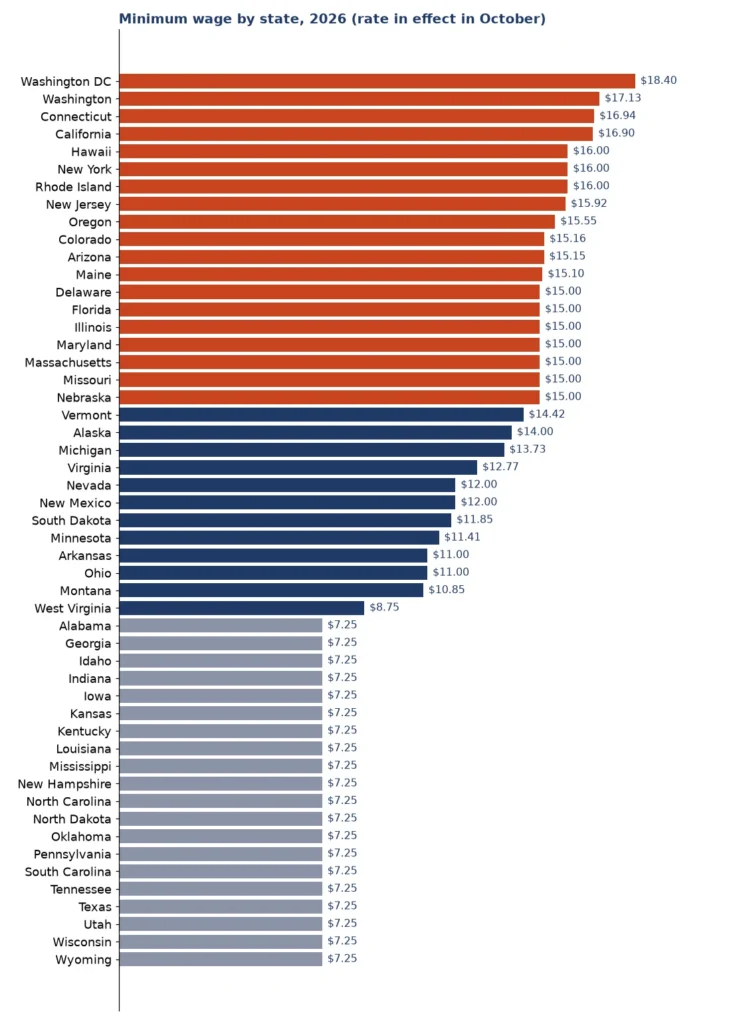
The federal minimum wage is still .25
The federal minimum has been $7.25 since July 24, 2009. It applies wherever a state’s rate is lower or there is no state law, as in Alabama, Louisiana, Mississippi, South Carolina and Tennessee, and Georgia and Wyoming, whose state minimum is $5.15. Full time, $7.25 is $15,080 a year; because the standard deduction is $16,100, there is no federal income tax, and take-home is $13,926 after Social Security and Medicare.
States with the highest minimum wage
- Washington DC: $18.40 an hour, $38,272 a year full time ($17.95 until June 30, 2026).
- Washington: $17.13 an hour, $35,630 a year full time ($17.73 on Jan. 1, 2027; some cities higher).
- Connecticut: $16.94 an hour, $35,235 a year full time.
- California: $16.90 an hour, $35,152 a year full time.
- Hawaii: $16.00 an hour, $33,280 a year full time.
- New York: $16.00 an hour, $33,280 a year full time ($17.00 in NYC, Long Island and Westchester).
Many cities set their own higher minimum, for example Denver, Seattle and several California cities, and New York’s rate is $17.00 in New York City, Long Island and Westchester.
Minimum wage increases already set for 2027
- Michigan: $13.73 to $15.00 on January 1, 2027.
- Virginia: $12.77 to $13.75 on January 1, 2027.
- South Dakota: $11.85 to $12.30 on January 1, 2027.
- Washington: $17.13 to $17.73 on January 1, 2027.
- Several other states (such as Arizona, California, Colorado, Connecticut, Maine, Minnesota, Montana, New Jersey, Ohio and Vermont) adjust for inflation each January; their 2027 rates are announced in the autumn.
Because state minimum wages change most often on January 1 and July 1, check the table again after those dates.
Who can be paid less than the minimum wage
- Tipped workers: under federal law, employers may pay a cash wage of $2.13 if tips bring the total to at least $7.25; many states set a higher tipped wage or none at all.
- Young workers: a federal youth wage of $4.25 is allowed for workers under 20 for their first 90 days.
- Small employers: some state minimums apply only above a set number of employees or level of sales, as noted in the table; the federal minimum still applies to businesses it covers.
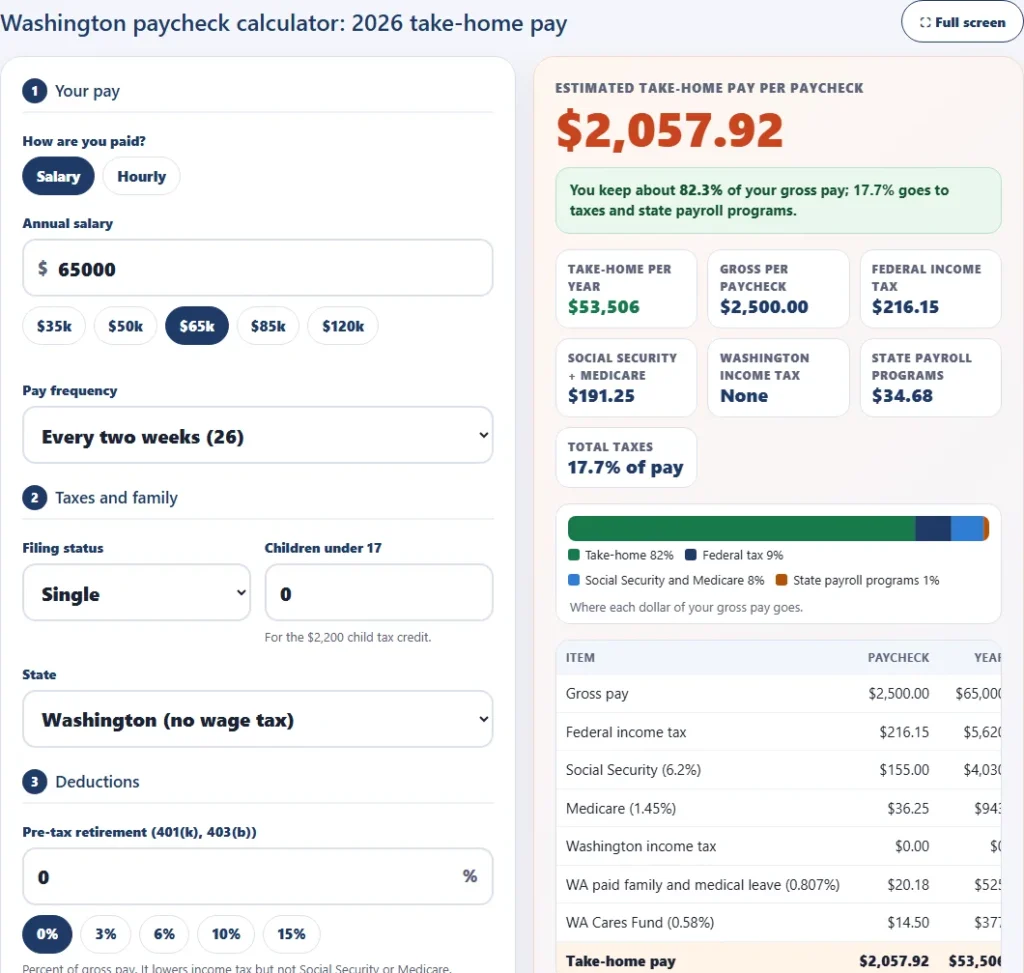
These are estimates for planning, using 2026 rules. Your employer’s payroll system, your W-4 and your tax return decide the real figures. This is general information, not tax advice.
Related calculators and guides
- Hourly to salary calculator
- all 51 state paycheck calculators
- $20 an hour after taxes
- Overtime calculator
Sources
- State minimum wage laws (U.S. Department of Labor): state rates as updated July 1, 2026
- Federal minimum wage (U.S. Department of Labor)
- Minimum wages for tipped employees (U.S. Department of Labor)
- DC Department of Employment Services
- FloridaCommerce minimum wage notice
- Wage and Hour (Alaska Department of Labor)
- Minimum wage schedule (Oregon BOLI)
- Minimum wage (Washington L&I)
Frequently asked questions
5 quick answers
What is the minimum wage by state in 2026?
From $7.25 (the federal minimum) in 20 states to $18.40 in Washington DC. See the table for every state.
Which state has the highest minimum wage in 2026?
Washington DC at $18.40 an hour. Among the 50 states, Washington is highest at $17.13, followed by Connecticut ($16.94) and California ($16.90).
Which states have a $7.25 minimum wage?
Alabama, Georgia, Idaho, Indiana, Iowa, Kansas, Kentucky, Louisiana, Mississippi, New Hampshire, North Carolina, North Dakota, Oklahoma, Pennsylvania, South Carolina, Tennessee, Texas, Utah, Wisconsin, Wyoming.
How much is minimum wage a year full time?
At $7.25 it is $15,080; at $15 it is $31,200; at $17.13 (Washington) it is $35,630, before tax.
Is the federal minimum wage going up?
No federal increase is scheduled; it has been $7.25 since 2009. State increases are listed above.
Did you like this?
Last updated: