Mortgage recast vs refinance: a recast lowers your payment by re-spreading a lump-sum payment over the years you have left, while a refinance replaces the loan with a new rate and term. A recast keeps your rate and costs a small fee; a refinance can cut your rate but comes with full closing costs. Which one saves more depends on your rate and on how much cash you can put down.

Mortgage recast vs refinance at a glance
| Recast | Refinance | |
|---|---|---|
| What changes | Balance and payment | Rate, term, payment, sometimes the lender |
| Interest rate | Stays the same | New rate |
| Payoff date | Stays the same | New term starts |
| Cost | A servicer fee, often a few hundred dollars | Closing costs, often thousands |
| Credit check and appraisal | Usually not needed | Usually needed |
| Needs a lump sum | Yes, often a minimum such as $5,000 or $10,000 | No |
What is a mortgage recast?
In a recast (also called re-amortization), you pay a lump sum toward principal and ask your servicer to recalculate the payment over the remaining term. The rate and payoff date stay the same; only the balance and the monthly payment go down. Servicers are not required to offer recasts, and many set a minimum lump sum and charge a flat fee. Loans backed by FHA, VA or USDA generally cannot be recast, so ask your servicer what applies to your loan.
Mortgage recast vs refinance: one loan, five choices
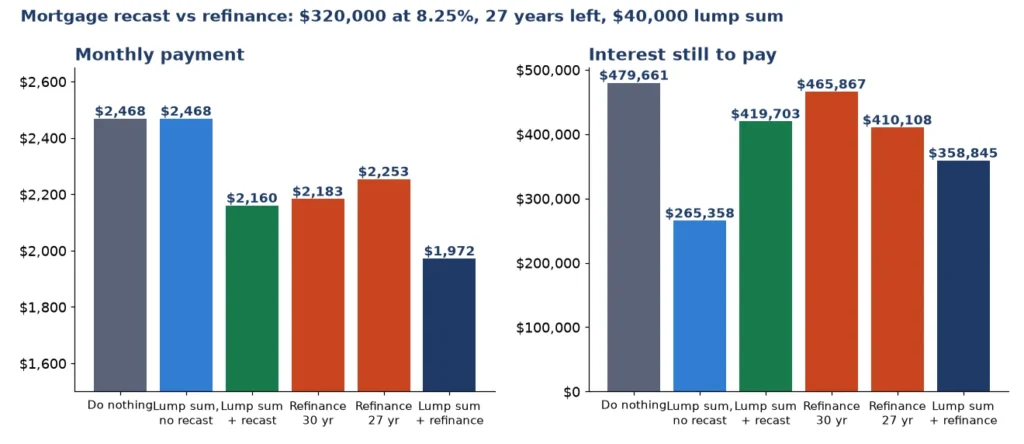
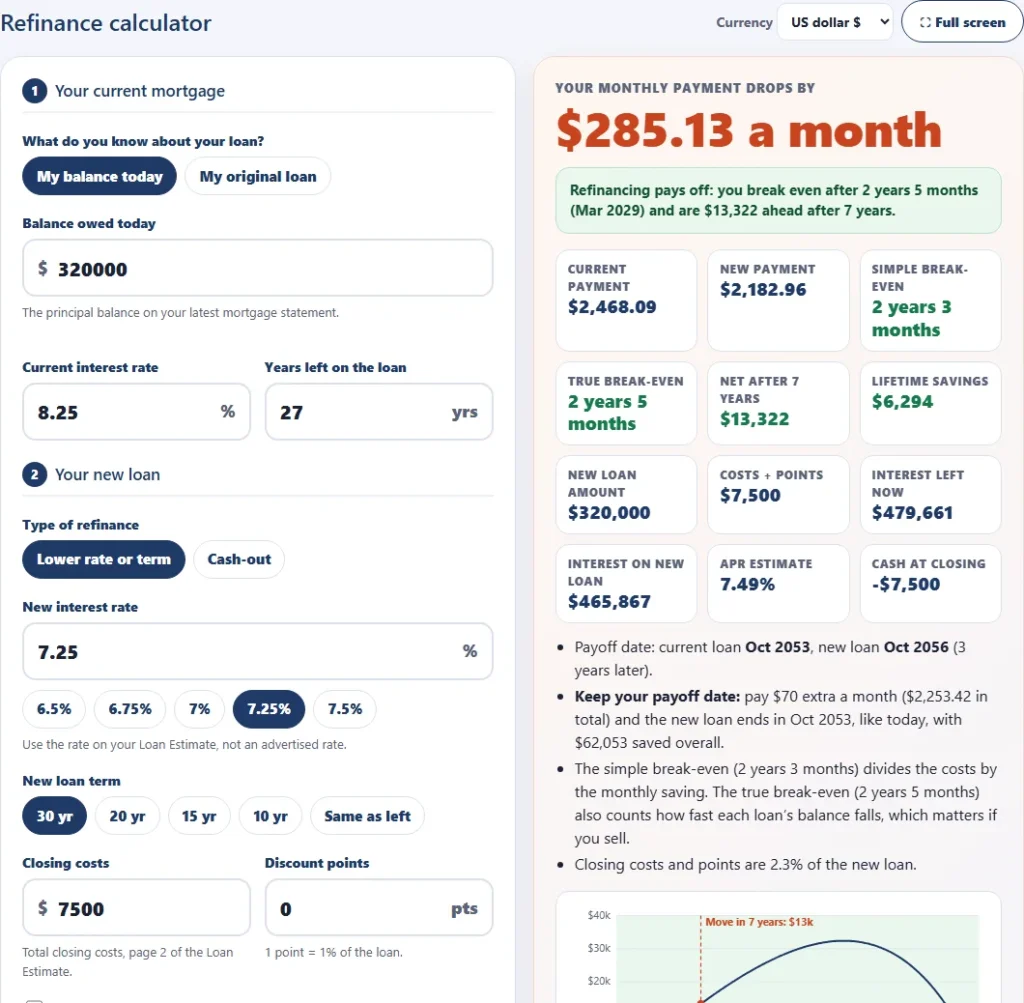
Take a $320,000 balance at 8.25% with 27 years left. The payment is $2,468.09 and the interest still to pay is $479,661. You have $40,000 in savings, and a lender quotes 7.25% with $7,500 in closing costs. We assume a $250 recast fee as an example; check yours.
| Choice | Monthly payment | Paid off in | Interest still to pay | Upfront cost |
|---|---|---|---|---|
| Do nothing | $2,468.09 | 27 years | $479,661 | $0 |
| Pay $40,000, no recast | $2,468.09 (same) | 18 years 5 months | $265,358 | $40,000 |
| Pay $40,000 and recast | $2,159.58 | 27 years | $419,703 | $40,250 |
| Refinance, 30 years | $2,182.96 | 30 years | $465,867 | $7,500 |
| Refinance, keep 27 years | $2,253.42 | 27 years | $410,108 | $7,500 |
| Pay $40,000, then refinance (27 years) | $1,971.74 | 27 years | $358,845 | $47,500 |
What the numbers show
- The recast lowers the payment by $308.51 a month for a $250 fee, and cuts the interest by $59,958. It is the cheapest way to get a lower payment if you have the cash.
- Paying the lump sum without a recast saves the most interest ($214,303 less than doing nothing), because your payment stays the same and the loan ends 8 years 7 months early. Choose this if you can afford the current payment.
- Refinancing to 7.25% on the same 27 years lowers the payment by $214.67 and saves $69,553 in interest without using your savings, but costs $7,500 at closing.
- A 30-year refinance gives the lowest payment with no lump sum, but the extra three years leave you with more interest than the shorter options.
- Lump sum plus refinance gives the lowest payment of all ($1,971.74), because the lower rate and the lower balance work together, but it uses both your $40,000 and the closing costs.
When to recast your mortgage instead of refinancing
A recast mortgage keeps everything you like about your loan and changes only the payment. It tends to win the comparison when:
- Your rate is already low or close to today’s rates, so refinancing would not cut it much.
- You have received a lump sum, such as a bonus, an inheritance or the sale of a previous home, and want a smaller payment.
- You want to avoid closing costs, a credit check and an appraisal.
- Your loan is conventional and your servicer offers recasts.
When to refinance instead
- Today’s rates are well below yours. The refinance calculator shows the break-even month and lifetime savings.
- You do not have a lump sum, or want to keep your savings for emergencies.
- You want to change the term (for example to 15 years), remove a co-borrower, or switch from an adjustable rate.
- Your loan is FHA, VA or USDA and cannot be recast.
How to recast a mortgage with your servicer
- Call or message your mortgage servicer (the company you pay each month) and ask whether your loan can be recast.
- Ask for the minimum lump sum, the fee and how long it takes to see the new payment.
- Get the new payment in writing before you send the money.
- Make the principal payment the way the servicer tells you, so it is applied to principal and not to future payments.
- Check your next statement: the balance should drop by the lump sum and the payment should be lower.
Before you decide on recast vs refinance, ask a lender for a refinance Loan Estimate too, and compare both on our free refinance comparison worksheet.

This guide explains the math for planning. It is general information, not financial advice; your lender’s documents give the real figures.
Related calculators and guides
- Refinance calculator with extra payments and break-even
- Mortgage calculator
- Loan calculator to test any balance, rate and term
- Cash-out refinance vs HELOC
- How to read a Loan Estimate
Sources
- What is a mortgage recast? (PNC Bank): how a recast works, fees and eligibility (ask your own servicer for its rules)
- A Consumer’s Guide to Mortgage Refinancings (Federal Reserve Board): refinancing costs and the break-even worksheet
- Primary Mortgage Market Survey (Freddie Mac): average rates (30-year 7.40% on October 15, 2026)
Run your own numbers with the mortgage recast calculator.
Frequently asked questions
5 quick answers
Is it better to recast or refinance?
In most cases, recast when your rate is already good and you have a lump sum, because it is cheap and fast. Refinance when today’s rates are clearly lower than yours, or when you have no lump sum to put down.
How much does a mortgage recast lower the payment?
In the example, a $40,000 lump sum on a $320,000 loan at 8.25% with 27 years left lowers the payment by $308.51 a month, from $2,468.09 to $2,159.58.
Does a recast change my interest rate?
No. A recast keeps the same rate and payoff date. Only the balance and the monthly payment change.
Can every mortgage be recast?
No. Servicers decide whether to offer recasts, and loans backed by FHA, VA or USDA generally cannot be recast. Ask your servicer.
Is paying extra better than recasting?
If you can afford your current payment, paying the lump sum without a recast saves more interest because the loan ends early. A recast is for when you want the lower monthly payment.
Did you like this?
Last updated: