These Bhai Dooj rangoli designs go from a simple 8-petal flower that a child can make in 15 minutes to a big mandala for the doorway, each with easy step-by-step instructions. Bhai Dooj 2026 is on Wednesday 11 November, so you can practise a design on paper first and make it on the floor on the morning of the tilak. Every Bhai Dooj rangoli here uses colours and shapes you can find at home.

Every rangoli on this page was designed for Bhai Dooj: there are diyas for the evening aarti, an aarti thali design, and a heart with two lamps for a brother and a sister. Start with the easy designs if you are new to rangoli, or if children are helping.
Coming up next: Diwali, Bhai Dooj, Children's Day, Chhath Puja and Guru Nanak Jayanti
Diwali (Sunday 8 November)
Bhai Dooj (Wednesday 11 November)
Children's Day (Saturday 14 November)
- Children's Day quiz
- Children's Day drawing and coloring pages
- Children's Day worksheets
- Children's Day speech
Chhath Puja (Sunday 15 November)
- Chhath Puja quiz
- Chhath Puja drawing and coloring pages
- Chhath Puja wishes
- Why Chhath Puja is celebrated
Guru Nanak Jayanti (Tuesday 24 November)
The six Bhai Dooj rangoli designs at a glance
| Design | Level | Time | Size | Colours |
|---|---|---|---|---|
| 1. Flower with a diya | Easy | 15 to 20 minutes | About 45 cm | 7 plus white |
| 2. Star flower | Easy | 20 to 30 minutes | About 50 cm | 5 |
| 3. Heart with two diyas | Medium | 30 to 40 minutes | About 60 cm | 5 plus flower petals |
| 4. Aarti thali rangoli | Medium | 40 to 50 minutes | About 70 cm | 7 plus a real thali or petals |
| 5. Peacock rangoli | Medium to hard | About 1 hour | About 75 cm | 8 |
| 6. Mandala with diyas | Harder | 1 to 1.5 hours | About 90 cm | 8 plus white |
What you need
- Rangoli powder in a few bright colours, plus white for outlines and dots. Small packets from a local shop are enough for one design.
- Chalk or a pencil to sketch the outline on the floor first.
- Household helpers: a bowl or plate to trace circles, a ruler or a long piece of string for straight lines, and a spoon or a paper cone for fine lines.
- Diyas and flowers (optional): small clay diyas, marigold and rose petals.
- Natural colours (optional): rice flour for white, turmeric for yellow, kumkum for red and dried leaf powder for green.
Easy Bhai Dooj rangoli designs
1. Simple flower rangoli with a diya (easy)
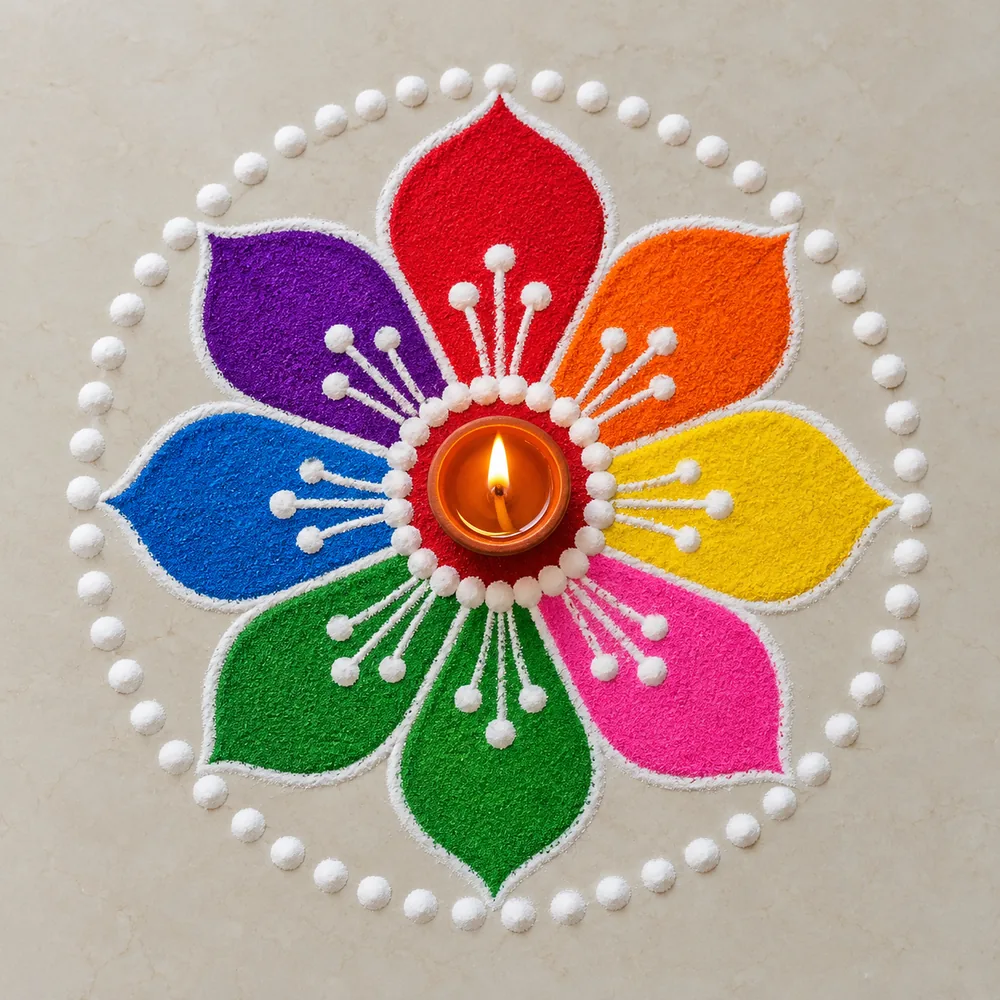
- Draw a small circle (about 8 cm) in the centre with chalk.
- Draw 8 rounded petals around it: first top, bottom, left and right, then one between each pair.
- Fill each petal with a different colour: red, orange, yellow, pink, green, blue and purple, using one colour twice.
- Draw thin white lines from the centre into each petal, like rays, and add a white dot at the end of each line.
- Make a ring of white dots around the whole flower, then place a lit diya in the centre.
Tip: This is the best simple design for children. Pour the powder from a folded piece of paper so it comes out in a thin line.
2. Star flower rangoli (easy)
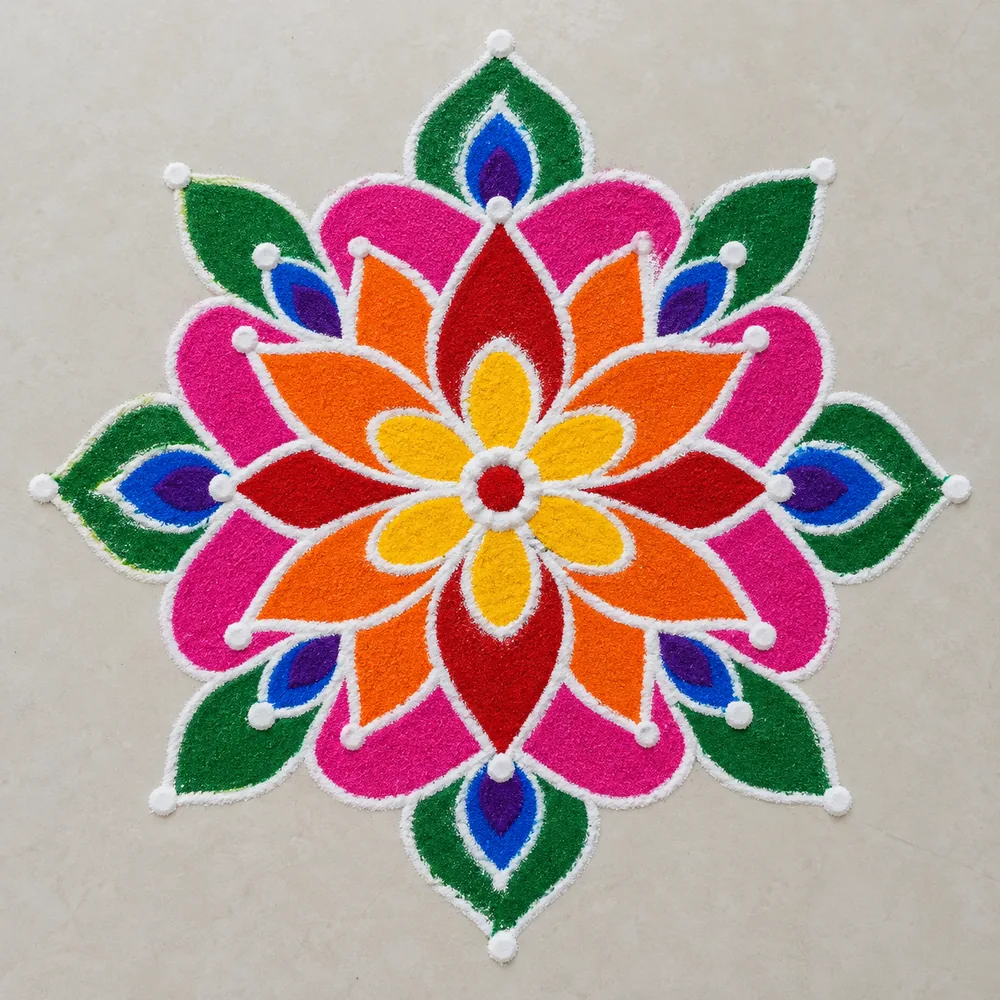
- Draw a small flower with 6 petals in the centre and fill it with yellow.
- Around it draw a second ring of 8 pointed petals in orange.
- Draw a third ring of 8 bigger pointed petals in pink, with red tips in between.
- Add 8 leaf shapes on the outside in green, each with a small blue petal inside.
- Outline every layer with a thin white line so the colours stay neat.
Tip: Keep the petal count the same in every ring (8) so the design looks balanced.
Bhai Dooj rangoli designs with a meaning
3. Heart rangoli with two diyas for a brother and a sister (medium)

- Draw a large heart outline with chalk.
- Fill a thick band around the heart with marigold petals (orange and yellow), then an inner band of red rose petals.
- Inside the heart, place two diyas side by side, one for the brother and one for the sister, on a small patch of blue and green colour.
- Add swirls and small flowers in purple, pink and green on the outside of the heart.
- Light the diyas just before the tilak.
Tip: Fresh petals wilt in a few hours, so add them on the morning of Bhai Dooj and make the powder part the night before.
4. Aarti thali rangoli (medium)
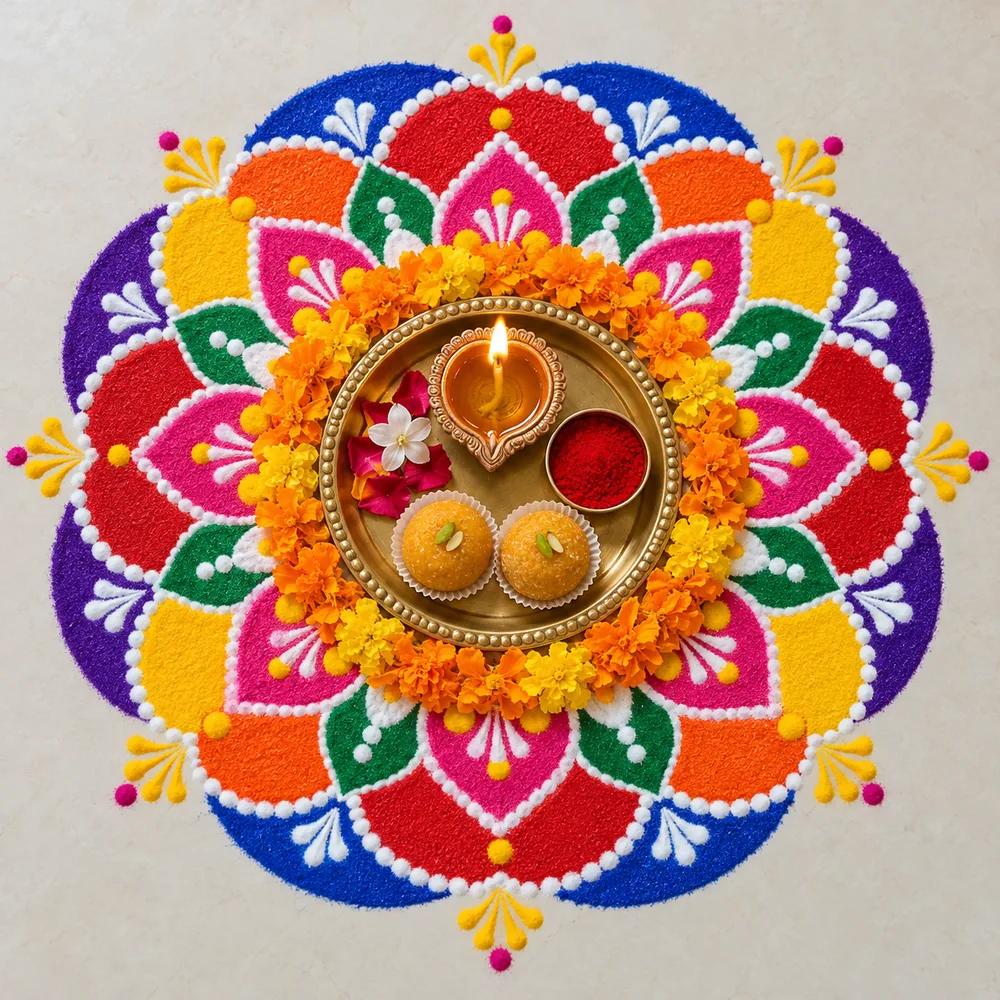
- Trace a circle the size of your aarti thali in the centre.
- Around it, make a ring of marigold petals or orange and yellow powder.
- Draw 8 large petals around the ring in red, then smaller pointed petals between them in pink and purple.
- Add an outer layer of yellow and blue petal tips and white dots.
- Place the real aarti thali in the centre with the diya, roli, rice and sweets, ready for the tilak.
Tip: This design doubles as the place where the brother sits for the tilak, so make it near a low seat or chowki.
Designs for experienced hands
5. Peacock rangoli (medium to hard)
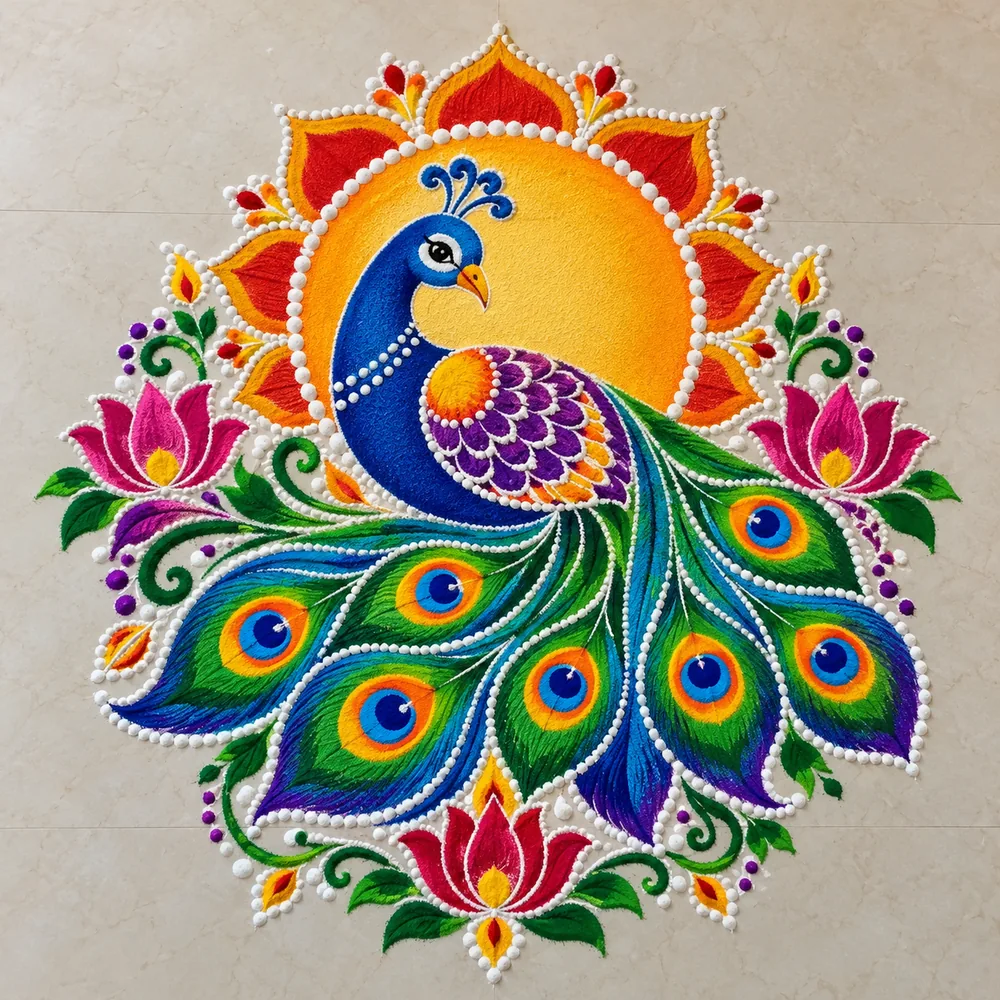
- Sketch a big circle (the sun) at the top, then the peacock’s body and neck as a long S-shape in front of it.
- Draw the tail as five or six long feathers fanning down and out, each ending in an “eye”.
- Fill the body and neck with royal blue, the feathers with green, and each eye with blue, green and yellow rings.
- Add pink lotus flowers and green leaves at the bottom on both sides.
- Outline the feathers with white dots to make them stand out.
Tip: Practise the feather shape on paper first. Our rangoli coloring pages are a good way to try colours before using powder.
6. Big mandala rangoli with diyas (harder)
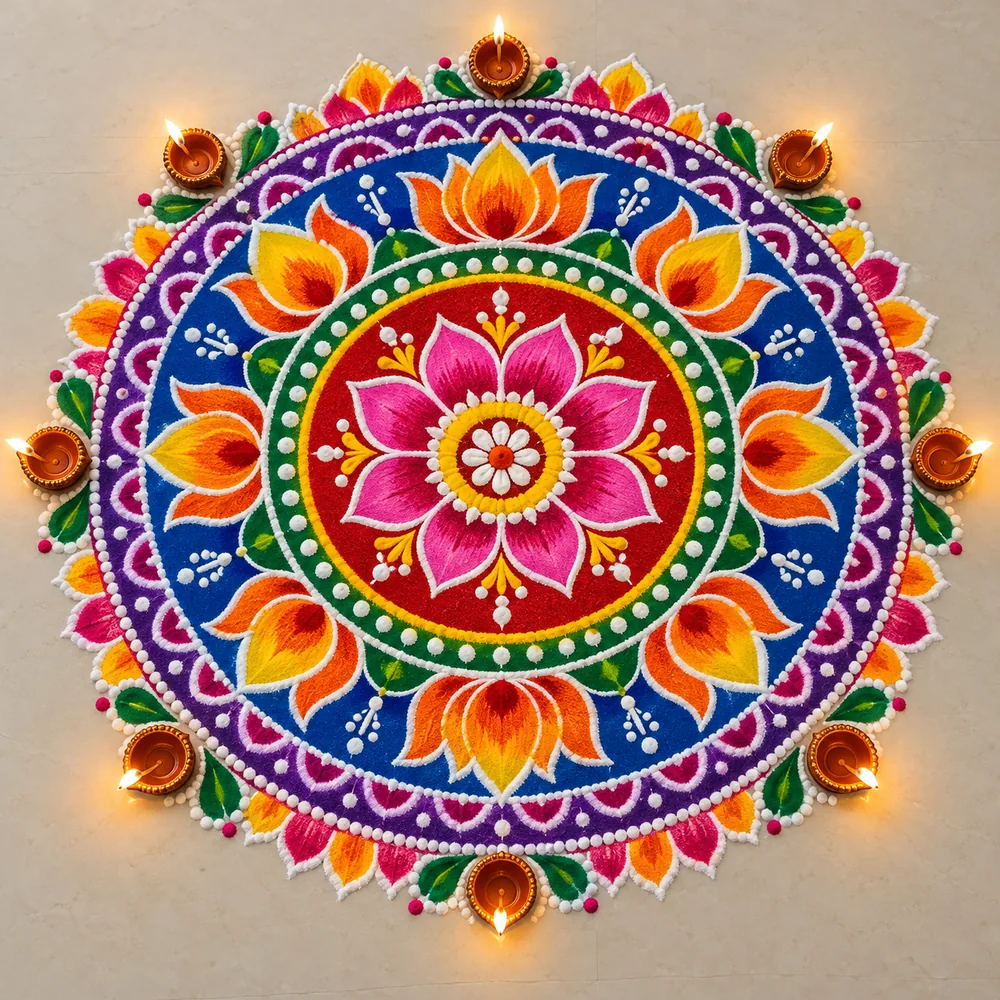
- Tie a piece of chalk to a string and draw four circles from the same centre: about 15, 30, 45 and 60 cm across.
- Fill the centre with a pink lotus and the next ring with a band of green, then a ring of orange petals.
- In the next band, draw large yellow and orange lotus petals with red tips.
- Make the outer band in dark blue with white dots and small shapes in each section.
- Place 8 lit diyas evenly around the edge.
Tip: Work from the centre outwards so you never have to lean over finished parts.
A simple Bhai Dooj rangoli for a busy morning
If the tilak is early and you have only 15 minutes, keep it simple: design 1 or 2 above, about 45 cm across, in two or three colors. The rangoli does not need to be large; a neat small flower with one diya at the doorway looks festive and is easy to sweep away the next day.
- 5 minutes: a circle of marigold petals with a diya in the middle.
- 15 minutes: the 8-petal flower (design 1) in two colors.
- 30 minutes: the heart with two diyas (design 3), one diya for the brother and one for the sister.
Tips for a neat rangoli
- Clean and dry the floor first. Powder will not hold on a damp or dusty floor.
- Sketch before you colour. Chalk lines can be wiped away; powder is harder to fix.
- Fill first, outline last. Fill shapes with colour, then add the white outlines and dots.
- Use a paper cone for fine lines: roll a square of paper into a cone and snip a tiny hole at the tip.
- Keep diyas safe. Leave space around the flames and keep dupattas, curtains and small children away from lit diyas.
- Where to make it: at the main door to welcome the brother, or around the spot where the tilak will be done.
Making a Bhai Dooj rangoli with kids
Children can make design 1 almost on their own: an adult draws the outline, and the child fills the petals. For younger children, try a paper rangoli first. Print a design from our Bhai Dooj coloring pages (page 3 is a rangoli) and colour it with crayons, or glue on coloured salt or rice instead of powder. It also makes a lovely card to give with a wish from our Bhai Dooj wishes.
Take a photo of your finished Bhai Dooj rangoli before the evening tilak, when the colours and diyas look their brightest.
Related guides and printables
- Bhai Dooj drawing and coloring pages
- Rangoli coloring pages: 8 designs to colour
- Bhai Dooj wishes for brother and sister
- Bhai Dooj gift ideas
- Bhai Dooj quiz and games
- Diwali activities for kids
Sources
- Bhai Dooj 2026 date: Drik Panchang, Bhai Dooj date and time (Wednesday 11 November 2026, New Delhi)
- Rangoli (Wikipedia), for materials and the custom of welcome designs at the doorway
- Bhai Dooj (Wikipedia), for the festival itself
Frequently asked questions
9 quick answers
What is an easy Bhai Dooj rangoli design?
The 8-petal flower with a diya in the centre (design 1). It needs one chalk circle, eight petals and a ring of dots, and takes about 15 to 20 minutes.
When is Bhai Dooj in 2026?
Wednesday 11 November 2026, three days after Diwali, according to Drik Panchang.
Where should I make the Bhai Dooj rangoli?
At the main entrance to welcome the brother, or around the place where the tilak and aarti will be done.
How can I make rangoli without colour powder?
Use rice flour for white, turmeric for yellow, kumkum for red, and flower petals such as marigold and rose. Coloured salt or rice also works well.
Which colours are best for a Bhai Dooj rangoli?
Bright festive colours such as red, orange, yellow and pink, with green and blue for contrast and white for outlines. Orange marigolds and lit diyas suit the evening aarti.
How do I keep a rangoli neat?
Sketch the outline in chalk, fill the shapes first, add outlines last, and pour powder from a paper cone for thin, even lines.
Which designs suit a small doorway?
Designs 1, 2 and 3 fit a doorway about 1 metre wide. A round rangoli of 45 to 60 cm leaves room to walk in and still frames the entrance where the sister welcomes her brother.
Can a child make the rangoli alone?
Yes, with the simple designs. A child of six or seven can make design 1 with petals or colored rice in about 15 minutes. An adult can draw the chalk outline first so the rangoli stays even.
Is there an easy rangoli for Bhai Dooj on a busy morning?
Yes. With 15 minutes, make the 8-petal flower in two colours, about 45 cm across. With only five minutes, a circle of marigold petals with a diya in the middle still looks festive at the doorway.
Did you like this?
Last updated: