Cash-out refinance vs HELOC comes down to one question: what rate is on your current mortgage? If your first mortgage has a low rate, a HELOC usually costs less because it leaves that rate alone. If your rate is higher than today’s, a cash-out refinance can lower the rate on everything you owe and still give you the cash.
Cash-out refinance vs HELOC at a glance
| Cash-out refinance | HELOC | |
|---|---|---|
| What it is | A new, bigger first mortgage; you get the difference in cash | A second loan, a line of credit you draw on |
| Your current mortgage | Paid off and replaced | Stays as it is |
| Interest rate | Usually fixed | Usually variable, tied to the prime rate |
| Closing costs | Full refinance costs, often thousands of dollars | Usually lower; ask each lender |
| Paperwork you get | A Loan Estimate | Truth-in-Lending disclosures (no Loan Estimate) |
| Best when | Your current rate is higher than today’s rates | Your current rate is low, or you need the money in stages |
How a cash-out refinance works
A cash-out refinance pays off your mortgage with a new, larger loan. If you owe $250,000 and take $50,000 out, the new loan is $300,000 and you receive $50,000 at closing, minus any costs you choose to pay from it. The new loan has a new rate and a new term, usually fixed, and you pay full closing costs, just like any refinance.
How a HELOC works
A home equity line of credit is a second loan secured by your home. You get a credit limit and borrow what you need, when you need it. The draw period typically lasts 10 years; after it ends, a repayment period begins. Most HELOCs have a variable rate that moves with the prime rate, which the Federal Reserve’s H.15 release shows at 7.00% in October 2026. Lenders add a margin to it, so your HELOC rate depends on your credit and the lender. Our HELOC calculator shows how much you could borrow.
Example 1: a low-rate mortgage
Say you owe $250,000 at 3.25% with 25 years left, so your payment is $1,218.29 a month. You need $50,000 for a renovation. Here are the two options, using a 7.25% cash-out rate with $7,500 in closing costs, and a HELOC at 8.00% (prime plus 1 point, as an example) repaid over 10 years with a $500 fee.
| Cash-out refinance | HELOC | |
|---|---|---|
| New loan | $300,000 at 7.25%, 30 years | $50,000 at 8.00%, repaid over 10 years |
| Monthly payment | $2,046.53 (replaces $1,218.29) | $1,218.29 + $606.64 = $1,824.93 |
| Payment change | +$828.24 a month for 30 years | +$606.64 a month for 10 years |
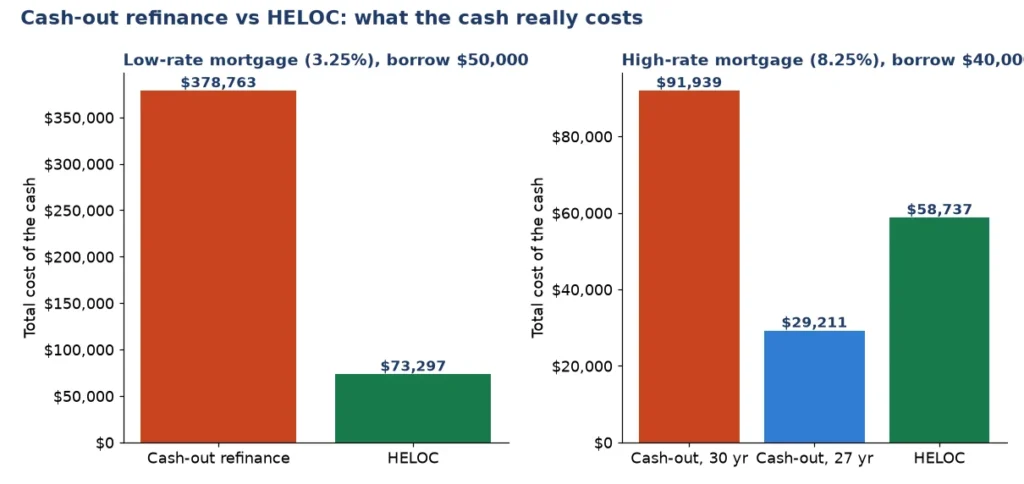
| Total cost of the $50,000* | $378,763 | $73,297 |
*Total cost of the $50,000 means everything you pay because you borrowed it: for the cash-out refinance, the new loan’s payments plus closing costs, minus what you would have paid on the old loan anyway; for the HELOC, its payments plus the fee. Both figures include paying back the $50,000 itself.
In this example the HELOC wins by about $305,467, because the cash-out refinance would raise the rate on the $250,000 you already owe from 3.25% to 7.25%. The risk is the variable rate: if the HELOC rate rose 2 points to 10%, its payment would go from $606.64 to about $660.75 a month. That is still far cheaper here than giving up a 3.25% mortgage.
Example 2: a mortgage rate higher than today’s
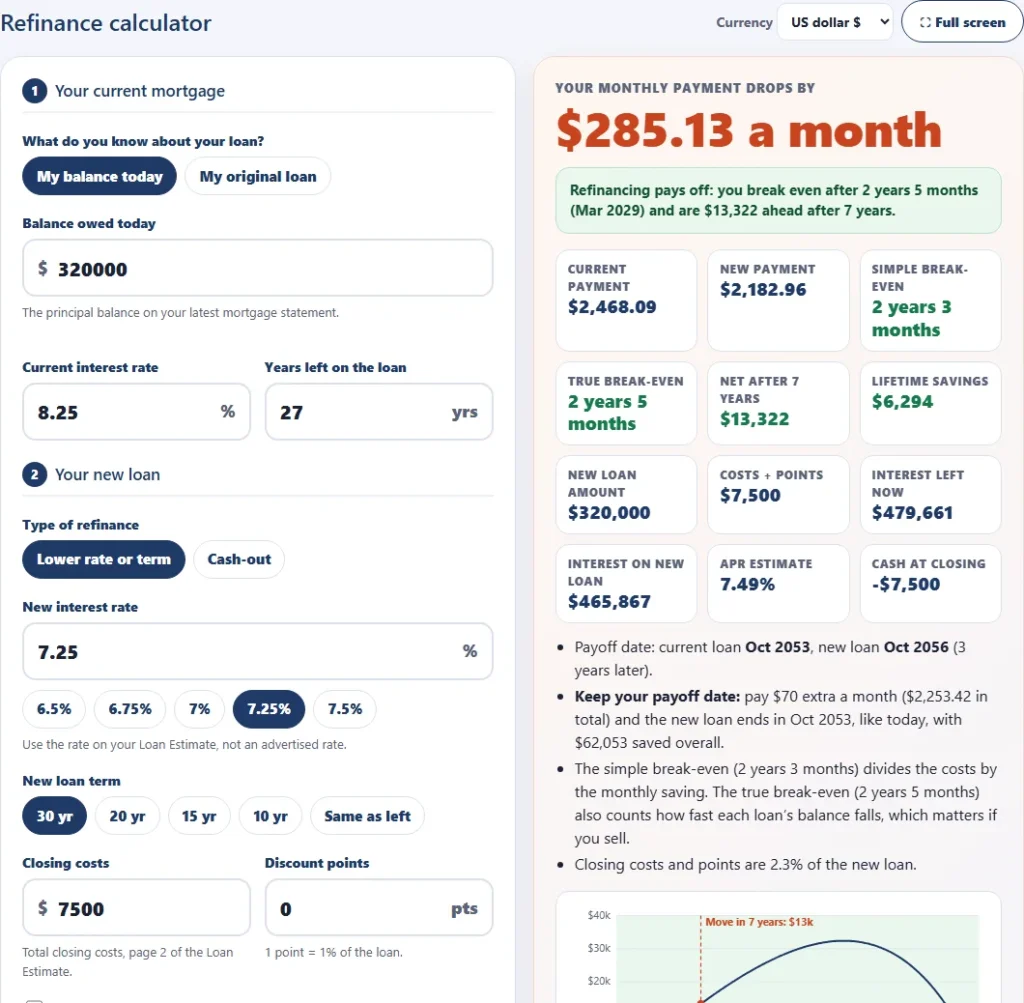
Now say you owe $320,000 at 8.25% with 27 years left (payment $2,468.09) and need $40,000. A cash-out refinance at 7.25% makes the new loan $360,000; the HELOC is $40,000 at 8.00% over 10 years.
| Cash-out refinance | HELOC | |
|---|---|---|
| Monthly payment | $2,455.83 | $2,468.09 + $485.31 = $2,953.40 |
| Total cost of the $40,000 | $91,939 (30-year term) | $58,737 |
| If you keep the old payoff date | $29,211 (27-year term) | – |
Here the answer flips once you keep the payoff date. On a 27-year term the cash-out refinance costs $29,211 in total for the $40,000, against $58,737 for the HELOC, because the lower rate now applies to the whole $320,000 too. On a 30-year term it costs $91,939, mainly because of three extra years of payments. You can test your own numbers in the refinance calculator: choose Cash-out and set the term to Same as left.
When the cash-out refinance makes more sense
- Your current rate is clearly higher than the rate you can get today, so refinancing helps the whole balance. This is the main reason to pick a cash-out refinance over a HELOC.
- You want a fixed rate and a single payment.
- You need all the money at once, for example to pay off high-interest debt in one go.
- You were going to refinance anyway, so the closing costs are not an extra.
When the HELOC makes more sense
- Your first mortgage has a low rate you do not want to lose.
- You need money in stages, such as a renovation paid in phases, and only want to pay interest on what you use.
- You expect to pay it back within a few years.
- You want lower upfront costs. Ask each lender about appraisal, annual and early-closure fees.
If you are still unsure between a cash-out refinance and a HELOC, run both through the numbers below: the one with the lower total cost for the money you need usually wins, unless you value a fixed rate more.
Questions to ask before you choose
- What is the rate today, and for the HELOC, what margin is added to the prime rate and is there a cap?
- What are the total closing costs? For a refinance they are on page 2 of the Loan Estimate.
- For the HELOC: how long is the draw period, and what will the payment be when repayment starts?
- Is there a fee to close the line early or a yearly fee?
- How much of the home’s value will the lender let you borrow in total?
Write the answers side by side on our free refinance comparison worksheet (also in A4).

This guide explains the math for planning. It is general information, not financial advice; your lender’s documents give the real figures.
Related calculators and guides
- Refinance calculator: cash-out mode, break-even and total cost
- HELOC calculator: how much you could borrow and the payment
- Closing cost calculator
- Mortgage calculator
- Mortgage recast vs refinance
- Debt snowball calculator if the cash is for paying off debt
Sources
- Selected Interest Rates H.15, bank prime loan rate (Federal Reserve)
- Home equity line of credit (Wikipedia): draw and repayment periods, variable rates
- What is a Loan Estimate? (Consumer Financial Protection Bureau): HELOCs get Truth-in-Lending disclosures instead of a Loan Estimate
- A Consumer’s Guide to Mortgage Refinancings (Federal Reserve Board)
- Primary Mortgage Market Survey (Freddie Mac)
Frequently asked questions
6 quick answers
Is a cash-out refinance or a HELOC cheaper?
It depends on your current mortgage rate. With a low rate, a HELOC is usually cheaper because your first mortgage stays untouched. With a rate above today’s, a cash-out refinance can be cheaper because the lower rate applies to the whole balance.
Can I get a HELOC instead of refinancing?
Yes. A HELOC is a separate second loan, so you keep your current mortgage, rate and payoff date. You make two payments: the mortgage and the HELOC.
Is the rate on a HELOC fixed?
Usually not. Most HELOCs have a variable rate tied to the prime rate plus a margin, so the payment can change. Some lenders let you fix the rate on part of the balance; ask what that costs.
Why does a cash-out refinance cost so much more in my example?
Because the new rate applies to the money you already owed, not only to the cash, and because a 30-year term spreads payments over more years. With a low current rate, that is expensive.
What is the main difference in a HELOC vs cash-out refinance?
A cash-out refinance replaces your whole mortgage with a new, larger one; a HELOC adds a separate line of credit and leaves your mortgage alone. That is why your current rate decides most comparisons between the two.
Do I get a Loan Estimate for a HELOC?
No. The CFPB says HELOCs come with Truth-in-Lending disclosures instead of a Loan Estimate, so compare the rate, margin, fees and repayment terms line by line.
Did you like this?
Last updated: