An overtime calculator works out what you earn when you work more than your regular hours. Premium pay is your hourly rate times a multiplier, usually 1.5 for time and a half, applied to the extra hours. At $20 an hour, 40 regular hours and 8 overtime hours, the week pays $1,040.
This free overtime pay calculator has three modes: pay from regular and extra hours, a week of total hours split at 40 (or your own threshold), and a reverse mode that finds the extra hours from total pay. It also takes a weekly or annual salary, and shows every step.
Quick answer: Overtime pay = hourly rate × overtime multiplier × overtime hours. Total weekly pay = regular pay + premium pay. At $20 an hour with 40 regular hours and 8 extra hours at 1.5×: 20 × 40 = $800, plus 20 × 1.5 × 8 = $240, which makes $1,040.
How to use the overtime calculator
Choose one of the three modes, type your pay rate and hours, and read the result. It updates as you type, and the working appears under the answer. Hours can be decimals (7.5) or hours and minutes (7:30).
| Mode | You type | You get |
|---|---|---|
| Pay from hours | Rate, regular hours, extra hours, multiplier, optional double-time hours | Total weekly pay, regular pay, premium pay and the average rate per hour |
| Split a week of hours | Rate, total hours worked, the hour where overtime starts, multiplier | Regular and extra hours worked out for you, plus the pay |
| Hours from pay | Rate, regular hours, multiplier, total pay for the week | The number of extra hours behind that pay |
If you are paid a salary, change Your pay is given as to a weekly or annual salary and type the weekly hours it covers. The tool turns it into an hourly equivalent first, which is how overtime based on salary is figured for non-exempt staff.
How to calculate overtime: formula and worked examples
To calculate overtime, multiply your regular hourly rate by the multiplier, then multiply that by the extra hours. Add the regular pay for the regular hours.
- Premium rate = regular rate × multiplier (1.5 for time and a half, 2 for double time)
- Premium pay = premium rate × extra hours
- Total pay = regular rate × regular hours + premium pay
- Extra hours = (total pay − regular pay) ÷ premium rate
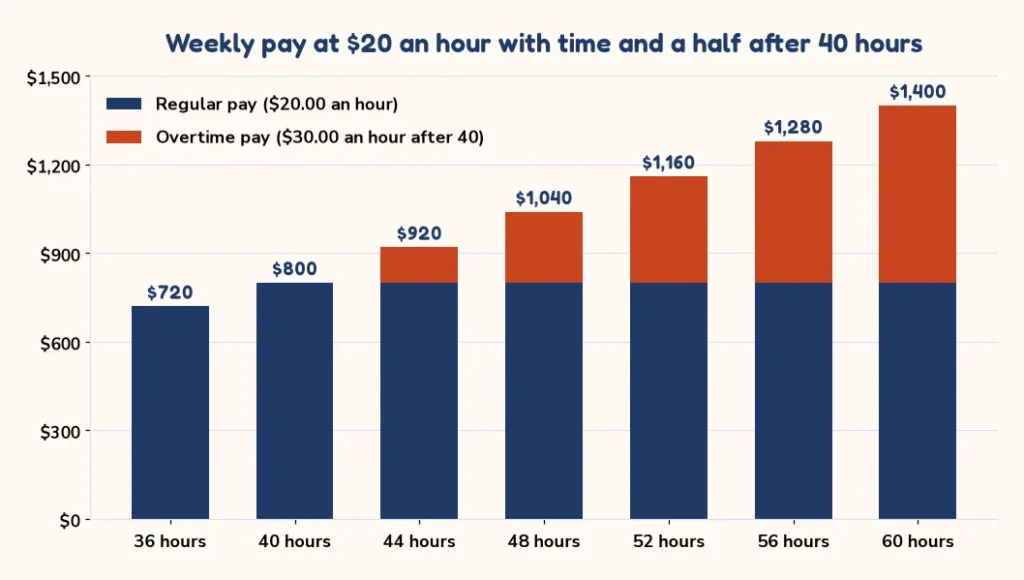
Example 1: $20 an hour, 40 regular hours, 8 overtime hours. The premium rate is 20 × 1.5 = $30. Regular pay is 20 × 40 = $800 and the extra hours pay 30 × 8 = $240, so the week pays $1,040. The average is $1,040 ÷ 48 = $21.67 an hour.
Example 2: a $1,200 weekly salary for 40 hours, then 6 extra hours. The hourly equivalent is 1,200 ÷ 40 = $30, and the premium rate is $45. The 6 extra hours pay 45 × 6 = $270, so the week pays $1,470. This is overtime based on salary for a non-exempt employee.
Example 3: total pay $1,000 at $20 an hour, 40 regular hours. Regular pay is $800, so $200 is premium pay. Divide by the $30 rate: 200 ÷ 30 = 6.67 overtime hours, which is 6 hours 40 minutes.
Weekly pay by hours worked (time and a half after 40)
Use this table to read off weekly pay without opening the overtime calculator. Each figure is regular pay for the first 40 hours plus time and a half for the rest.
| Hours worked | $15 an hour | $20 an hour | $25 an hour | $30 an hour | $40 an hour |
|---|---|---|---|---|---|
| 40 | $600 | $800 | $1,000 | $1,200 | $1,600 |
| 42 | $645 | $860 | $1,075 | $1,290 | $1,720 |
| 44 | $690 | $920 | $1,150 | $1,380 | $1,840 |
| 45 | $712.50 | $950 | $1,187.50 | $1,425 | $1,900 |
| 48 | $780 | $1,040 | $1,300 | $1,560 | $2,080 |
| 50 | $825 | $1,100 | $1,375 | $1,650 | $2,200 |
| 52 | $870 | $1,160 | $1,450 | $1,740 | $2,320 |
| 55 | $937.50 | $1,250 | $1,562.50 | $1,875 | $2,500 |
| 60 | $1,050 | $1,400 | $1,750 | $2,100 | $2,800 |
Premium rate for common hourly pay
The rate for each extra hour depends only on your regular rate and the multiplier. This table shows time and a half, double time and the pay for 8 extra hours.
| Regular rate | Time and a half (1.5×) | Double time (2×) | 8 hours at 1.5× |
|---|---|---|---|
| $12 | $18.00 | $24.00 | $144.00 |
| $15 | $22.50 | $30.00 | $180.00 |
| $18 | $27.00 | $36.00 | $216.00 |
| $20 | $30.00 | $40.00 | $240.00 |
| $25 | $37.50 | $50.00 | $300.00 |
| $30 | $45.00 | $60.00 | $360.00 |
| $40 | $60.00 | $80.00 | $480.00 |
| $50 | $75.00 | $100.00 | $600.00 |
Overtime pay calculator examples for real jobs
These examples use the same formula as the tool, with time and a half after 40 hours. They show how the extra hours lift a paycheck in jobs where long weeks are common.
| Job | Hourly rate | Hours in the week | Weekly pay | Extra pay from the long week |
|---|---|---|---|---|
| Warehouse picker | $19.50 | 46 | $955.50 | $58.50 |
| Retail, holiday season | $16.00 | 50 | $880.00 | $80.00 |
| Delivery driver | $18.25 | 48 | $949.00 | $73.00 |
| Care assistant | $22.00 | 44 | $1,012.00 | $44.00 |
| Restaurant cook | $15.00 | 42 | $645.00 | $15.00 |
| Construction foreman | $35.00 | 55 | $2,187.50 | $262.50 |
The last column compares the week with the same hours paid at the regular rate. The warehouse worker, for example, earns 19.50 × 46 = $897.00 at straight time but $955.50 with the premium, an extra $58.50.
The regular rate, bonuses and shift pay
The multiplier applies to your regular rate, which is not always the same as your base wage. A shift differential, a production bonus or a commission can raise the rate that the multiplier is applied to, depending on local law. If your pay stub shows a higher rate than your contract wage, type that figure into the Pay amount box and the calculator will follow it.
When in doubt, ask payroll how the regular rate is built. A short written answer helps you check the numbers on your pay stub against this tool, line by line, and spot a mistake early.
Timesheets: keep your own record of hours
Write down your start time, finish time and unpaid break each day, then add the totals for the workweek. Rounding to the nearest quarter hour changes the result a little: 7 hours 50 minutes is 7.83 hours, while 7 hours 45 minutes is 7.75. Enter the exact hours and minutes in the calculator, then compare the answer with your pay stub. If the two differ, check the rounding rule, the unpaid break and the week your employer uses.
Time and a half and double time explained
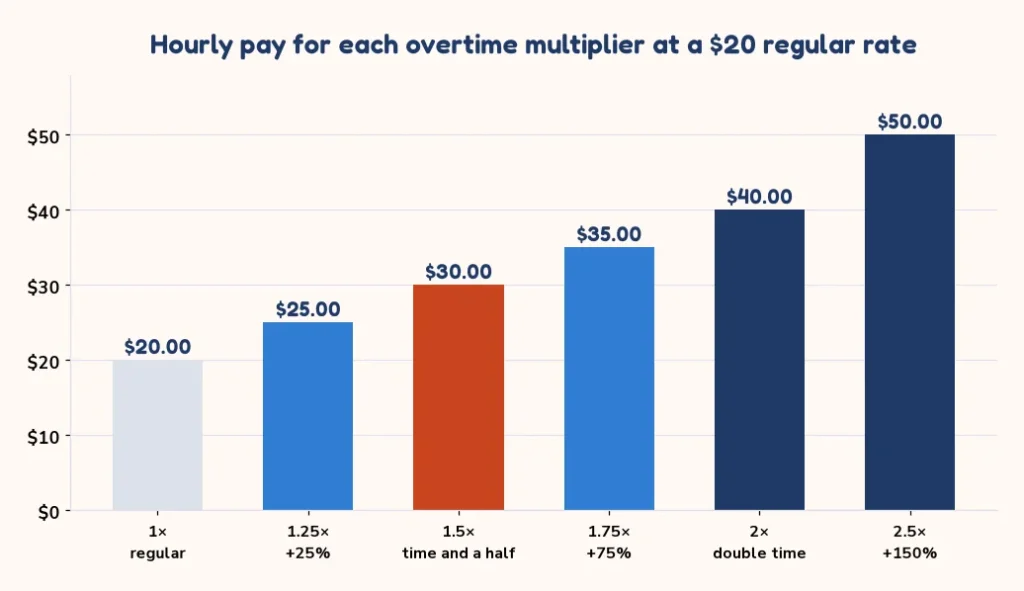
Time and a half means each extra hour pays 1.5 times your regular hourly rate. At $18 an hour, time and a half is 18 × 1.5 = $27. Double time pays twice the rate, so $36 at the same wage. The tool accepts any multiplier, so it also handles 1.25, 1.75 and 2.5 for contracts with other tiers.
How do you calculate 30 minutes of overtime?
Convert minutes to hours by dividing by 60, then use the same formula. Thirty minutes is 0.5 hours, so at $20 an hour and time and a half, 30 minutes of overtime pays 20 × 1.5 × 0.5 = $15. You can also type 0:30 in the hours box.
| Extra minutes | As hours | Pay at $20 and 1.5× |
|---|---|---|
| 10 | 0.167 | $5.00 |
| 15 | 0.250 | $7.50 |
| 20 | 0.333 | $10.00 |
| 30 | 0.500 | $15.00 |
| 45 | 0.750 | $22.50 |
| 60 | 1.000 | $30.00 |
Overtime rules in the United States
Under the Fair Labor Standards Act (FLSA), the US Department of Labor says covered employees who are not exempt must be paid at least one and one-half times their regular rate for hours worked over 40 in a workweek. A workweek is a fixed period of 168 hours, and the FLSA does not require overtime for weekends or holidays unless the hours push you past 40.
Averaging is not allowed. A week with 45 hours followed by a week with 35 hours is not an 80-hour pair at straight time. At $20 an hour, the first week pays 800 + 150 = $950 and the second pays $700, which is $1,650 for the two weeks. Averaging would give $1,600. For biweekly paychecks, run the calculator once for each week.
Some workers are exempt depending on pay and duties, and a salary alone does not decide it. Check the Department of Labor guidance or your payroll team. The extra pay counts as part of gross pay, so the calculator shows the amount before tax.
Overtime calculator California: daily and weekly overtime
Some states add daily overtime. Under California Labor Code section 510, work over 8 hours in a day, over 40 hours in a week, and the first 8 hours on the seventh consecutive day of a workweek is paid at 1.5 times the regular rate. Work over 12 hours in a day, and over 8 hours on the seventh day, is paid at double the regular rate. Alternative workweek schedules and other exceptions apply.
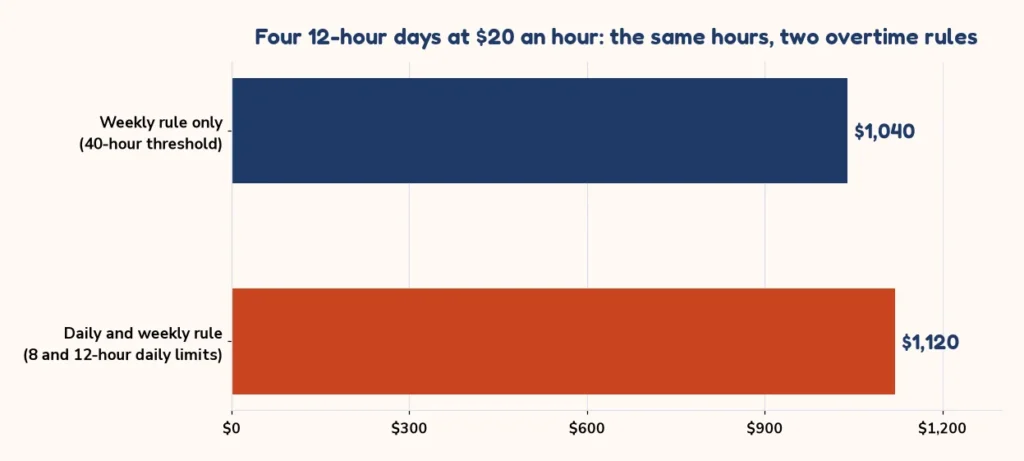
The same hours can pay differently. Take four 12-hour days at $20, which is 48 hours. Under a weekly-only rule, 40 hours are regular and 8 are overtime: 800 + 240 = $1,040. Under California-style daily rules, each day has 8 regular hours and 4 overtime hours: 4 × (160 + 120) = $1,120. A 13-hour day adds one double-time hour: 160 + 120 + 40 = $320. Use the double-time box for that last hour.
Canada, UK, Australia and Europe
Canada
Canadian overtime rules differ by province or territory, and the Canada Labour Code covers federally regulated workplaces. Standard hours, the threshold and the multiplier all vary, so type your own values in the threshold and multiplier boxes. Many employers use 1.5.
United Kingdom
GOV.UK says employers do not have to pay for overtime, but average pay for the total hours worked must not fall below the National Minimum Wage. The contract usually sets the overtime rate. Most workers cannot be made to work more than 48 hours a week on average over 17 weeks unless they opt out.
Australia and New Zealand
In Australia, overtime and penalty rates come from the applicable award or agreement, which the Fair Work Commission publishes, so the multiplier and the starting hours depend on your industry. Enter the rates from your award into the boxes.
| Region | General rule | What to type in the tool |
|---|---|---|
| United States (federal) | 1.5× over 40 hours in a workweek for non-exempt staff | Threshold 40, multiplier 1.5 |
| California | Daily overtime over 8 hours and double time over 12 | Use the double-time box |
| Canada | Set by province or territory | Your province’s threshold and multiplier |
| United Kingdom | No general overtime premium; set by contract | The multiplier in your contract |
| Australia | Set by award or agreement | The award’s overtime and penalty rate |
Is overtime worth it? A quick comparison
Five extra hours a week at $25 an hour with time and a half pays 5 × 37.50 = $187.50 more a week, or $9,750 over 52 weeks, before tax. The same five hours at straight time pays $6,500. Extra hours are attractive because each one earns more, but it comes with long days, so also compare the hours with the pay.
Before you accept long weeks, also count the hours you will not get back. Ten extra hours a week at time and a half pays well, yet commuting, childcare and rest are costs the calculator cannot show. Run both versions, with and without the extra shifts, and compare the pay per hour of your whole week.
Common mistakes with overtime pay
- Multiplying the whole week by 1.5. Only the hours above the threshold earn the premium.
- Averaging two weeks. In the United States the premium is worked out one workweek at a time.
- Using minutes as decimals. 7 hours 30 minutes is 7.5 hours, not 7.30.
- Forgetting double-time tiers. Some states and contracts pay 2× after a daily limit.
- Reading gross as take-home. The calculator shows pay before tax and deductions.
Questions people ask about overtime pay
How do you calculate overtime for salaried employees?
Divide the salary by the hours it covers to get an hourly equivalent, then apply the multiplier to the overtime hours. A $62,400 annual salary for 40-hour weeks is 62,400 ÷ 52 ÷ 40 = $30 an hour, so 6 overtime hours pay 45 × 6 = $270.
Is there a calculator that shows overtime after tax?
This tool gives gross pay. Take-home pay depends on your tax rate, withholding and deductions, so multiply the gross overtime by the share you keep for an estimate.
Frequently asked questions
10 quick answers
How is overtime pay calculated?
Overtime pay is the regular hourly rate times the multiplier times the extra hours. At $20 an hour, 8 extra hours at 1.5× pays 20 × 1.5 × 8 = $240. Add regular pay for the first 40 hours to get the weekly total.
What is time and a half?
Time and a half is a rate of 1.5 times your regular hourly pay. At $16 an hour, time and a half is $24. It is the usual federal rate in the United States for non-exempt employees working over 40 hours a week.
What is double time?
Double time pays 2 times your regular rate, so $20 an hour becomes $40. It applies after certain daily limits in some states, such as California, and in some contracts and awards.
How many hours before overtime starts?
In the United States, federal overtime starts after 40 hours in a workweek. Some states also count daily hours, and other countries and contracts use different thresholds. Type your own threshold in the tool.
How do I find overtime hours from total pay?
Subtract regular pay from total pay and divide by the overtime rate. With $1,000 total pay, $800 regular pay and a $30 overtime rate, overtime hours are 200 ÷ 30 = 6.67. The reverse mode does it for you.
Does overtime apply to salaried employees?
It can. In the United States, salaried non-exempt employees are owed overtime, while exempt employees are not. Exemption depends on duties and pay, not on being salaried alone.
Do holidays and weekends count as overtime?
Not automatically. The US Department of Labor says the FLSA does not require overtime pay for Saturdays, Sundays or holidays unless the hours put you over 40 in the workweek. Your contract or state law may pay a premium.
Can I enter hours and minutes?
Yes. Type 7:30 or 7.5 for seven and a half hours. The tool treats 0:30 as half an hour.
Is the overtime result before or after tax?
It is before tax. Taxes, benefits and other deductions are taken from gross pay, so your take-home pay will be lower.
Does the UK have a statutory overtime rate?
No. GOV.UK says employers do not have to pay for overtime, though average pay must stay above the National Minimum Wage. The contract sets any premium rate.
Related calculators and printables
- Hourly to salary calculator: annual, monthly and biweekly pay
- Work hours calculator: add up shifts and breaks
- Time calculator: add hours and minutes
- Percentage calculator: pay rises and shares
- All free calculators
- Money worksheets for wage practice
Sources and further reading
- US Department of Labor: Overtime Pay
- California Labor Code section 510
- GOV.UK: Overtime, your rights
- Canada.ca: Federal labour standards
- Fair Work Commission (Australia)
This page is general information, not legal or payroll advice. Overtime rules depend on your country, state, contract and role. Last updated: October 2026.