This Constitution Day quiz has 30 questions with answers about the Constitution of India, Dr B. R. Ambedkar and the Constituent Assembly, sorted into easy, medium and hard rounds for Class 1 up to adults. Constitution Day (Samvidhan Divas) 2026 falls on Thursday 26 November, 77 years after the Constituent Assembly adopted the Constitution on 26 November 1949.
Every answer has been checked against Government of India sources such as the Press Information Bureau, the Rajya Sabha and the official text of the Constitution. Where a number has changed over the years, the answer gives both the original and the current figure. The questions are new, so they do not repeat our Children’s Day quiz or the Gandhi Jayanti quiz.
Constitution Day quiz at a glance
Pick the rounds that suit your group. Classes 1 to 4 can stop after the easy round; senior classes and adult teams can play all 30 questions in about 35 minutes.
| Round | Questions | Best for | Focus |
|---|---|---|---|
| Easy | 1 to 10 | Ages 6 to 9 (Classes 1 to 4) | Dates, Dr Ambedkar, the Preamble |
| Medium | 11 to 20 | Ages 10 to 13 (Classes 5 to 8) | Constituent Assembly, rights and duties |
| Hard | 21 to 30 | Ages 14 and up (Class 9 to adults) | Articles, schedules, amendments, the hand-written copy |
What is Constitution Day (Samvidhan Divas)?
Read this short note aloud before the Constitution Day quiz so everyone starts with the same facts.
A constitution is the main rule book of a country. It says how the government is formed, what rights every citizen has, and what duties citizens should follow. India’s Constitution was written by the Constituent Assembly, which first met in New Delhi on 9 December 1946. Dr Rajendra Prasad was elected its president, and Dr B. R. Ambedkar led the Drafting Committee that prepared the text.
After almost three years of debate, the Assembly adopted the Constitution on 26 November 1949. It came into force on 26 January 1950, the day India became a republic. That is why 26 January is Republic Day and 26 November is Constitution Day. Many schools call a Constitution Day quiz a Samvidhan Divas quiz for the same reason. The date 26 January was chosen because on 26 January 1930 the Indian National Congress had called for Purna Swaraj, or complete independence.
For many years, lawyers marked 26 November as National Law Day; the Supreme Court Bar Association began this in 1979. In 2015, the 125th birth anniversary year of Dr Ambedkar, the Government of India declared that 26 November would be observed every year as Constitution Day.
Easy Constitution Day quiz questions (Classes 1 to 4)
Read each question twice, and accept any answer that shows the right idea.
- On which date is Constitution Day celebrated in India?
Answer: 26 November - What is the Hindi name for Constitution Day?
Answer: Samvidhan Divas - What is a constitution?
Answer: The main rule book of a country, which sets out how the government works and the rights and duties of its people - Who is often called the chief architect of the Indian Constitution?
Answer: Dr B. R. Ambedkar (Babasaheb Ambedkar) - Which national day do we celebrate on 26 January, when the Constitution came into force?
Answer: Republic Day - What is the short introduction at the start of the Constitution called?
Answer: The Preamble - With which words does the Preamble begin?
Answer: “We, the people of India” - Was the original Constitution printed by a machine or written by hand?
Answer: Written by hand, in beautiful handwriting (calligraphy), in English and in Hindi - Who became the first President of India in 1950?
Answer: Dr Rajendra Prasad - In which city did the Constituent Assembly meet to write the Constitution?
Answer: New Delhi (in the Constitution Hall, now the Central Hall of the old Parliament House)
Medium round: the Constituent Assembly, rights and duties (Classes 5 to 8)
This round follows how the Constitution was made, then looks at the rights and duties it gives every citizen.
- In which year did the Constituent Assembly adopt the Constitution?
Answer: 1949 (on 26 November) - On which date did the Constituent Assembly hold its first sitting?
Answer: 9 December 1946 - Who chaired that first sitting as the temporary chairman?
Answer: Dr Sachchidananda Sinha - Who was elected president of the Constituent Assembly on 11 December 1946?
Answer: Dr Rajendra Prasad - Which committee, set up on 29 August 1947, did Dr Ambedkar chair?
Answer: The Drafting Committee - About how long did the Constituent Assembly take to make the Constitution?
Answer: Almost three years (about 2 years and 11 months), over 11 sessions and 165 days of sittings - Name the four big ideals the Preamble promises to all citizens.
Answer: Justice, Liberty, Equality and Fraternity - How many groups of Fundamental Rights does the Constitution have today?
Answer: Six. There were seven at the start, but the Right to Property was removed from the list by the 44th Amendment in 1978. - How many Fundamental Duties are there today, and in which article are they listed?
Answer: Eleven, in Article 51A - Which Fundamental Right did Dr Ambedkar call the “heart and soul” of the Constitution?
Answer: The Right to Constitutional Remedies (Article 32), which lets a citizen go to the Supreme Court if their rights are taken away
Hard round: Constitution Day quiz questions and answers for seniors (Class 9 to adults)
The hard round covers numbers, amendments and the hand-written copy. It suits senior classes and adult teams.
- When it came into force, how many articles, parts and schedules did the Constitution have?
Answer: 395 articles in 22 parts, and 8 schedules - How many schedules does the Constitution have today?
Answer: 12. Four were added by amendments, the last two (the Eleventh and Twelfth, on panchayats and municipalities) in 1992. - The last article is still numbered 395. So how have new articles been added over the years?
Answer: By giving them letters after a number, such as Article 21A (Right to Education) and Article 51A (Fundamental Duties) - In which year was 26 November first observed as Constitution Day, and whose birth anniversary year was it?
Answer: 2015, the 125th birth anniversary year of Dr B. R. Ambedkar - Before 2015, by what name was 26 November mainly known?
Answer: National Law Day (marked since 1979) - Which calligrapher hand-wrote the English original of the Constitution?
Answer: Prem Behari Narain Raizada - Which famous artist from Santiniketan, with his students, decorated the pages of the hand-written Constitution?
Answer: Nandalal Bose - Which amendment added the words “socialist”, “secular” and “integrity” to the Preamble?
Answer: The 42nd Amendment, 1976. The same amendment added the first ten Fundamental Duties. - Which amendment added the eleventh Fundamental Duty, and what does it say?
Answer: The 86th Amendment, 2002. Parents or guardians must give their child the chance of education between the ages of 6 and 14. - On which date did members of the Constituent Assembly sign the hand-written copies of the Constitution?
Answer: 24 January 1950, two days before it came into force
The hand-written Constitution
The original Constitution was not printed. The English text was written by hand by Prem Behari Narain Raizada in a flowing italic style, and the Hindi version was calligraphed by Vasant Krishan Vaidya. Artists from Kala Bhavan, Santiniketan, led by Nandalal Bose, then decorated the pages. Each of the 22 parts opens with an illustration showing a scene from India’s long history, from the Indus Valley to the freedom struggle.
The original copies are kept safely in the Parliament Library in New Delhi.
Preamble reading activity
Reading the Preamble together is the most common Constitution Day activity in Indian schools and offices. Here is the Preamble as it stands today:
WE, THE PEOPLE OF INDIA, having solemnly resolved to constitute India into a SOVEREIGN SOCIALIST SECULAR DEMOCRATIC REPUBLIC and to secure to all its citizens:
JUSTICE, social, economic and political;
LIBERTY of thought, expression, belief, faith and worship;
EQUALITY of status and of opportunity;
and to promote among them all
FRATERNITY assuring the dignity of the individual and the unity and integrity of the Nation;
IN OUR CONSTITUENT ASSEMBLY this twenty-sixth day of November, 1949, do HEREBY ADOPT, ENACT AND GIVE TO OURSELVES THIS CONSTITUTION.
Try these simple steps:
- Read together. One child reads a line, and the whole group repeats it.
- Find the big words. Ask children to spot the four ideals: justice, liberty, equality and fraternity.
- Explain in your own words. Each group takes one ideal and gives a classroom example, such as taking turns (equality) or helping a new classmate (fraternity).
- Spot the date. Ask: which date is written inside the Preamble itself? (26 November 1949.)
- Write it out. Older children copy the Preamble in their best handwriting, like Raizada did. Our cursive writing worksheets help with practice first.
How to run the Constitution Day quiz in a school assembly
A Constitution Day quiz works best with mixed teams of four, one student from each class group, so younger and older children each answer the round that suits them.
This plan fits a 35 to 40 minute assembly or a double period.
- Open with the Preamble (5 minutes). The whole school reads it together, led by a student.
- Share the story (3 minutes). A student reads the “What is Constitution Day” note above.
- Make house teams. Use your school houses, or name teams after the four ideals: Team Justice, Team Liberty, Team Equality and Team Fraternity.
- Play the rounds (20 minutes). Junior classes answer the easy round aloud. Middle and senior teams write answers on slates or paper for the medium and hard rounds, with 30 seconds per question.
- Mark as you go. Use this Constitution Day quiz with answers as your key: one point for each correct answer, and a bonus point for an extra correct detail, such as a year.
- Close with a promise (5 minutes). Ask each team to name one Fundamental Duty they will follow this week, such as keeping public places clean or protecting the environment.
For quick revision afterwards, our online India GK quiz checks answers automatically.
Adapting the Constitution Day quiz questions for different ages
- Ages 6 to 8: show a picture of Dr Ambedkar, the Preamble page and the national flag, and ask simple “who” and “what” questions.
- Ages 9 to 11: give three spoken options, and link each Fundamental Duty to a school rule.
- Ages 12 to 14: ask teams to put five dates in order: 9 December 1946, 29 August 1947, 26 November 1949, 24 January 1950 and 26 January 1950.
- Ages 15 and up: ask teams to explain one Fundamental Right and one Fundamental Duty.
Printable constitution day quiz (free PDF)
Print this constitution day quiz as a quiz sheet: every question from the rounds above with a line to write the answer, and a separate answer key for the quizmaster. The constitution day quiz PDF has 4 pages and prints on US Letter or A4.
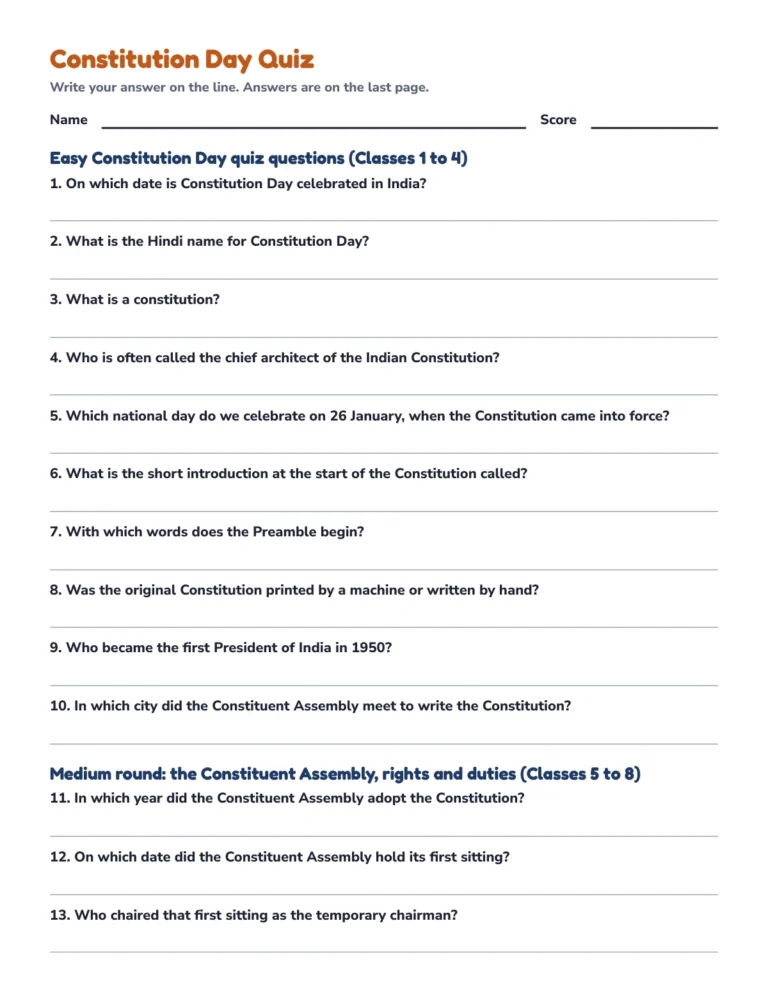
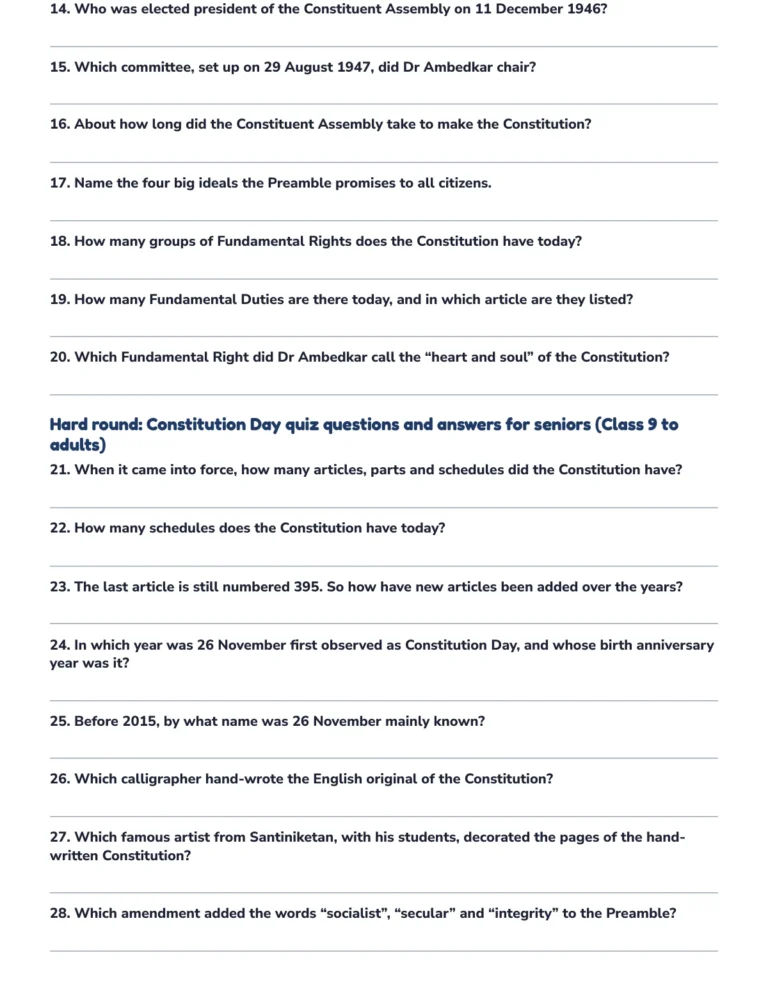
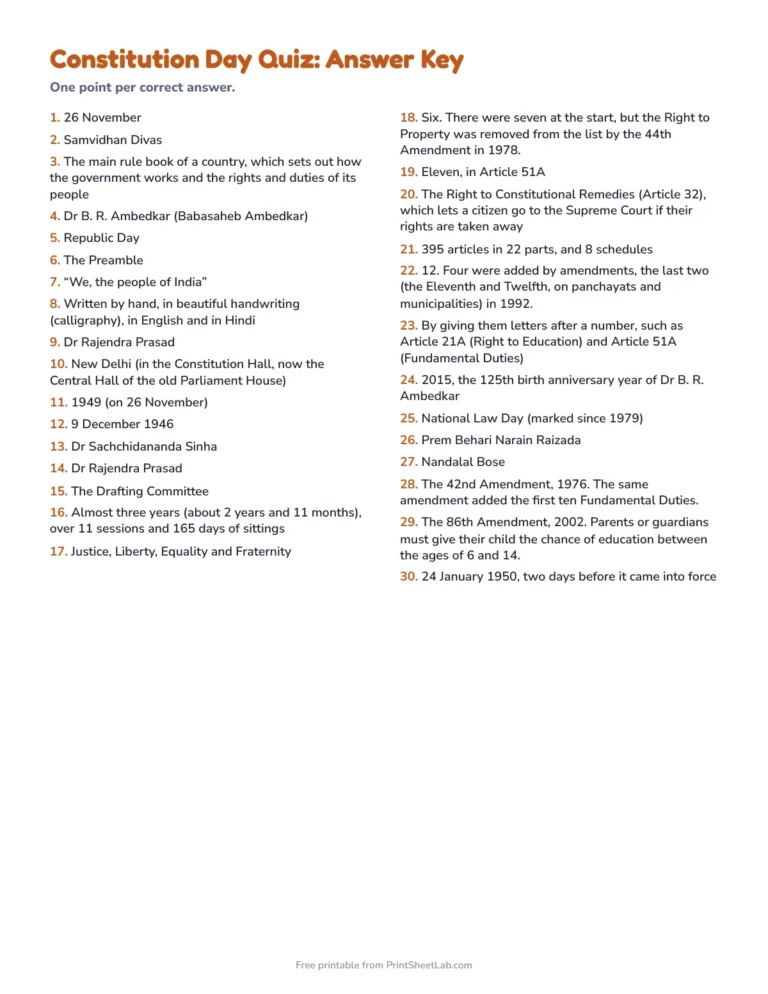
Print at 100% (actual size). Every page is black and white line art, so it copies cleanly on a school printer.
Related guides and printables
- Children’s Day quiz with 30 questions
- Gandhi Jayanti quiz for school
- Online India GK quiz with instant answers
- Indian states and capitals quiz
- Quiz questions for kids
- Reading comprehension worksheets
- India holidays 2027 calendar
Sources
- Press Information Bureau (Ministry of Parliamentary Affairs): “Constitution Day – November 26” backgrounder, 2021 (adoption date, 395 articles, 22 parts and 8 schedules, Drafting Committee of 29 August 1947, 11 sessions over 165 days, first sitting on 9 December 1946, signing on 24 January 1950)
- Press Information Bureau: Samvidhan Divas 2024 releases (Constitution Day observed since 2015)
- Rajya Sabha (sansad.in): Constituent Assembly of India, facts and committees
- Constituent Assembly Debates, Volume I (Lok Sabha Secretariat): election of Dr Rajendra Prasad, 11 December 1946
- Legislative Department, Ministry of Law and Justice: The Constitution of India (official text, Preamble, Article 51A, 12 schedules) and the Constitution (Forty-second Amendment) Act, 1976
- Ministry of Law and Justice: Law Day address, 26 November 2014 (Law Day marked since 1979)
- NCERT Class 7 arts textbook Kriti: the calligraphers of the English and Hindi versions
- Encyclopaedia Britannica: Constitution of India
Frequently asked questions
8 quick answers
When is Constitution Day 2026?
Constitution Day 2026 is on Thursday 26 November 2026. It is not a national public holiday, so schools and offices usually mark it with a Preamble reading, a quiz or a talk during the working day.
Why is Constitution Day celebrated on 26 November?
The Constituent Assembly adopted the Constitution of India on 26 November 1949. The Government of India declared the date Constitution Day in 2015, the 125th birth anniversary year of Dr B. R. Ambedkar.
What is the difference between Constitution Day and Republic Day?
Constitution Day (26 November) marks the day the Constitution was adopted in 1949. Republic Day (26 January) marks the day it came into force in 1950, when India became a republic.
Is Constitution Day the same as National Law Day?
Yes, it is the same date. Lawyers have marked 26 November as National Law Day since 1979. Since 2015 the day has been officially observed as Constitution Day, or Samvidhan Divas.
How many articles and schedules are in the Indian Constitution?
When it came into force, the Constitution had 395 articles in 22 parts, and 8 schedules. Today it has 12 schedules. The last article is still numbered 395, but many new articles have been added with letters, such as 21A, so the actual total is much higher. The Constitution has been amended 106 times, most recently in 2023.
What are some easy Constitution Day quiz questions for kids?
Try: When is Constitution Day? (26 November). What is its Hindi name? (Samvidhan Divas). Who led the Drafting Committee? (Dr B. R. Ambedkar). With which words does the Preamble begin? (“We, the people of India”).
Why do some schools call it a Samvidhan Divas quiz?
Samvidhan Divas is the Hindi name for Constitution Day, which falls on 26 November, the date the Constituent Assembly adopted the Constitution in 1949. Many schools use the Hindi name for the quiz for the same reason.
What activity can follow an Indian Constitution quiz?
A group reading of the Preamble works well, and it is the Constitution Day activity Indian schools use most. One child reads a line and the group repeats it, then children spot the four ideals: justice, liberty, equality and fraternity.
Did you like this?
Last updated: