This Diwali speech page gives students ready speeches in simple English for 1, 2 and 3 minutes, plus a green Diwali speech, a teacher’s address and anchoring lines. Diwali 2026 falls on Sunday 8 November, so most schools will hold their Diwali assembly in the first week of November.
Each Diwali speech below is original. Read it aloud, add one detail from your own home, and practise with a timer.
Diwali speech for students at a glance
| Speech | Who it suits | Time |
|---|---|---|
| Short speech | Class 1 to 3 | About 1 minute |
| Medium speech | Class 4 to 8 | About 2 minutes |
| Long speech | Class 9 to 12 | About 3 minutes |
| Safe and green Diwali | Class 5 and above | About 2 minutes |
| Teacher or principal address | Staff at the assembly | 2 to 3 minutes |
| Anchoring script | Student hosts | Through the programme |
What should a speech on Diwali say?
A good Diwali speech has three parts. First, greet the audience. Next, say what Diwali is and why people celebrate it. Last, end with a wish or a promise. Many Hindus remember Lord Rama’s return to Ayodhya and worship Goddess Lakshmi. Sikhs celebrate Bandi Chhor Divas on the same day, and Jains remember Lord Mahavira. Friends of every background join in too, so a kind speech includes everyone.
Short speech on Diwali for Class 1 to 3 (1 minute)
About 120 words. Small children can learn it in two or three days.
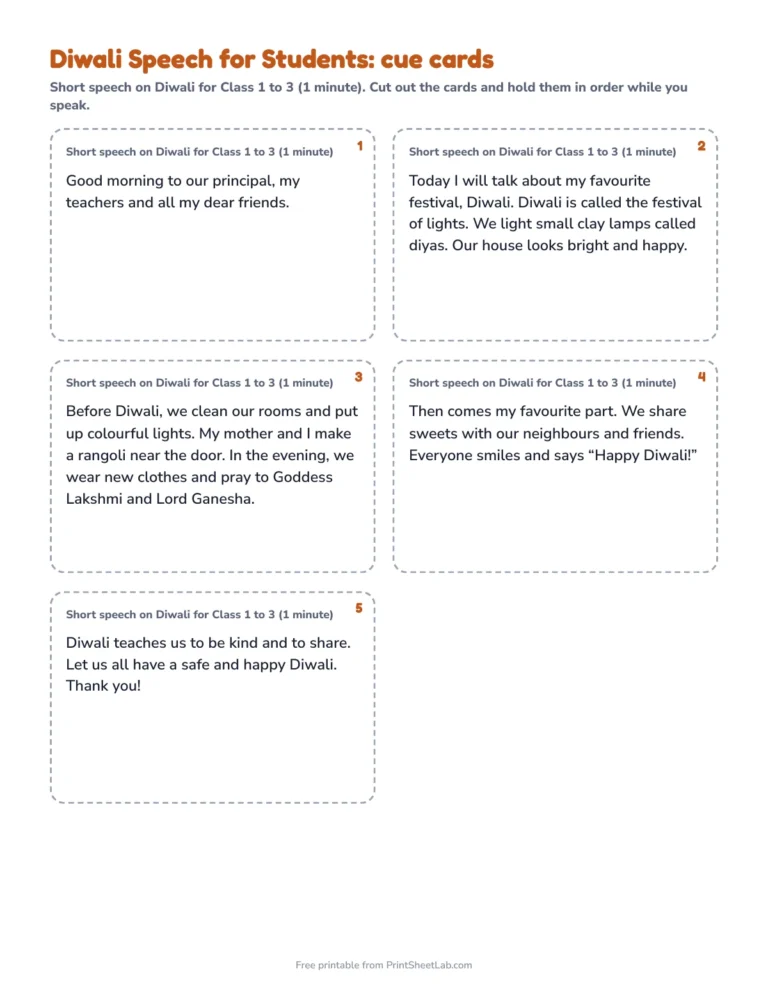
Good morning to our principal, my teachers and all my dear friends.
Today I will talk about my favourite festival, Diwali. Diwali is called the festival of lights. We light small clay lamps called diyas. Our house looks bright and happy.
Before Diwali, we clean our rooms and put up colourful lights. My mother and I make a rangoli near the door. In the evening, we wear new clothes and pray to Goddess Lakshmi and Lord Ganesha.
Then comes my favourite part. We share sweets with our neighbours and friends. Everyone smiles and says “Happy Diwali!”
Diwali teaches us to be kind and to share. Let us all have a safe and happy Diwali. Thank you!
Diwali speech for kids in Class 4 to 8 (2 minutes)
About 240 words. This Diwali speech adds the story behind the festival and the five days.
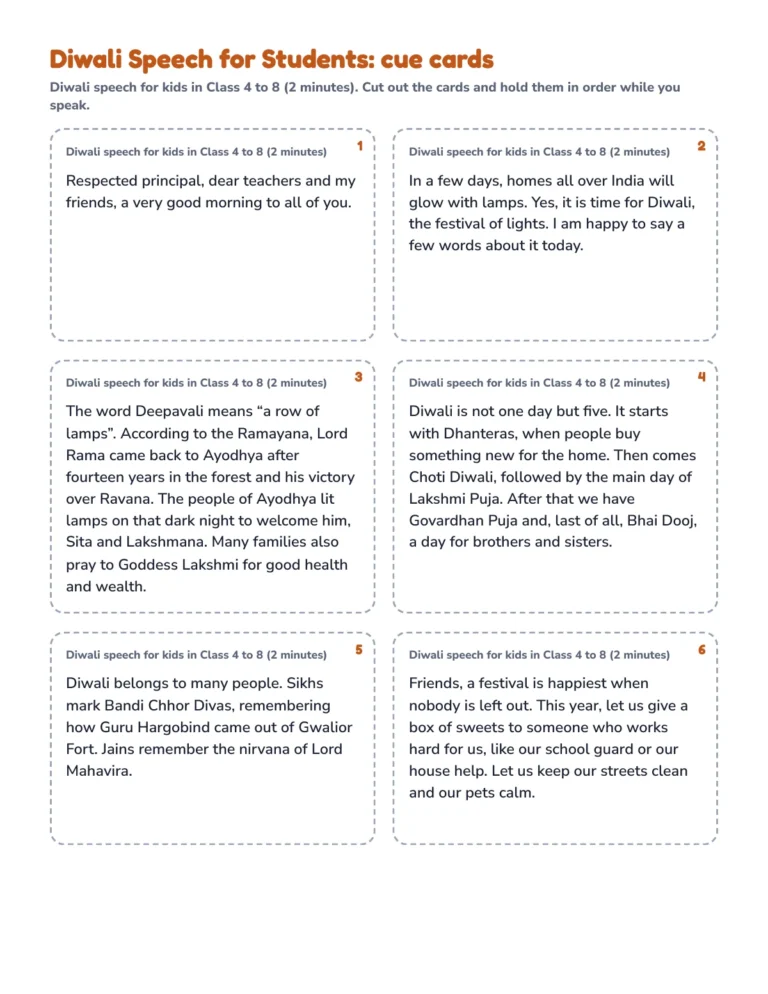
Respected principal, dear teachers and my friends, a very good morning to all of you.
In a few days, homes all over India will glow with lamps. Yes, it is time for Diwali, the festival of lights. I am happy to say a few words about it today.
The word Deepavali means “a row of lamps”. According to the Ramayana, Lord Rama came back to Ayodhya after fourteen years in the forest and his victory over Ravana. The people of Ayodhya lit lamps on that dark night to welcome him, Sita and Lakshmana. Many families also pray to Goddess Lakshmi for good health and wealth.
Diwali is not one day but five. It starts with Dhanteras, when people buy something new for the home. Then comes Choti Diwali, followed by the main day of Lakshmi Puja. After that we have Govardhan Puja and, last of all, Bhai Dooj, a day for brothers and sisters.
Diwali belongs to many people. Sikhs mark Bandi Chhor Divas, remembering how Guru Hargobind came out of Gwalior Fort. Jains remember the nirvana of Lord Mahavira.
Friends, a festival is happiest when nobody is left out. This year, let us give a box of sweets to someone who works hard for us, like our school guard or our house help. Let us keep our streets clean and our pets calm.
I wish you and your families a bright and joyful Diwali. Thank you.
Diwali speech for senior students (3 minutes)
About 300 words, for Class 9 to 12 or an inter-school event.
Respected principal, honoured guests, dear teachers and my fellow students, good morning.
Think of the darkest night of the year. No moon, no stars, only black sky. Now picture one small diya being lit on a doorstep. Then another, until the whole street shines. That picture is the heart of Diwali, and it is what I want to talk about today.
Diwali falls on Amavasya, the new moon night of Kartik. For many Hindus, it marks Lord Rama’s return to Ayodhya. In parts of South India, people remember Lord Krishna’s victory over the demon Narakasura. In Bengal, families worship Goddess Kali on this night. Sikhs celebrate Bandi Chhor Divas, when Guru Hargobind was released from Gwalior Fort and the Golden Temple in Amritsar is lit up. Jains mark the day Lord Mahavira attained nirvana.
So one festival holds many stories. Yet they all share one idea: light is stronger than darkness, and good is stronger than evil. In December 2025, UNESCO named Deepavali part of the world’s intangible cultural heritage.
What does “light over darkness” mean for us, as students? I think it means small, daily choices: a kind word to a new classmate, help for a friend who finds maths hard, or patience with a younger brother or sister.
It also means caring for the world we share. We can choose clay diyas, buy sweets from local shops, and think about how noise and smoke affect our neighbours, the elderly and animals.
Friends, we may not be able to light up a whole city. But each of us can be one diya. If all of us shine a little, our school, our town and our country will glow brighter than any firework.
On behalf of all students, I wish everyone here a happy, safe and peaceful Diwali. Thank you.
Speech on a safe and green Diwali
About 220 words. Suits an eco club, a Class 5 to 10 assembly or a competition on the environment.
Good morning, respected principal, teachers and dear friends.
We all love the lamps, sweets and family time of Diwali. Today I want to ask one simple question: can we keep all this joy and still be kind to the earth? I believe we can.
Let us begin with lights. Clay diyas are made by local potters and can be used again next year. Rangoli made from flower petals, rice flour or turmeric is safe for ants and birds.
Now let us talk about firecrackers. They are bright and exciting, but they can cause burns. Their smoke makes the air harder to breathe, especially for small children, older people and anyone with asthma. In many cities, the air is already poor in November. The loud bangs also frighten dogs, cats, cows and birds. Many cities now permit only green crackers during set hours, so please follow your local rules.
If your family does light crackers, please stay safe. Light them in an open place, away from homes and parked cars. An adult should always be present. Keep a bucket of water or sand close by, and wear cotton clothes, not loose synthetic ones.
Friends, a green Diwali is not a dull Diwali. It is a festival where people, animals and our planet all celebrate together. Thank you.
Diwali speech for teachers and the principal at the school assembly
About 200 words. A teacher or principal can read it before the holidays begin.
Good morning, dear students, and good morning to my colleagues.
In a few days, our school will close for the Diwali holidays. Before you go, I want to share a few thoughts with you.
Diwali is celebrated in different ways in our country. Some of you will do Lakshmi Puja at home. Some of you will visit the gurdwara for Bandi Chhor Divas. Some of you will go to a Jain temple, and many of you will join friends and neighbours for their celebrations. That is the beauty of this festival. It brings us together while letting each family keep its own traditions.
I have two small requests for these holidays.
First, be safe. If there are crackers at home, stay with an adult, keep water nearby and keep your distance. We want every one of you back in class with a smile.
Second, be kind. Remember the people who make our festival possible: the shopkeepers, the delivery workers, the cleaners and the guards. A thank you or a share of your sweets means a lot.
Students, you are the lights of this school. On behalf of all the teachers, I wish you and your families a very happy and safe Diwali.
Anchoring script lines for a school Diwali programme
Two anchors can share these lines. Change names and items to suit your programme.
- Welcome: “A very good morning to our respected principal, our teachers and all our friends. Welcome to our Diwali celebration, a morning of light, music and joy.”
- Lamp lighting: “Every good beginning starts with a little light. We request our principal to come forward and light the lamp.”
- Before a speech: “Every diya has a story. To tell us the story of Diwali, we invite [name] of Class [number].”
- Before a dance: “When the lamps are lit, feet start tapping. Here is a colourful dance by the students of Class [number].”
- Before a quiz: “How much do you know about the festival of lights? Time to find out with a short Diwali quiz.”
- Principal’s message: “Now we request our principal to share a few words and good wishes with us.”
- Vote of thanks and close: “We thank our principal, our teachers and every student who made this morning special. May your Diwali be bright and safe. Happy Diwali!”
Tips to speak confidently
- Know your first two lines by heart. A strong start calms the nerves for the rest.
- Write key words on a small card, not the whole speech, so you look up more than down.
- Practise with a timer. Most children speak too fast on stage, so slow down and pause after each idea.
- Look at three spots in the hall: left, centre and right.
- If you forget a line, breathe and move on. The audience does not know your script.
Printable diwali speech (free PDF)
Print this diwali speech for students as numbered cue cards: each part of every speech on its own card, so a child can hold them on stage without losing their place. The diwali speech PDF has 8 pages and prints on US Letter or A4.

Print at 100% (actual size). Every page is black and white line art, so it copies cleanly on a school printer.
Related guides and printables
- 60 Diwali quiz questions with answers
- 10 lines on Diwali for every class
- Diwali essay for kids in 100 to 500 words
- Diwali coloring pages
- Diwali worksheets: word search, acrostic and card
- Diwali party games
- Diwali wishes for kids
Sources
- Government of India, central government holiday list 2026: Diwali on Sunday 8 November
- Drik Panchang (New Delhi): dates of Dhanteras, Lakshmi Puja, Govardhan Puja and Bhai Dooj 2026
- UNESCO Representative List of the Intangible Cultural Heritage of Humanity: Deepavali, December 2025
- Encyclopaedia Britannica: Diwali; Wikipedia entries on Bandi Chhor Divas and Diwali in Jainism
Further reading: Diwali (Wikipedia) and Diya, the oil lamp (Wikipedia).
Frequently asked questions
5 quick answers
When is Diwali 2026?
Diwali 2026, the night of Lakshmi Puja, is on Sunday 8 November. Drik Panchang lists Dhanteras on Friday 6 November, Govardhan Puja on Tuesday 10 November and Bhai Dooj on Wednesday 11 November. A few calendars show Bhai Dooj on 10 November instead.
How do I start a Diwali speech?
Greet the principal, teachers and friends, then open with a picture, such as a dark street lighting up one diya at a time. Say what you will talk about in one line.
How long should a Diwali speech for students be?
One minute (about 120 words) suits Class 1 to 3, two minutes (about 240 words) suits Class 4 to 8, and three minutes (about 300 words) suits senior classes.
Can I give a short speech on Diwali in English if I am shy?
Yes. Learn the 1-minute speech, practise in front of family twice a day, and keep a small card with key words in your hand.
Is Diwali celebrated only by Hindus?
No. Hindus, Sikhs (Bandi Chhor Divas) and Jains each mark the day for their own reasons, and many people of other faiths join in with friends and neighbours.
Did you like this?
Last updated: