This children’s day essay page gives you five ready essays in simple English, of 100, 150, 200, 300 and 500 words, for Class 1 to Class 8. Children’s Day 2026 in India falls on Saturday 14 November, Pandit Jawaharlal Nehru’s birthday, so there is time to read, practise and write your own essay on children’s day.
Each essay below is original and written in short, clear sentences. Read one aloud with your child, talk about the ideas, then let them write a version in their own words.
Coming up next: Diwali, Bhai Dooj, Children's Day, Chhath Puja and Guru Nanak Jayanti
Diwali (Sunday 8 November)
Bhai Dooj (Wednesday 11 November)
- Bhai Dooj quiz and games
- Bhai Dooj drawing and coloring pages
- Bhai Dooj wishes
- Bhai Dooj rangoli designs
Children's Day (Saturday 14 November)
- Children's Day quiz
- Children's Day drawing and coloring pages
- Children's Day worksheets
- Children's Day speech
Chhath Puja (Sunday 15 November)
- Chhath Puja quiz
- Chhath Puja drawing and coloring pages
- Chhath Puja wishes
- Why Chhath Puja is celebrated
Guru Nanak Jayanti (Tuesday 24 November)
Children’s day essay at a glance
| Essay | Best for | Main idea |
|---|---|---|
| 100 words | Class 1 to 3 | Children’s Day at my school |
| 150 words | Class 3 and 4 | Who was Chacha Nehru? |
| 200 words | Class 4 and 5 | Why and how we celebrate |
| 300 words | Class 5 and 6 | A day for fun and for rights |
| 500 words | Class 6 to 8 | Full essay with headings |
Children’s day essay in 100 words (Class 1 to 3)
Children’s Day at My School
Every year on 14 November, my school celebrates Children’s Day. On this day, we do not wear our uniform. We come to school in bright, colourful clothes. Our classroom is full of balloons and paper stars. In the morning assembly, our principal tells us about Chacha Nehru, who loved children very much. Then the best part begins. Our teachers sing songs, act in a funny play and dance for us. We clap, cheer and laugh until our tummies hurt. Later, we play games and eat sweets with our friends. Children’s Day makes every one of us feel special and loved.
Essay on children’s day in 150 words (Class 3 and 4)
Who Was Chacha Nehru?
Children’s Day, or Bal Diwas, is celebrated in India on 14 November because it is the birthday of Pandit Jawaharlal Nehru. He was born in 1889 in the city of Allahabad, which is now called Prayagraj.
Nehru grew up in a big house called Anand Bhawan. His father, Motilal Nehru, was a famous lawyer. As a young man, Jawaharlal studied in England. When he came back, he joined Mahatma Gandhi to free India from British rule. The British sent him to jail many times, but he never gave up his dream of a free India.
In 1947, India became free, and Nehru became our first Prime Minister. He worked hard to build schools, factories and dams. Even when he was very busy, he loved to meet children and listen to them. That is why children everywhere called him Chacha Nehru. On his birthday, we remember him with love.
Essay on children’s day in 200 words (Class 4 and 5)
Why and How We Celebrate Children’s Day
Children’s Day is a special day for all the children of India. It is celebrated on 14 November every year, the birthday of our first Prime Minister, Pandit Jawaharlal Nehru.
Nehru believed that children are the real wealth of a country. He wanted every child to be healthy, happy and able to study. Children felt close to him because he was gentle and cheerful with them, and they lovingly called him Chacha Nehru. After he died in 1964, India decided to celebrate Children’s Day on his birthday. Before that, it was marked on 20 November.
Schools prepare for this day with great excitement. The halls are decorated with streamers, balloons and charts. In the assembly, students give speeches and recite poems about Nehru. Many children come dressed as Chacha Nehru, with a white cap, a long coat and a rose. Teachers often perform songs, dances and skits for their pupils. There are quiz contests, drawing competitions and games, and every child gets a sweet or a small gift.
Children’s Day is full of fun, but it also has a message. It reminds grown-ups to take good care of children and to give each one a chance to learn and grow.
Children’s day essay in 300 words (Class 5 and 6)
Children’s Day: A Day for Fun and for Rights
Ask any student about their favourite school day, and many will say Children’s Day. On 14 November, the rules relax a little, the teachers become performers and the whole school feels like a party. But behind all the fun lies an important idea.
The day honours Pandit Jawaharlal Nehru, who was born on 14 November 1889. He led India as its first Prime Minister from 1947 to 1964. Nehru wrote warm, simple letters to his daughter Indira about nature and the history of the world, which later became books. In a letter to the children of India, he wrote that grown-ups build walls of caste, religion and language, but children hardly know about them. Children called him Chacha Nehru, and after his death, his birthday became Bal Diwas.
Children’s Day also reminds us that every child has rights. In 1989, the United Nations adopted the Convention on the Rights of the Child, and India accepted it in 1992. It says that every child has the right to life and health, to education, to play and rest, to be protected from harm and to be heard. In India, the Right to Education Act, 2009, makes school free and compulsory for all children between 6 and 14 years.
Sadly, not every child enjoys these rights. Some children have to work in shops, fields or homes when they should be in class. Some do not get enough food. Children’s Day asks us to think about them too.
We students can help in small ways. We can donate old books and toys, teach a younger child to read and include classmates who feel left out. When we do these things, we celebrate Children’s Day in the truest way, not just for ourselves, but for every child in India.
Children’s day essay in 500 words (Class 6 to 8)
Introduction
One of the ways India looks after its future is by setting aside a whole day for its children. Children’s Day, also known as Bal Diwas, is celebrated across the country on 14 November. It is a day of laughter and games, but it is also a day to think about what children need to grow into happy, capable adults.
Why 14 November
The date is the birth anniversary of Pandit Jawaharlal Nehru, who was born on 14 November 1889 in Allahabad, now Prayagraj. For many years, India marked Children’s Day on 20 November along with the United Nations’ Universal Children’s Day. When Nehru died on 27 May 1964, the country chose to honour him by moving the celebration to his birthday. The world still marks World Children’s Day on 20 November, so India has two dates linked to children in the same month.
Chacha Nehru and children
Nehru studied at Harrow and Cambridge, joined Mahatma Gandhi in the freedom struggle and spent about nine years in British jails. When India won freedom in 1947, he became its first Prime Minister and served until 1964. Yet the memory most children carry of him is gentle and personal: a smiling man in a white cap with a red rose on his coat.
He enjoyed visiting schools, answering questions and playing with young people, who named him Chacha Nehru. He wrote long letters to his daughter Indira about the earth, early people and the history of the world, later published as Letters from a Father to His Daughter and, from prison, Glimpses of World History. He wanted Indian children to love science, ask questions and see all people as one family.
How schools celebrate
Schools prepare for days. Classrooms are decorated, and special assemblies are planned. Students give speeches, sing patriotic songs and act out scenes from Nehru’s life. One of the most loved traditions is the teachers’ programme, in which teachers dance, sing or perform a comic play for their pupils. There are often fancy-dress contests, quizzes, art competitions, sports and picnics. Many schools give out sweets, and some invite children from nearby shelters or villages to join the fun.
Children’s rights
Behind the celebrations is a serious message. In 1989, the United Nations adopted the Convention on the Rights of the Child, and India accepted it in 1992. It promises every child the right to survive, to grow, to be protected and to have a say in matters that affect them. India’s Right to Education Act, 2009, gives all children aged 6 to 14 the right to free and compulsory schooling. Even so, problems such as child labour, hunger and early marriage still keep some children away from their childhood. Children’s Day reminds families, schools and the government that these promises must be kept.
Conclusion
Children’s Day is not only about cake and balloons. It is about remembering a leader who believed in young people, and about making sure every child in India gets love, safety, food and a good education. If we celebrate it with kindness and care, we will truly honour Chacha Nehru.
How to write a children’s day essay
- Start with the date. In your first line, say that Children’s Day is celebrated on 14 November, Nehru’s birthday.
- Plan three parts. Beginning (what and when), middle (Nehru and the celebration) and end (the message).
- Keep to the word limit. For 100 words, write 8 to 10 short sentences. For 300 words, write 4 or 5 paragraphs.
- Use headings for long essays. A 500-word essay reads better with four to six headings, like the one above.
- Add a personal touch. One line about your own school celebration makes the essay come alive.
- Check facts. Nehru was born in 1889, became Prime Minister in 1947 and died in 1964.
- Write neatly. Use our story paper for younger children and cursive writing worksheets for joined handwriting.
Useful words for your essay
| Word | Meaning |
|---|---|
| Celebration | A happy event for a special day |
| Convention | An agreement signed by many countries |
| Curious | Wanting to know and learn more |
| Patriotic | Loving and caring about your country |
| Child labour | Children made to work instead of going to school |
| Independence | Freedom from rule by another country |
| Legacy | Something a person leaves behind for others |
| Welfare | Health, safety and happiness |
Printable children’s day essay (free PDF)
Print this children’s day essay as reading and copying sheets: each essay on its own page, plus a ruled page where children write their own version. The children’s day essay PDF has 4 pages and prints on US Letter or A4.
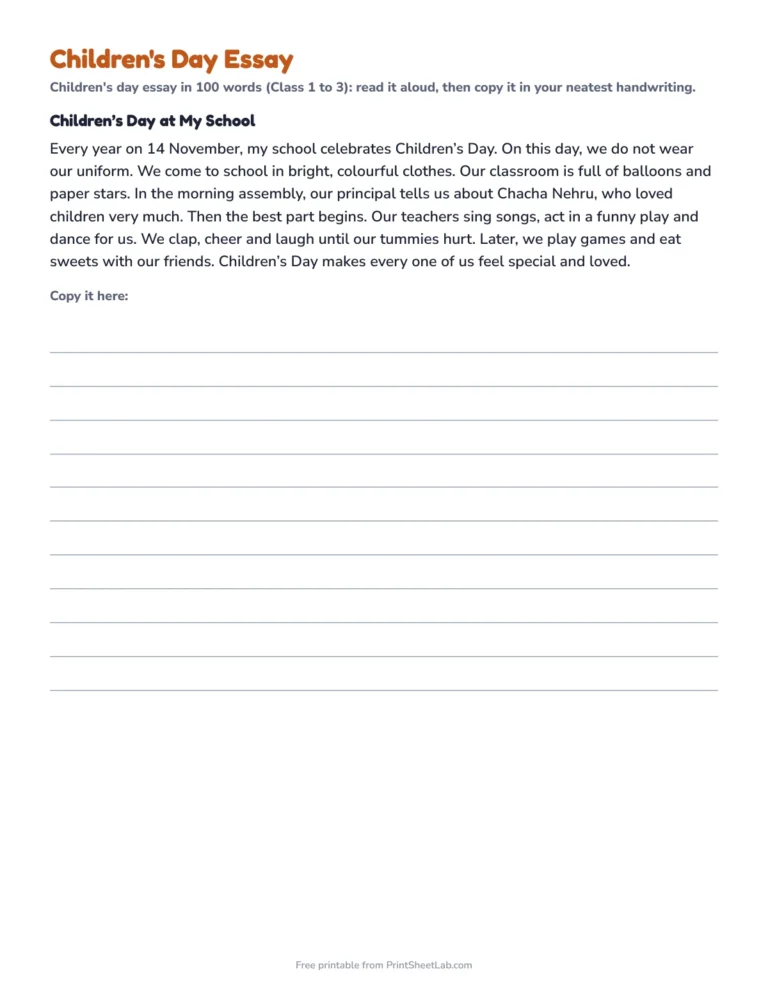
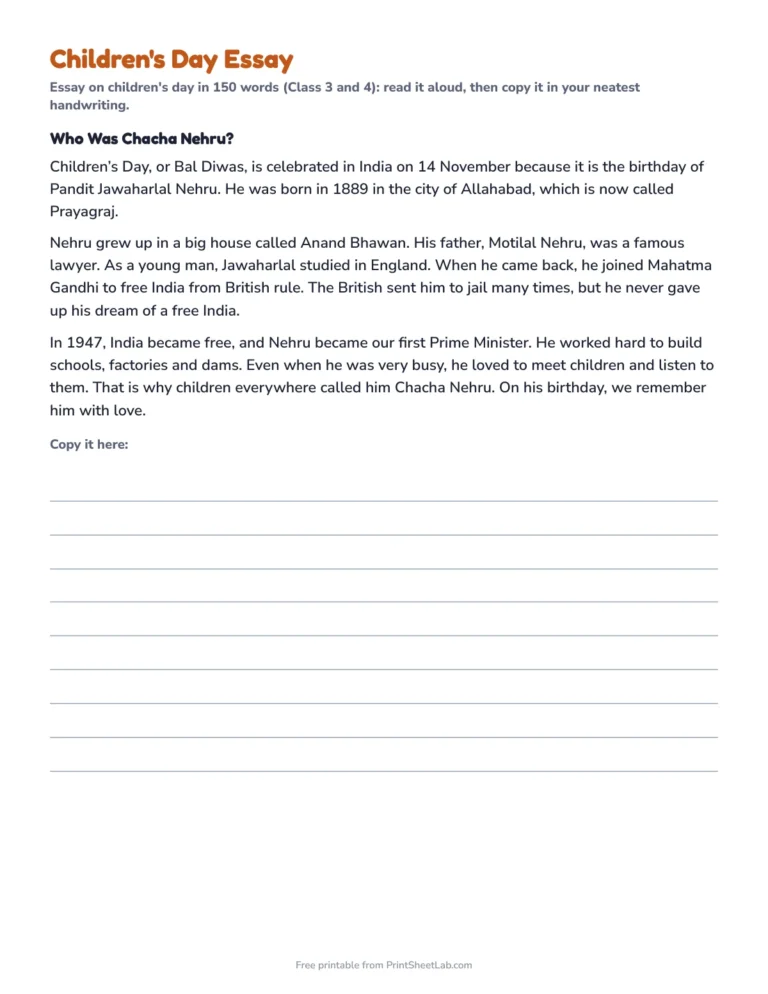
Print at 100% (actual size). Every page is black and white line art, so it copies cleanly on a school printer.
Related guides and printables
- Children’s Day quiz with answers
- Children’s Day speech for students and teachers
- 10 lines on Children’s Day
- Children’s Day worksheets
- Diwali essay for kids
- Reading comprehension worksheets
Sources
- Encyclopaedia Britannica: Jawaharlal Nehru (birth, education, imprisonment, years as Prime Minister, books, death)
- United Nations: Universal Children’s Day; Convention on the Rights of the Child (adopted 20 November 1989)
- UNICEF: World Children’s Day; Convention on the Rights of the Child, ratification by India (1992)
- Government of India: Right of Children to Free and Compulsory Education Act, 2009
- Incredible India (Ministry of Tourism): Anand Bhawan, Prayagraj
Further reading: Children's Day in India (Wikipedia), Jawaharlal Nehru (Wikipedia), World Children's Day (United Nations) and Convention on the Rights of the Child (UNICEF).
Frequently asked questions
7 quick answers
When is Children’s Day 2026?
Children’s Day in India is on Saturday 14 November 2026, and World Children’s Day is on Friday 20 November 2026. Many schools will celebrate on Friday 13 November.
How do I start an essay on children’s day?
Begin with one clear line: “Children’s Day is celebrated in India every year on 14 November, the birthday of Pandit Jawaharlal Nehru.” Then add why he loved children.
What is a good essay on children’s day for Class 5?
The 200-word or 300-word essay above suits Class 5. Both explain Nehru’s link to the day and how schools celebrate it.
How many words is a short children’s day essay?
A short essay is usually 100 to 150 words, or about 8 to 12 sentences. Longer school essays are 300 to 500 words with paragraphs or headings.
What should I write about children’s rights in my essay?
Mention that the UN adopted the Convention on the Rights of the Child in 1989, and that India’s Right to Education Act gives children aged 6 to 14 free schooling. Add one line on why these rights matter.
What is a good Children's Day essay for Class 5?
For Class 5, the 200-word Children's Day essay above is a good length. It explains why we celebrate on 14 November and what Chacha Nehru believed about children. You can also shorten the 300-word essay on Children's Day by keeping one paragraph from each part.
How should a long children's day essay in English be planned?
Plan three parts: the beginning says what the day is and when, the middle covers Nehru and the celebration, and the end gives the message.
Did you like this?
Last updated: