This Diwali essay for kids page has five ready essays in simple English, of 100, 150, 200, 300 and 500 words, for Class 1 to Class 8. Diwali 2026 falls on Sunday 8 November, so there is still time to read, practise and write your own essay on Diwali before the holidays.
Each Diwali essay for kids below is original and written in short sentences. Read one aloud, talk about it, then help your child write a version in their own words.
Coming up next: Diwali, Bhai Dooj, Children's Day, Chhath Puja and Guru Nanak Jayanti
Diwali (Sunday 8 November)
Bhai Dooj (Wednesday 11 November)
- Bhai Dooj quiz and games
- Bhai Dooj drawing and coloring pages
- Bhai Dooj wishes
- Bhai Dooj rangoli designs
Children's Day (Saturday 14 November)
- Children's Day quiz
- Children's Day drawing and coloring pages
- Children's Day worksheets
- Children's Day speech
Chhath Puja (Sunday 15 November)
- Chhath Puja quiz
- Chhath Puja drawing and coloring pages
- Chhath Puja wishes
- Why Chhath Puja is celebrated
Guru Nanak Jayanti (Tuesday 24 November)
Diwali essay for kids at a glance
| Essay | Best for | Main idea |
|---|---|---|
| 100 words | Class 1 to 3 | How my family celebrates |
| 150 words | Class 3 and 4 | The story of Rama’s return |
| 200 words | Class 4 and 5 | Why and how we celebrate |
| 300 words | Class 5 and 6 | One festival, many traditions |
| 500 words | Class 6 to 8 | Full essay with headings |
What is Diwali? A quick note before you write
Diwali, or Deepavali, is a Hindu festival that Sikhs and Jains also celebrate. The main day falls on the new moon night (Amavasya) of Kartik, in October or November. Many Hindus link it to Lord Rama’s return to Ayodhya, and families worship Goddess Lakshmi that evening.
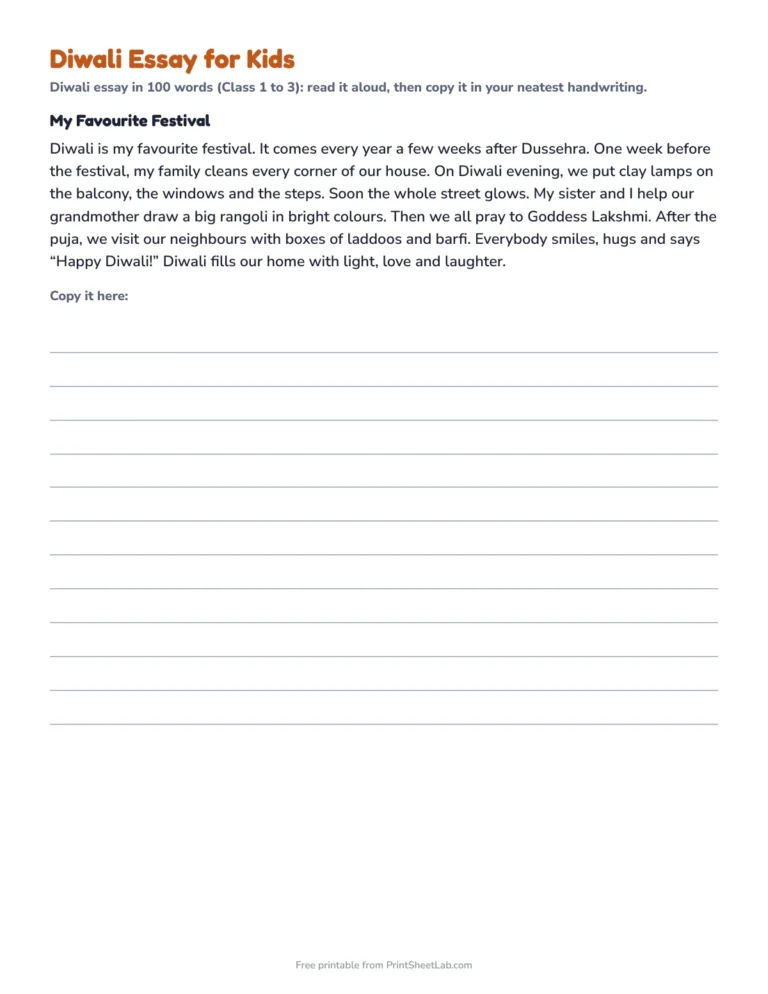
Diwali essay in 100 words (Class 1 to 3)
My Favourite Festival
Diwali is my favourite festival. It comes every year a few weeks after Dussehra. One week before the festival, my family cleans every corner of our house. On Diwali evening, we put clay lamps on the balcony, the windows and the steps. Soon the whole street glows. My sister and I help our grandmother draw a big rangoli in bright colours. Then we all pray to Goddess Lakshmi. After the puja, we visit our neighbours with boxes of laddoos and barfi. Everybody smiles, hugs and says “Happy Diwali!” Diwali fills our home with light, love and laughter.
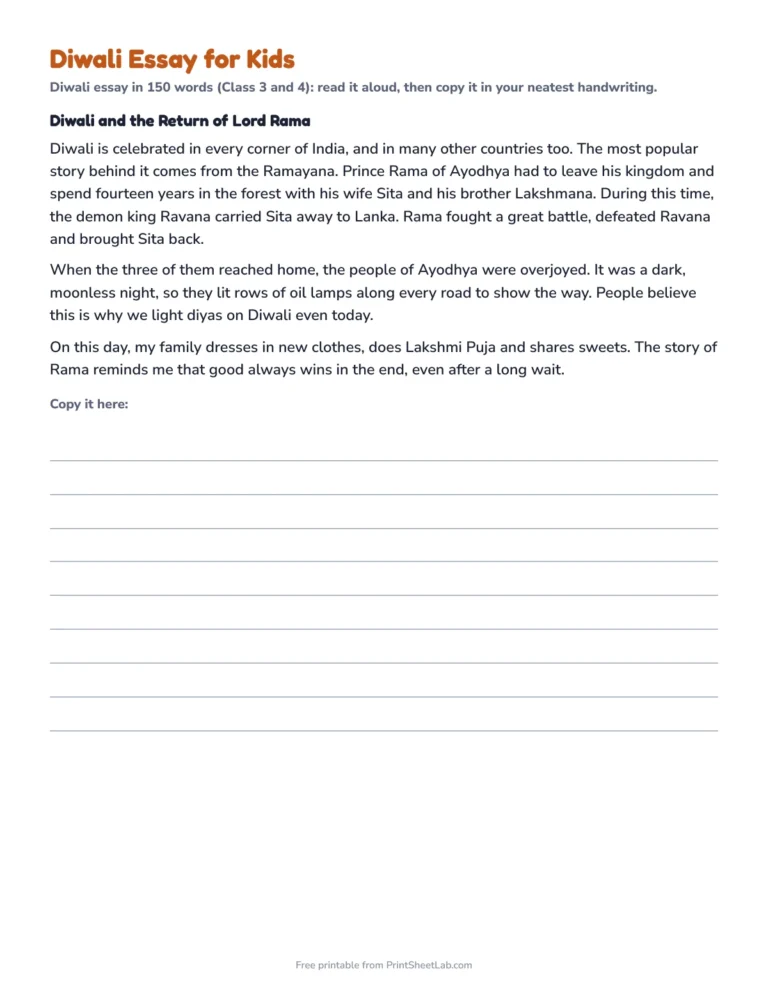
Diwali essay in 150 words (Class 3 and 4)
Diwali and the Return of Lord Rama
Diwali is celebrated in every corner of India, and in many other countries too. The most popular story behind it comes from the Ramayana. Prince Rama of Ayodhya had to leave his kingdom and spend fourteen years in the forest with his wife Sita and his brother Lakshmana. During this time, the demon king Ravana carried Sita away to Lanka. Rama fought a great battle, defeated Ravana and brought Sita back.
When the three of them reached home, the people of Ayodhya were overjoyed. It was a dark, moonless night, so they lit rows of oil lamps along every road to show the way. People believe this is why we light diyas on Diwali even today.
On this day, my family dresses in new clothes, does Lakshmi Puja and shares sweets. The story of Rama reminds me that good always wins in the end, even after a long wait.
Diwali essay in 200 words (Class 4 and 5)
Why and How We Celebrate Diwali
Diwali, also known as Deepavali, is one of the happiest times of the year in India. Schools close, markets fill with shoppers and homes shine with lights.
There are many reasons to celebrate. Many Hindus remember Lord Rama coming home to Ayodhya after defeating Ravana. Others honour Goddess Lakshmi, who is believed to bring wealth and good luck. In some places, people remember how Lord Krishna defeated the demon Narakasura. Sikhs and Jains have their own special reasons to celebrate at the same time.
Preparations begin days before. People clean and paint their homes, hang paper lanterns and buy new clothes. On the main evening, they light earthen lamps and draw rangoli at the entrance to welcome Goddess Lakshmi. After the puja, children enjoy sweets like gujiya, kaju katli and jalebi. Friends and relatives drop in with gifts, and the visits go on late into the night.
Diwali also brings people together. Neighbours who rarely talk greet each other warmly. Old quarrels are forgotten, and everyone wishes each other well. For me, the best part is sitting with my whole family in the soft glow of the lamps. Diwali teaches us to spread light, kindness and hope.
Diwali essay in 300 words (Class 5 and 6)
Diwali: One Festival, Many Traditions
Every year, as the weather turns cool in October or November, India gets ready for Diwali. It is a festival of joy, but it is not the same everywhere. Different regions and faiths celebrate it in their own special ways.
In North India, Diwali marks the day Lord Rama, Sita and Lakshmana returned to Ayodhya after fourteen years away. People light lamps just as the people of Ayodhya are believed to have done. In much of South India, the main celebration falls on Naraka Chaturdashi, which recalls Lord Krishna’s victory over the demon Narakasura. Many families there take an oil bath before sunrise. In West Bengal, Odisha and Assam, people worship Goddess Kali on the night of Diwali.
Diwali is also important for other faiths. Sikhs celebrate Bandi Chhor Divas, the day Guru Hargobind was freed from Gwalior Fort and returned to Amritsar. The Golden Temple is lit up beautifully on this night. For Jains, Diwali marks the day Lord Mahavira attained nirvana, or freedom from the cycle of birth and death.
Some customs are shared by almost everyone. Homes are cleaned and decorated. Earthen diyas are placed in rows on doorsteps and walls. Colourful rangoli patterns welcome guests. Families pray together and share boxes of sweets and dry fruits. Many business families also begin new account books on this day, and in Gujarat the next day is celebrated as the new year. In the evening, the sky sparkles and the air smells of ghee and flowers.
What I like most about Diwali is that it belongs to everyone. My friends from different families each tell a different story about the festival, but we all light lamps on the same night. Diwali shows that there are many ways to celebrate goodness. It teaches us to respect each other’s beliefs and to share our happiness with all.
Diwali essay in 500 words (Class 6 to 8)
Introduction
Some festivals are celebrated for one day, but Diwali lasts for five. It is one of the oldest and best-loved festivals of India, celebrated by Hindus, Sikhs and Jains, and enjoyed by people of every background. The name Deepavali comes from Sanskrit words meaning “a row of lamps”. On the darkest night of Kartik, millions of tiny flames turn cities and villages into seas of light. In 2025, UNESCO recognised Deepavali as world cultural heritage.
Why we celebrate
Diwali has many stories, and each one carries the same message: light wins over darkness, and good wins over evil. According to the Ramayana, Lord Rama returned to Ayodhya after defeating Ravana, and the joyful people lit lamps to welcome him. Many Hindus also worship Goddess Lakshmi, the goddess of wealth, and Lord Ganesha, who is believed to remove obstacles. In Bengal, the night belongs to Goddess Kali. Sikhs remember the release of Guru Hargobind from Gwalior Fort, and Jains mark the nirvana of Lord Mahavira.
The five days
The festival begins with Dhanteras, when families buy something new for the home, often a steel pot or a little gold or silver. The second day, Naraka Chaturdashi or Choti Diwali, recalls Krishna’s victory over Narakasura. The third day is the main day of Lakshmi Puja. Next comes Govardhan Puja, which remembers Krishna lifting Govardhan hill to shelter the people of Braj from heavy rain. The festival ends with Bhai Dooj, when sisters put a tilak on their brothers’ foreheads and pray for their long lives. In some years, the way the moon’s days fall stretches these five days over six calendar dates.
How we celebrate
Weeks before Diwali, homes are cleaned, painted and decorated with marigold garlands, torans and fairy lights. Markets become crowded with people buying clothes, utensils, sweets and gifts. On the main night, families wear their best clothes and gather for the puja. Diyas are lit in every room and along the boundary walls. Afterwards, people visit friends and relatives with mithai and dry fruits. Children love the chakli and besan laddoo that grandmothers make only once a year.
A safe and green Diwali
In recent years, many people have started to think about how Diwali affects the world around us. Firecrackers can cause burns, and their smoke adds to air pollution, which is already high in many Indian cities in November. The loud noise frightens pets, street animals and birds. Many families now choose clay diyas over plastic lights, natural colours for rangoli and gifts that do not come wrapped in plastic. These small choices keep the joy of the festival without harming others.
Conclusion
Diwali is much more than lights, sweets and new clothes. It is a time to clean not only our homes but also our hearts, to forgive, to give and to spend time with the people we love. When I light a diya on Diwali night, I remember that even one small flame can push back the dark. If each of us does a little good, together we can make the whole world brighter.
How to write a Diwali essay for kids
These steps work for an essay on Diwali for Class 5 or Class 8.
- Read the question carefully. Note the word limit and the title.
- Plan in three parts. An introduction (what Diwali is), a body (why and how it is celebrated) and a conclusion (what it means to you).
- Add one detail from your own home, such as the sweet your family always makes.
- Use a few strong words, from the list below, but keep sentences short and clear.
- Check facts. Write “many people believe” when you tell a story, because versions differ.
- Read it aloud at the end. Fix spellings and full stops, and count the words.
Write the first draft on our story paper, or plan it in pictures with the storyboard template.
Diwali essay in English: words to use
| Word or phrase | Meaning | Use it like this |
|---|---|---|
| Illuminate | To light up | Thousands of diyas illuminate the streets. |
| Auspicious | Lucky, a good time to begin something | Dhanteras is an auspicious day to buy something new. |
| Triumph | A great victory | The festival marks the triumph of good over evil. |
| Gratitude | Being thankful | We pray with gratitude for the year gone by. |
| Harmony | Living together peacefully | Diwali brings neighbours together in harmony. |
| Pollution | Making air, water or land dirty | Fewer crackers mean less pollution. |
Printable diwali essay for kids (free PDF)
Print this diwali essay for kids as reading and copying sheets: each essay on its own page, plus a ruled page where children write their own version. The diwali essay for kids PDF has 4 pages and prints on US Letter or A4.

Print at 100% (actual size). Every page is black and white line art, so it copies cleanly on a school printer.
Related guides and printables
- 10 lines on Diwali for every class
- Diwali worksheets: word search, acrostic and writing prompt
- 60 Diwali quiz questions with answers
- Diwali activities for kids
- Bhai Dooj quiz
- Reading comprehension worksheets
- Diwali coloring pages for kids
- Diwali speech for students
- Diwali wishes and card messages
Sources
- Diwali 2026 date: Government of India central holiday list for 2026 (Sunday 8 November), cross-checked with Drik Panchang
- Diwali 2026 five-day calendar: Drik Panchang, New Delhi
- UNESCO Intangible Cultural Heritage: Deepavali (inscribed December 2025)
- Wikipedia, with its cited sources: Diwali, Bandi Chhor Divas, Diwali (Jainism); Ramayana story as told in Valmiki’s Ramayana
Further reading: Diwali (Wikipedia) and Rangoli (Wikipedia).
Frequently asked questions
6 quick answers
When is Diwali 2026?
The main Diwali night, with Lakshmi Puja, is Sunday 8 November 2026. The festival starts with Dhanteras on Friday 6 November and ends with Bhai Dooj on Wednesday 11 November, as per Drik Panchang; some calendars put Bhai Dooj on 10 November.
How do I write an essay on Diwali in 100 words?
Write about eight short sentences: what Diwali is, how your home is lit, the rangoli and puja, sharing sweets, and how you feel.
Which Diwali essay is best for Class 5?
The 200-word and 300-word essays suit Class 5. They explain why and how different regions and faiths celebrate.
Can my child copy these essays for school?
Use them as models. Read one together, then ask your child to write their own version with one personal detail.
What are the five days of Diwali?
Dhanteras, Naraka Chaturdashi (Choti Diwali), Lakshmi Puja, Govardhan Puja and Bhai Dooj, from 6 to 11 November in 2026.
How should an essay on Diwali for Class 5 be planned?
Read the question carefully and note the word limit and title. Then plan it in three parts: an introduction saying what Diwali is, a body on why and how it is celebrated, and a conclusion on what the festival means.
Did you like this?
Last updated: