Simple word problems are short math stories with one step, small numbers and one clear question, such as “Sam has 4 red cars and 5 blue cars. How many cars does he have?” (4 + 5 = 9 cars). Below are 40 simple word problems for kids, 10 each for addition, subtraction, multiplication and division, with the number sentence and answer for every one, plus a four-step routine that helps children solve them on their own.
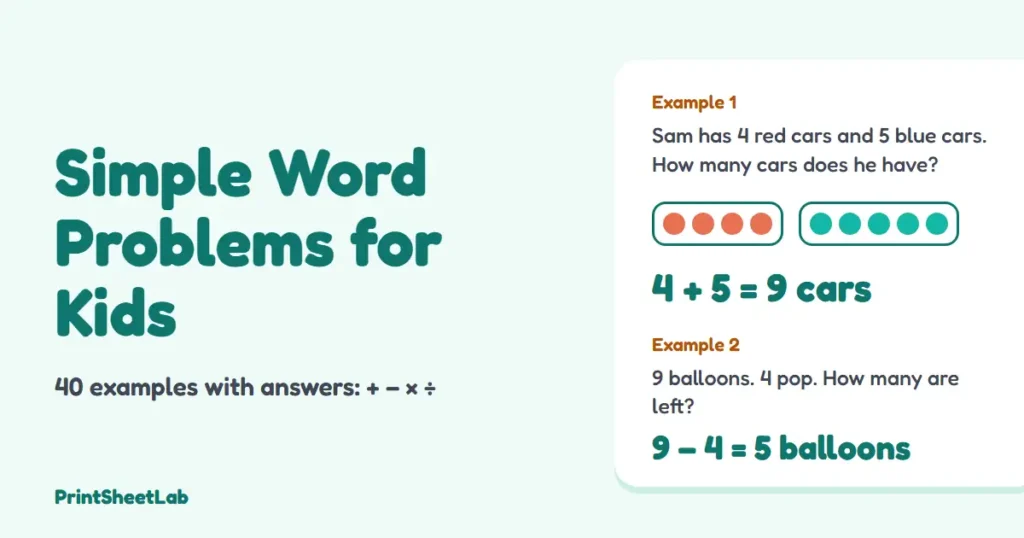
When your child is ready for more, the printable math word problems worksheets have 56 PDFs with answer keys, sorted by topic and grade.
What makes a word problem simple?
A word problem is simple when a child can picture the whole story at once and only needs one calculation to answer it. Simple word problems usually have:
- One step: one operation gives the answer, with no hidden question in the middle.
- Small, friendly numbers: within 20 for early addition and subtraction, or times tables facts for multiplication and division.
- A familiar story: toys, food, animals and family, so the words do not get in the way of the math.
- No extra information: every number in the story is needed.
Once children are confident with these, they are ready for two-step word problems, where they must find one number before they can find the answer.
How to solve a simple word problem in 4 steps
- Read the story twice. The first time, just listen to what happens. The second time, look for the numbers and the question.
- Picture or draw it. Quick circles, tally marks or a bar model show whether things are being joined, taken away, grouped or shared.
- Write a number sentence. For example, 9 + 6 = ? or 24 ÷ 4 = ?
- Answer in a sentence with the unit. “There are 15 apples in the basket” is better than just “15”, because it shows the child has answered the question that was asked.
For a longer walk-through with harder examples, see our guide on how to solve math word problems.
10 simple addition word problems
Addition stories join two groups or add more to a group. The first eight stay within 20; the last two use tens and ones within 100.
| # | Word problem | Number sentence | Answer |
|---|---|---|---|
| 1 | Sam has 4 red cars and 5 blue cars. How many cars does he have? | 4 + 5 = 9 | 9 cars |
| 2 | There are 7 birds on a fence. 3 more birds land. How many birds are on the fence now? | 7 + 3 = 10 | 10 birds |
| 3 | Lily reads 6 pages in the morning and 8 pages at night. How many pages does she read? | 6 + 8 = 14 | 14 pages |
| 4 | A basket has 9 apples. Dad puts in 6 more. How many apples are in the basket? | 9 + 6 = 15 | 15 apples |
| 5 | Ben scores 8 points in the first game and 7 in the second. How many points does he score in all? | 8 + 7 = 15 | 15 points |
| 6 | There are 12 children on the bus. 5 more get on. How many children are on the bus now? | 12 + 5 = 17 | 17 children |
| 7 | Mia has 11 stickers. Her friend gives her 9 more. How many stickers does Mia have? | 11 + 9 = 20 | 20 stickers |
| 8 | A class plants 14 sunflowers and 6 tulips. How many flowers do they plant? | 14 + 6 = 20 | 20 flowers |
| 9 | Grandma bakes 25 cookies on Monday and 30 on Tuesday. How many cookies does she bake? | 25 + 30 = 55 | 55 cookies |
| 10 | A shop sells 42 pencils in the morning and 36 in the afternoon. How many pencils does it sell? | 42 + 36 = 78 | 78 pencils |
10 simple subtraction word problems
Subtraction stories take some away, find what is left, or compare two amounts. Problems 6 and 10 are comparison stories (“how many more”, “how much taller”), which many children find harder than take-away stories, even though the numbers are small.
| # | Word problem | Number sentence | Answer |
|---|---|---|---|
| 1 | There are 9 balloons. 4 pop. How many balloons are left? | 9 − 4 = 5 | 5 balloons |
| 2 | Tom has 10 crayons. He gives 3 to his sister. How many crayons does Tom have now? | 10 − 3 = 7 | 7 crayons |
| 3 | There are 15 ducks on a pond. 7 fly away. How many ducks are still on the pond? | 15 − 7 = 8 | 8 ducks |
| 4 | Ava has 12 grapes. She eats 5. How many grapes are left? | 12 − 5 = 7 | 7 grapes |
| 5 | A box holds 18 eggs. 9 are used for a cake. How many eggs are left in the box? | 18 − 9 = 9 | 9 eggs |
| 6 | Jack has 14 marbles. Leo has 8. How many more marbles does Jack have than Leo? | 14 − 8 = 6 | 6 marbles |
| 7 | A book has 20 pages. Noah has read 13. How many pages does he still have to read? | 20 − 13 = 7 | 7 pages |
| 8 | There are 16 children in the pool. 9 get out. How many children are still in the pool? | 16 − 9 = 7 | 7 children |
| 9 | A baker makes 50 rolls and sells 32. How many rolls are left? | 50 − 32 = 18 | 18 rolls |
| 10 | A tree is 75 cm tall and a bush is 48 cm tall. How much taller is the tree? | 75 − 48 = 27 | 27 cm |
For more stories like these, with space to draw, print the addition and subtraction word problems worksheets for grades 1 and 2.
10 simple multiplication word problems
Multiplication stories have equal groups: bags with the same number of oranges, rows with the same number of chairs. Ask “how many groups, and how many in each group?” before writing the number sentence.
| # | Word problem | Number sentence | Answer |
|---|---|---|---|
| 1 | There are 3 bags with 2 oranges in each bag. How many oranges are there? | 3 × 2 = 6 | 6 oranges |
| 2 | A spider has 8 legs. How many legs do 2 spiders have? | 2 × 8 = 16 | 16 legs |
| 3 | There are 4 rows of chairs with 5 chairs in each row. How many chairs are there? | 4 × 5 = 20 | 20 chairs |
| 4 | Each pack has 6 juice boxes. How many juice boxes are in 3 packs? | 3 × 6 = 18 | 18 juice boxes |
| 5 | A car has 4 wheels. How many wheels do 5 cars have? | 5 × 4 = 20 | 20 wheels |
| 6 | Mom buys 7 bunches of bananas with 3 bananas in each bunch. How many bananas does she buy? | 7 × 3 = 21 | 21 bananas |
| 7 | A box of pencils holds 10 pencils. How many pencils are in 6 boxes? | 6 × 10 = 60 | 60 pencils |
| 8 | There are 5 tables with 8 children at each table. How many children are there? | 5 × 8 = 40 | 40 children |
| 9 | A comic costs $4. How much do 9 comics cost? | 9 × $4 = $36 | $36 |
| 10 | A garden has 6 rows of carrots with 7 carrots in each row. How many carrots are there? | 6 × 7 = 42 | 42 carrots |
10 simple division word problems
Division stories come in two kinds. In sharing problems you know the number of groups and find how many are in each (problems 1, 3, 5, 7, 8 and 10). In grouping problems you know how many are in each group and find the number of groups (problems 2, 4, 6 and 9). Both use the same number sentence.
| # | Word problem | Number sentence | Answer |
|---|---|---|---|
| 1 | 6 cookies are shared equally between 2 friends. How many cookies does each friend get? | 6 ÷ 2 = 3 | 3 cookies |
| 2 | There are 12 eggs packed in boxes of 6. How many boxes are there? | 12 ÷ 6 = 2 | 2 boxes |
| 3 | 15 children sit in 3 equal groups. How many children are in each group? | 15 ÷ 3 = 5 | 5 children |
| 4 | 20 apples are put into bags of 5. How many bags are filled? | 20 ÷ 5 = 4 | 4 bags |
| 5 | A teacher shares 24 pencils equally among 4 tables. How many pencils does each table get? | 24 ÷ 4 = 6 | 6 pencils |
| 6 | 18 socks are put into pairs. How many pairs are there? | 18 ÷ 2 = 9 | 9 pairs |
| 7 | A ribbon 30 cm long is cut into 3 equal pieces. How long is each piece? | 30 ÷ 3 = 10 | 10 cm |
| 8 | 35 flowers are put into 5 vases with the same number in each. How many flowers are in each vase? | 35 ÷ 5 = 7 | 7 flowers |
| 9 | A farmer packs 40 eggs into boxes of 10. How many boxes does he fill? | 40 ÷ 10 = 4 | 4 boxes |
| 10 | $48 is shared equally among 6 children. How much does each child get? | $48 ÷ 6 = $8 | $8 |
The multiplication and division word problems worksheets have more equal groups, arrays, sharing and grouping stories for grades 3 and 4.
Simple word problems by grade
| Grade | What simple word problems look like | Example |
|---|---|---|
| Kindergarten | Add or take away within 10, acted out with objects | There are 9 balloons. 4 pop. How many are left? |
| Grade 1 | Add and subtract within 20, including comparison stories | Jack has 14 marbles. Leo has 8. How many more does Jack have? |
| Grade 2 | Add and subtract within 100 | A shop sells 42 pencils, then 36 more. How many in all? |
| Grade 3 | Multiply and divide within 100 using equal groups | There are 5 tables with 8 children at each. How many children? |
These grade levels follow the operations and algebraic thinking standards in the Common Core State Standards for Mathematics (K.OA.A.2, 1.OA.A.1, 2.OA.A.1 and 3.OA.A.3). Start with simple word problems, sometimes called easy word problems, one grade below your child’s level, and move up once they are confident.
Tips for writing your own simple word problems
- Use your child’s world. A story about their own toys, pets or snack is easier to picture than one about strangers.
- Change one thing at a time. Keep the story the same and change the numbers, or keep the numbers and change the story from “join” to “compare”.
- Let your child write one. Give them a number sentence such as 12 − 5 and ask them to tell a story that matches it. This shows whether they really understand what subtraction means.
- Keep the reading easy. Short sentences and familiar words let children focus on the math.
Common mistakes with simple word problems
- Grabbing the numbers and adding them. Ask “what is happening in the story?” before any calculation.
- Trusting one key word. “More” does not always mean add: “How many more marbles does Jack have?” is a subtraction.
- Forgetting the unit. An answer of “8” does not say whether it is 8 ducks or 8 eggs.
- Not checking. Ask “does the answer make sense?” If there are fewer balloons after some pop, the answer must be smaller than 9.
Printable simple word problems (free PDF)
Print these simple word problems as worksheets, one operation per page with room to draw, plus an answer key with each number sentence. The simple word problems PDF has 5 pages and prints on US Letter or A4.

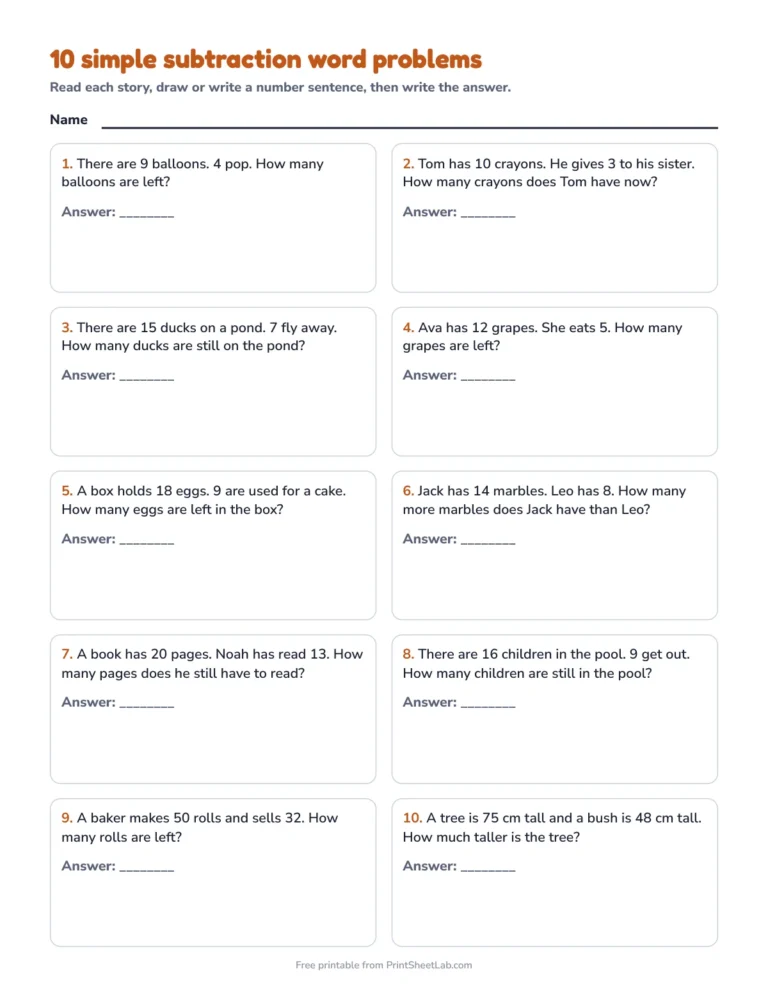
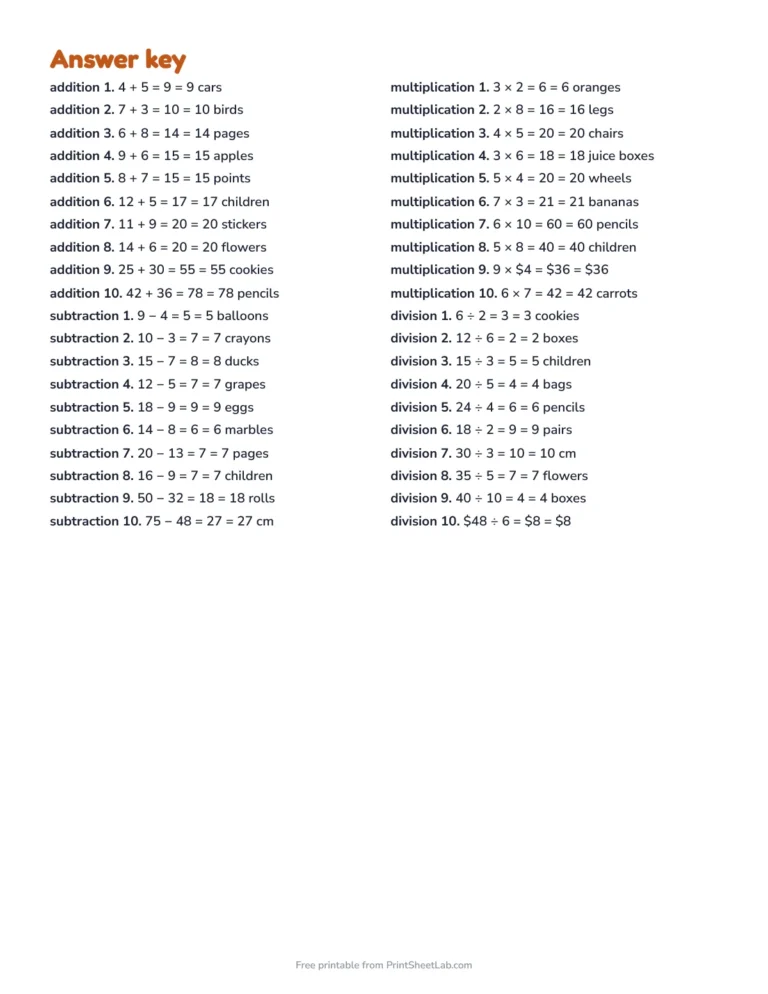
Print at 100% (actual size). Every page is black and white line art, so it copies cleanly on a school printer.
Frequently asked questions
5 quick answers
What is a simple word problem?
A simple word problem is a short story with one question that can be answered with one calculation, using small numbers and a familiar situation. For example: “There are 7 birds on a fence. 3 more land. How many birds are there now?”
What is an example of a simple math word problem?
“A basket has 9 apples. Dad puts in 6 more. How many apples are in the basket?” The number sentence is 9 + 6 = 15, so there are 15 apples.
At what age do children start simple word problems?
Most children meet simple addition and subtraction stories within 10 in kindergarten, around age 5 or 6, usually acted out with objects or drawings before they write number sentences.
How do I help my child with simple word problems?
Read the story aloud together, ask your child to draw what happens, then write the number sentence. Finish by saying the answer in a full sentence with the unit.
Where can I find printable simple word problems?
The free math word problems worksheets on PrintSheetLab have 56 printable PDFs with answer keys, starting with one-step stories within 20.
Related guides and printables
- Math word problems worksheets (56 free PDFs)
- Addition and subtraction word problems
- Multiplication and division word problems
- Two-step word problems
- How to solve math word problems: a 6-step method
- Fraction of a fraction word problems
Did you like this?
Last updated: