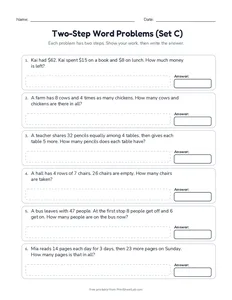
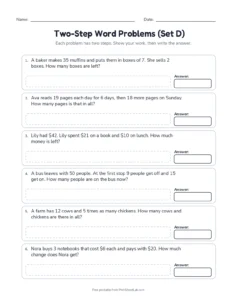
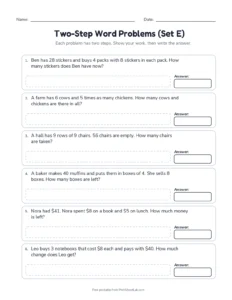
Two-step word problems hide a question inside the question: children have to find one number before they can find the answer. The five PDFs on this page have six problems each that need two calculations, using all four operations, with space for each step, and every sheet has an answer key. They follow standards 3.OA.D.8 and 4.OA.A.3 of the Common Core standards for grade 3 operations and algebraic thinking, and the notes below show how to find the hidden question, how to check with an estimate and how to write the steps.
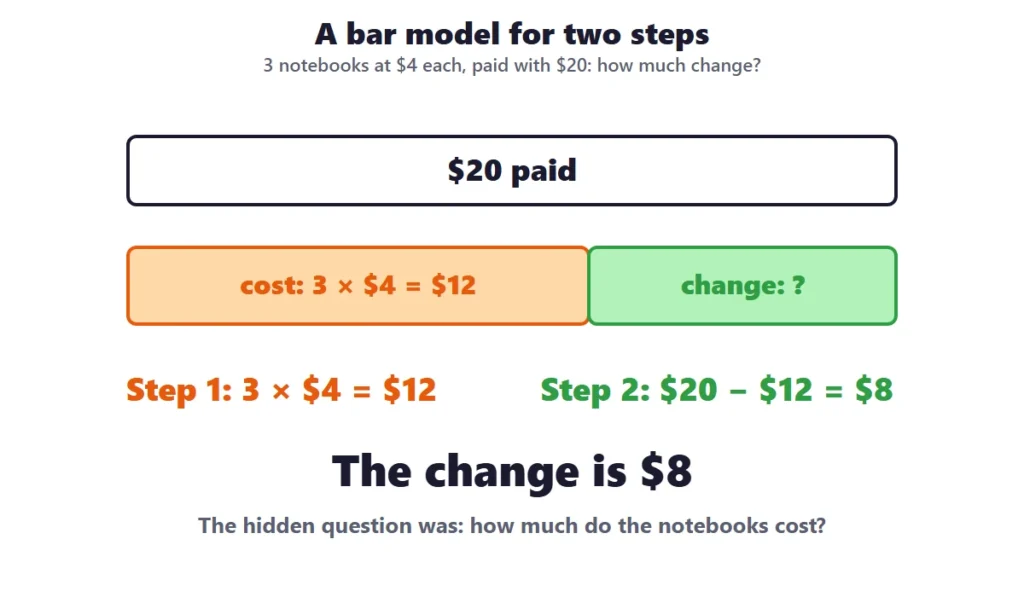
A bar model. 3 notebooks at $4, paid with $20.
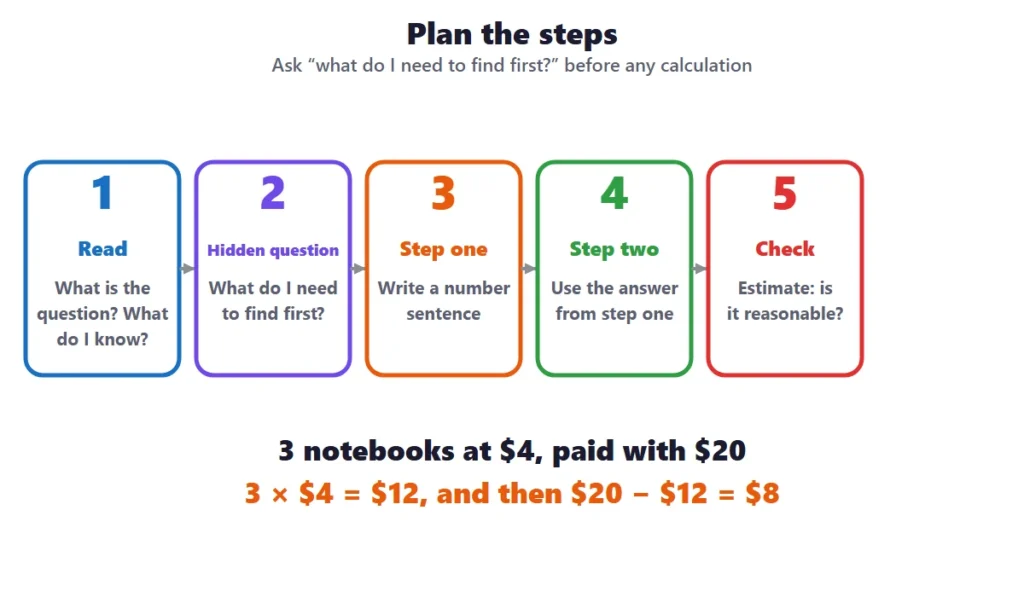
Plan the steps
Two-step problems hide a question inside the question. In “3 notebooks at $4 each, pay with $20, how much change?”, you first need the cost (3 × $4 = $12), then the change ($20 − $12 = $8). Asking “What do I need to find first?” is the key habit. Grade 3 children solve two-step problems with all four operations (Common Core 3.OA.D.8).
Two-step word problems worksheets: what is in the set
There are 5 two-step word problems worksheets on this page, and every one has an answer key except for any cut-out games. Every set has six problems that need two calculations, and the five sets mix all four operations.
Worksheet
What children do
Standard
Two-Step Word Problems (Set A)
Six problems that need two steps.
3.OA.D.8
Two-Step Word Problems (Set B)
Six more two-step problems.
3.OA.D.8
Two-Step Word Problems (Set C)
Six more two-step problems.
3.OA.D.8
Two-Step Word Problems (Set D)
Six more problems that need two calculations.
3.OA.D.8
Two-Step Word Problems (Set E)
Six more mixed two-step problems.
3.OA.D.8
Two step word problems: what they look like
Two step word problems ask one question, but the answer needs two calculations. The first calculation finds a number that the story does not give, and the second uses it to answer the question. The step that is hidden is often the one that children miss. Wikipedia’s article on word problems describes why these problems are important in school mathematics. This table shows eight problems, with the hidden step, the two number sentences and the answer:
Problem
Hidden question
Step 1
Step 2
Answer
3 notebooks cost $4 each. Mia pays with a $20 bill. How much change does she get?
How much do the 3 notebooks cost?
3 × 4 = 12
20 − 12 = 8
8
Mia has 24 stickers and gets 8 more. She shares all of them equally among 4 friends. How many does each friend get?
How many stickers does Mia have in all?
24 + 8 = 32
32 ÷ 4 = 8
8
A school has 5 boxes of 12 pencils. 9 pencils are broken. How many good pencils are there?
How many pencils are there in all?
5 × 12 = 60
60 − 9 = 51
51
A class of 30 children has 12 children away. The rest make teams of 6. How many teams are there?
How many children are here?
30 − 12 = 18
18 ÷ 6 = 3
3
A book has 100 pages. Ravi reads 15 pages a day for 4 days. How many pages are left?
How many pages has Ravi read?
15 × 4 = 60
100 − 60 = 40
40
Ana has 48 beads. She uses 3 beads for each of 10 bracelets. How many beads are left?
How many beads did Ana use?
3 × 10 = 30
48 − 30 = 18
18
A pizza costs $18 and is shared by 6 people. Each person also buys a $2 drink. How much does each person pay?
How much is each person’s share of the pizza?
18 ÷ 6 = 3
3 + 2 = 5
5
A shirt costs $14 and shorts cost $9. How much do 2 sets cost?
How much do one shirt and one pair of shorts cost?
14 + 9 = 23
23 × 2 = 46
46
Each of the eight problems uses two different operations. In the change, book and bead problems the first step finds an amount that is taken away from a total, so the second step subtracts it from the total and not the other way round. Reading the whole story before writing anything is the best habit.
Two step word problems grade 3: the standard 3.OA.D.8
For two step word problems grade 3, the standard is 3.OA.D.8. Children solve two-step problems with the four operations, write equations with a letter for the unknown, and judge whether answers are reasonable using mental math and estimation, including rounding. The Common Core standards for grade 3 operations and algebraic thinking list it with the other grade 3 standards. Each of the three parts is practiced on this page: the steps, the equation and the estimate. This table shows the equation with a letter for five stories:
Story
Equation with an unknown n
Step 1
Solve for n
3 packs of 4 stickers, and n more make 20
3 × 4 + n = 20
3 × 4 = 12
n = 20 − 12 = 8
5 packs of 6 stickers, and n more make 40
5 × 6 + n = 40
5 × 6 = 30
n = 40 − 30 = 10
2 packs of 15 stickers, and n more make 50
2 × 15 + n = 50
2 × 15 = 30
n = 50 − 30 = 20
4 packs of 9 stickers, and n more make 60
4 × 9 + n = 60
4 × 9 = 36
n = 60 − 36 = 24
6 packs of 7 stickers, and n more make 50
6 × 7 + n = 50
6 × 7 = 42
n = 50 − 42 = 8
The letter n is the hidden number that is left after the first step. A child who writes the equation first and then solves it in two steps is using algebra, even if they do not call it that. The addition and subtraction word problems and multiplication and division word problems pages have the one-step stories that come before.
Mixed operations word problems: sixteen pairs of steps
Mixed operations word problems can use any two of the four operations, and there are sixteen possible pairs, in order. Most of the problems in grade 3 use only some of them, but children should be ready for any. This table shows the sixteen pairs for the numbers 24, 4 and 2:
First step ↓ Second step →
then + 2
then − 2
then × 2
then ÷ 2
+
(24 + 4) + 2 = 30
(24 + 4) − 2 = 26
(24 + 4) × 2 = 56
(24 + 4) ÷ 2 = 14
−
(24 − 4) + 2 = 22
(24 − 4) − 2 = 18
(24 − 4) × 2 = 40
(24 − 4) ÷ 2 = 10
×
(24 × 4) + 2 = 98
(24 × 4) − 2 = 94
(24 × 4) × 2 = 192
(24 × 4) ÷ 2 = 48
÷
(24 ÷ 4) + 2 = 8
(24 ÷ 4) − 2 = 4
(24 ÷ 4) × 2 = 12
(24 ÷ 4) ÷ 2 = 3
The table shows that the order of the operations changes the answer. (24 + 4) ÷ 2 is 14, but (24 ÷ 4) + 2 is 8. This is the reason why each step is written on its own line, and why the brackets matter when two steps are written together.
Multi step word problems: grade 4 and beyond
In grade 4, the multi step word problems can have more than two steps, and some have remainders that must be interpreted. Standard 4.OA.A.3 asks children to solve multistep problems with whole numbers and the four operations, including problems in which the remainder has to be interpreted. The Common Core standards for grade 4 operations and algebraic thinking describe the standard. This table shows four problems with the same division and different meanings of the remainder:
Problem
Division
Answer
What the remainder means
A van holds 8 people. 50 people are going. How many vans are needed?
50 ÷ 8 = 6 R2
round up: 7 vans
the 2 people who are left need a van
Eggs are packed 6 to a box. There are 50 eggs. How many full boxes?
50 ÷ 6 = 8 R2
drop the remainder: 8 boxes
only full boxes count
50 cookies are shared by 7 children, and the rest are kept. How many does each child get?
50 ÷ 7 = 7 R1
7 each
the leftover stays in the jar
A rope of 50 m is cut into 4 m pieces. How long is the piece left over?
50 ÷ 4 = 12 R2
2 m
the remainder is the answer
The same division, 50 ÷ 8, can give an answer of 6, 7 or 2, depending on the question. A good habit for children is to ask “what does the remainder mean here?” before writing the answer. The division with remainders and long division worksheets pages have the division skills.
4th grade word problems: estimating to check
In 4th grade word problems, the numbers are larger, and children check their answers with an estimate. To estimate a two-step problem, round each number to the nearest ten, and do the two steps with the rounded numbers. This table shows six problems, with the estimate and the exact answer:
Plan the steps. Find the hidden question first.
Calculation
Estimate with rounded numbers
Exact answer
Reasonable?
(19 × 6) − 8
(20 × 6) − 10 = 110
106
close
(52 + 38) ÷ 6
(50 + 40) ÷ 6 = 15
15
close
(75 − 28) × 3
(80 − 30) × 3 = 150
141
close
(31 × 4) − 45
(30 × 4) − 50 = 70
79
close
(96 ÷ 8) + 37
(100 ÷ 8) + 40 = 52
49
close
(63 + 29) − 18
(60 + 30) − 20 = 70
74
close
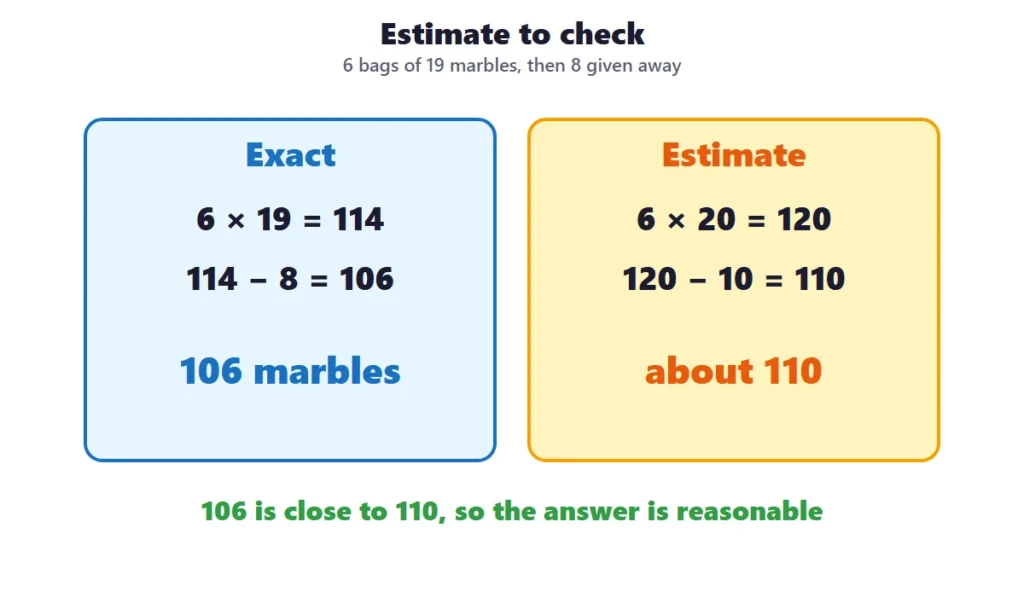
An estimate is not an exact answer, and the question is only whether the exact answer is close. The estimate for 19 × 6 − 8 is 20 × 6 − 10 = 110, and the exact answer is 106, so the answer is reasonable. The estimating with rounding page has more practice with estimating, and the money worksheets pages use two-step problems with change.
Common mistakes with two-step word problems
The most common mistake is to stop after the first step. This table shows five mistakes, what went wrong and the fix:
What the child writes or says
What went wrong
The fix
Answers the first step and stops
does not see that the question is not yet answered
underline the question, and check that the answer matches it
3 × $4 + $20 = $32
adds the paid money to the cost
the change is what is left of the $20: $20 − $12 = $8
Does the steps in the order the numbers appear
does not find the hidden question
ask “what do I need to find first?”
Writes one long number sentence that is wrong
puts both steps in one line without brackets
write one number sentence for each step
Does not check the answer
moves on after the second step
estimate with rounded numbers and see if the answer is close
Two-step word problems word problems
Two-step stories hide a question inside the question. Ask children to say the hidden question, write one number sentence for each step, and then answer in a sentence:
Word problem
Working
Answer
3 notebooks cost $4 each. Mia pays with a $20 bill. How much change does she get?
3 × $4 = $12, then $20 − $12
$8
A box of 24 stickers gets 8 more, and all of them are shared among 4 friends. How many does each friend get?
24 + 8 = 32, then 32 ÷ 4
8 stickers
A school has 5 boxes of 12 pencils, and 9 are broken. How many good pencils are there?
5 × 12 = 60, then 60 − 9
51 pencils
30 children are in a class and 12 are away. The rest make teams of 6. How many teams are there?
30 − 12 = 18, then 18 ÷ 6
3 teams
A book has 100 pages. Ravi reads 15 pages a day for 4 days. How many pages are left?
15 × 4 = 60, then 100 − 60
40 pages
A pizza costs $18 and 6 people share it. Each also buys a $2 drink. How much does each person pay?
$18 ÷ 6 = $3, then $3 + $2
$5
Games and activities for two-step word problems
Children learn two-step word problems best when they play with it. These games use things that are found at home or in a classroom:
Hidden question: read a story and say only the hidden question, without any calculating
Story chains: one child writes the first step, and a partner writes the second
Make it two steps: take a one-step story and add a second question to it
Shop and change: buy two items at a class shop with play money and find the change
Estimate first: estimate each answer before calculating, and see who is closest
Word problem bingo: a bingo card with answers, and calling cards with stories
Extra support and extra challenge with two-step word problems
For children who need more support: make sure that one-step stories are secure first, and do each problem as two separate one-step stories. Cover the second question until the first is answered. Write the first step on one line and the second on another, and draw a bar model if it helps. Do one sheet at a time with the answer key beside the work.
For children who need more challenge: ask for a story that needs three steps, for a story that fits the equation 3 × 4 + n = 20, and for a story where the remainder has to be rounded up in the last step. Making up their own two-step story, and swapping it with a friend, is a good challenge.
How to tell that a child is ready to move on from two-step word problems
Before moving on from two-step word problems, check that the child can do all four of these things:
The child says the hidden question before calculating.
The child writes one number sentence for each step.
The child answers the question that is asked, not the first step.
A short lesson is the best way to introduce two-step word problems. This 20-minute plan can be used in a classroom, at a tutoring session or at home, and it uses the worksheets at the end:
Estimate to check. Exact 106 and estimate 110.
Minutes
Activity
What to say or ask
0 to 3
Read “3 notebooks at $4, paid with $20” and ask for the change
What do we need to find first?
3 to 8
Draw a bar of $20, and mark the cost of the notebooks
How much do the notebooks cost?
8 to 13
Write one number sentence for each step
Which step comes first?
13 to 18
Estimate the answer with rounded numbers
Is the exact answer close?
18 to 20
Start a worksheet and check one answer
Did we answer the question that was asked?
Where two-step word problems fits across the grades
No skill stands alone. This table shows what children learn before and after two-step word problems, with the standard that goes with each step:
This page is the last of the whole-number word problem pages. The whole sequence is on the math word problems worksheets page.
Helping at home with two-step word problems
Parents do not need to be experts to help with two-step word problems. These suggestions work well, and each takes only a few minutes:
Ask “what do you need to find first?” when a problem looks hard.
Use real shopping: two items, then the change.
Ask the child to read the question again before the answer is written.
Estimate together, and ask “is it close?”.
Check that the answer is for the question that was asked.
How to check progress in two-step word problems
A teacher or parent can check progress in two-step word problems with the answer key and a few questions. This table shows three common situations, what they mean and what to do next:
What you see
What it means
What to do next
The child answers with the number from step one
The hidden question was found but the second step was forgotten
Underline the question, and check the answer against it
The child gets 9 of 10 right in every set
The skill is secure
Move on to grade 4 multistep problems
The child puts both steps in one number sentence and gets it wrong
The order of the steps is not clear
Write one sentence per step, and add brackets only later
A five-day plan for two-step word problems
Most children need about a week of short sessions for two-step word problems. This plan follows the order of the worksheets on this page:
Day
What to do
Practice
Day 1
Find the hidden question in five stories, without calculating
Two-Step Word Problems (Set A)
Day 2
Write one number sentence for each step
Two-Step Word Problems (Set B)
Day 3
Stories that use multiplication and then subtraction
Two-Step Word Problems (Set C)
Day 4
Stories that use division, and check with an estimate
Two-Step Word Problems (Set D)
Day 5
A mix of all four operations
Two-Step Word Problems (Set E)
When the plan for two-step word problems is complete, the child is ready for multi-step stories. The whole sequence is on the math word problems worksheets page.
Frequently asked questions
5 quick answers
Should children write two number sentences?
Yes. One sentence per step makes the thinking visible and easy to check.
How do I check the answer is reasonable?
Estimate. If each notebook is about $4 and you buy 3, the cost is about $12, so change from $20 should be around $8.
Should children write two number sentences?
Yes. One sentence per step makes the thinking visible and easy to check. Later, children can combine them into one equation with brackets or a letter for the unknown.
How do I check that the answer is reasonable?
Estimate. If each notebook is about $4 and you buy 3, the cost is about $12, so the change from $20 should be about $8. Round each number to the nearest ten and do the two steps.
What is the hidden question in two-step word problems?
It is the question that you need to answer first, before you can answer the question that is asked. In “3 notebooks at $4 each, paid with $20, how much change?”, the hidden question is “how much do the notebooks cost?”.