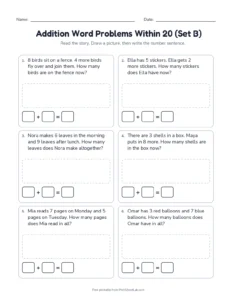
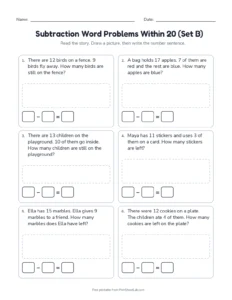
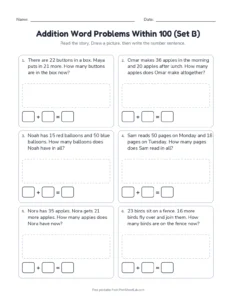
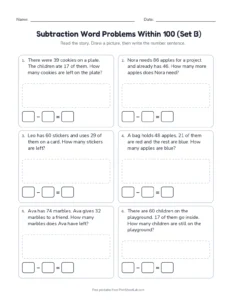
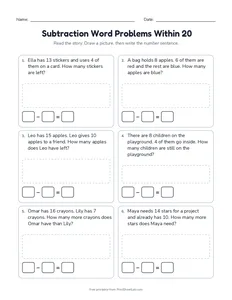
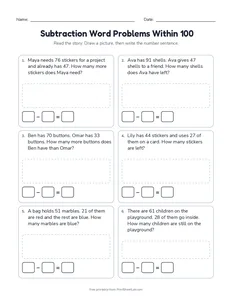
Addition and subtraction word problems are the first stories that children turn into number sentences. The eight PDFs on this page have stories within 20 and within 100, with space to draw, and every sheet has an answer key. They follow standards 1.OA.A.1 and 2.OA.A.1 of the Common Core standards for grade 1 operations and algebraic thinking, and the notes below show the kinds of story that children meet, and how to teach each one.
Part, part, whole. 3 red and 5 blue make 8.
Quick answer: Addition and subtraction word problems are short stories where children decide whether to add or subtract. The main types are add to, take from, put together, take apart and compare. This page has 8 free printable worksheets with answer keys for grades 1 and 2. Updated October 2026.
Types of stories
Addition stories join groups (“gets 5 more”). Subtraction stories take away (“gives 3 away”), compare (“how many more”) or find a missing part (“the rest are blue”). Mixing these types, as these sheets do, helps children think about the story instead of guessing from key words.
Addition and subtraction word problems worksheets: what is in the set
There are 8 addition and subtraction word problems worksheets on this page, and every one has an answer key except for any cut-out games. Four sheets are within 20 and four are within 100, and each set has joining stories or take-away, compare and missing part stories.
Worksheet
What children do
Standard
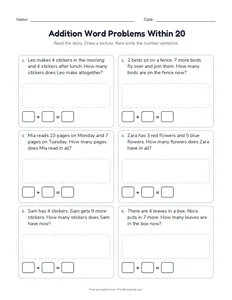
Addition Word Problems Within 20
Six joining stories to draw and solve.
1.OA.A.1
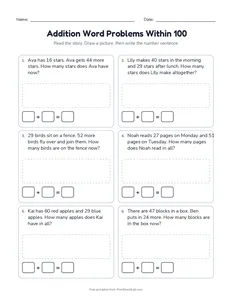
Addition Word Problems Within 100
Six stories with 2-digit numbers.
1.OA.A.1
Addition Word Problems Within 20 (Set B)
More join stories within 20, with space to draw.
1.OA.A.1
Subtraction Word Problems Within 20 (Set B)
More take-away and compare stories within 20.
1.OA.A.1
Addition Word Problems Within 100 (Set B)
Two-digit addition stories.
1.OA.A.1
Subtraction Word Problems Within 100 (Set B)
Two-digit subtraction stories.
1.OA.A.1
Subtraction Word Problems Within 20
Take away, compare and missing part stories.
1.OA.A.1
Subtraction Word Problems Within 100
Six stories with 2-digit numbers.
1.OA.A.1
Addition and subtraction word problems: twelve kinds of story
Addition and subtraction word problems seem simple, but there are twelve different kinds of story, and some are much harder than others. The Common Core standards group them as add to, take from, put together or take apart, and compare, and each group has three versions in which a different part of the story is unknown. Wikipedia’s article on word problems explains why the position of the unknown matters so much. This table shows all twelve with the numbers 3, 5 and 8:
Kind of story
What is unknown
Example
Number sentence
Answer
Add to
result unknown
5 birds sit on a fence. 3 more birds fly to the fence. How many birds are on the fence now?
5 + 3 = ?
8
Add to
change unknown
5 birds sit on a fence. Some more birds fly to the fence. Now there are 8. How many flew in?
5 + ? = 8
3
Add to
start unknown
Some birds sit on a fence. 3 more fly to it. Now there are 8. How many were there at first?
? + 3 = 8
5
Take from
result unknown
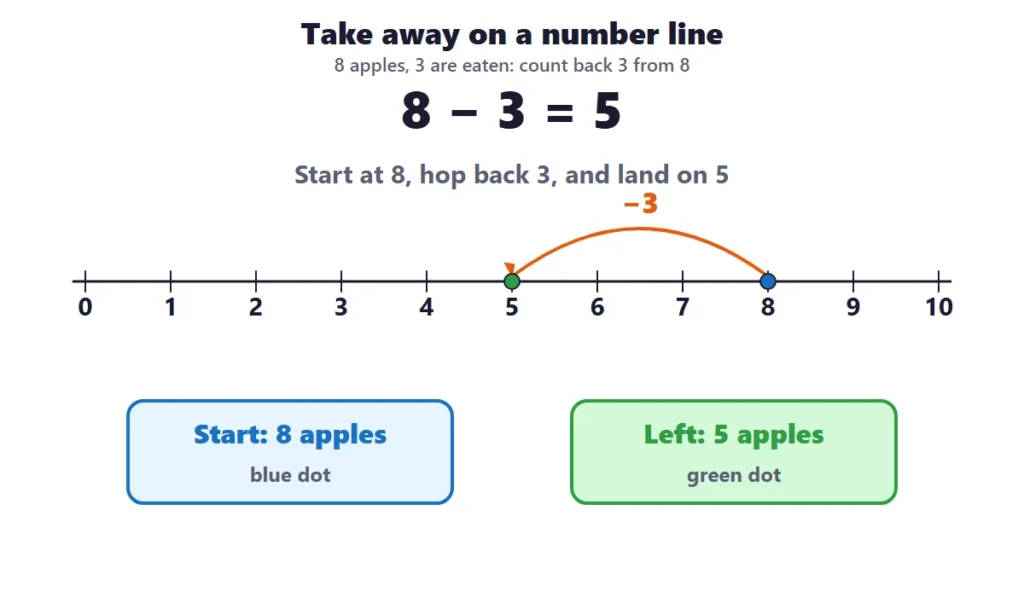
8 apples are on a table. 3 are eaten. How many are left?
8 − 3 = ?
5
Take from
change unknown
8 apples are on a table. Some are eaten. 5 are left. How many were eaten?
8 − ? = 5
3
Take from
start unknown
Some apples are on a table. 3 are eaten. 5 are left. How many were there at first?
? − 3 = 5
8
Put together
total unknown
3 red and 5 blue crayons are in a box. How many crayons are there in all?
3 + 5 = ?
8
Take apart
addend unknown
8 crayons are in a box. 3 are red and the rest are blue. How many are blue?
3 + ? = 8
5
Take apart
both addends unknown
Grandma has 8 flowers. How many can she put in her red vase and how many in her blue vase?
8 = ? + ?
several answers
Compare
difference unknown
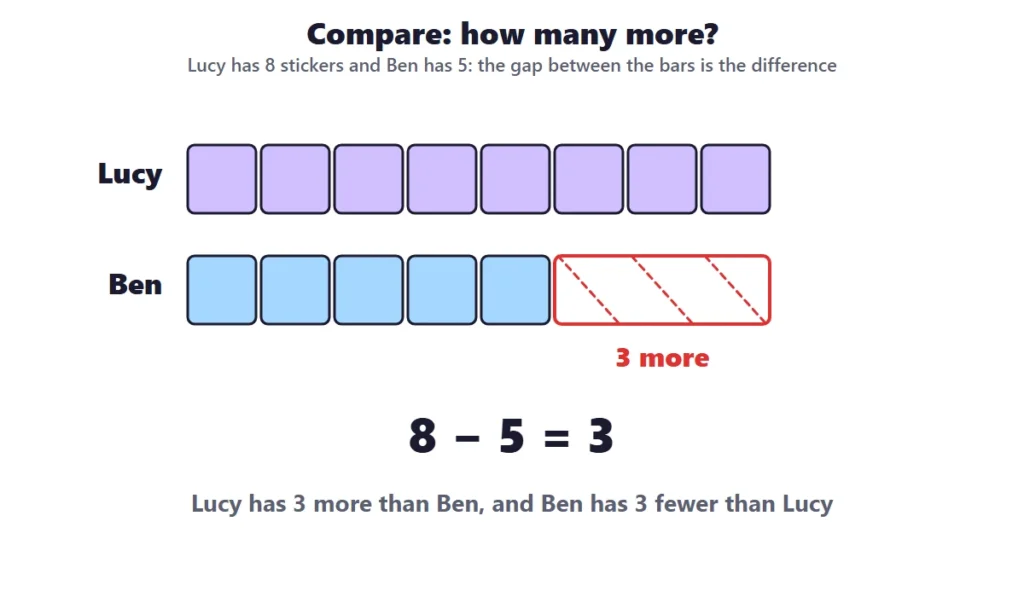
Lucy has 8 stickers. Ben has 5. How many more does Lucy have than Ben?
8 − 5 = ?
3
Compare
bigger unknown
Ben has 5 stickers. Lucy has 3 more than Ben. How many does Lucy have?
5 + 3 = ?
8
Compare
smaller unknown
Lucy has 8 stickers. That is 3 more than Ben has. How many does Ben have?
8 − 3 = ?
5
The same three numbers appear in every story, so every story uses the same fact family: 3 + 5 = 8, 5 + 3 = 8, 8 − 3 = 5 and 8 − 5 = 3. The stories with the unknown at the start are the hardest, because the first number in the story is not the first number in the number sentence. The worksheets on this page mix all of these kinds, so that children think about the story and not about one rule.
Addition word problems: join, put together and compare
The addition word problems on this page have stories where groups are joined, parts are put together, or one amount is found from another. In every case the answer is the total. When the total is known and the parts are not, the story is a take-apart story, and there is often more than one answer. This table shows how many ways each total from 5 to 12 can be split into two parts:
The eight crayons from the example can be split nine ways if the order counts, or five ways if red and blue are not told apart. Stories with several answers help children see that a number can be made in many ways, which is the idea behind the making 10 page.
Subtraction word problems: take away, compare and missing part
The subtraction word problems have three kinds of story: take away, compare and missing part. In all of them the answer is found by subtracting, or by adding up from the smaller number. It is tempting to use key words, such as “more” or “left”, to choose the operation, but key words can be wrong. This table shows five stories where the key word points to the wrong operation, or where there is no key word:
Story
Key word
What to do
Number sentence
Tom has 5 marbles. He has 3 more than Sara. How many does Sara have?
more
subtract
5 − 3 = 2
There are 12 birds in all. 7 are on the fence and the rest are in the tree. How many are in the tree?
in all
subtract
12 − 7 = 5
Mia had some stickers. She gave 4 away and has 6 left. How many did she start with?
gave away, left
add
6 + 4 = 10
Sam is 9 years old. His sister is 3 years older. How old is his sister?
older
add
9 + 3 = 12
There are 15 children. 8 are boys. How many are girls?
none
subtract
15 − 8 = 7
Drawing the story works every time, which is why every worksheet has space to draw. A child who draws a picture of the marbles knows that Sara has fewer than Tom, and so subtracts. The subtraction worksheets pages have the number facts that these stories use.
Word problems grade 1: what children need to know
For word problems grade 1, the standard is 1.OA.A.1. Children use objects, drawings and equations with a symbol for the unknown to solve problems within 20 about adding to, taking from, putting together, taking apart and comparing, with the unknown in any position. In plain words, children should be able to draw a story, write a number sentence with a box or a question mark, and say the answer in a sentence. This table lists five strategies that help:
Strategy
What children do
When to use it
Draw the story
circles, boxes or sticks for each number in the story
beginners, and every new kind of story
Bar model
a bar for the whole and parts, or two bars to compare
put together, take apart and compare stories
Number line
hops forward to add and back to take away
adding and subtracting small numbers
Number sentence
write the numbers with a symbol and a box for the unknown
after the picture makes sense
Check
use the opposite operation, or say whether the answer makes sense
every story
The first two worksheets on this page use stories within 20. A child who knows the facts to 20 well, as taught in the addition within 20 page, can spend all their attention on the story.
Word problems within 20: how many facts are there?
Word problems within 20 use only the facts where the sum or the minuend is 20 or less. There are 231 addition facts a + b with a sum of 20 or less, counting each order, and 231 matching subtraction facts. This table shows how the numbers grow as the limit goes up:
Compare. How many more? 8 − 5 = 3.
Within
Addition facts a + b
Subtraction facts
Facts that make exactly the total
10
66
66
11
20
231
231
21
100
5,151
5,151
101
Within 100 there are 5,151 addition facts, so no child learns them all by heart. That is why larger numbers need methods, such as adding tens and then ones, and why the second grade standard turns to place value. Every story within 20 uses just one of the 231 facts.
2nd grade word problems: stories within 100
The 2nd grade word problems use numbers up to 100, and the standard 2.OA.A.1 also includes two-step stories. In these problems the story can be simple, but the calculation needs regrouping. This table shows six problems from the worksheets of this kind, with the answer and whether the ones need regrouping:
Problem
Answer
Regrouping?
Kind of story
47 + 38
85
yes: the ones need regrouping
a story with joining or putting together
56 + 23
79
no
a story with joining or putting together
82 − 37
45
yes: the ones need regrouping
a story with taking away or comparing
75 − 24
51
no
a story with taking away or comparing
64 + 19
83
yes: the ones need regrouping
a story with joining or putting together
90 − 46
44
yes: the ones need regrouping
a story with taking away or comparing
Regrouping is a separate skill from the story, and the 2-digit subtraction with regrouping page practices it. If a child finds the story hard, give them a version with numbers within 20, and if the calculation is hard, give them a version with easy numbers.
Common mistakes with addition and subtraction word problems
The most common mistake is to use a key word to choose the operation. This table shows five mistakes, what went wrong and the fix:
What the child writes or says
What went wrong
The fix
Always adds when the story says more
uses the key word instead of the story
draw it: Sara has fewer marbles than Tom, so subtract
Always subtracts when the story says left
uses the key word instead of the story
in “6 left after giving 4 away” the start is unknown, so add 6 + 4
Writes 8 − 3 = 5 for a story that adds
picks the operation from the biggest number
say what is happening: joining, taking away or comparing
Writes only the answer, 5
does not say what the 5 is
write the unit: 5 birds
Does not check the answer
moves on after a quick calculation
ask “does it make sense?” and check with the opposite operation
Addition and subtraction word problems word problems
Story problems use the facts that children know. Ask them to draw the story, write a number sentence, and say the answer in a sentence:
Word problem
Working
Answer
There are 14 ducks on a pond. 6 more ducks swim to the pond. How many ducks are on the pond now?
14 + 6
20 ducks
Mia has 17 stickers. She gives 9 to a friend. How many does she have left?
17 − 9
8 stickers
A shelf has 38 books and 27 more are added. How many books are on the shelf?
38 + 27
65 books
Ben has 52 marbles and Tia has 36. How many more does Ben have than Tia?
52 − 36
16 more
A farmer has 20 hens. Some hens are brown and 12 are white. How many are brown?
20 − 12
8 brown hens
There are 45 children in the hall. 18 are boys. How many are girls?
45 − 18
27 girls
Games and activities for addition and subtraction word problems
Children learn addition and subtraction word problems best when they play with it. These games use things that are found at home or in a classroom:
Act it out: use counters or toys to act out a story, and write the number sentence
Story cards: draw a card with two numbers and make up a story that joins or takes away
Draw and solve: give a story and ask for a picture before any numbers
Same numbers, new story: write a joining story and a take-away story that use the same three numbers
Find the unknown: write a story with the unknown at the start, and swap with a partner
Word problem bingo: a bingo card with answers, and calling cards with stories
Extra support and extra challenge with addition and subtraction word problems
For children who need more support: start with stories within 10 and real objects. Read the story aloud, act it out with counters, and then draw it. Use only one kind of story at a time at first, and use the answer key to check the picture, not only the answer. Never ask the child to look for key words.
For children who need more challenge: ask for a story with the unknown at the start, for two different stories that use the same number sentence, and for a two-step story such as 25 birds, 8 fly away and 6 more come. Making up stories for a number sentence, and trading them with a friend, is a good challenge.
How to tell that a child is ready to move on from addition and subtraction word problems
Before moving on from addition and subtraction word problems, check that the child can do all four of these things:
The child draws a picture that matches the story.
The child writes a number sentence with a box for the unknown.
The child solves joining, take-away, compare and missing part stories.
The child says the answer in a sentence and checks that it makes sense.
A 20-minute lesson on addition and subtraction word problems
A short lesson is the best way to introduce addition and subtraction word problems. This 20-minute plan can be used in a classroom, at a tutoring session or at home, and it uses the worksheets at the end:
Take away. 8 − 3 = 5 on a number line.
Minutes
Activity
What to say or ask
0 to 3
Read a story aloud and act it out with counters
What is happening in the story? What do we know?
3 to 8
Draw the story as a bar and write the number sentence
What is the unknown? Where is the box?
8 to 13
Do a compare story and a missing part story together
Is this the same kind of story, or a different one?
13 to 18
Solve a story with the unknown at the start
How can a picture help here?
18 to 20
Start a worksheet and check one answer
Does the answer make sense?
Where addition and subtraction word problems fits across the grades
No skill stands alone. This table shows what children learn before and after addition and subtraction word problems, with the standard that goes with each step:
Grade
What children do
Standard or page
Kindergarten
Add and subtract within 10 with objects and drawings
This page is the start of the word problem sequence. The whole sequence is on the math word problems worksheets page.
Helping at home with addition and subtraction word problems
Parents do not need to be experts to help with addition and subtraction word problems. These suggestions work well, and each takes only a few minutes:
Make up stories at the dinner table: “I had 12 peas and ate 5”.
Ask the child to draw the story before solving it.
Use toys or snacks as counters.
Ask “what is unknown?” rather than “is it plus or minus?”.
Check the answer by saying it in a sentence.
How to check progress in addition and subtraction word problems
A teacher or parent can check progress in addition and subtraction word problems with the answer key and a few questions. This table shows three common situations, what they mean and what to do next:
What you see
What it means
What to do next
The child picks the operation from a key word
The child is not reading the story as a whole
Ask the child to draw and retell the story before choosing
The child gets 9 of 10 right in every set
The skill is secure
Move on to multiplication and division word problems
The child can solve joining stories but not the others
The kinds of story with an unknown at the start or in the middle are new
Use a bar model, and do each kind of story on its own
A five-day plan for addition and subtraction word problems
Most children need about a week of short sessions for addition and subtraction word problems. This plan follows the order of the worksheets on this page:
Day
What to do
Practice
Day 1
Join stories within 20: draw and write the number sentence
Addition Word Problems Within 20
Day 2
Take-away, compare and missing part stories within 20
Subtraction Word Problems Within 20
Day 3
More joining and take-away stories, with space to draw
Sam had 13 stickers and gave away 5. How many now?
13 – 5 = 8
Put together
Sam has 8 red and 5 blue stickers. How many in all?
8 + 5 = 13
Take apart
13 stickers are red or blue, and 8 are red. How many are blue?
13 – 8 = 5
Compare
Sam has 13 stickers and Jo has 8. How many more does Sam have?
13 – 8 = 5
Notice that a compare problem uses subtraction, even though there is no taking away in the story. That is why addition or subtraction word problems need reading, not just keyword spotting.
Adding and subtracting word problems, mixed and two-step
This page is also searched as adding and subtracting word problems, addition subtraction word problems, word problems with addition and subtraction, mixed addition and subtraction word problems and addition and subtraction word problems 3rd grade. Mixed addition and subtraction word problems ask children to choose the operation, which is the real skill. A two-step problem, such as 2 step addition word problems, needs two operations: Sam had 8 stickers, got 5 more, then gave 4 away. For bigger numbers, try addition and subtraction word problems within 100 and adding and subtracting with regrouping word problems once children can solve the problems in the table. Use the multiplication and division word problems page for multiplication and division stories.
Frequently asked questions
6 quick answers
Are key words like “in all” reliable?
Not always. “How many more” can mean adding in some stories. Drawing the story is more reliable than key words.
What grade does word problems within 100?
Grade 2 (Common Core 2.OA.A.1); grade 1 works within 20.
What are the different kinds of addition and subtraction word problems?
The Common Core groups them as add to, take from, put together or take apart, and compare. Each group has versions in which the result, the change or the start is unknown, so there are twelve kinds in all.
Why should children draw the story?
A picture shows what is happening in the story, so the operation comes from the story and not from a key word. It also works for the harder kinds of story, where the unknown is at the start.
Is it a good idea to teach key words in addition and subtraction word problems?
Key words are not reliable. “More” can mean add or subtract, and “left” can mean subtract or add. Children do better when they learn to picture the story, as the worksheets on this page ask them to do.
Where can I download free addition and subtraction word problems?
Open any worksheet in the gallery above, choose US Letter or A4, then print or save the PDF. They are free and each has an answer key.