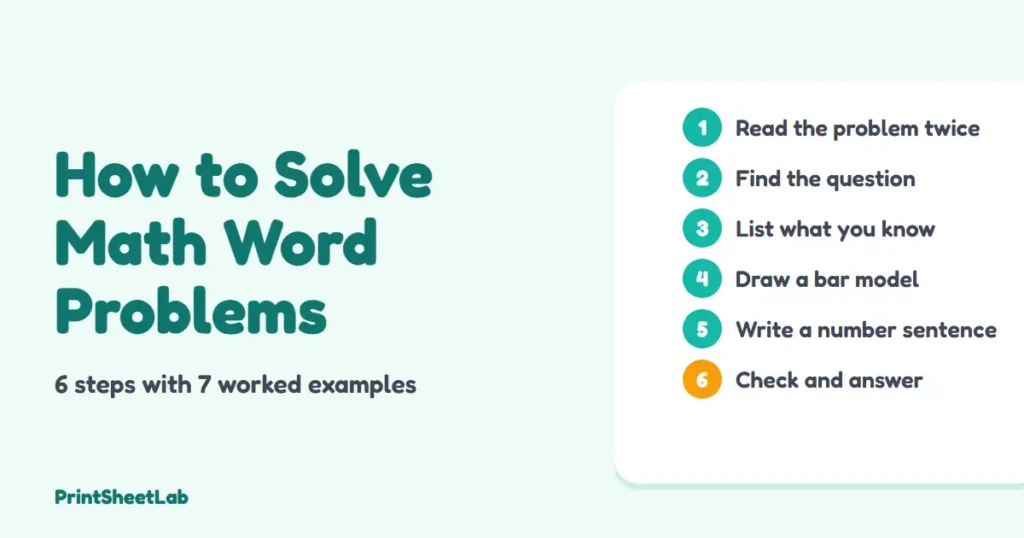
How to solve math word problems: read the problem twice, find the question, list what you know, draw a picture or bar model, write a number sentence, then solve it and check that the answer makes sense. This guide to how to solve math word problems explains each of those six steps with worked examples, from simple one-step stories to two-step problems, and shows the common traps that make word math problems feel harder than they are.
If you want practice straight away, the free math word problems worksheets have 56 printable PDFs with answer keys, and our list of 40 simple word problems with answers is a good place to start.
Why word problems feel hard
Most children who struggle with word problems can do the calculation. What trips them up is deciding which calculation to do. A word problem asks children to read, picture a situation, choose an operation and only then compute. If any one of those steps goes wrong, the answer is wrong, even when the arithmetic is perfect. A clear routine makes each step visible, so you can see exactly where a child gets stuck.
How to solve math word problems: the 6-step method
Step 1: Read the problem twice
Read it once for the story and once for the details. On the first read, ask “what is happening?” On the second, notice the numbers and the units.
Step 2: Find the question
The question is usually the last sentence. Underline it and put it in your own words: “I need to find how many stickers Mia has left.”
Step 3: List what you know
Write the useful numbers with their labels, such as “17 stickers at the start, gave away 9”. Cross out any number the question does not need.
Step 4: Draw a picture or bar model
A bar model is a rectangle split to show parts and a whole. If you know the parts, add them to find the whole. If you know the whole and one part, subtract to find the other part. If the parts are all the same size, multiply or divide.
Step 5: Write a number sentence and solve it
Turn the picture into math, for example 17 − 9 = ?, and work it out.
Step 6: Check and answer in a sentence
Ask “is this a sensible size?” and check with the opposite operation (8 + 9 = 17). Then answer the question in words, with the unit: “Mia has 8 stickers left.”
Worked examples of word math problems
Example 1: Joining (addition)
A class collects 23 cans on Monday and 18 cans on Tuesday. How many cans do they collect altogether?
Both amounts are parts and the question asks for the whole, so add: 23 + 18 = 41. They collect 41 cans. Check: 41 − 18 = 23.
Example 2: Comparing (subtraction)
Ella has 52 beads. Zoe has 37 beads. How many more beads does Ella have than Zoe?
The word “more” might suggest adding, but this story compares two amounts. Draw two bars, one longer than the other; the difference is the gap: 52 − 37 = 15. Ella has 15 more beads. Check: 37 + 15 = 52.
Example 3: Equal groups (multiplication)
There are 6 tables in a classroom with 4 chairs at each table. How many chairs are there?
There are 6 equal groups of 4, so multiply: 6 × 4 = 24. There are 24 chairs.
Example 4: Sharing with a remainder (division)
29 children go on a trip. Each car can take 4 children. How many cars are needed?
29 ÷ 4 = 7 remainder 1. Seven cars carry 28 children, but one child is left over, so another car is needed. 8 cars are needed. This is a good example of why step 6 matters: the calculation says 7 r 1, but the story needs a whole number of cars.
Example 5: A two-step money problem
Sam buys 3 notebooks that cost $4 each. He pays with a $20 bill. How much change does he get?
The hidden question is “how much do the notebooks cost?” Step one: 3 × $4 = $12. Step two: $20 − $12 = $8. Sam gets $8 change. More stories like this are on the two-step word problems worksheets.
Example 6: Two subtractions or one addition?
A library has 120 books on a shelf. On Monday 45 are borrowed and on Tuesday 38 are borrowed. How many books are left on the shelf?
You can take away each day in turn (120 − 45 = 75, then 75 − 38 = 37) or add the borrowed books first (45 + 38 = 83, then 120 − 83 = 37). 37 books are left. Showing both ways helps children see that there is often more than one correct path.
Example 7: A fraction of an amount
There are 24 children in a class. Three quarters of them have a pet. How many children have a pet?
Find one quarter first: 24 ÷ 4 = 6. Three quarters is 3 × 6 = 18. 18 children have a pet. For harder fraction stories, see fraction of a fraction word problems.
Key words in word problems: helpful, but only a little
Lists of key words are popular, but they can mislead. Use them as clues, not rules.
| Key words | Often means | But watch out |
|---|---|---|
| altogether, in all, total, sum | add | “6 bags with 4 in each, how many altogether?” is multiplication |
| left, fewer, difference, how many more | subtract | “Ella has 15 more beads than Zoe, who has 37” is addition |
| each, every, groups of, times | multiply | “24 pencils shared so each table gets the same” is division |
| shared, split, equally, per | divide | always check whether the question wants the number in each group or the number of groups |
The safest habit is to picture the story first and let the picture decide the operation.
Word problem strategies by grade
Teachers will recognise this whole method as the first Common Core Standard for Mathematical Practice: make sense of problems and persevere in solving them. It applies at every grade; only the numbers and the stories change.
| Grade | Typical word problems | Most useful strategy |
|---|---|---|
| K–1 | Add and subtract within 20 | Act it out with objects, then draw |
| 2 | Add and subtract within 100, one and two steps | Bar models for part-part-whole and comparison |
| 3 | Multiply and divide within 100; two-step problems | Equal-group drawings and arrays; find the hidden question |
| 4–5 | Multi-step problems, remainders, fractions | Plan the steps in writing; estimate to check |
Common mistakes and how to fix them
- Doing something with every number. Fix: cross out numbers the question does not need before calculating.
- Answering the wrong question. In example 5, $12 is a correct calculation but the wrong answer. Fix: re-read the question before writing the answer.
- Ignoring the remainder. Fix: ask what the remainder means in the story, as in example 4.
- Skipping the check. Fix: always use the opposite operation or a quick estimate.
How to practice word problems at home
Ten minutes a few times a week works better than one long session. Start with simple one-step word problems until your child can draw and solve them confidently, then move on to the addition and subtraction and multiplication and division worksheets, and finally to two-step problems. Ask your child to explain their drawing out loud: if they can tell you why they chose an operation, they understand the problem.
Free word problem organizer: how to solve math word problems on paper
This printable organizer turns the steps for how to solve math word problems into six boxes, so children can show their thinking on paper. Print the blank page for practice and the worked example to model the method first. The how to solve math word problems PDF has 2 pages and prints on US Letter or A4.
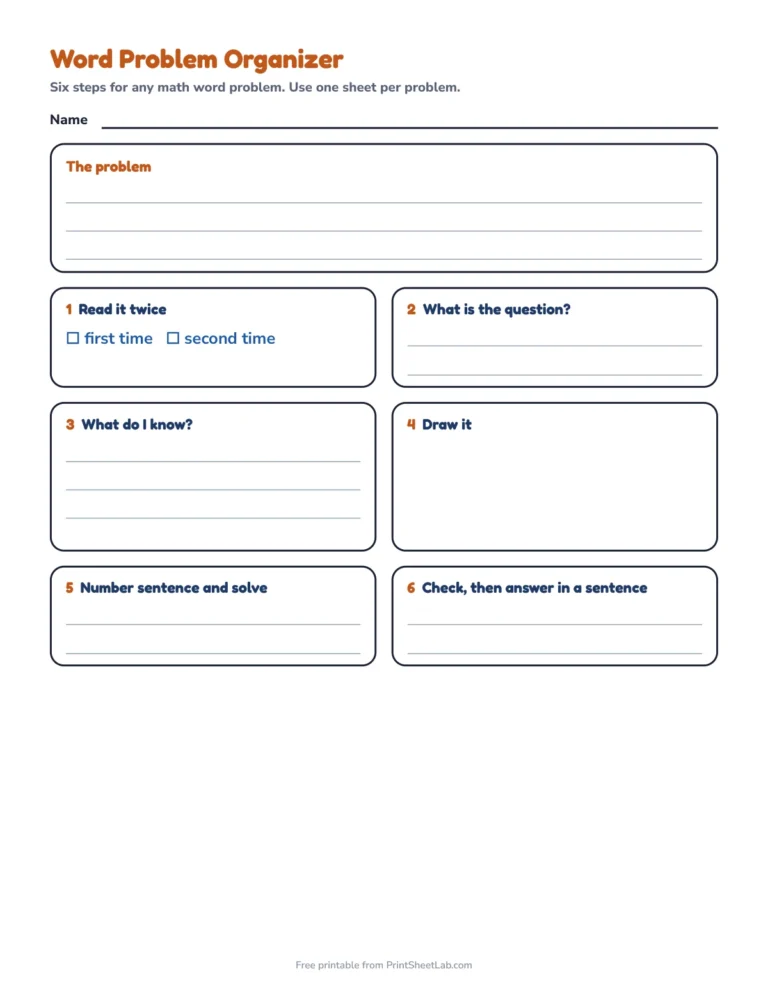
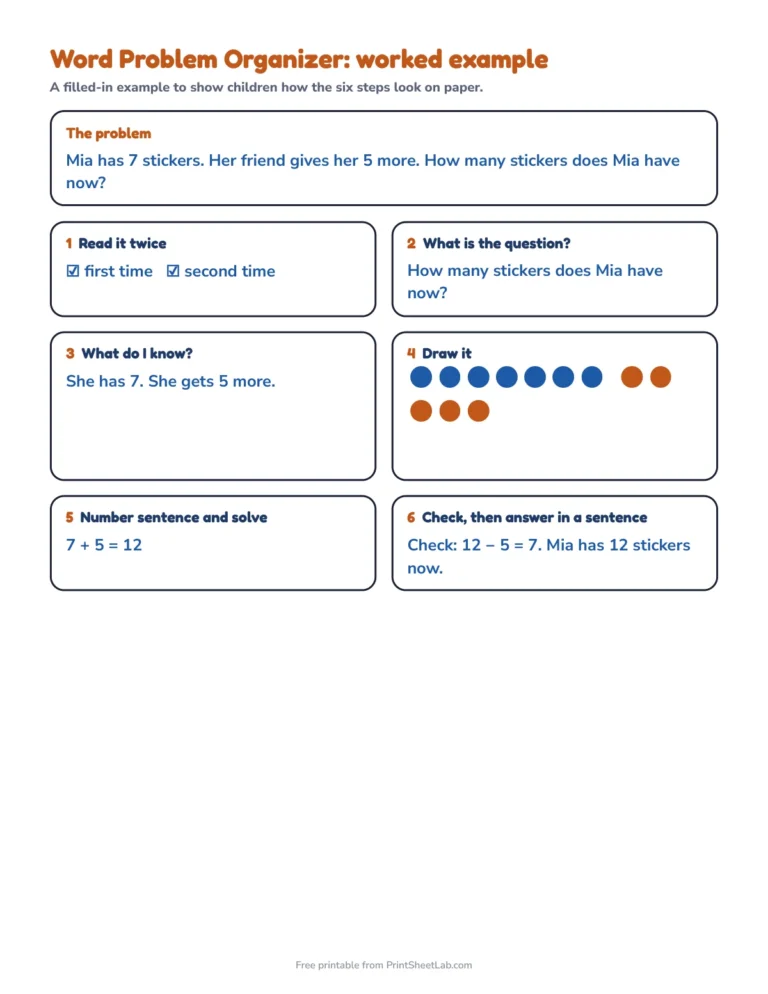
Print at 100% (actual size). Every page is black and white line art, so it copies cleanly on a school printer.
Frequently asked questions
7 quick answers
How to solve math word problems step by step?
Read the problem twice, find the question, list what you know, draw a picture or bar model, write and solve a number sentence, then check the answer and write it in a sentence with the unit.
How do you know which operation to use in a word problem?
Picture what happens. Joining parts means add, finding a missing part or a difference means subtract, equal groups means multiply, and sharing or grouping equally means divide.
Why are word problems hard for some children?
They combine reading with math. A child may know the facts but struggle to picture the story or choose the operation. Drawing the story usually helps more than extra arithmetic practice.
Are key words a good way to solve word problems?
Key words can give a clue, but they are not reliable on their own. “How many more” can mean subtract or add depending on the story, so always picture the situation first.
Where can I get free math word problems worksheets?
PrintSheetLab has 56 free printable math word problems worksheets with answer keys, covering addition, subtraction, multiplication, division and two-step problems.
What is the best way to teach a child how to solve word problems at home?
Short ten-minute sessions a few times a week beat one long sitting. Start with simple one-step problems until your child can draw and solve them confidently, then move on to two-step problems, and ask them to explain their drawing out loud.
Are there math word problems examples with two steps?
Example 5 is one: Sam buys 3 notebooks at $4 each and pays with a $20 bill. The hidden question is the cost, 3 × $4 = $12, and then $20 − $12 = $8, so Sam gets $8 change.
Related guides and printables
- Math word problems worksheets (56 free PDFs)
- 40 simple word problems for kids with answers
- Addition and subtraction word problems
- Multiplication and division word problems
- Two-step word problems
- Fraction of a fraction word problems
Did you like this?
Last updated: