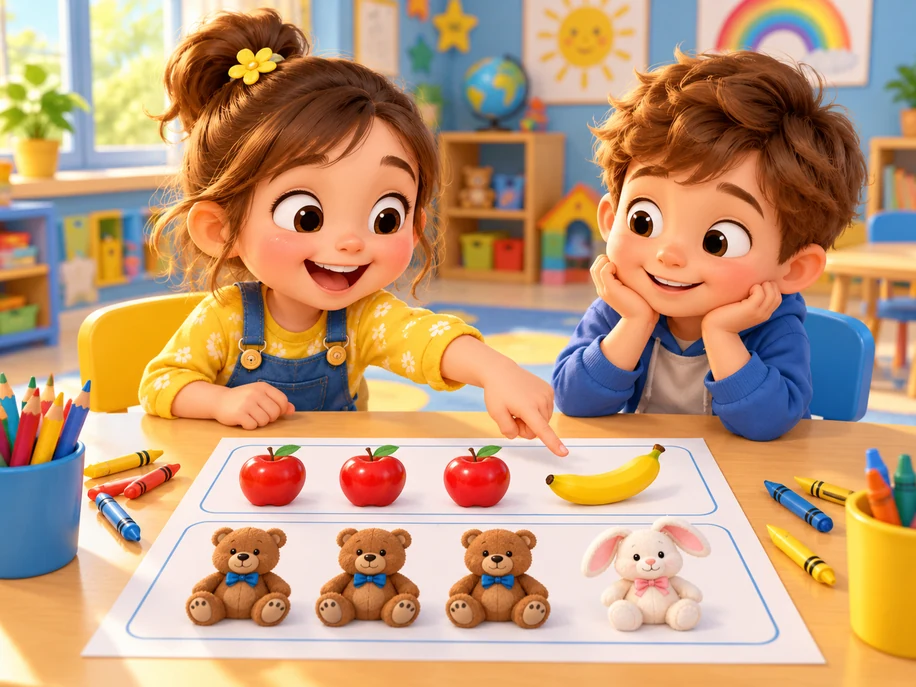
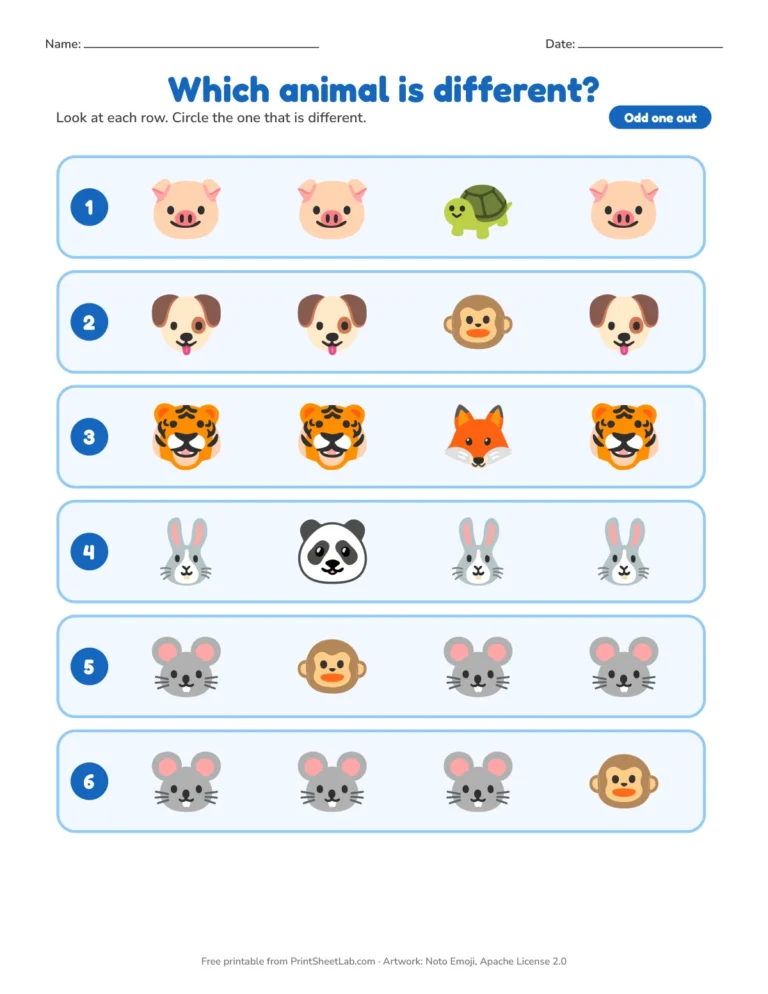
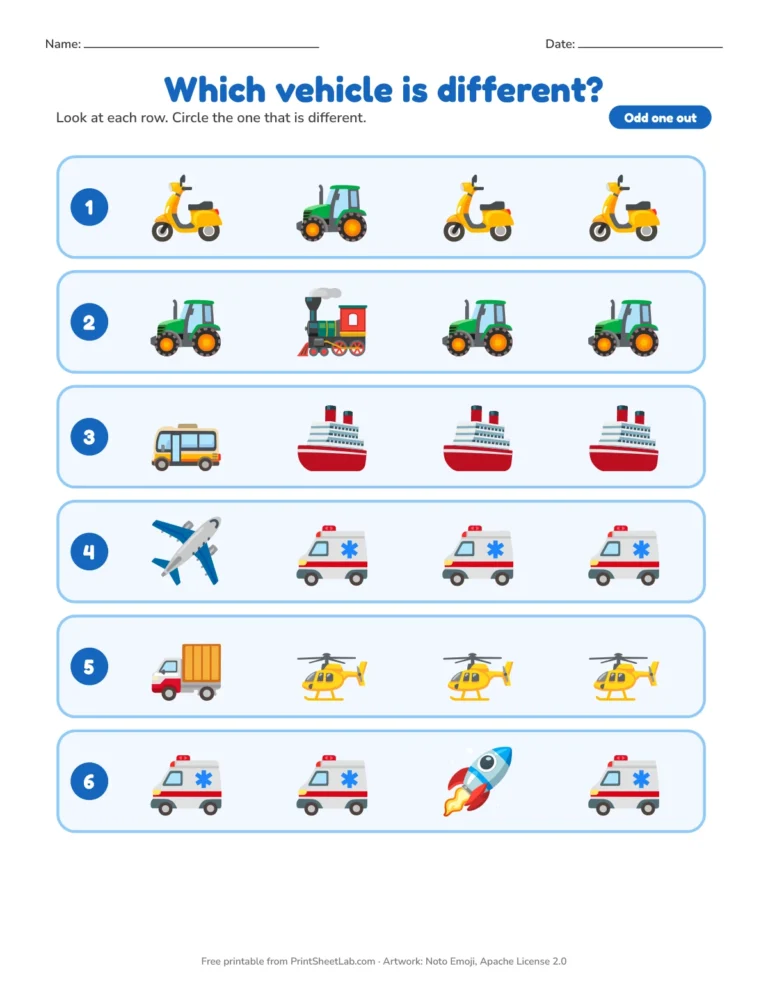
Same and different worksheets train one of the first skills in early math and reading: looking closely and sorting what matches from what does not. This free set has six printable pages. Three odd-one-out pages use animals, food and vehicles, one page uses colors and shapes, one asks children to match the same picture, and one asks them to say whether two pictures are the same or different. Every PDF has the worksheet on page 1 and an answer key on page 2. The same and different worksheets build early observation skills for preschool and kindergarten.
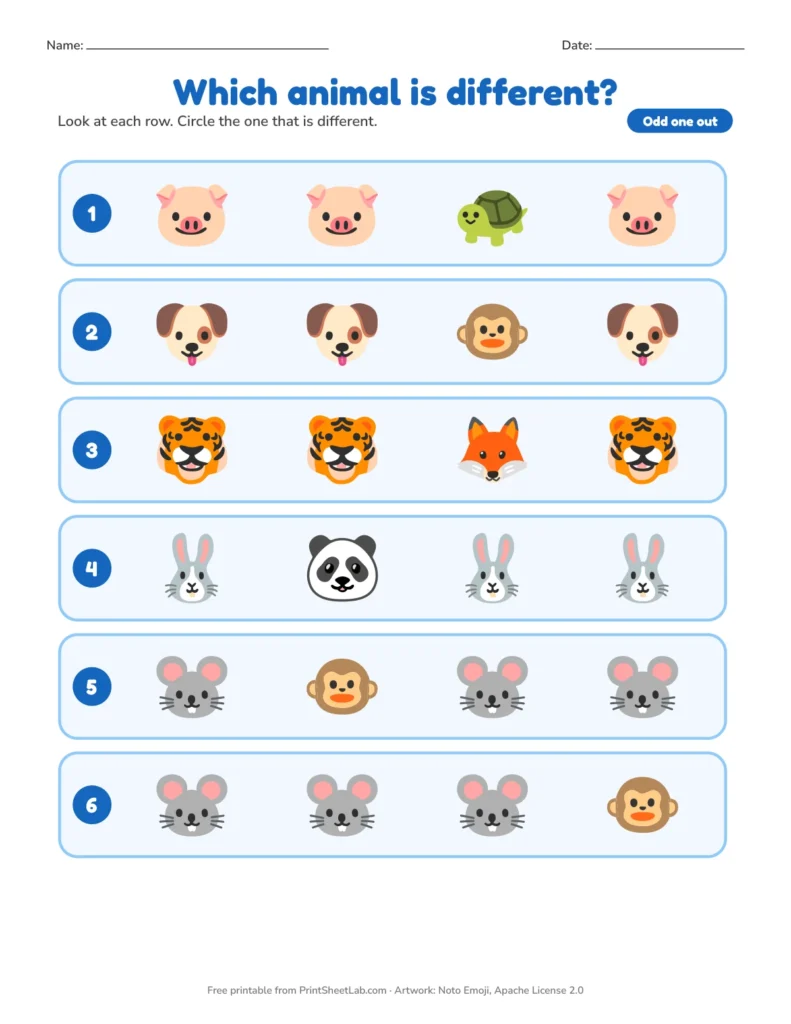
Quick answer: print one page, hand the child a pencil and ask them to circle the picture that is different. Start with the animals page for ages 3 to 4, move on to food and vehicles, and finish with the colors-and-shapes page and the pairs page for ages 5 to 6.
Same and different worksheets (PDF)
Six pages, each a PDF with the worksheet on page 1 and the answer key on page 2. Click a picture to open it.



Where to start with preschoolers
| Page | Skill | Good for |
|---|---|---|
| Odd one out: animals | Spot the one animal that is different | Ages 3 to 4, a gentle start |
| Odd one out: food and vehicles | The same skill with new pictures | Ages 3 to 5, extra practice |
| Odd one out: colors and shapes | Tell apart colors and shapes in one row | Ages 4 to 6 |
| Match the same picture | Find the identical picture among four | Ages 4 to 6, visual matching |
| Same or different pairs | Compare two pictures and decide | Ages 5 to 7, early logic and reading readiness |
How to teach same and different step by step
- Start with real objects. Put three identical spoons and one fork on the table and ask which one is different.
- Use the words. Say “same” and “different” out loud, and ask the child to explain how they know.
- Move to the page. Show the first row together, name each picture and circle the odd one.
- Let the child lead. Cover the answer key and let them work down the rows alone.
- Check and talk. Turn to page 2, compare answers and ask why each picture was the different one.
Why same and different matter
- Visual discrimination: noticing small differences helps children tell similar letters apart, such as b and d.
- Sorting and classifying: deciding what belongs together is the base of early math.
- Language: the worksheets teach the words same, different, match and odd, which are part of kindergarten readiness lists.
- Focus: checking each picture in a row builds the habit of looking before answering.
Games to play with the same and different worksheets
- Real-life hunt: ask children to find two things in the room that are the same and two that are different.
- Sort the toys: make piles of the same animals, the same blocks or the same cars.
- Draw your own: on the back of a page, draw three of one thing and one different thing, and give it to a friend.
- Memory partner: turn the page over, ask which picture was different and see who remembers.
Tips for different ages
Three-year-olds do best with the animals page and one row at a time. Four- and five-year-olds can finish a full page and begin the colors-and-shapes page, which asks them to look for a color change or a shape change. Print the pages as a set, and six-year-olds can try the pairs page and explain what was different.
Keep sessions short, about ten minutes, and stop while the child still enjoys the game. Praise the effort, not just the answer, and let the child explain each choice in their own words. A small sticker for every correct row makes the answer key feel like a reward instead of a test. If a child is stuck, cover three pictures and compare the remaining two, then add the others back.
How these sheets are made
Every sheet is generated by a program. It picks the rows, hides the odd picture in a random place and draws the answer key from the same list, so the circles always match the puzzle. The pictures are Noto Emoji artwork from Google, used under the Apache License 2.0; the project is on GitHub. A credit line is printed on every page.
Use one of the same and different worksheets a day, and talk through each answer with your child.
Frequently asked questions
7 quick answers
Are these same and different worksheets free?
Yes. Print as many copies as you like for your own children or class, with no account or sign-up.
What age are they for?
The odd-one-out pages suit ages 3 to 6, the matching page suits ages 4 to 6 and the pairs page suits ages 5 to 7.
Is there an answer key?
Yes. Page 2 of every PDF shows the correct answers, circled or filled in.
What is the difference between same and different and spot the difference?
These pages sort whole pictures into the same and the different, which is an early skill. Spot-the-difference puzzles ask children to find small changes between two scenes, which is a harder visual puzzle.
Can I use them in a classroom?
Yes. Print a stack for centers, morning work or early finishers.
Do they work for speech therapy?
Teachers and therapists often use same and different pictures to practice comparing and describing. You can ask the child to say a sentence for each row.
Which same and different worksheets for preschool should I start with?
Begin with the odd-one-out animals page, one row at a time for three-year-olds. Then move on to the food and vehicles pages, which use the same skill with new pictures for ages 3 to 5.
More matching, puzzle and picture games
- Spot the difference printables for a harder picture puzzle.
- Find and count worksheets for counting practice.
- I spy printables with find-and-count pages.
- Hidden objects printables.
- Printable mazes and classroom bingo.
- Charades for kids for a quick matching game.
- Picture bingo for kids.
- Every puzzle and brain teaser on PrintSheetLab.
Did you like this?
Last updated: