Change the numbers, layout and number of problems, then download a new PDF with its answer key.
2-digit subtraction with regrouping, also called borrowing, is needed when the ones digit on top is smaller than the ones digit below. The nine PDFs on this page have borrowing problems in columns, on grid paper and in mixed sets, plus a riddle, a color-by-difference heart, match-up cards, bingo and story problems, and every sheet has an answer key. They follow standards 2.NBT.B.5 and 2.NBT.B.9 of the Common Core standards for grade 2 number and operations in base ten, and the notes below show the steps, how often borrowing happens and other ways to find the same answer.
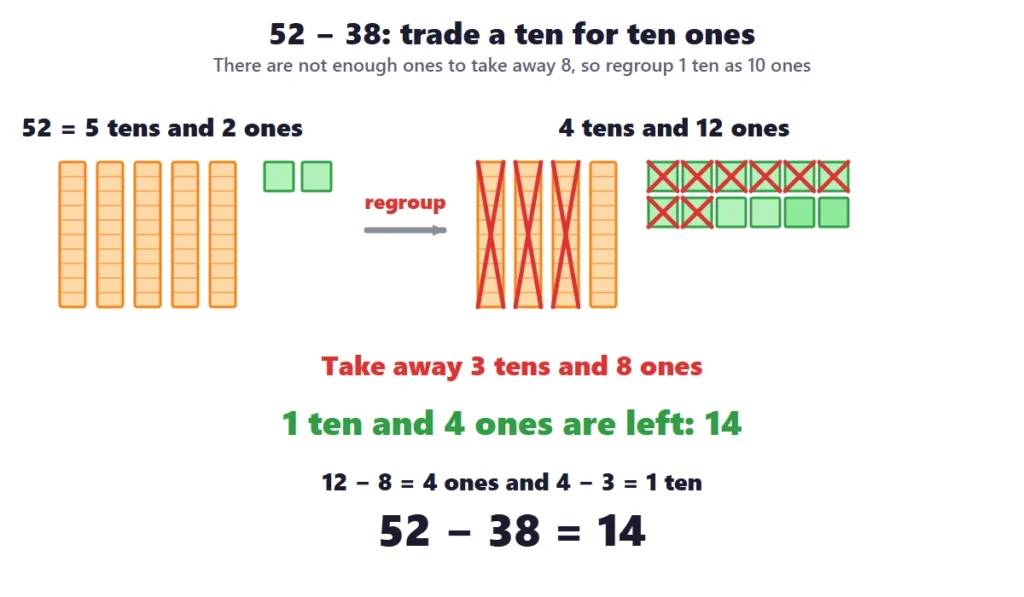
Regrouping with blocks. 52 − 38 = 14.
Quick answer: 2-digit subtraction with regrouping, also called borrowing, means subtracting when the ones digit on top is smaller than the ones digit below, so you trade a ten for ten ones, as in 52 – 27 = 25. This page has 9 free printable worksheets with answer keys for grade 2. Updated October 2026.
About subtraction with regrouping
Regrouping, also called borrowing, is needed when the top digit in a column is smaller than the digit below it. In 52 − 38 you cannot take 8 from 2, so you swap 1 ten for 10 ones: 5 tens and 2 ones becomes 4 tens and 12 ones. Then 12 − 8 = 4 and 4 − 3 = 1, so the answer is 14.
Step by step
Start with the ones. Ask: is the top digit big enough?
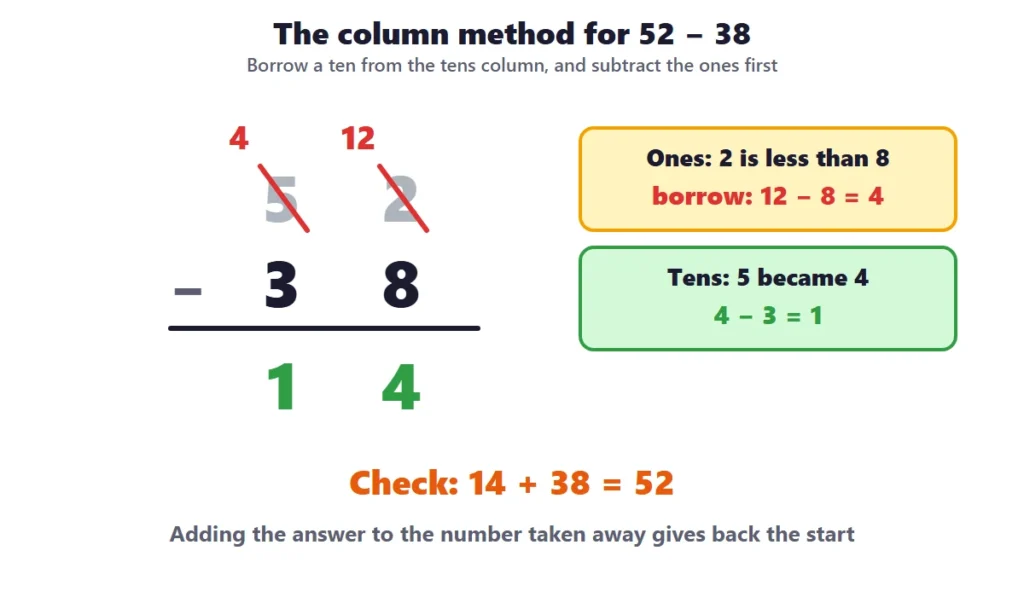
If not, cross out the tens digit, write one less above it, and put a small 1 before the ones digit.
Subtract the ones, then the tens.
Check by adding the answer to the bottom number.
What is on this page
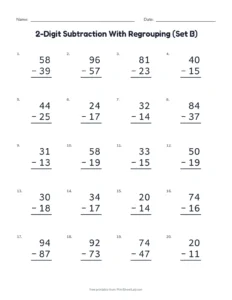
Borrowing practice: two sets of 20 problems where every problem needs regrouping.
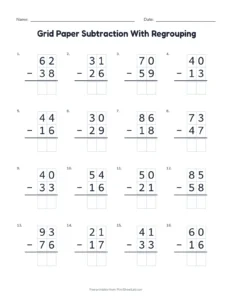
Grid paper: boxes keep the digits lined up and leave room for the crossed-out tens.
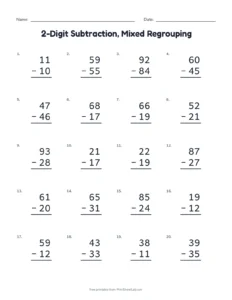
Mixed set: some problems need borrowing and some do not, so children have to check each column.
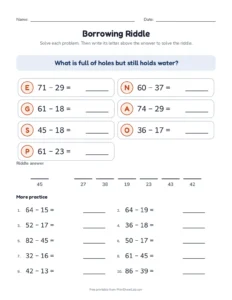
Games: a riddle, a color-by-difference heart, match-up cards and bingo.
Story problems that need borrowing.
Common mistakes
Taking the smaller digit from the bigger one: writing 52 − 38 = 26. Always subtract bottom from top, borrowing when needed.
Forgetting to lower the tens digit after borrowing.
Borrowing when it is not needed: the mixed set helps with this.
2-digit subtraction with regrouping worksheets: what is in the set
There are 9 2-digit subtraction with regrouping worksheets on this page, and every one has an answer key except for any cut-out games. Three sheets are column problems, one is on grid paper, one is a mixed set, and the rest are a riddle, a color-by-difference heart, match-up cards, bingo and story problems.
Worksheet
What children do
Standard
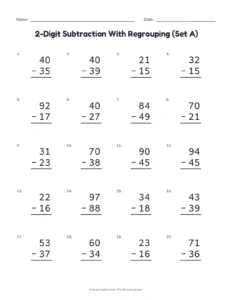
2-Digit Subtraction With Regrouping (Set A)
20 column problems that all need borrowing.
2.NBT.B.5
2-Digit Subtraction With Regrouping (Set B)
Another 20 borrowing problems.
2.NBT.B.5
Grid Paper Subtraction With Regrouping
Digits in boxes with room to cross out and borrow.
2.NBT.B.5
2-Digit Subtraction, Mixed Regrouping
Some problems need borrowing and some do not.
2.NBT.B.5
Borrowing Riddle
Solve borrowing problems to decode a riddle.
2.NBT.B.5
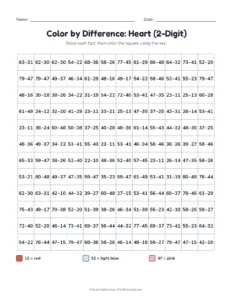
Color by Difference: Heart (2-Digit)
Solve 2-digit problems and color by the key.
2.NBT.B.5
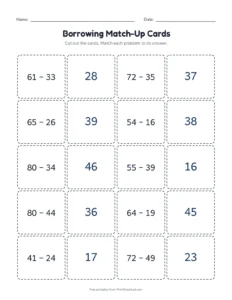
Borrowing Match-Up Cards
Match 10 borrowing problems to their differences.
2.NBT.B.5
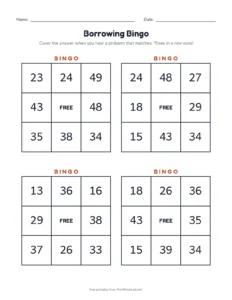
Borrowing Bingo
Bingo boards and calling cards with borrowing problems.
2.NBT.B.5
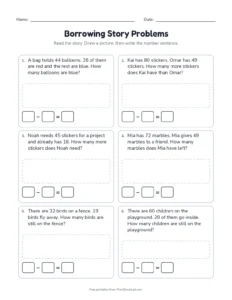
Borrowing Story Problems
Six 2-digit story problems that need borrowing.
2.NBT.B.5
Subtraction with regrouping worksheets: what regrouping means
The subtraction with regrouping worksheets are about trading. In 52 − 38, there are not enough ones to take away 8 from 2, so one ten is traded for ten ones. 5 tens and 2 ones become 4 tens and 12 ones. Then 12 − 8 = 4 and 4 − 3 = 1, so the answer is 14. Wikipedia’s article on subtraction describes the method, which is the one that most schools teach. The base ten blocks tool lets children trade a rod for ten cubes on the screen. This table shows the steps in the column for 52 − 38:
Column
Top digit
Bottom digit
Borrow needed?
After borrowing
Subtract
Ones
2
8
yes: 2 is less than 8
4 tens and 12 ones
12 − 8 = 4
Tens
5
3
one ten was borrowed
4 tens
4 − 3 = 1
The picture above shows the same trade with blocks. The tens digit goes down by 1 and the ones digit goes up by 10, so the number is the same as before: 5 tens and 2 ones is 52, and 4 tens and 12 ones is also 52.
Double digit subtraction with borrowing: the steps
Double digit subtraction with borrowing always has the same steps. First look at the ones column. If the top digit is smaller than the bottom digit, borrow one ten from the tens column. Then subtract the ones, and then subtract the tens. This table shows 71 − 29:
Column
Top digit
Bottom digit
Borrow needed?
After borrowing
Subtract
Ones
1
9
yes: 1 is less than 9
6 tens and 11 ones
11 − 9 = 2
Tens
7
2
one ten was borrowed
6 tens
6 − 2 = 4
A good way to remember is to ask one question at the start of each column: “is the top number big enough?”. If it is, subtract. If not, borrow. The answer keys on this page show the borrowed numbers in small print, so children can compare each step with their own work. The tens and ones page explains the tens and ones that the steps use.
Borrowing subtraction worksheets: how often is borrowing needed?
The borrowing subtraction worksheets have problems where every one needs a borrow, so it is useful to know how common borrowing is. This table counts all the subtractions of two 2-digit numbers where the top number is bigger, which is 4,005 problems:
2-digit subtractions where the top number is bigger
How many
Share
Example
All of them
4,005
100%
52 − 38, 85 − 23
Need regrouping (ones on top are smaller)
1,620
40%
52 − 38, 71 − 29
Need no regrouping
2,385
60%
85 − 23, 96 − 61
Need regrouping and the top ones digit is 0
324
8.1%
90 − 47, 60 − 28
The two tens digits are the same
405
10%
57 − 52, 84 − 81
Four in ten of all 2-digit subtractions need regrouping, so it is a skill that children use a great deal. The hardest cases are those in which the top ones digit is 0, as in 90 − 47. This table shows five of them:
Problem
Regroup
Ones
Tens
Answer
90 − 47
9 tens → 8 tens and 10 ones
10 − 7 = 3
8 − 4 = 4
43
60 − 28
6 tens → 5 tens and 10 ones
10 − 8 = 2
5 − 2 = 3
32
80 − 35
8 tens → 7 tens and 10 ones
10 − 5 = 5
7 − 3 = 4
45
50 − 19
5 tens → 4 tens and 10 ones
10 − 9 = 1
4 − 1 = 3
31
70 − 54
7 tens → 6 tens and 10 ones
10 − 4 = 6
6 − 5 = 1
16
When the top ones digit is 0, the whole of the tens digit gives up one ten, which becomes ten ones: 90 is 8 tens and 10 ones, so 10 − 7 = 3 and 8 − 4 = 4, and the answer is 43. This case is the reason for the “across zeros” rule that comes back with larger numbers.
2 digit subtraction with regrouping: why it is hard for children
2 digit subtraction with regrouping is hard because children have to hold several ideas at once: the place of each digit, the trade of a ten for ten ones, the subtraction fact in the ones column, and the new tens digit. Children who are not secure in one of these make mistakes in the others. For this reason, 2-digit subtraction with regrouping is best taught in small steps, starting with blocks and moving to the column method only when the trade is clear.
The column method. Borrow, then subtract.
2nd grade subtraction: the ones facts that borrowing needs
For 2nd grade subtraction, borrowing depends on the subtraction facts within 20, since the ones column becomes a teen number minus a digit, such as 12 − 8. This table shows how many ones calculations there are when borrowing is needed:
Ones column when regrouping is needed
How many
Pairs of ones digits where the top is smaller
45
…of which the top ones digit is 0, so the fact is 10 minus a digit
9
…of which the fact is a teen number minus a digit, such as 12 − 8
36
Biggest ones result after regrouping
9
Smallest ones result after regrouping
1
Of the 45 pairs of ones digits where the top is smaller, 36 give a teen number minus a digit, which is exactly the type of fact in the addition within 20 page. A child who knows these facts borrows quickly, and the making 10 page helps with the first step, which is to find how many more are needed to make 10. The Common Core standards for grade 2 operations and algebraic thinking include the standard 2.OA.B.2 for the facts.
Other ways to subtract: counting up and compensation
The column method is not the only way to subtract, and children who know others can check their answers and choose the best method for each problem. Counting up starts at the smaller number and jumps to the bigger. Compensation subtracts a round number and then corrects. This table shows three methods for six problems:
Problem
Column method
Counting up from the smaller number
Compensation (subtract a ten, then adjust)
Answer
52 − 38
borrow 1 ten: 12 − 8, 4 − 3
38 + 2 + 10 + 2 = 52
52 − 40 = 12, then + 2
14
71 − 29
borrow 1 ten: 11 − 9, 6 − 2
29 + 1 + 40 + 1 = 71
71 − 30 = 41, then + 1
42
90 − 47
borrow 1 ten: 10 − 7, 8 − 4
47 + 3 + 40 = 90
90 − 50 = 40, then + 3
43
83 − 56
borrow 1 ten: 13 − 6, 7 − 5
56 + 4 + 20 + 3 = 83
83 − 60 = 23, then + 4
27
64 − 28
borrow 1 ten: 14 − 8, 5 − 2
28 + 2 + 30 + 4 = 64
64 − 30 = 34, then + 2
36
45 − 19
borrow 1 ten: 15 − 9, 3 − 1
19 + 1 + 20 + 5 = 45
45 − 20 = 25, then + 1
26
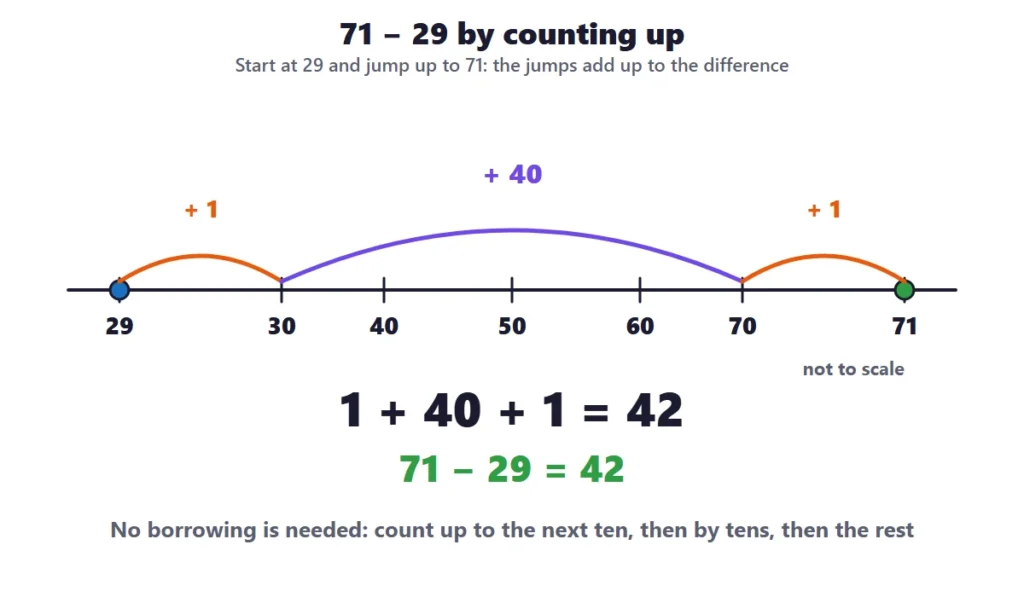
For 71 − 29, counting up goes from 29 to 30 (1), then to 70 (40), then to 71 (1), which is 42. The diagram above shows the jumps. The number line tool shows the same steps on a line. The standard 2.NBT.B.9 asks children to explain why these strategies work, using place value.
Subtraction with regrouping: checking with addition
Every subtraction can be checked with addition. If 52 − 38 = 14, then 14 + 38 must be 52. A child who checks each answer finds most of the mistakes alone. This table checks six problems:
Problem
Answer
Check: add the answer to the number taken away
Gives the start?
52 − 38
14
14 + 38 = 52
yes
71 − 29
42
42 + 29 = 71
yes
90 − 47
43
43 + 47 = 90
yes
83 − 56
27
27 + 56 = 83
yes
64 − 28
36
36 + 28 = 64
yes
45 − 19
26
26 + 19 = 45
yes
The check works because subtraction is the opposite of addition. It is the same idea as the fact families in the addition worksheets pages. An estimate is another way to check, and the estimating with rounding page shows how to do it.
When regrouping is not needed
The mixed sheet has problems with and without borrowing, so that children do not borrow when they should not. In a problem such as 85 − 23, each digit on top is bigger than the digit below, so no regrouping is needed. This table shows four problems that need no regrouping:
Problem
Ones
Tens
Answer
Why no regrouping
85 − 23
5 − 3 = 2
8 − 2 = 6
62
the top ones digit 5 is not less than 3
96 − 61
6 − 1 = 5
9 − 6 = 3
35
the top ones digit 6 is not less than 1
74 − 52
4 − 2 = 2
7 − 5 = 2
22
the top ones digit 4 is not less than 2
59 − 37
9 − 7 = 2
5 − 3 = 2
22
the top ones digit 9 is not less than 7
Borrowing when it is not needed does not make the answer wrong, if it is done correctly, but it is slower and easier to get wrong. The best habit is to check each column first. The place value worksheets pages explain why the tens digit and the ones digit are subtracted separately.
Common mistakes with 2-digit subtraction with regrouping
The most common mistake is to subtract the smaller digit from the bigger in each column. This table shows five mistakes, what went wrong and the fix:
What the child writes or says
What went wrong
The fix
52 − 38 = 26
subtracts the smaller digit from the bigger in each column
always subtract the bottom from the top: 12 − 8 = 4, so the answer is 14
52 − 38 = 114
borrows but does not take 1 from the tens
after borrowing the tens digit is 4, so 4 − 3 = 1: the answer is 14
90 − 47 = 53 shown as 9 − 4 and 0 − 7 = 7
does not know how to borrow from a tens digit when the top ones is 0
90 is 8 tens and 10 ones, so 10 − 7 = 3 and 8 − 4 = 4: 43
71 − 29 = 52
forgets to borrow, and subtracts 9 − 1 = 8 as 1 − 9 reversed
the ones need regrouping: 11 − 9 = 2 and 6 − 2 = 4: 42
Borrows when it is not needed
borrows every time
check each column first: borrow only if the top is smaller
2-digit subtraction with regrouping word problems
Borrowing comes up when things are given away or sold. Ask children to write the subtraction, to solve it in columns, and to check with addition:
Word problem
Working
Answer
Mia has 52 stickers and gives 38 to her friends. How many stickers does she have left?
52 − 38
14 stickers
A baker makes 71 rolls and sells 29. How many rolls are left?
71 − 29
42 rolls
There are 90 children in a hall. 47 are boys. How many are girls?
90 − 47
43 girls
A shop has 83 pens and sells 56. How many pens are left?
83 − 56
27 pens
A book has 64 pages. Sam has read 28. How many pages are left to read?
64 − 28
36 pages
Lin has 45 beads. She uses 19 for a bracelet. How many beads are left?
45 − 19
26 beads
Games and activities for 2-digit subtraction with regrouping
Children learn 2-digit subtraction with regrouping best when they play with it. These games use things that are found at home or in a classroom:
Trade a rod: build 52 with rods and cubes, trade a rod for ten cubes, and take away 38
Borrowing bingo: the worksheet pack has boards and calling cards with borrowing problems
Match-up cards: match 10 borrowing problems with their differences
Beat the borrow: roll two dice for each digit, and subtract a smaller number from the bigger one
Counting up race: find the difference by counting up, and then check in columns
Color by difference: solve the problems on the heart picture and color by the key
Extra support and extra challenge with 2-digit subtraction with regrouping
For children who need more support: use real base-ten blocks, and trade a rod for ten cubes before taking away. Always ask “is the top number big enough?” first. Cross out the tens digit and write one less above it, and write a small 1 before the ones digit. Do the grid paper sheet first, so that each digit has its own box, and use the answer key to check each step.
Counting up. 71 − 29 = 42.
For children who need more challenge: ask for the missing digit in 5☐ − 38 = 14, for a subtraction where the answer is 25 and borrowing is needed, and for the difference of the biggest and smallest 2-digit numbers that can be made from 3, 7, 5 and 9. Subtract from a multiple of ten, such as 80 − 36, and explain what happens.
How to tell that a child is ready to move on from 2-digit subtraction with regrouping
Before moving on from 2-digit subtraction with regrouping, check that the child can do all four of these things:
The child checks whether the top ones digit is big enough.
The child regroups one ten as ten ones, and writes the new digits.
The child subtracts correctly when the top ones digit is 0.
The child checks the answer by adding it to the number taken away.
A 20-minute lesson on 2-digit subtraction with regrouping
A short lesson is the best way to introduce 2-digit subtraction with regrouping. This 20-minute plan can be used in a classroom, at a tutoring session or at home, and it uses the worksheets at the end:
Minutes
Activity
What to say or ask
0 to 3
Show 52 with 5 rods and 2 cubes, and ask to take away 38
Can we take 8 cubes from 2?
3 to 8
Trade one rod for ten cubes, and take away
How many rods and cubes now?
8 to 13
Write 52 − 38 in columns, and cross out the 5
What does the 1 beside the 2 mean?
13 to 18
Check the answer 14 by adding 38
Do we get 52?
18 to 20
Start a worksheet and check one answer
Is the top number big enough?
Where 2-digit subtraction with regrouping fits across the grades
No skill stands alone. This table shows what children learn before and after 2-digit subtraction with regrouping, with the standard that goes with each step:
This page is the main page for 2-digit subtraction. The whole sequence is on the subtraction worksheets page.
Helping at home with 2-digit subtraction with regrouping
Parents do not need to be experts to help with 2-digit subtraction with regrouping. These suggestions work well, and each takes only a few minutes:
Use coins to show 2-digit subtraction with regrouping: change a dime for ten pennies to show borrowing.
Ask “is the top number big enough?” before each column.
Check each answer by adding it to the number taken away.
Use graph paper, so each digit has a box.
Praise the check as much as the answer.
How to check progress in 2-digit subtraction with regrouping
A teacher or parent can check progress in 2-digit subtraction with regrouping with the answer key and a few questions. This table shows three common situations, what they mean and what to do next:
What you see
What it means
What to do next
The child takes the smaller digit from the bigger one
The order of the subtraction is not yet fixed
Always take the bottom from the top, and borrow when needed
The child gets 9 of 10 right in every set
2-digit subtraction with regrouping is secure
Move on to 3-digit subtraction
The child borrows but forgets to reduce the tens
The borrowed ten is not yet taken from the tens
Cross out the tens digit and write one less above it
A five-day plan for 2-digit subtraction with regrouping
Most children need about a week of short sessions for 2-digit subtraction with regrouping. This plan follows the order of the worksheets on this page:
Day
What to do
Practice
Day 1
Review subtraction within 20, and subtract tens
Set A, column problems
Day 2
Regroup with base-ten blocks, then in columns
Grid Paper Subtraction With Regrouping
Day 3
Borrow in every problem, and check with addition
Set B, column problems
Day 4
Decide whether to borrow, in a mixed set
Mixed Regrouping
Day 5
The riddle, the color-by-difference heart, bingo and stories
Subtraction with borrowing worksheets: how often is regrouping needed?
We checked all 4,095 two-digit subtraction problems where the answer is not negative, from 10 – 10 to 99 – 10: 1,620 of them (40%) need regrouping, because the ones digit on top is smaller than the ones digit below. That is why subtraction with regrouping worksheets are worth a lot of practice time.
Subtraction worksheets with regrouping, borrowing worksheets and practice
Parents also search for subtraction regrouping worksheets, subtraction with regrouping worksheet pages, subtraction worksheets regrouping, regrouping in subtraction worksheets, a borrowing subtraction worksheet, subtraction borrowing worksheet pages and subtraction worksheets with borrowing. All of them are the free PDFs above, with an answer key. Free subtraction with regrouping worksheets and subtraction with regrouping worksheets pdf downloads need no sign-up. For more subtraction with regrouping practice, press Customize on any worksheet to make a new set.
Frequently asked questions
7 quick answers
Is borrowing the same as regrouping?
Yes. Both words describe trading 1 ten for 10 ones (or 1 hundred for 10 tens) so a column can be subtracted.
What grade learns subtraction with regrouping?
Grade 2, as part of subtracting fluently within 100 (Common Core 2.NBT.B.5).
Is borrowing the same as regrouping?
Yes. Both words describe trading 1 ten for 10 ones (or 1 hundred for 10 tens), so that a column can be subtracted. Many schools now say regrouping, since nothing is really borrowed and given back.
What grade learns 2-digit subtraction with regrouping?
Grade 2, as part of subtracting fluently within 100 (Common Core 2.NBT.B.5). Grade 1 children subtract multiples of ten and work with tens and ones.
How do you subtract when the top number has a 0 in the ones place?
Regroup one ten from the tens digit, so that the ones become 10. For 90 − 47, 90 is 8 tens and 10 ones, so 10 − 7 = 3 and 8 − 4 = 4, which gives 43.
How long does it take to learn 2-digit subtraction with regrouping?
Most children need two or three weeks of short sessions to be comfortable with 2-digit subtraction with regrouping, if they start with blocks. The sheets on this page go from column problems to grid paper and games, so a child can practice for as long as they need.
Where can I download free subtraction with regrouping worksheets?
Open any worksheet in the gallery above, choose US Letter or A4, then print or save the PDF. They are free and each has an answer key.