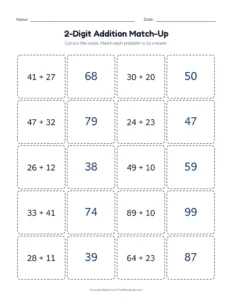
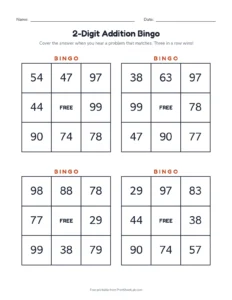
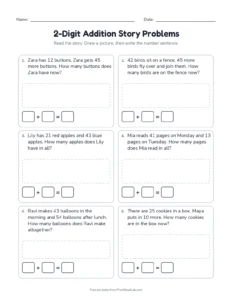
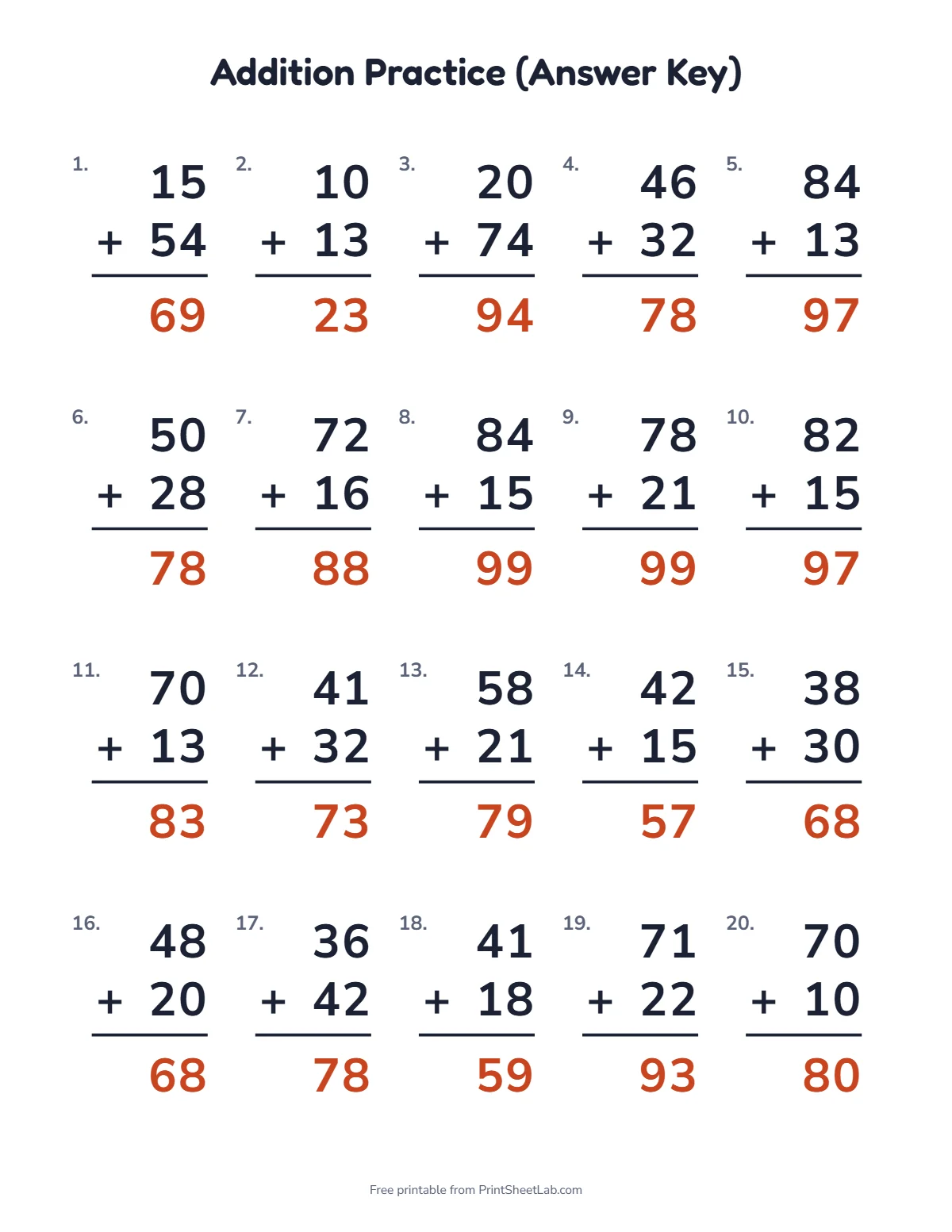
Change the numbers, layout and number of problems, then download a new PDF with its answer key.
2-digit addition without regrouping worksheets to print (PDF)
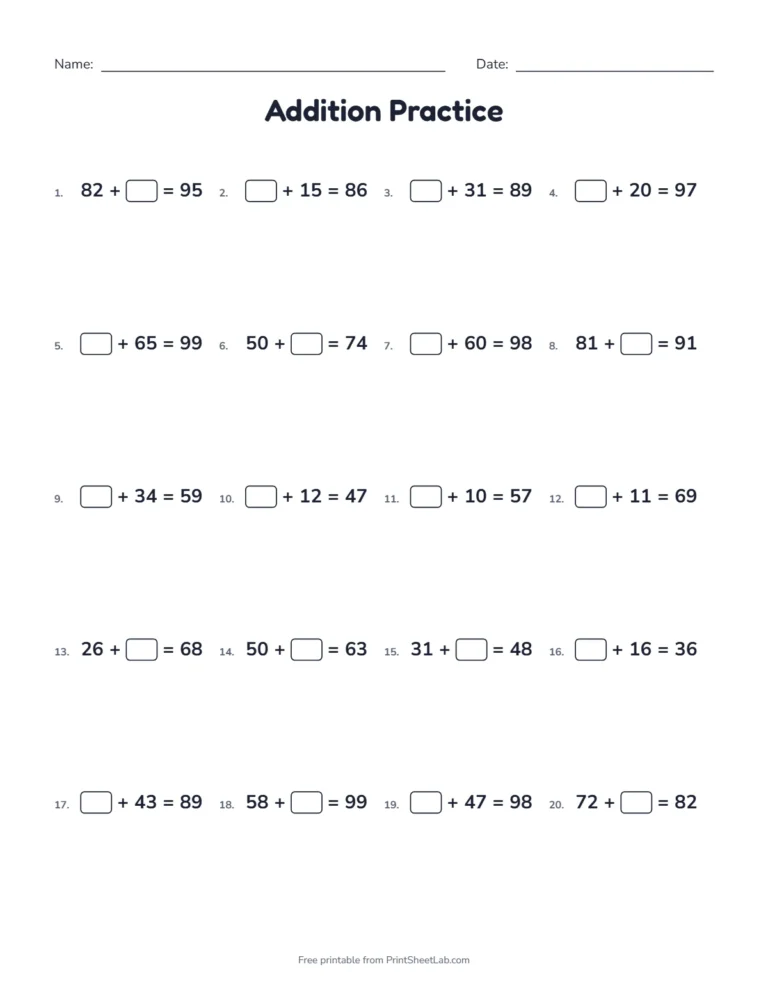
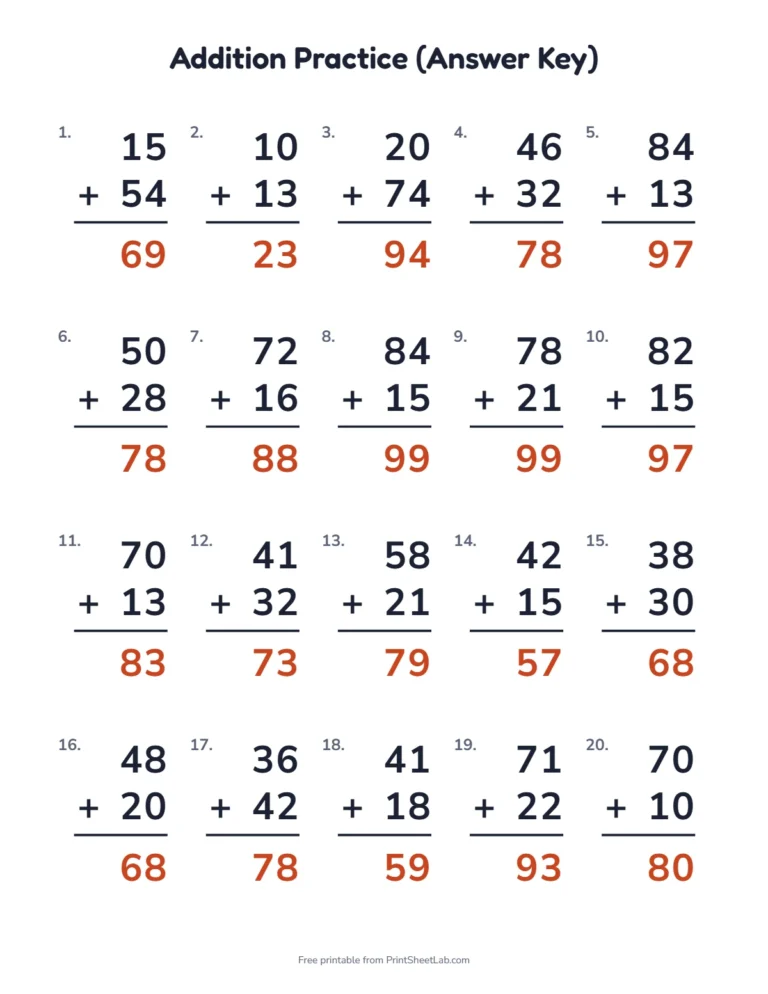
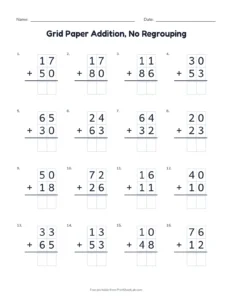
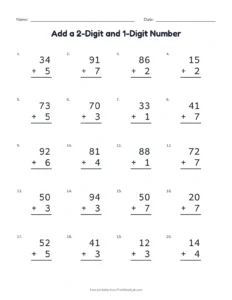
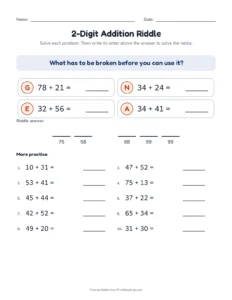
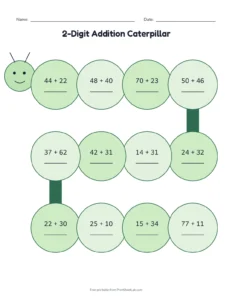
These 2-digit addition without regrouping worksheets show what the generator prints: a page of 20 vertical problems with no carrying, a horizontal page for mental math, a missing-number page and the answer key. Click a picture for the PDF, or use the generator above to make a new set.
Vertical worksheet20 problems, no carrying.PDFHorizontalFor mental math.PDFMissing numberFind the missing digit.PDFAnswer keyPage 2 of every PDF.
About 2-digit addition without regrouping
In these 2-digit addition without regrouping worksheets the ones add up to 9 or less and so do the tens, so children never need to carry. That lets them focus on the big idea of place value: add the ones to the ones, then the tens to the tens. The Common Core standards for grade 1 number and operations in base ten begin this work in grade 1 (1.NBT.C.4), and it builds on positional notation, the idea that the position of a digit gives its value.
How to add 2-digit numbers without regrouping
Take 34 + 25:
Line up the numbers so the ones are under the ones and the tens are under the tens.
Add the ones: 4 + 5 = 9.
Add the tens: 3 + 2 = 5.
The answer is 59.
The grid paper worksheet puts every digit in its own box, which is the easiest way to keep columns straight.
2 digit addition without regrouping worksheets: how many problems qualify?
Most pairs of 2-digit numbers need regrouping, so a worksheet that has none must be chosen with care. Of all 8,100 ordered pairs of 2-digit numbers, only 1,980 have no regrouping, which is 24.4%. The reason is simple: the ones digits must add up to 9 or less, and so must the tens digits. In the generator, the “No carrying or borrowing” setting picks only those problems, so every problem on the page is a 2-digit addition without regrouping problem. Here is how the ones digits can add up:
Ones digits add up to
Ordered pairs of digits
Examples
0
1
0 + 0
1
2
0 + 1
2
3
0 + 2, 1 + 1
3
4
0 + 3, 1 + 2
4
5
0 + 4, 1 + 3, 2 + 2
5
6
0 + 5, 1 + 4, 2 + 3
6
7
0 + 6, 1 + 5, 2 + 4, 3 + 3
7
8
0 + 7, 1 + 6, 2 + 5, 3 + 4
8
9
0 + 8, 1 + 7, 2 + 6, 3 + 5, 4 + 4
9
10
0 + 9, 1 + 8, 2 + 7, 3 + 6, 4 + 5
There are 55 ordered pairs of ones digits with a sum of 9 or less. The tens digits are the digits 1 to 9, since a 2-digit number cannot start with 0, so there are fewer pairs:
Tens digits add up to
Ordered pairs of digits (each digit from 1 to 9)
Examples
2
1
1 + 1
3
2
1 + 2
4
3
1 + 3, 2 + 2
5
4
1 + 4, 2 + 3
6
5
1 + 5, 2 + 4, 3 + 3
7
6
1 + 6, 2 + 5, 3 + 4
8
7
1 + 7, 2 + 6, 3 + 5, 4 + 4
9
8
1 + 8, 2 + 7, 3 + 6, 4 + 5
That gives 36 pairs of tens digits. Multiply 55 by 36 and you get the 1,980 problems that never regroup, and that is the pool that the worksheets draw from.
Double digit addition without regrouping: four ways to think about 34 + 25
Double digit addition without regrouping is the first place where children use place value to add. These four problems show three ways to add, and all of them work with the generator’s worksheets:
Problem
Tens and ones
Jump on a number line
Base-ten blocks
34 + 25
30 + 20 = 50, and 4 + 5 = 9, so 59
Start at 34, jump 20 to 54, jump 5 to 59
3 tens and 4 ones, then 2 tens and 5 ones: 5 tens and 9 ones
52 + 36
50 + 30 = 80, and 2 + 6 = 8, so 88
Start at 52, jump 30 to 82, jump 6 to 88
5 tens and 2 ones, then 3 tens and 6 ones: 8 tens and 8 ones
23 + 45
20 + 40 = 60, and 3 + 5 = 8, so 68
Start at 23, jump 40 to 63, jump 5 to 68
2 tens and 3 ones, then 4 tens and 5 ones: 6 tens and 8 ones
61 + 27
60 + 20 = 80, and 1 + 7 = 8, so 88
Start at 61, jump 20 to 81, jump 7 to 88
6 tens and 1 ones, then 2 tens and 7 ones: 8 tens and 8 ones
Each method says the same thing in a different way: the tens and the ones can be added separately, because 34 + 25 is 30 + 4 + 20 + 5.
Two digit addition worksheets: 30 practice problems with answers
Here are 30 problems from the pool of 1,980, with the working. Use them as a quick test, or cover the last column and let a child solve each problem. They show that two digit addition worksheets with no regrouping still need careful work, since the tens and ones are added separately:
Problem
Tens
Ones
Answer
20 + 57
2 + 5 = 7
0 + 7 = 7
77
21 + 63
2 + 6 = 8
1 + 3 = 4
84
86 + 13
8 + 1 = 9
6 + 3 = 9
99
44 + 45
4 + 4 = 8
4 + 5 = 9
89
74 + 13
7 + 1 = 8
4 + 3 = 7
87
30 + 36
3 + 3 = 6
0 + 6 = 6
66
14 + 10
1 + 1 = 2
4 + 0 = 4
24
22 + 20
2 + 2 = 4
2 + 0 = 2
42
57 + 12
5 + 1 = 6
7 + 2 = 9
69
15 + 11
1 + 1 = 2
5 + 1 = 6
26
44 + 53
4 + 5 = 9
4 + 3 = 7
97
14 + 80
1 + 8 = 9
4 + 0 = 4
94
22 + 51
2 + 5 = 7
2 + 1 = 3
73
35 + 14
3 + 1 = 4
5 + 4 = 9
49
57 + 21
5 + 2 = 7
7 + 1 = 8
78
11 + 82
1 + 8 = 9
1 + 2 = 3
93
40 + 19
4 + 1 = 5
0 + 9 = 9
59
26 + 71
2 + 7 = 9
6 + 1 = 7
97
31 + 33
3 + 3 = 6
1 + 3 = 4
64
31 + 37
3 + 3 = 6
1 + 7 = 8
68
66 + 20
6 + 2 = 8
6 + 0 = 6
86
13 + 75
1 + 7 = 8
3 + 5 = 8
88
10 + 79
1 + 7 = 8
0 + 9 = 9
89
18 + 81
1 + 8 = 9
8 + 1 = 9
99
34 + 65
3 + 6 = 9
4 + 5 = 9
99
46 + 43
4 + 4 = 8
6 + 3 = 9
89
12 + 47
1 + 4 = 5
2 + 7 = 9
59
65 + 20
6 + 2 = 8
5 + 0 = 5
85
42 + 32
4 + 3 = 7
2 + 2 = 4
74
19 + 20
1 + 2 = 3
9 + 0 = 9
39
2 digit addition no regrouping: adding a multiple of ten
A good first step is to add a multiple of ten to a 2-digit number. In 2 digit addition no regrouping problems of this kind, only the tens digit changes and the ones digit stays the same, which helps children to see the pattern:
Problem
Think
Answer
34 + 20
3 tens + 2 tens = 5 tens, and the ones stay 4
54
52 + 30
5 tens + 3 tens = 8 tens, and the ones stay 2
82
27 + 40
2 tens + 4 tens = 6 tens, and the ones stay 7
67
63 + 10
6 tens + 1 tens = 7 tens, and the ones stay 3
73
45 + 50
4 tens + 5 tens = 9 tens, and the ones stay 5
95
18 + 70
1 tens + 7 tens = 8 tens, and the ones stay 8
88
Addition without carrying: estimating and checking
Addition without carrying is the right place to teach children to estimate and check their work, because the numbers are small and the answers are easy to verify. Round each number to the nearest ten to get an estimate, and check the answer by subtracting one addend:
Problem
Round each to the nearest ten
Estimate
Exact answer
How far off
34 + 25
30 + 30
60
59
1
52 + 36
50 + 40
90
88
2
23 + 45
20 + 50
70
68
2
61 + 27
60 + 30
90
88
2
74 + 15
70 + 20
90
89
1
46 + 32
50 + 30
80
78
2
Problem
Answer
Check by subtracting
Check by adding the other way
34 + 25
59
59 − 25 = 34
25 + 34 = 59
52 + 36
88
88 − 36 = 52
36 + 52 = 88
23 + 45
68
68 − 45 = 23
45 + 23 = 68
61 + 27
88
88 − 27 = 61
27 + 61 = 88
74 + 15
89
89 − 15 = 74
15 + 74 = 89
The check by subtracting also shows the link between addition and subtraction, which is a key idea for grade 2 (2.NBT.B.5).
2-digit addition without regrouping word problems
Word problems show why children need 2-digit addition without regrouping. These six stories can be solved with one addition. Ask children to write the number sentence first and then to say what the answer counts:
Word problem
Number sentence
Answer
Leo has 34 marbles and finds 25 more. How many marbles does he have?
34 + 25 = ?
59 marbles
There are 52 red flowers and 36 yellow flowers in the garden. How many flowers is that?
52 + 36 = ?
88 flowers
A library has 23 picture books and 45 chapter books on one shelf. How many books are on the shelf?
23 + 45 = ?
68 books
Ava reads 61 pages on Monday and 27 pages on Tuesday. How many pages did she read?
61 + 27 = ?
88 pages
A team scores 42 points in the first half and 53 in the second half. What is the total?
42 + 53 = ?
95 points
A farmer picks 74 apples and 15 pears. How many pieces of fruit is that?
74 + 15 = ?
89 pieces of fruit
Common mistakes in 2-digit addition without regrouping
Because there is no carrying, the mistakes in 2-digit addition without regrouping are different from those in problems with regrouping. This table shows what the wrong answers look like, so a teacher can see what the child has misunderstood:
Problem
Correct answer
Added every digit
Left out the ones
Swapped the digits of the second number
34 + 25
59
14
50
86
52 + 36
88
16
80
115
23 + 45
68
14
60
77
61 + 27
88
16
80
133
42 + 53
95
14
90
77
A child who adds every digit has not understood place value, and a child who leaves out the ones may have lined up the numbers wrongly. Grid paper, where each digit has its own box, prevents both mistakes.
Where 2-digit addition without regrouping fits in the addition sequence
Children do not learn addition in one step. This table shows the order in which the skills are usually taught, with the grade level and the matching worksheets on this site:
Skill
Main idea
Grade
Worksheets
1 digit + 1 digit
Addition facts within 20
Grade 1
Addition worksheets
2 digit + 1 digit, and 2 digit + multiple of 10
No regrouping at first
Grade 1 (1.NBT.C.4)
2-digit addition without regrouping
2 digit + 2 digit, no regrouping
Add tens to tens and ones to ones
Grades 1 and 2
2-digit addition without regrouping (this page)
2 digit + 2 digit, with regrouping
Trade 10 ones for 1 ten
Grade 2 (2.NBT.B.5)
2-digit addition with regrouping
3 digit + 3 digit
Add hundreds, tens and ones
Grades 2 and 3
3-digit addition
Fact families for 2-digit addition without regrouping
Every addition problem belongs to a fact family of four number sentences. When children write the family for a 2-digit addition without regrouping problem, they see that subtraction undoes addition. This is also a good way to check an answer:
Problem
Turn-around
Take away one part
Take away the other part
34 + 25 = 59
25 + 34 = 59
59 − 34 = 25
59 − 25 = 34
52 + 36 = 88
36 + 52 = 88
88 − 52 = 36
88 − 36 = 52
23 + 45 = 68
45 + 23 = 68
68 − 23 = 45
68 − 45 = 23
61 + 27 = 88
27 + 61 = 88
88 − 61 = 27
88 − 27 = 61
The hundred chart and 2-digit addition without regrouping
A hundred chart is a picture of 2-digit addition without regrouping. To add the tens, move down one row for each ten, and to add the ones, move right one square for each one. Since there is no regrouping, the child never has to go past the end of a row. The same five problems on a hundred chart look like this:
Problem
Start on the hundred chart
Move down for the tens
Move right for the ones
Land on
34 + 25
34
2 rows down to 54
5 squares right
59
52 + 36
52
3 rows down to 82
6 squares right
88
23 + 45
23
4 rows down to 63
5 squares right
68
61 + 27
61
2 rows down to 81
7 squares right
88
14 + 33
14
3 rows down to 44
3 squares right
47
You can print a chart from the hundreds chart tool and let children trace each move with a counter.
Number bonds for the ones column
In every problem with no regrouping, the ones digits add up to 9 or less. Children who know the number bonds for 5 to 9 can find these sums at once, so a few minutes with the bonds is a good warm-up before the worksheets:
Number
Number bonds (two parts that make it)
5
0 + 5, 1 + 4, 2 + 3
6
0 + 6, 1 + 5, 2 + 4, 3 + 3
7
0 + 7, 1 + 6, 2 + 5, 3 + 4
8
0 + 8, 1 + 7, 2 + 6, 3 + 5, 4 + 4
9
0 + 9, 1 + 8, 2 + 7, 3 + 6, 4 + 5
How to use the 2-digit addition without regrouping worksheets in a lesson
Show the idea with blocks for two or three problems, and say the tens and the ones aloud.
Solve one problem together on the board with the numbers lined up in columns.
Give the vertical worksheet for independent work, with the grid paper layout for children who need it.
Check with the answer key, and let children find their own mistakes.
End with a few word problems to link the written method to real situations.
A five-day plan for 2-digit addition without regrouping
Most children need about a week of short sessions before they are fluent. This plan goes from adding a multiple of ten to word problems:
Day
What to do
Practice
Day 1
Add a multiple of ten to a 2-digit number (34 + 20)
12 problems
Day 2
Add 2-digit numbers with blocks, tens first and then ones
10 problems
Day 3
Use the worksheets with the numbers lined up on grid paper
It means no column adds up to 10 or more, so nothing is carried to the next column.
What grade learns 2-digit addition without regrouping?
It usually starts in grade 1 and becomes fluent in grade 2, when children add within 100 using place value.
Are there answer keys?
Yes, on the last page of each PDF, except the bingo and matching games.
How do I know that a child is ready for 2-digit addition without regrouping?
A child is ready when they can add a 1-digit number to a 2-digit number within 100 and can count in tens from any number. If counting on is still slow, practice with a hundred chart first.
Why teach 2-digit addition without regrouping before regrouping?
The two skills use the same layout, but regrouping adds a hard step. When children have mastered 2-digit addition without regrouping, they can put all their attention on the carry when it comes.
Can I make 2-digit addition without regrouping problems on grid paper?
Yes. Choose the grid paper layout in the generator, and every digit will have its own box. This is the best layout for children who write the digits unevenly.